Day 308: Love in a Cold Climate

Cover for Love in a Cold ClimateLove in a Cold Climate is more of a companion novel to Nancy Mitford’s The Pursuit of Love than a sequel, because it focuses on a different group of characters. Fanny is still the narrator, and she returns to tell a little more of her own story but mostly that of her beautiful friend and distant relation Polly Hampton.

When Fanny receives an invitation to stay with the family upon their return from India, she is happy to renew her friendship with Polly. Polly’s demanding mother, Lady Montdore, has been pushing her toward marriage, but Polly resists. Polly has always been difficult to read, unlike Fanny’s Radlett cousins from The Pursuit of Love, who “told everything.” Although Polly is so beautiful that she could have her pick of the eligible bachelors, she tells Fanny that she finds the whole life of the social season boring.

Lady Montdore is a rapacious, snobbish manipulator with social ambitions, although not without charm. Another family member who is important to the novel is also a snob, “Boy” Dougdale, the husband of Polly’s aunt, Lady Patricia. Fanny and her cousins have always called Boy “the Lecherous Lecturer” because of his tendency to furtively grope very young girls. Much to everyone’s surprise, Polly’s secret comes out when, shortly after Lady Patricia’s death, she marries a reluctant Boy, for she has been in love with him for years.

Polly is ostracized from her family and cut out of her father’s will as a result. But the plot thickens upon the arrival of Lord Montdore’s heir, the effeminate and hilarious Cedric Hampton.

As usual with Mitford, we have a strong suspicion that all her ghastly and funny characters strongly resemble real-life society members of her time. Her novels are full of vivid characterizations and incisive dialogue. Even in today’s world, so removed from her own, her novels are extremely funny.

As a side comment about the cover art, I find the covers of the most recent editions of Mitford’s novels to be too romantic and to do nothing to convey the spirit of her novels. I was able to find a better cover for The Pursuit of Love, but this was all I could find for Love in a Cold Climate.

Day 304: Flashman

Cover for FlashmanHaving enjoyed Fraser’s The Candlemass Road, I thought I would give his satirical Flashman series another try. I read one years ago but wasn’t prepared to be met with such an unmitigated scoundrel as the main character.

Flashman is the first of the series, and it begins when Flashman is expelled from Rugby. Apparently, the character is based on a bully who appears in Tom Brown’s School Days, a novel I have never read but which is frequently referenced in other literature.

Flashman at a young age is already a complete scoundrel, cheat, and poltroon, so the comedy in the novel centers around his ability to be successful and eventually to be lauded as a hero despite his true nature. Having set his sights on a position as officer in the Eleventh Light Dragoons, a unit he selects as unlikely to see combat, Flashman is getting along swimmingly under the ridiculous Lord Cardigan until he makes the mistake of seducing a Scottish merchant’s daughter and being forced to marry her. To the snooty Lord Cardigan this fraternization with the middle class is unacceptable, so Flashman is forced into an Indian regiment.

Flashman is not happy to be consigned to what was then regarded as second class service, but once he arrives in India he finds he enjoys bossing around the natives and discovers in himself a facility for languages. Unfortunately from his point of view, this talent gets him assigned to Afghanistan as an aide to Lord Elphinstone just before the infamous and harrowing 1842 retreat.

This satire of the army and society reminds me of Thackeray’s more subtle Vanity Fair. I think you have to be in the mood for Flashman’s antics, but the novel is based on solid historical research and is certainly entertaining. Fraser’s prose is incisive as he cuts swaths through Victorian society and skewers the ineptitude of the British army.

Day 285: Full Dark House

Cover for Full Dark HouseThe back cover of this mystery calls it “mapcap” and “great fun.” I found it mildly amusing in a silly way.

John May arrives at work in the present time to find the place has been blown up, apparently with his partner Arthur Bryant inside. He investigates this incident while he thinks back to their first case together.

John joined Arthur during the Blitz in World War II working in the Peculiar Crimes Unit. Their case was that of a dancer at a theatre in Covent Garden who is drugged and then dragged into the elevator with her feet sticking out, so that when the elevator moves, her feet are cut off.

There are many gothic touches in this novel, which is not surprising because the author is apparently a writer of horror fiction. However, after references to phantoms, vampires, spiritualism, and so on, the murderer turns out to be human after all. I came away feeling that this book promises more, in the way of humor and the unusual, than it actually delivers.

Day 282: Speaking From Among the Bones

Cover for Speaking From Among the BonesEleven-year-old chemist and detective Flavia de Luce is back with her latest adventure in Speaking From Among the Bones. An expert in poisons and an accomplished snoop, Flavia has already solved four crimes before the ripe old age of twelve.

Having accompanied her sister Ophelia (Feely) to her organ practice one night, Flavia hears a flapping in the organ pipes that she thinks is a trapped bat. Feely is practicing for the Easter Sunday service, as Mr. Collicutt, the organist, has vanished.

The next morning when Flavia goes back to the church to get the bat out of the pipes (so that she can look at its blood under her microscope), she gets distracted into eavesdropping on a confrontation between the vicar and the bishop’s secretary over the unearthing and reburial of the bones of St. Tancred from his crypt in the church. The vicar has previously received permission to do this and now the bishop is trying to rescind it through a magistrate.

The vicar insists on going ahead, and the men open the sealed crypt enough so that Flavia can look into it. Inside the crypt is the body of Mr. Collicutt, with his head in an old gas mask.

Flavia’s investigations take her as usual all over the village and turn up all sorts of secrets, including a man hidden away in an old house, a secret passageway into St. Tancred’s crypt, and the whereabouts of a diamond that was buried with his body in the saint’s crozier. At the same time she worries about family problems, such as her sister’s impending marriage and the sale of the crumbling family mansion, Buckshaw, for back taxes.

As usual, Flavia herself is the most charming part of the series, as she plunges recklessly into and out of difficult situations, contemplates the structure of blood and the properties of ether, irritates her older sisters, and rides all over the village on her trusty bike Gladys. The novel is funny, the mystery absurd, the writing splendid, and Flavia always entertaining.

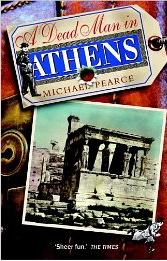
Day 275: A Dead Man in Athens

Cover for A Dead Man in AthensThe “Dead Man” series sounds interesting because of the exotic locales (Athens, Istanbul, Trieste, Tangier, Malta) and the time it is set (pre-World War I), but it proves a bit light for me. I like mysteries that are funny or have an edge, but my idea of humor doesn’t match that of many writers. This book was called “effortlessly funny,” but its humor escaped me. A Dead Man in Athens is the third in the series, and I still don’t know why the books are always named “dead man” here or there, except as possibly a suggestion of Anthony Burgess’s novel A Dead Man in Deptford. Otherwise, believe me, there is no comparison.

Sandor Seymour, a multi-lingual Scotland Yard detective, is sent out to Athens by the Foreign Office because someone has poisoned the cat of the Ottoman sultan living in exile there. The Foreign Office fears someone may be practicing for an attempt on the sultan.

Seymour soon believes that the poisoning may be simply domestic in nature, but the Foreign Office is sure it has something to do with war brewing in the Balkans. Then someone poisons the British engineer hired by the Greeks to take care of Blériot machines, early airplanes that the engineer feels could be useful to the Greeks for reconnaissance during the war.

The novel has many characters, but few are more than narrowly drawn. The mystery is not very complicated, and the absurdity of investigating the death of a cat doesn’t really carry the novel, as far as humor goes.

Day 243: The Pursuit of Love

Cover for The Pursuit of LoveIt’s always fun to re-read Nancy Mitford’s charming and funny autobiographical novel about her youth and young womanhood. Mitford’s alter ego is Linda, a young woman with terrible taste in men, who throws herself from one extreme to another in pursuit of love.

Mitford’s strength is her portrayal of peculiar but lovable characters, all modeled upon her own eccentric family or on figures in society. The novel is narrated by Fanny, a sensible but lonely girl who spends a lot of time with her cousins, the Radletts. Her terrifying Uncle Matthew (modeled on Mitford’s father) loves to hunt his children instead of foxes, a game the children love. Aunt Sadie is unutterably vague, which she probably has to be to live with Uncle Matthew. Uncle David is a cultured hypochondriac. The Bolter, Fanny’s mother, is supposedly a portrayal of Lady Idina Sackville, a famous society woman who kept leaving her husbands and was a member of Kenya’s famous Happy Valley set.

Mitford starts the novel with childhood–the children are hunted, hang out in the linen cupboard fantasizing about running away, and generally run wild–and follows the older girls into young adulthood. The novel finally centers on the story of how Linda first impetuously marries a stuffy banker who bores her silly, then leaves him for a communist who only thinks about his causes, and finally falls into the arms of Fabrice, a French duke who is a world-class womanizer. Characterized by facetious observations of society life and dialogue brimming with zingers, Mitford’s novel is a joy to read.

Just as an aside because I’ve recently read a few posts about cover design, I originally copied into this post the most recent cover of the book, which shows a romantic black and white photo of a debutant holding a bouquet of flowers with a pink banner for the title. I decided to replace it with this older cover (the one on the copy I have), which I think does a much better job of conveying the type of novel it is, much more of a social commentary than a romantic novel.

Day 239: Lucky Jim

Cover for Lucky JimI hate to use the word “hapless” two days in a row, but here goes. Hapless Jim Dixon is an unhappily employed lecturer in history at a “new university” in England. (I believe even that phrase is supposed to be fraught with meaning, but I am not British, so I don’t know what it might be.) Uncertain of whether he’ll be keeping his job in the coming year, he is forced to listen with an attentive air to the endless prosings of his boss Professor Welch and to take on all the tedious chores he is assigned. He vents his frustration through silly pranks and grotesque grimaces when he thinks no one is looking.

He has also gotten himself entangled with Margaret, a manipulative coworker whom he pities because she recently attempted suicide when her fiancé left her.

During a stultifying weekend of amateur theatrics and madrigal singing at the Welch’s, Jim meets the beautiful Christine, the girlfriend of the horrible Bertrand, Welch’s pretentious and belligerant son. Jim is startled to find that perhaps Christine returns his interest.

Amis’ amusing skewering of academic life comes to a climax at Jim’s well-attended lecture on Merrie England. Amis’ novel is known both for being the first “campus novel,” one that takes the point of view of a lecturer rather than a student, and for its down-to-earth, witty writing style, an approach that was unusual at the time. Although it was published in 1954, it holds up pretty well in modern times.

Day 231: I Am Half-Sick of Shadows

Cover for I Am Half-Sick of ShadowsAnother comic mystery starring the eleven-year-old sleuth Flavia de Luce, I Am Half-Sick of Shadows is the usual fun, even though the clues don’t add up until after the murderer is revealed.

Flavia’s father has rented out the house for Christmas to a film company in an effort to save the estate, since the family is so badly in debt. On Christmas Eve, the lead actors, Phyllis Wyvern and Desmond Duncan, perform a small benefit concert for the village of Bishop’s Lacey, after which everyone is snowed in by a blizzard. During the night, Wyvern is murdered, strangled to death with a length of film. This situation leaves the entire film crew and population of the village as potential suspects.

Although Flavia doesn’t know who the killer is, she becomes trapped on the roof where she has gone to shoot off fireworks and perform a scientific experiment. She has devised a super-sticky bird lime and has spread it all over the roof in an effort to capture Father Christmas, if he exists. Unfortunately, the murderer finds some reason to suspect that Flavia might be on his or her trail.

Day 165: Alexandria

Cover for AlexandriaFor years I avidly collected all of Lindsey Davis’s Didius Falco mysteries. My passion has cooled a bit, as it usually does for series mysteries, but I still enjoy them enough to pick them up when I find them.

Marcus Didius Falco is a cynical, rascally, wisecracking “informer” during the Roman Empire of Vespasian. I have followed his path from the first book when he met Helena Justina, the fiery, unconventional daughter of a senator. Falco has had to work his way up from the plebeian rank and earn enough money so that he can legally be permitted to marry her.

In Alexandria, the 19th novel in this series, Falco and Helena Justina have been married for awhile when they travel to Alexandria with their two daughters, their adopted teenage daughter, and their mongrel dog for a vacation and visit to his uncle. Almost immediately upon arrival Falco is plunged into an investigation when his uncle’s dinner guest of the night before, Theon, the head of the famed library, is found dead, locked in his own office.

Of course, Falco has to figure out how Theon was murdered and why. He soon finds that several of the library’s scholars may want Theon’s job. Of course, people begin dropping like flies, including a philosophy student who is mauled by a crocodile. Falco begins to suspect that something else might be going on.

Davis’s books always involve a multitude of interesting, shifty characters and lots of dirty politics and other shenanigans, and Falco is always engaging and amusing. Davis does a convincing job of re-creating the ancient world in her books.

If you are interested in this series, I recommend that you start with the first book, Silver Pigs (recently renamed The Silver Pigs). Although the mysteries are stand-alone, developments in Falco’s personal life make it more enjoyable if you read this series in order.

Day 134: A Red Herring Without Mustard

Cover for A Red Herring Without MustardBest Book of the Week!
A Red Herring without Mustard is another of Alan Bradley’s delightful, comic mysteries featuring Flavia de Luce, the eleven-year-old detective and chemist.

In this book a mysterious gypsy woman is nearly beaten to death after Flavia allows her to camp on de Luce land. Something odd is going on. After Flavia surprises a neighborhood thug in the de Luce’s drawing room when everyone else is in bed, she finds him dead the next day, hanging from the trident of a fountain of Poseidon.

As usual, Flavia races all over the countryside on her bike Gladys, feuds with her sisters, consorts with her father’s shell-shocked batman, and tumbles into trouble in this novel, set in England just after World War II.

Bradley’s plots are implausibly complex, but it is not for the mysteries that I read these books but for the funny, irrepressible character of Flavia.