Review 1808: The House in the Cerulean Sea

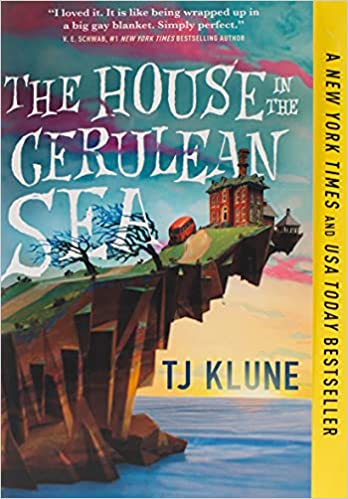
I have to confess to having picked this book out because of its cover and title. What a great word “cerulean” is.

Linus Baker is a caseworker in the Department in Charge of Magical Youth. He goes completely by the book, which may be why he is selected for an unusual task—to investigate the orphanage on the island of Marsyas where seven magical orphans live under the tutelage of Dr. Parnassus. He is instructed to report everything.

On the island, he meets Dr. Parnassus as well as Ms. Chapelwhite, a sprite who helps with the cooking and care of the house and children, and the seven orphans. These unusual children include Lucy, the six-year-old Antichrist.

This novel is well written and occasionally amusing, but I don’t read much fantasy, and when I do, I have high requirements for it. This isn’t really my genre. But my biggest problem with it was trying to decide who it was written for. It reads like a children’s book and its sense of humor is juvenile. However, Linus and Dr. Parnassus have conversations on such topics as Kant and I think it was Schopenhauer that would certainly be above most kids’ heads, and he uses vocabulary (like “self-flagellation”) that seems aimed at adults. In addition, the novel features a love story between two middle-aged men, which doesn’t seem as if it would appeal to even gay children, so more for adults. But the tone of the piece smacks of children’s literature, and not necessarily good children’s literature.

Finally, though, the novel was just too saccharine to appeal to me. I ended up reading about 2/3 of it but eventually decided that I wasn’t invested in the outcome. The kids were cute but kind of one-dimensional, although I thought the concept of Lucy was clever and sometimes funny.

Miss Peregrine’s Home for Peculiar Children

Good Omens: The Nice and Accurate Prophecies of Agnes Nutter, Witch

Neverwhere

Review 1806: Harlequin House

When Mr. Partridge decides he needs a holiday, he just walks off from the Peters Lending Library, leaving it closed. He may be an older man with a shape like an egg, but he is lawless. Wandering around the seaside town of Dormouth Bay, he spots Lisbeth Campion and follows her. Lisbeth is the type of girl that men are always following. He not only follows her, he has tea with her and her aunt.

Later that night, he sees Lisbeth getting into a car with a man. He gets in the back. Finding they have landed in London at midnight, he learns that Lisbeth has been looking for her brother, Ronnie, who through a misunderstanding, of course, has been in prison for delivering cocaine and is just out. Ronnie claims he thought it was baking powder.

Although Lisbeth is engaged to a fine, upstanding captain in the army, Captain Brocard wants to ship Ronnie to Canada with a small pension, as he has never successfully kept a job. Lisbeth has other plans, though: to rehabilitate Ronnie so that the captain returns to find him an upstanding citizen with a job.

Using Mr. Partridge’s five pounds, the three find a modest lodging in Paddington and set out to find jobs. And they find very odd ones.

Harlequin House is a charming, silly comedy. It made me laugh.

Cluny Brown

The Stone of Chastity

Our Spoons Came from Woolworths

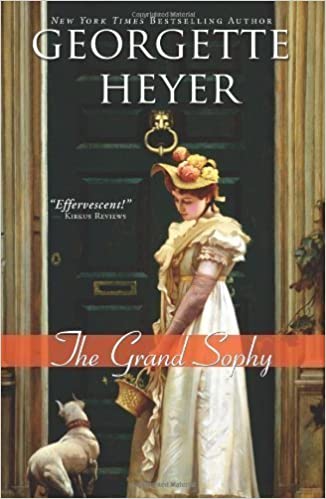
Review 1801: Classics Club Dare! The Grand Sophy

The latest Classics Club Dare is to read something romantic for February, so I have chosen The Grand Sophy from my list.

When Sir Horace Stanton-Lacey unexpectedly arrives at Lord Ombersley’s home to ask his sister to take charge of his daughter Sophy for a while, he discovers a depressed household. Lord Ombersley’s gambling debts had almost overrun the establishment until his son and heir, Charles Rivenhall, inherited a fortune from a distant relative. Charles “did something with the mortgages” and paid off the debts, and now he is trying to get the household to economize.

Charles is also engaged to Eugenia Wraxton, whose outward sweetness hides a self-righteous and meddling disposition. Her plans to occupy the family home after the wedding depress everyone except Charles.

By the time Sophy arrives, the announcement of her cousin Cecilia’s engagement to Lord Charlbury has been delayed by his having contracted mumps. Cecilia now thinks herself in love with Augustus Fawnhope, a devastatingly handsome but vague young man who fancies himself a poet.

Sophy arrives like a breath of fresh air. She brings a monkey and a parrot to entertain the children, a shy greyhound, and a fabulous black steed to ride. She immediately realizes that the family needs her help. And she never shirks her obligations.

Sophy is a firecracker of a heroine, and The Grand Sophy is one of Heyer’s most beloved novels. There is lots of fun to be had as Sophy’s stratagems twist and turn the plot. The novel is a re-read for me for the Classics Club, but I loved it this time just as much as I did the first time I read it.

Frederica

Venetia

Faro’s Daughter

Review 1768: Venetia

I didn’t remember Venetia as being one of my favorite Georgette Heyer books, but actually I liked it very much. It features a sparkling heroine.

Venetia Lanyon has lived almost secluded in the Yorkshire countryside. When her mother died, her father became a recluse and refused permission when the time came for Venetia to be brought out by her aunt. Now 25, since her father’s death she has been taking care of her brother’s estate until he returns from the wars, at which time she plans to take a house with her younger brother, Aubrey. Although she has two suitors, she cares for neither of them and believes she will need to be there for Aubrey, who has a bad hip and does not relish meeting people.

The Lanyons’ neighbor, Lord Damerel, is seldom home and has such a bad reputation that when they were children Venetia and her brothers called him the Wicked Baron. Venetia is out picking berries one day when she meets Damerel. He at first mistakes her for a village girl and kisses her. However, he soon finds his mistake and doesn’t know what to make of her reaction. Fairly quickly, they find themselves friends.

Of course, this will never do, think her friends and relations, and we’re off for another funny romp with Heyer.

Black Sheep

Regency Buck

Frederica

Review 1761: #ThirkellBar! Pomfret Towers

Cover for Pomfret Towers

It’s time to talk about the sixth book in Angela Thirkell’s Barsetshire series, Pomfret Towers. Who read it and what did you think?

This novel is another one that I reviewed several years ago, so I will not repeat the plot synopsis and review but simply supply a link to the original review.

What struck me this time around was how sweet a story this is, with Thirkell creating characters we like tremendously but not forgetting a couple we can dislike. Yet, she’s subtle about all of this and shows a little sympathy for one of the most irritating characters.

Little Alice, so young and shy, is both a sympathetic character and one who provides some good-natured comedy. For example, her reaction to being invited to Pomfret Towers for the weekend—a terrifying prospect—is to hope the house burns down overnight before she has to go. She is silly and adolescent in her attachment to the odious Julian Rivers and very brave when she finally sees through him.

On the other side is Mrs. Rivers, so full of herself as a Writer of popular novels that sound dreadful, so managing in a house where she is not the hostess, and so irritating in her attempts to throw together her daughter Phoebe and the mild-mannered Gillie Foster, the heir to the earldom. But when she is humiliated by her son at the end of the novel, Thirkell deftly makes us feel sorry for her (but not for Julian).

I liked practically everyone in this novel, even Lord Pomfret, known for his rudeness. Another charming novel by Thirkell.

Summer Half

August Folly

The Demon in the House

Review 1738: #1976 Club! Lady Oracle

My final choice for the 1976 Club is this early novel by Margaret Atwood, her third. Up until now, the earliest novel I’ve read by her is The Handmaid’s Tale, published nine years later. Although her novels have mostly been totally unlike each other except for frequent forays into dystopia, Lady Oracle was surprising to me. For the most part, it is quite a silly romp.

When we first meet Joan, she has faked her own death and run away from her life to make a new start in Italy. Over the course of the novel, we learn why.

Joan grows up with a distant and disapproving mother and a mostly absent and ineffectual father. Her mother focuses on her weight, though, so as she gets older, Joan changes from trying to please her mother to defiantly trying to get fatter. It takes the death of her beloved aunt to bring her down to a normal size, because if she loses weight, she’ll inherit enough money to run away from Toronto to London. However, she is thereafter haunted by the spirit of the fat lady.

As a naïve teenager in London, she gets involved in the first of a series of odd relationships characterized by her eagerness to please—first an impoverished Polish Count to whom she loses her virginity simply because she doesn’t know what to do in an embarrassing situation; then her husband, a fervent and ascetic believer in some cause, if only he could figure out which one; then the Royal Porcupine, an artist who offers a bit of romance, albeit on the shabby side. All the while, she is hiding two secrets—that she used to be hugely fat and that she writes trashy romance novels for a living. To hide her past, she accumulates complex lies. However, her secrets are threatened when she almost inadvertently writes a best-selling book of poetry.

By and large, I enjoyed this novel, which gets more and more complicated as it goes along, and sillier and sillier. I was deeply disappointed in the ending, which read to me as if Atwood just got tired of writing the novel and wanted to get it over with. Although Joan seems to be finally developing some self-esteem by the last chapters, everything is left up in the air, and I fear she is doomed to repeat her past.

Related Posts

Hag-Seed

Alias Grace

The Heart Goes Last

Review 1725: Cluny Brown

Best of Ten!

Mr. Porritt, the plumber, is worried about his niece, young Cluny Brown, because, he says, she does not know her place. Why, the other day she went to the Ritz just to see what it was like. When he catches Cluny about to take a bath in a gentleman’s lovely bathtub after she made a plumbing call, Mr. Porritt decides to take advice and send Cluny into service.

She ends up as a parlor maid in Devonshire for Lady Carmel and Sir Henry. There, although she’s not very adept at being a parlor maid, she finds she likes the country and she befriends a golden lab belonging to Colonel Duff-Graham, who allows her to take the dog out for walks.

In the meantime, Lady Carmel’s son Andrew has met Mr. Belinski, an eminent man of letters who has had to abruptly flee Poland and is barely getting by. Andrew invites Mr. Belinski to stay at his parents’ manor, where he can write. Andrew himself is preparing to propose to the beautiful Betty Cream.

Cluny is struck by Mr. Wilson, the chemist, and he rearranges his shop’s closing day to take walks with her. There’s something about Cluny, who is direct and forthright and doesn’t seem to understand customary boundaries.

This is a wonderful comic novel, absolutely delightful, and my first by Margery Sharp (I have reviewed one that I read after this one). I’ll be looking for more.

The Stone of Chastity

Beneath the Visiting Moon

Joanna Godden

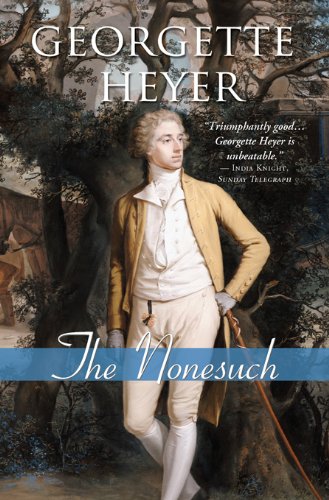
Review 1719: The Nonesuch

Often when I am in the middle of some hefty nonfiction book, I take a break by reading some sort of light fiction. I was reading a biography of Lyndon Johnson when I thought I hadn’t read any Georgette Heyer lately, so I picked The Nonesuch out of my library.

The inhabitants of the village of Oversett are all interested when they hear that Sir Waldo Hawkridge, known as the Nonesuch, has inherited Broom Hall from the miserly Joseph Calver and will be arriving to look it over. The young men are excited to see this notable whip. Up at Staples, kindly Mrs. Underhill is dismayed to learn that Sir Waldo has arrived with a lord, his young cousin Lord Lindeth, for her unprincipled but beautiful ward, Tiffany Wield, has announced that she means to marry into the nobility. Tiffany’s governess/companion, Ancilla Trent, remarks with her customary humor and calmness that they will just have to convince Tiffany she is wasted on anyone under a Marquess.

Lord Lindeth meets Tiffany after she carefully arranges an encounter while he is out fishing. When Waldo sees her and her affect on Lindeth, he is dismayed. However, he is much struck by Ancilla. It is Ancilla who does not have a high opinion of Corinthians, the set to which Waldo belongs.

As usual with Heyer, this novel is full of likeable characters, humor, and an engaging hero and heroine. I tend to like Heyer’s sillier plots best, because they are so funny. This is not one of them, but I enjoyed it very much just the same. A perfect Covid-era lightener. (I re-read it last January.)

Related Posts

The Convenient Marriage

Sprig Muslin

Cotillion

Review 1715: #ThirkellBar! The Demon in the House

This third book of Thirkell’s Barsetshire series returns to the village of High Rising and Laura Morland and her young son Tony. Tony is now thirteen, and he is of course the demon in the house.

The novel is set during four holiday seasons that make up most of the year, during which Tony creates as much havoc as is humanly possible. During the Easter holidays in the first section, Tony talks his mother into getting him a new bike. He has grown out of his old one but is not yet tall enough for an adult bike, so she compromises by renting one from Mr. Brown. Then, knowing his talent for falling into trouble, she waits, agonized, to hear about his lifeless body being picked up from the road.

During the course of the novel, several of the old friends from High Rising are on the scene. We also meet new ones, though, in particular Master Wesendonck, Tony’s friend from school, who manages to be silent throughout the novel while proving himself to be loyal and sweet.

Lest we be afraid that there will be no romance in this novel, there is one, but it is very understated. The novel is mostly about Tony’s hijinks. Tony is the same ebulliant, know-it-all motormouth, but some of his adventures seem a little young for thirteen. Still, times have changed, and children now are probably a lot more sophisticated. In any case, this is another charming and funny entry in the series. I hope that the readers who are not on Team Tony will still want to continue with the series.

Related Posts

High Rising

Wild Strawberries

Diary of a Provincial Lady

Review 1710: Classics Club Spin Result! The Woods in Winter

I might have saved The Woods in Winter for a chillier time of year, but its number was chosen for me for the latest Classics Club spin. It’s a lovely tale.

Ivy Gover (not Gower, as it says on the back cover of my Furrowed Middlebrow edition), three times a widow and a charwoman, is living in a tidy but small North London flat when she receives a letter. Not being able to read well, she takes it to her employer, Miss Helen Green, who tells her she has inherited her great-uncle’s cottage out in Buckinghamshire for her lifetime.

Ivy abruptly moves to the country but not before stealing a neighbor’s dog that she has heard barking for months and finds living in its own dirt. Although the cottage is primitive and has a hole in its thatch, she moves right in and begins befriending the local animals. For she has a touch with wild things and for healing, as Lord Gowerville finds out when she magically cures his dying dog. The next day, he sends someone over to fix the thatch in her roof.

As Ivy befriends the birds, a fox, and eventually a boy, her neighbors also have their adventures. The vicar is suddenly taken with Pearl Cartaret, one of two sisters who open a tea shop. Helen is sometimes nearby pursuing an affair with an elusive young man. Angela Mordaunt, a “spinster” brought up by her mother more as a well-bred boy than a girl, catches the eye of Sam Lambert, a kind farm laborer.

This novel was the last one published (in 1970) during Stella Gibbons’ lifetime and displays a longing for the England of 40 years before, when most of it is set. I just loved it. It is funny yet astringent, has some engaging and other very lifelike characters, and contains lyrical descriptions of the countryside around Ivy’s cottage as well as a conservationist conclusion. Ivy herself is a spunky individualist. I liked her a lot.

Nightingale Wood

A Pink Front Door

Bramton Wick