Review 2208: The Foolish Gentlewoman

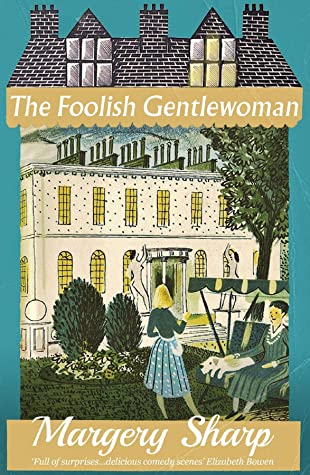
When crusty, prim Simon Brocken goes to live with his widowed sister-in-law Isabel while his home is repaired from bomb damage shortly after World War II, he isn’t expecting to enjoy living so closely with other people. However, the household gets along comfortably together even though the four occupants don’t have much in common. Isabel is kind and generous, although Simon thinks she’s an idiot. Her Australian nephew Humphrey has come to stay, and he is slowly pursuing an understated courtship of Jackie, Isabel’s companion/secretary.

However, something is bothering Isabel, and eventually she tells them what it is. A preacher’s sermon about bad acts in the past being no less bad has made her consider an incident from when she was a girl, when her actions blighted the marital hopes of Tilly Cuff, a poor cousin her family treated a little like a servant. Tilly took a job as governess, and Isabel eventually married Simon’s brother.

Now Isabel thinks she must make amends to Tilly, so she has invited her to stay. But she also intends to give Tilly her entire fortune. Simon is appalled by this but can’t get her to change her mind. Then Tilly arrives, and everyone but Isabel soon realizes that she is actively malicious.

This novel is witty and sharply observant of human nature. It creates a situation that I couldn’t imagine being resolved neatly and that made me want to see what happens.

Related Posts

Harlequin House

Rhododendron Pie

Cluny Brown

Review 2155: #1940 Club! Miss Hargreaves

When I saw Miss Hargreaves on the list of books published in 1940, I knew I had to read it for the 1940 Club, mostly because of recommendations by Simon Thomas.

Norman Huntley is quite a young man, impetuous and given to making up stories. He is traveling with his friend Henry in Ulster when they take refuge from the rain in a church they agree is hideous. However, the sexton appears and insists on giving them a tour.

When the sexton shows them a commonplace inscription dedicated to a previous vicar, Norman blurts out that he has a friend who knew him. Together he and Henry describe an eccentric old lady named Miss Hargreaves, continuing after they leave to add details.

To cap the joke, Norman writes a letter to the address they made up, inviting Miss Hargreaves to visit. Shortly after he returns home, he receives a letter from Miss Hargreaves saying she is arriving on Monday.

Miss Hargreaves is exactly as Norman described her, including a dog named Sarah and a parrot named Dr. Pepusch. Norman is confused and his friends treat him badly because of his relationship with the old lady. But he comes to believe that Miss Hargreaves exists only because he created her. He both likes and hates his creation.

Although some events seem to confirm this idea, after he gives Miss Hargreaves a title, she begins to go in her own direction, and things get even more complicated.

Of course, this frothy story is meant in fun, but I couldn’t help thinking that the novel could be a metaphor for an author and his creations—how they sometimes take control and don’t want to do what you planned, and how you can love them and hate them at the same time.

Although I don’t usually like magical realism, I found this novel madcap and funny, and I especially loved the character of Norman’s father.

Related Posts

Cluny Brown

The Stone of Chastity

Berry and Co.

Review 2115: Summer Lightning

I intended to read Summer Lightning for the 1929 Club last fall, but it didn’t arrive in time from the library. It is one of the Blandings books, and I have not read many of those.

The country is buzzing at the news that Galahad Threepwood, that old reprobate, is planning to publish his memoirs. Old men up and down the country are terrified of what he might reveal.

At Blandings Castle, where Galahad has repaired to write, both Mr. Ronald Fish, Lord Emsworth’s nephew, and Miss Millicent Threepwood, a niece, are in love, unfortunately not with each other as their daunting aunt, Lady Constance, intends. Millicent has fallen for Hugo Carmody, Lord Emsworth’s secretary, and Ronnie for Sue Brown, a chorus girl.

As usual, Lord Emsworth is besotted with his pig, the Empress of Blandings. Ronnie gets the idea to steal the Empress and hide her away then pretend to find her, thereby winning Lord Emsworth’s regard.

In the meantime, Hugo has to run up to town and takes the opportunity to go dancing with Sue. Unfortunately, he has promised Millicent he will do no such thing. Mr. Pilbeam, an oily detective, has just accepted a job from Hugo to find the Empress (which he only accepted because someone is paying him a lot of money to steal Galahad’s manuscript) when he comes upon Sue waiting at their table for Hugo. He has been calling her and sending her flowers, to which she hasn’t responded, so he sits at her table uninvited. At that moment, jealous Ronnie appears.

As if this isn’t enough silly fun, Sue impersonates a wealthy American so she can visit Blandings and make things up with Ronnie. The novel also features the reappearance of Baxter, Lord Emsworth’s previous secretary, whom Lord Emsworth thinks is batty. And he’s on the tail of the Empress, too.

I enjoyed this book, but I think the Blandings series is missing something compared to Jeeves and Wooster. That something is Bertie’s insouciant, dim-witted yet witty and kind narrative style.

Related Posts

Berry and Co.

Tea Is So Intoxicating

The Stone of Chastity

Review 2103: Kill Me Tender

When I asked Dean Street Press to send me books for Dean Street Press in December, I felt that a mystery starring Elvis Presley might be clever and amusing. This was despite my usual dislike for mysteries using an actual person or someone else’s character as the detective. So, I asked for the first book in the series. Unfortunately, I wasn’t able to post my review until now, so I missed the event.

Elvis is feeling strange and unfocused since he returned from his army service. He keeps an eye on his correspondence and is distressed to learn that the president of one of his fan clubs, a young girl, died of a heart attack. Also, someone has sent him a record of an Elvis impersonator singing one of his songs, only with the lyrics horribly changed. Then, he learns that another fan club president has died unexpectedly—and both girls had a red spot on their tongues. After a third death, Elvis begins to suspect that someone is killing off his fans. Elvis feels he must get to the bottom of this.

His investigation leads him to meet colorful characters—an uncredentialed doctor serving the Black community and his beautiful nurse, a whole room of Elvis impersonators, an expert on criminology, and a hippy-like jail resident who seems to be psychic.

The humor of this novel seems to be based in strange encounters and outrageous behavior, and it didn’t really work for me. Far from the witty maybe sharp novel I expected, it comes off as a fanboy tribute.

What bothered me more, though, was that while Klein obviously researched Elvis, he didn’t spend the same amount of time checking the accuracy of his memory of 1965. For example, a 14-year-old Southern girl of the time would be very unlikely to even know the language that one character uses. Elvis’s affair with a black nurse is also unlikely. But there is at least one downright anacronism—the use of the term “serial killer” ten years before it was coined.

Characterization is mostly one-dimensional in this novel except for Elvis himself. The rest of the characters are just being put through their paces.

I received this book from the publisher in exchange for a free and fair review.

Related Posts

Scot Free

Eight Perfect Murders

Insomniacs, Inc.

Review 2088: Mrs. Tim Flies Home

I intended to read the Mrs. Tim books in order, but that hasn’t quite worked out, and I received this one just in time for Dean Street Press in December.

Hester Christie (Mrs. Tim) reluctantly leaves her husband in Kenya, where he is now posted, to form a household in England that her children can return to for the summer holidays. But en route she stops for two days in Rome. There she is unexpectedly met by family friend Tony Morley. Her couple days of sightseeing with him create a misunderstanding that travels all the way back to England to cause trouble for her through the person of Mrs. Alston, whom she met on the plane from Kenya to Rome.

Mrs. Tim has found a house in Old Quinings called the Small House. Although she loves the house, she finds she has a troublesome back neighbor and a landlady who isn’t to be trusted. She also meets some pleasant neighbors and helps out a young man in his romance with a nice young girl. She solves a mystery and finds out why some of the villagers are treating her oddly.

This book is another breezy entry in the Mrs. Tim series, written in the form of letters to her husband. It gets a little patronizing toward the ancient Romans (conveniently forgetting about the Inquisition), but they’re dead so they won’t mind. Otherwise, it’s an entertaining read.

I received this book from the publisher in exchange for a free and fair review.

Related Posts

Mrs. Tim of the Regiment

Mrs. Tim Gets a Job

The Two Mrs. Abbotts

Review 2077: Literary Wives! State of the Union

Today is another review for the Literary Wives blogging club, in which we discuss the depiction of wives in fiction. If you have read the book, please participate by leaving comments on any of our blogs.

Be sure to read the reviews and comments of the other wives!

My Review

Literary Wives logo

State of the Union takes place in ten scenes, as Tom and Louise meet in a pub before their marriage-counseling sessions. The novel is almost completely dialogue as the couple bicker and each picks apart what the other says. Although Louise has had an affair, she says it’s because Tom stopped having sex with her. Tom says he stopped having sex with her because she was clearly uninterested.

I haven’t read a Nick Hornby novel in a while, although the ones I read I found touching and engaging, particularly High Fidelity and About a Boy. State of the Union just seems too facile to me, though, about a couple who are more interested in scoring points off each other than talking seriously about their problems. Then when they finally start talking, they clear up their problems too quickly.

What does this book say about wives or about the experience of being a wife?

It says Hornby wants someone to make a movie from his book.

Related Posts

I’m Fine and Neither Are You

Wait for Me, Jack

How To Be a Good Wife

Review 2069: Mobituaries: Great Lives Worth Reliving

TV host and comedian Mo Rocca loves obituaries and little factoids. So does my husband, so I bought him Mobituaries last Christmas. Then, after listening to the podcast, I decided to read it myself.

Unfortunately for me, a good deal of the content of the book was in the podcast and in seemingly greater detail. Still, it’s a fun book to read and full of factoids.

Rocca has written not just about the lives of people, some well-known, like Audrey Hepburn and Elizabeth Taylor, some whose contributions are less known, like Elizabeth Jennings (the first black woman to refuse to leave a streetcar, 100 years before Rosa Parks) or Ada Lovelace (inventor of the computer algorithm in 1843) but also of objects and concepts that are not longer with us—the belief in dragons, Prussia, the station wagon, alchemy, and other medieval sciences. Obviously, this book, while not at all comprehensive, more notional, is wide-ranging. It is also fairly funny, and its asides, quips, and incidental factoids remind me of some of the works of Bill Bryson, although Bryson is a better prose stylist.

In any case, the book is enjoyable to read and provides plenty of fodder for trivia buffs.

Related Posts

At Home: A Short History of Private Life

The Body: A Guide for Occupants

Brief Lives

Review 1836: Rhododendron Pie

Ann Laventie comes from an artistic and elegant family, all of whom are witty and have excellent taste. All, that is, except for Ann, who thinks they are wonderful but likes ordinary things and people. While her family disdains their solid Sussex neighbors and stays away from them, she likes them, especially the large and noisy Gayford family. Still, she feels she must be at fault.

A young film maker, Gilbert Croy, comes to stay and pays Ann a lot of attention. After Ann’s sister Elizabeth moves to London, Ann goes to visit her, convinced that she is in love with Croy and determined to come back engaged. But once in London, she begins to notice things. Her brother Dick’s sculptures, for example, all look alike. She absolutely adores a girl that everyone in her siblings’ group of friends shuns.

Rhododendron Pie is Margery Sharp’s first novel, and it’s quite funny as it explores the bohemian world of her upbringing versus the more mundane. Ann is an appealing heroine, and frankly I liked the Gayfords a lot better than the Laventies, especially in their reaction to Ann’s engagement. Her mother, though, an invalid who is mostly just a presence in the novel, gives a wonderful speech at the end. A fun one from Margery Sharp. I’m glad to have read it for my Classics Club list.

Related Posts

Harlequin House

Cluny Brown

The Stone of Chastity

Review 1821: Berry and Co.

I hadn’t heard of Dornford Yates until a friend gave me a copy of Berry and Co. Apparently, Yates wrote a series of books about the same characters called the Berry books. This one was published in 1920.

The characters are Boy, the narrator, a major but certainly no longer serving; his sister Daphne, who is married to their cousin, Berry; and their cousins Jonah and Jill, all wealthy young people who live together at Whiteladies in Hampshire.

There isn’t really much of a plot to Berry and Co. In fact, I would have taken it for a collection of short stories except that it is clearly labeled a novel. Each chapter consists of a little adventure or some sort of prank, and the only recurring plot has to do with Boy flirting with a series of young women until he finally settles on one.

The novel is certainly meant to be funny and light-hearted, similar perhaps to Wodehouse’s Jeeves and Wooster series. Now, I do love a Jeeves and Wooster, but I did not much enjoy Berry and his pals. In fact, the reason I bring in the Jeeves books is because comparing them helped me understand why I liked one much more than the other.

Of course, Bertie Wooster and his pals are always getting themselves in ridiculous situations or pulling pranks similar to the ones in this novel. Here’s the difference. Bertie is essentially brainless, but he is also good-hearted. Almost all of his tangles result from him trying to help out a similarly dim-witted pal.

Berry and his friends, however, are highly intelligent, and their pranks tend to be mean-spirited. Sometimes, they are aimed at nasty characters, but other times these idle people, who have to be pushing 30 by 1920, just don’t like the way someone looks or is dressed. In other words, it’s a class thing.

I didn’t enjoy most of these jokes, which seemed juvenile, like something they would have done in college. Further, the zippy narration is periodically interrupted by rather florid descriptions of the scenery that don’t seem to belong to the same novel.

The characters, with the exception of Berry, aren’t very distinctive. They all engage in the same kind of banter, and a lot of time is spent with them rolling in laughter or trying to suppress it. Frankly, my favorite character was Noddy, a Sealyham terrier with a lot of personality.

This Side of Paradise

Empire Girls

On Her Majesty’s Frightfully Secret Service

Review 1818: Quichotte

I was fairly sure I was going to hate Quichotte. I did not much like Midnight’s Children or Don Quixote for that matter, which Quichotte retells. However, this novel is part of my Booker project, so I opened it with hope.

Quichotte is Ismail Smile, an elderly consumer of all things TV who becomes infatuated with Salma R, a young TV star. He decides to go on a quest to earn the love of his beloved. This is a road trip, and for a partner he takes Sancho, his imaginary son. To add another layer, Quichotte is himself an imaginary character, created by Brother, a writer of spy novels who has decided to change his genre.

This novel is one full of circumlocution. As we meet each character—and we meet a lot of them—we go off on the tangent of that person’s life story. Further, there are lots of subplots, for example, the one about Smile’s cousin and employer, whose pharmaceutical company has developed a drug even more dangerous than OxyContin and who has himself developed a similar model to that of the makers of Oxy, delivering it in huge quantities to small rural communities.

The genre for this novel is fantasy and of course satire. Fantasy is not my genre, and although I wouldn’t have thought the same was true about satire, I have not enjoyed the satirical entries on the various shortlists. They all feel the same to me: ponderous, overblown, and written by old men. Definitely lacking subtlety. Even the reviewer from The Guardian remarked that the book was funny but not as funny as Rushdie thought it was. That is exactly how I feel about it, except I didn’t think it was very funny. I sensed Rushdie winking all the time.

Still, I was enjoying parts of the novel, although it didn’t seem to be getting anywhere. Then Sancho decided he wanted to be a real boy, and guess who popped up? Jiminy Cricket. At that point I had to restrain myself from throwing the book across the room (only because it was a library book), and I stopped reading.

The Finkler Question

You & Me

The Broom of the System