Day 892: Wild Strawberries

Cover for Wild StrawberriesThis title does not refer to the Ingmar Bergman film but to the second (or third, depending on where you look) Barsetshire novel by Angela Thirkell. Unlike the others I’ve reviewed lately, Wild Strawberries was written before World War II. It is a delightful and gentle comedy with a romantic triangle.

Wild Strawberries is about a summer with the Leslies. Lady Emily is universally adored, a vague woman always leaving a trail of her possessions behind. She is also a managing type whose attempts to arrange things that are already decided repeatedly throw the family into chaos. The novel opens with a hilarious scene in which the family is late for service and disrupts the sermon while Lady Emily tries to tell everyone where to sit. Lady Emily is the mother whose passing is much lamented in Enter Sir Robert, which I reviewed a few months ago.

And if I am not mistaken, Agnes, a daughter of the house, is the same Lady Graham who is a major character in Enter Sir Robert, and as in that novel, Robert is continually referred to but not present. Agnes is a young mother with three children, kind but silly, and entirely obsessed with the children.

Other members of the household are Mr. Leslie, gruff but kind, sons John and David, and grandson Martin. Martin is the son of the Leslies’ deceased oldest son. John is a widower who has been mourning his wife Gay. David is a charming but selfish playboy.

The Leslies have invited Mary Preston to spend the summer with them while her mother recuperates at a spa on the Continent. Mary is Agnes’s niece by marriage, and her affections play a major part in the plot. She is a young, naive girl who is immediately charmed by David. John, on the other hand, falls in love with her when he hears her singing. We find ourselves rooting for John, but in Thirkell’s novels, the characters we like best are not always successful in love.

Providing humor are a visit from Mr. Holt, a toady to the upper class and expert on gardens, who invites himself to visit the Leslies, and the establishment at the vicarage of a French family. Seventeen-year-old Martin gets himself embroiled in a demonstration to restore the French monarchy, and Mr. Holt finds himself rewarded for his gate-crashing by being entertained by Agnes and her children.

This is a delightful novel with sympathetic and engaging characters and a great deal of humor. I enjoyed it very much.

I have to say that my Moyer Bell edition (not the one pictured above) was riddled with typographical errors, including a chapter that literally ended in the middle of a word, to be completed after the next chapter title. I just picked this up at a used bookstore, but next time I buy Thirkell, I will look for a Virago edition.

Related Posts

Enter Sir Robert

Miss Bunting

Happy Returns

Day 883: Salmon Fishing in the Yemen

Cover for Salmon Fishing in the YemenI enjoyed the movie Salmon Fishing in the Yemen, a light romantic comedy, so I picked up the novel. Although most of the same elements are there, the novel is a bit darker and more satirical, the emphasis on government idiocy.

Dr. Alfred Jones is a scientist for the National Centre for Fisheries Excellence. He loves his work but is taken aback when he receives a letter about assisting with a project to establish salmon in the Yemen, to be sponsored by a wealthy sheik. Fred thinks the idea is scientifically absurd and ignores it.

But government officials in the prime minister’s office get wind of the project and see it as a possible source of good publicity about the relationship between the U.K. and the Middle East. The outcome is that Fred is ordered to follow through on the project.

Fred is pleasantly surprised at the apparent competence of the project manager, Harriet Chetwode-Talbot, but it is when he meets the sheik that he begins to have an interest in the project. The sheik is a devoted fisherman who has an outlandish but possibly feasible plan for his project.

Fred’s marriage isn’t going smoothly. His no-nonsense wife Mary has accepted a temporary posting to Geneva without consulting him. She is far better paid than he is and is dismissive in her attitudes toward his career, even when a political shift toward the project gets him fired and he is taken on by Harriet’s company at a lot higher salary.

Harriet also has some personal problems. Her fiancé Robert has been posted somewhere in the Middle East, and she is no longer receiving his letters. Nor can she get any information about him from the Marines.

This novel is epistolary, told completely in emails, Fred’s diary entries, letters, transcripts of interviews, and newspaper articles. It is occasionally funny, almost ridiculously satirical, and a little bit sweet. However, if you are hoping for the movie ending, you will be disappointed, because in the movies, the boy always has to get the girl, especially if he’s played by Ewan McGregor. In fiction, things can be more complicated.

Related Posts

To Rise Again at a Decent Hour

The Descendants

Major Pettigrew’s Last Stand

Day 876: The Diary of a Provincial Lady

Cover for Diary of a Provincial LadyBest Book of the Week!
The Diary of a Provincial Lady was popular again quite a few years ago, but I didn’t read it then. Now that I have read it, I wish I’d read it earlier.

Considering that I have little in common with a 1930’s suburban upper-class English housewife and mother struggling with servant problems, I found this novel very funny.

The novel begins with a visit from Lady B., for whom the narrator’s husband Robert works as a land agent. Lady B. is in turn patronizing and demanding, first nearly sitting on the indoor bulbs, then questioning where the narrator got them and telling her where she should have got them, then telling her it’s too late to plant them anyway. The bulbs appear throughout the novel as a running joke. They get moved to the basement and then to the attic, are over-watered and under-watered, get stepped on by Robert when he is bringing down the suitcases, and are nibbled by mice. What they don’t do is bloom.

The house is made lively by a constant stream of visitors, including Our Vicar’s Wife, who always must be getting along but stays another hour. Another less pleasing visitor is the hearty Miss Pankerton, who barges her way into invitations and thinks nothing of bringing along an extra three people and two dogs on what was supposed to be a family picnic.

The narrator has two lively children—Robin, who makes frequent visits from prep school, and Vicky, who is at  home with a very French governess, Mademoiselle. I had to break out Google Translate for Mademoiselle, who continually manages to insult her employer and persists in being overly dramatic.

The narrator’s husband is taciturn except when complaining about expenses or the condition of the house, but he never denies her and is often kind. Many paragraphs, though, end with “Robert said nothing,” which begins to be very funny after a while. In fact, there is a lot that Robert finds nothing to say about. Meanwhile, the poor narrator is constantly scrambling for money, hocking her grandmother’s jewels and so on, to be able to keep up a decent appearance.

To some extent Delafield is depicting types but they also seem like real people, very funny real people. Delafield’s sense of humor is dry. Particularly amusing are her memos to herself and her queries. For example, after arguing with the children about washing up for tea:

(Mem: Have sometimes considered—though idly—writing letter to The Times to find out if any recorded instances exist of parents and children whose views on this subject coincide. Topic of far wider appeal than many of those so exhaustively dealt with.)

All I can say is, I can’t tell you how many times a page I chuckled, or just plain laughed out loud.

Related Posts

Where’d You Go, Bernadette?

Love in a Cold Climate

The Pursuit of Love

Day 828: Sex and Stravinsky

Cover for Sex and StravinskySex and Stravinsky is about two families that live far apart from each other but eventually meet. Caroline and Josh live in England with their daughter Zoe, while Hattie and Herman live in South Africa with their daughter Cat.

Caroline is Australian, tall, beautiful, and vastly capable. All her life she has been striving to please her mother, who continues to favor her other daughter Janet. Caroline leaves Australia to study in England and eventually marries Josh, a small, mild-mannered theatre academic. They struggle financially for their first few years. They are just able to afford their own house when Caroline’s mother moves to England without warning. She demands that they buy her a house and give her an allowance, and they seem unable to resist her commands. So, they continue struggling, living in a bus even though they have two professional salaries.

Hattie was Josh’s girlfriend until she met Herman. She was a ballerina despite the lack of support from her family. But when she married Herman, she started teaching and began writing a series of children’s books about a girl who wants to dance. Herman, a wealthy businessman, is away on business most of the time, and Hattie’s teenage daughter Cat treats her with contempt.

Caroline and Josh’s daughter Zoe has always wanted to learn ballet, and she adores the ballet series written by Hattie, who was Josh’s first love. But Caroline thinks Zoe is being silly about wanting to dance, even though Josh’s career deals heavily with ballet. Caroline says that in any case they can’t afford ballet lessons.

When Josh goes to a conference in South Africa, he reconnects with Hattie. Caroline finds out something shocking about her mother that sends her flying to South Africa to find Josh; Hattie finds out her lodger has a secret identity.

Trapido’s novels are witty and engaging. I always love them. They are sparkling with amusing dialogue, they have likable and not so likable characters, but ones that seem to be real people. Trapido continues to be one of my favorite writers.

Related Posts

Brother of the More Famous Jack

The Travelling Hornplayer

The Weird Sisters

Day 778: This Is Your Life, Harriet Chance!

Cover for This Is Your Life, Harriet ChanceA few years ago, I read Jonathan Evison’s West of Here. This Is Your Life, Harriet Chance! is nothing like it. It’s a somewhat whimsically told story of the whole of one woman’s difficult life.

Harriet Chance is a widow nearing 80 whose husband died a few months before from Alzheimer’s. She gets a call from a cruise company telling her that her husband booked a cruise to Alaska for two. At first, she has no intention of going, but then she decides to take her best friend, Mildred.

Her friends and family are a little concerned, because she claims she is being haunted by her husband, Bernard. Harriet is a little worried that they want her to enter the retirement community where Mildred lives. She loves her home and doesn’t want to leave. Besides, Bernard is haunting her.

When Mildred’s son arrives to pick Harriet up for the cruise, she learns that Mildred isn’t coming after all. Instead, Dwight gives her a letter to open on the ship. Harriet isn’t going to like what it says.

link to NetgalleyTold in a way that is supposed to remind us of the old TV show, “This Is Your Life,” the novel skips backward and forward to scenes from Harriet’s ordinary-seeming but painful life. This narrative technique is anchored by the story of the cruise, which is told linearly.
I found this novel touching, although in some ways the narrative style creates distance from the story. It’s a serious story told as if it’s a comedy, with bumbling, repentant Bernard as a chorus in ghost form.

Related Posts

West of Here

A Heartbreaking Work of Staggering Genius

Sweet Caress

Day 743: Happy Returns

Cover for Happy ReturnsHappy Returns is one of Angela Thirkell’s books set in Barsetshire, the setting also of Anthony Trollope’s novels. Thirkell’s novels were written in the 1930’s-50’s and feature, in large part, pleasant and well-meaning characters, gentle romances, and problems bravely dealt with, particularly during and after the war.

Happy Returns is set in 1951 and 1952, just before and after Winston Churchill’s ascension to the office of Prime Minister. Much of the conversation at the beginning of the novel is about the government, called Them, the depredations its taxes have made to the neighborhood, and the characters’ hope that there will be an election that will bring Churchill into office.

The situation of Lady Lufton is one of the focuses of this novel. Her husband is recently dead at an early age, and she is struggling with grief and apathy. The family fortunes have suffered so from death taxes that she is forced to lease half her house to a tenant, Mr. MacFadyen of Amalgamated Vedge. She is concerned because her son, the young Lord Lufton, can’t afford to rent a better place when he goes up to London for Parliament and has to stay with a miserly relative, who does not feed him well in exchange for his ration card. Frankly, the gentle Lord Lufton fears he is too poor to marry.

Charles Belton is another important character. He has been engaged for a year to Clarissa Graham, but they show no sign of marrying. Clarissa has been behaving petulantly, so that Charles has begun to doubt that she wants to marry him. It takes his friend Eric Swan to notice that Clarissa is actually madly in love with Charles and fears he doesn’t love her back.

Swan, a schoolteacher, doesn’t seem very ambitious, but he is actually considering trying for a place at Oxford. But then he meets Grace Grantly and falls in love with her. At this time, fellows at Oxford couldn’t be married, so he decides to put his plans on hold and see what develops.

The whole neighborhood notices that Francis Brandon hasn’t been treating his nice wife Peggy very well lately. She, along with several other women in the novel, is very pregnant and despite her husband’s behavior keeps her good humor.

As an example of the flavor of this book, Lady Lufton and Lord Lufton are having a conversation when Mr. MacFadyen comes in. Mr. MacFadyen observes sympathetically that some of Lady Lufton’s comments are of the type to make a young man impatient, but Lord Lufton always replies gently and patiently.

Most of the characters in Happy Returns are nice people, except maybe the Bishop, who never actually appears. Throughout the entire novel, Mrs. Joram is planning a party but is waiting for the Bishop and his wife to depart for Madeira so she won’t have to invite them. The Bishop is apparently so disliked by many people that when he finally leaves for Madeira and his ship is overtaken by a storm, almost every character wishes for a shipwreck.

I enjoyed this novel with its depiction of the hardships of post-World War II Britain. My only problem with it was the plethora of characters, for I could not keep track of who they all were and what their relationships were. Probably someone following the series from the beginning would not have this problem. I have read several of the books, but that was a long time ago.

There are also quite a few cultural and literary references I didn’t get—and probably many jokes. For the tone of the novel, although it has touching moments, is one of humor, with many funny asides addressed directly to the reader about what will or will not be further explained. I think a fair comparison for someone who is not familiar with Thirkell’s work would be the novels of Nancy Mitford, although they are more obviously unrealistic and caricatured.

Related Posts

The Warden

The Pursuit of Love

Love in a Cold Climate

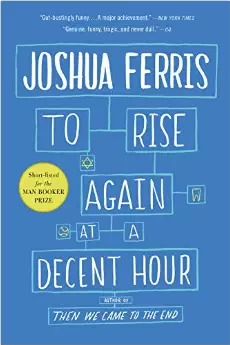
Day 719: To Rise Again at a Decent Hour

Cover for To Rise Again at a Decent HourThe descriptions I’ve read of this book in reviews and on the cover don’t really do a good job of conveying what it is like, and I’m afraid mine won’t be any better. Still, I’ll give it a try.

Paul O’Rourke is a rather neurotic New Yorker, a middle-aged dentist who loves the Red Sox. He wants to belong to something so badly that his desire has messed up his two most significant relationships. Each time, he has fallen madly for his girlfriend’s family—the first a close-knit Catholic family whom he offended by announcing he was an atheist, the second a close-knit Jewish family he tried to impress by his research into the Holocaust.

Paul feels he needs to engage more with life but instead engages less. He records and watches baseball games and eats take-out and does little else except worry about how little his patients floss. At least, that’s all he’s done since he and Connie, his office manager, broke up.

Although Paul texts, he does not use other Internet technology, so he is surprised when someone puts up a web site for his dental practice. He immediately contacts the designers of the site and asks them to take it down. Soon, someone is posting odd messages about a group called Ulm on the site and has also started a Facebook page and Twitter feed in his name.

Rather than simply working through a lawyer, Paul engages with this other “Paul” in long philosophical arguments by text. Soon Paul’s other self is trying to get him to visit his “homeland” in the Negev desert.

This novel creates a distinct personality in Paul as well as a fair amount of humor. I enjoyed it even though I thought many of the discussions were gratuitous and the plot a bit whacky.

Related Posts

Straight Man

Wife 22

Await Your Reply

Day 716: The Siege of Krishnapur

Cover for The Siege of KrishnapurThe Siege of Krishnapur, the second in J.G. Farrell’s trilogy about the British Empire, is a novel of ideas, full of the mordant humor and irony that characterizes the first book, Troubles. Farrell based his novel on the true-life 1857 siege of Lucknow, during which British residents held out for five months against attacks from Indian sepoys.

As author Pankaj Mishra explains in the introduction, this siege and similar incidents generated at the time a popular romantic genre of fiction, wherein two young English people meet in India just before the rebellion and bravely withstand privation to prevail in the end. In The Siege of Krishnapur, Farrell is among other things satirizing this genre.

George Fleury arrives in Calcutta with his sister Miriam just before news of the first sepoy rebellions. Like Farrell’s protagonist of Troubles, Fleury is an unformed young man, and worse, he tends to the pedantic. He is inclined to the romantic and likes to lecture about the supremacy of feelings and ideas over the new plethora of objects and inventions resulting from the current Industrial Revolution.

In Calcutta, Fleury and Miriam meet another brother and sister, Harry and Louise Dunstable, offspring of one of Krishnapur’s doctors. Harry is a young lieutenant, and Louise is thought to be the prettiest (English) girl in India. Fleury is taken by her, but she spends her time flirting with the young soldiers.

Once the young people reach Krishnapur, it is not long before the rumors of trouble turn into reality. The Collector, who is in charge of the district, has been paying attention, though. The others have been ridiculing him for surrounding the Residency with trenches and sending his wife home to England.

The Collector can’t quite comprehend why the natives would want to attack the British, who in his mind are bringing them the wonderful benefits of civilization. He himself attended the Great Exhibition and has filled his house with some of the marvels exhibited there, including electroplated busts of some of the great poets. (Shakespeare’s head turns out later to make a great cannonball; Keats’ does not.)

Once the British are under attack, there are thrilling yet funny descriptions of the fighting, bravely and innovatively conducted by Harry and the other soldiers, who have limited resources, and incompetently assisted by Fleury. Fleury is continually arming himself with some bulky and impractical weapon. Inside the Residency, the British begin by maintaining strict social levels and having tea parties. Once Fleury and Harry have rescued Lucy, a suicidal fallen woman, from her bungalow outside the compound, the other ladies are horrified at having to share quarters with her, even though they are sleeping on billiard tables.

Many vibrant characters inhabit this novel. The Padre is an Anglican clergyman who endlessly tries to convert his flock’s thoughts into more pious channels, haranging them even in the midst of battle. Dr. Dunstable is so incensed by the more modern treatments of his rival, Dr. McNab, that he challenges him to verbal debates and eventually gets himself killed trying to prove Dr. McNab is wrong about the cause and treatment of cholera. Even when Dr. Dunstable’s death proves Dr. McNab is right, the supposedly rational and enlightened British still somehow believe he is wrong. The Magistrate is so interested in phrenology that he shocks everyone by feeling the back of Lucy’s head to determine its amativeness and is slapped for it.

As conditions in the Residency deteriorate, the true nature of the British rulers of India emerges, petty, jingoistic, and chauvinistic, caring little for the natives, who do not appear much in the novel except as servants or attackers. In one revealing speech, an opium grower rejoices at how much money has been made by forcing the Indians to grow opium and then using it to addict the Chinese. In fact, it was just at this time that the 8th Earl of Elgin stopped to hear about the rebellion in northern India while he was on his way to China to force the Chinese emperor to admit British opium dealers.

The novel tells a great story, while still being full of wit and philosophy.

Related Posts

Troubles

Sea of Poppies

River of Smoke


Day 707: Don Quijote

Cover for Don QuijoteI know. This is not the spelling of “Quixote” most people are accustomed to seeing, but it is the one used in my Norton Critical Edition, translated by Burton Raffel. And a sprightly translation it is.

Don Quijote is the story of an old man who has studied the popular chivalric romances so much that they have addled his brain. He declares himself a knight errant and takes to the road seeking adventure. Accompanying him is a neighboring farmer, Sancho Panza, who he has convinced to come with him as his squire in exchange for a share in certain rewards. In particular, Sancho has his heart set on the governorship of an island.

Don Quijote doesn’t just look for adventure. In the first book, he hurls himself at every passer by, convincing himself that windmills are giants, a barber is a knight, an inn is a castle. Above all else, he worships his lady, the beautiful Dulcinea, whom he has never met but whom Sancho remembers as a muscular peasant girl.

Don Quijote is both a parody of the chivalric romances and a satire against the Spanish conquistadores. Its most important distinction is that it is considered the first modern novel. I found volume one to be amusing in a sort of slapstick style, as Don Quijote’s adventures always go wrong and end up with him and Sancho Panza being beaten up.

Volume two was a little too much of the same, though. In a bit of metafiction, Cervantes lists some of the things readers criticized from the first volume and then attempts to avoid them. So, for example, the two adventurers are not beaten up as often. However, both volumes contain long disquisitions on such topics as marriage, poetry, chivalry that don’t all translate well into modern times.

Finally, after Don Quijote had himself lowered into Montesino’s Cave to see its wonders and then fell asleep and dreamt a bunch of nonsense and never even saw the cave, I had to stop. Quijote was in the midst of recounting his ridiculous dream, which he took for reality, and it seemed to go on and on. I leafed ahead, looking for the end of it, never found the end, and finally lost patience. I fully believe, since apparently someone else published a book about our hero after the first volume came out, that Cervantes only brought Quijote back out on the road so that he could kill him off at the end.

Related Posts

People of the Book

The Black Tulip

Othello

Day 684: Ella Minnow Pea

Cover for Ella Minnow PeaEven though I enjoyed Mark Dunn’s unusual novel Under the Harrow, I avoided Ella Minnow Pea for some time because it sounded too gimmicky. When I finally read it, I found it mildly entertaining, but yes gimmicky, although I can see why it would amuse those with a different sense of humor than mine.

Ella Minnow Pea is a 17-year-old girl living on a fictional island off the coast of South Carolina that is not part of the United States. This island, called Nollop, is named after Nevin Nollop, the supposed author of “The quick brown fox jumped over the lazy dog.” Nollop is the island’s most eminent native son, and there is a cenotaph containing the sentence in the middle of Nollopton.

This epistolary novel opens with a letter from Ella to her cousin Tassie in Nollopville, in which she relates that the letter z fell off the cenotaph. Soon, the island council announces that the spirit of Nollop has used this way to send the message that the letter z must be removed from all island correspondence and speech. Violation of this statute is punished severely with a third occurrence resulting in banishment. The libraries are soon closed, because no books exist without the letter z. A rebellious youth is banished almost immediately. Conveniently, the procedures for running the government are destroyed, including those for recalling the council, because they contain the banned letter. People make mistakes and are punished or banished. The radio station eventually shuts down and the newspaper struggles, because it is too difficult to avoid the letter.

Then another letter falls, then another.

It is mildly amusing to see how the characters get around the problem of the disappearing letters in their correspondence. Of course, the novel is a statement about tyranny and freedom of expression.

Dunn’s latest novel Ibid, a novel written entirely in footnotes, has good reviews for its originality. Another gimmick, and I’m not sure I’ll try it. Dunn’s interests seem to lie in inventing isolated imaginary places where over-elaborate speech is common, along with made-up words, and where the government can’t be trusted.

Have you read Ibid? What did you think of it?

Related Posts

Under the Harrow

Good Omens: The Nice and Accurate Prophecies of Agnes Nutter, Witch

Brave New World