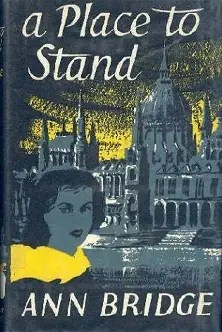
Review 2598: A Place to Stand

The first novel I read by Ann Bridge was contemplative. This one becomes much more action oriented. But both are about women developing new conceptions of themselves. This one is about a young woman becoming an adult.

A Place to Stand was published in 1951, but it is set ten years earlier. Hope Kirkland is a little bit spoiled, a nineteen-year-old American whose wealthy father is an oil executive living in Budapest for the last eight years. Although she and her mother have lived there that long, neither of them seems to understand much about what’s going on around them politically.

Hope is engaged to Sam Harrison, a young journalist who has just been transferred to Istanbul. At his departure, he gives Hope a large box of chocolates, which she thinks is an odd goodbye gift. However, when she opens it, she finds it contains two passports for young men and money with a note of where to take them. So, she does. In a less desirable neighborhood, she finds a group of Polish refugees, an old woman, her two sons Jurek and Stefan, and Jurek’s fiancée Litka.

Hungary is neutral, but Poland is fighting the Nazis. Some Hungarian politicians are pushing the country toward Germany, so Polish refugees are in potential danger. Stefan and Jurek are almost ready to leave the country, but they are waiting for something to arrive from Poland first.

Hope is immediately drawn into the affairs of the Polish group. She is struck by what was clearly once a wealthy family having no home and no possessions. Then the Nazis arrive in Budapest and immediately begin looking for Poles. At the same time, the Americans are asked to leave the country.

I had to get over my initial reaction to Hope and her general obliviousness, which was made worse for me by Bridge’s continual use of the word “little” to describe just about everything about her, her little hand, her little figure, etc. However, this novel turns into an adventure that results in self-discovery for her. I enjoyed it quite a bit, acknowledging that probably many rich American girls at the time were silly and clueless (although ones living right there in Budapest? I’m not so sure).

Related Posts

Illyrian Spring

The Flight Portfolio

The Invisible Bridge

Review 2305: The Fawn

The Fawn is an unusual novel, narrated as it is by Eszter, who through the entire novel is speaking to another person. Eventually, we understand this is her lover, whose identity is not confirmed until the last half of the book.

The novel moves among scenes from the present and the past, sometimes with no transition, so that I was briefly confused about the when. Eszter grows up very poor. Her parents are from more prosperous roots, her father’s perhaps aristocratic, but his family has thrown them off. Her father is a lawyer but he takes few cases. He is more interested in horticulture and in fact is ailing for most of her life. So, her mother teaches endless piano lessons to support them, and Eszter earns money by tutoring other students and sometimes by stealing. Her life is made harder by her parents’ sufficiency for each other. She feels that they pay no attention to her.

Although Eszter becomes a famous actress with a good income and a nice flat in Budapest, she never forgets or forgives the slights of her childhood. In particular, she hates Angéla, a schoolmate who is beautiful and kind, but whose way is made easy by everyone because she is rich and beautiful. Her bad grades are corrected by the school after visits from her parents. Eszter is happy to see her family leave town after it is disgraced, but Angéla re-emerges after the war, married to the man who becomes Eszter’s lover.

Eszter is a complex character, not likable but someone who still keeps our sympathy. This novel explores the complexity of human relationships. Eszter laments that no one has ever loved her for herself, but she has turned herself into a chameleon—a famous actress who so submerges herself in her roles that on the street no one recognizes her. The Party members refuse to believe her true story when she submits her CV for approval to work at the theater, so she has to reinvent her life to make herself into a reformed aristocrat. Her lover loves her but doesn’t understand her at all.

I found this novel a little difficult at first because it just seemed to be rambling, but the narrative is compelling. Once I really got going, I just wanted to see how it ended.

Related Posts

Iza’s Ballad

Abigail

Nightwood

Review 2173: Iza’s Ballad

When Ettie Szȍcs’s husband Vince dies, she is terrified of being left alone in her house in the small town where they’ve lived for many years. So, she is relieved when her daughter Iza tells her Ettie will come to live with her in Pest, in her modern apartment. Iza has always been the light of her and Vince’s lives, a proud defender of her father as a child after he was dismissed from his position as a judge for political reasons, an excellent student who worked against the Nazis during the war, now a respected doctor, a post-Stalinist modern woman. Ettie also has an invitation to stay in her own house with Antal, her ex-son-in-law, who bought it. But even though she still treats Antal like a son, she pays little attention to his invitation. In fact, she is more than a little befuddled by grief.

Iza is self-assured and always tries to do the right thing. However, she allows her mother no input into her own fate. She arranges to sell her mother’s house to Antal and puts her mother on a train directly after the funeral, not even giving her time to attend the little gathering that was planned. When eventually Ettie arrives in Pest expecting to see her furniture and little keepsakes, she finds Iza has sold or given away most of her possessions.

Ettie just wants to be useful. Although a simple soul who is easily frightened, she is still an active woman in her 70’s who is used to doing everything for herself and her husband. In Pest, she thought she could cook and clean for her daughter, but Iza has a housekeeper and doesn’t want Ettie to interfere. Iza believes Ettie should be happy to relax, but Ettie literally has nothing to do.

Iza works hard and then wants time alone or with her friends. It takes a remark from Domokos, Iza’s lover, to make her realize that Ettie is lonely. But even when they try to arrange a treat for Ettie, it’s something they want to do rather than something that would please Ettie.

The introduction to the NYRB edition says the novel asks what to do with the old and talks about Ettie’s inability as a country person to adapt to the city, but I think this novel is more a character study of Iza, a person who always thinks she knows best and is blind to the feelings of others. Her marriage to Antal was her only failure, and she still doesn’t understand why he left, since he was clearly in love with her. It’s a fascinating but sad novel.

Related Posts

Abigail

The Invisible Bridge

Effi Briest

Review 2065: The Invisible Bridge

One of the reasons I learned to love reading was that I got swept up into another time or place or even world. As I got older and more discriminating, this experience happened less often. It happened most recently within a few pages of starting The Invisible Bridge, which I read for my James Tait Black project.

Andras Lévi, a young Hungarian Jew, arrives in Paris in 1937 to study architecture. He has brought with him a letter that an acquaintance asked him to mail once he was in Paris. He mails the letter but notices the address.

Soon he is involved in the technicalities of art school, made more difficult because he almost immediately loses his scholarship, a first act of the anti-Semitisim that is perceptibly increasing, although not as bad in Paris as it was in Budapest. He seeks a job at a theater from Zoltán Novak, a man he met on the train from Hungary. When he begins a friendship there with an older actress, she sends him to lunch with friends at the address on the envelope he mailed, and that’s how he meets Klara, an older woman with whom he falls madly in love.

This novel, which starts out seeming very particular, about a love affair between two people, grows into a novel of great breadth, covering events of World War II, the Hungarian Holocaust, life in work camps, the siege of Budapest. All of it is centered in the importance of family.

I absolutely loved this novel. It is sweeping, wonderfully well written, touching, harrowing. And what a story, based on the lives of Orringer’s grandparents. I can’t recommend this book enough.

Related Posts

Great House

A Town Like Alice

Between the Woods and the Water: On Foot to Constantinople: From the Middle Danube to the Iron Gates

Review 1814: Temptation

From before his birth in a Hungarian village in 1912, Béla is unwanted. His mother, away working in Budapest, pays Rozi to care for him. But when his mother can’t pay, Rozi doesn’t feed him. So, at age seven, he begins stealing to feed himself.

Rozi also makes him work instead of going to school, that is until he, thirsting for knowledge, goes to the schoolteacher. At school, he begins finding success, until an incident results in him being shipped off to Budapest to live with his mother.

Béla must forget about schooling in Budapest, because his mother has found him a job in a fancy hotel. Unfortunately, as an apprentice he is not paid, and he and his mother are barely scraping by, scrambling to pay rent and eating seldom.

At work, Béla meets Elamér, who begins instructing him in Socialism. Although the Democratic Socialist party is legal, the right-wing government behaves as if it is not. Then Béla is distracted by his infatuation with Her Excellency, a beautiful member of the nobility who uses the boys in the hotel for sex.

Within a background of a country sliding toward chaos and Fascism, we follow Béla in his enthralling journey toward political self-awareness. This picaresque novel is vital and exciting. What a great story!

Jamrach’s Menagerie

American War

The Spoilt City

Review 1612: Abigail

Gina is a fourteen-year-old girl who is adored by her father, General Vitaly, and has led a carefree life in Budapest. Then some changes occur. Her adored governess, Marcelle, must leave home because she is French and thus on the opposite side of World War II. Then, her father enters her into Matula, a school for girls in the provinces. He does this with no warning, and Gina is at a loss to understand why he has chosen a cheerless, strict Calvinist school.

Upon arrival, Gina is stripped of her possessions and given charmless garments to wear. Her hair is cut off. The other girls in her class seem friendly at first, but after a horrible first day, she has a melt-down and blurts out a class secret. After that, no one will speak to her.

One of the school traditions, at least among the girls, is that if you write a note asking for help and put it in the vase held by a statue named Abigail in the garden, she will help you. This tradition is one of the things Gina finds ridiculous in her first days, but after a while, she comes to believe that someone, perhaps one of the staff, probably is helping.

When Gina becomes so miserable at school that she can’t take it, she plots to run away. She is prevented by one of the teachers, König, whom she despises. Soon, her father comes to see her and tells her a secret, something that requires her to stay in the school. She realizes she must try to make peace with her classmates.

This may sound like a standard novel about life in school, but it is an adventure novel that actually becomes quite suspenseful. The identity of Abigail wasn’t very hard to guess. It is Gina who is oblivious to all the clues until the last sentence of the novel. There is certainly a cast to pick from, including Susanna, the beautiful and strict prefect; Mr. Kalmár, the handsome young teacher who is in love with her; and Gedeon Torma, the director, the source of the cheerlessness and strictness. This is also Mitsi Horn, a former student who is a legend at the school.

Despite knowing who Abigail was almost from minute one, I really enjoyed this novel. Gina, headstrong and oblivious, is still appealing, and the plot is an interesting one.

Related Posts

Salt to the Sea

The Book Thief

The Nightingale

Review 1594: They Were Divided

They Were Divided is the third book in Míklos Bánffy’s Transylvanian Trilogy about the fortunes of Hungary and its leaders coming up to the First World War. It again follows two young noblemen, Laszlo Gyeroffy and Balint Abady, but it is mostly about Balint.

I got a little bogged down in They Were Found Wanting, the second volume of this series. I think that was because I wasn’t particularly interested in Balint’s affair with the married Adrienne, which occupied much of that volume. In that book (small spoiler for the second book), Adrienne kept delaying her request for a divorce from her husband out of fear of a man who was becoming more and more unstable. Now, he has been consigned to a mental hospital, which means that Adrienne cannot legally divorce him. So, Balint and Adrienne are forced to discreetly continue their affair.

On the political front, the Budapest legislature continues its obstructive techniques, not allowing any legislation relating to modernization. But Balint is more and more concerned about the events in other countries that he fears are leading to war. The Hungarian politicians continue to behave as if nothing outside their country affects them.

As for Laszlo, having gambled away most of his inheritance and been cheated of the rest, he has settled down in a small cottage on his estate to drink himself to death.

This novel has some amusing moments and is full of eccentric characters, but it is essentially serious. It depicts a society that has ceased to take care of its property and obligations, including its obligations in government, and spends all its time in frivolous activities. It does have one conversation that made me wince, where Balint insists that historically, nobles did not abuse their serfs because it would be against their own interests. It’s hard to tell whether this is supposed to show Balint’s own naïveté or whether Bánffy really believed this, or perhaps the novel is trying to show what a particular type of Hungarian believes (although I am fairly sure that Balint is Bánffy’s alter ego). Obviously, Balint, anyway, doesn’t compare that thought with his own observations of the Hungarian nobles gambling away their inheritances and mismanaging their government.

Did I enjoy this series? It provided me with a window into a time and place I knew very little about. It was more interesting than not. It was evocative in describing scenery, settings, and characters. At times the series went slowly, but this book clipped along pretty well until the last few pages, when Bánffy was trying hard to get the moral in.

Related Posts

They Were Counted

They Were Found Wanting

Between the Woods and the Water: On Foot to Constantinople: From the Middle Danube to the Iron Gates

Review 1545: They Were Found Wanting

They Were Found Wanting is the second book of Bánffy’s Transylvanian Trilogy. It again follows the fortunes of cousins Balint Abady and Laszlo Gyeroffy, Hungarian/Transylvanian noblemen, although it spends much more time with Balint.

In the first book, Balint began an affair with Adrienne Uzdy, married to a cruel and unstable neighbor of Balint’s Transylvanian estate. They resolved to part in that book but come together early in the second book. Balint wants Adrienne to divorce Uzdy, but Adrienne fears Uzdy will become violent. Moreover, she will likely lose custody of her daughter.

Laszlo started on the path of destruction in the first book after his cousin Klara rejected him because of his gambling. He has been cheated out of most of the profits from his estate by Azbej, a crooked lawyer, and he is drinking what little money he has. Early in the book, Dodo Gyalakuthy, who is so wealthy that no one will propose to her, asks him to marry her. Laszlo is stung by this and refuses, not realizing that Dodo loves him.

Balint is a member of the Hungarian Parliament, and much of this book is devoted to the machinations of the political parties, who manage to accomplish nothing because of their efforts to prevent the work of the other party. All the while, Balint is conscious of disquieting events in the outer world as it heads to World War I.

I struggled with this book a bit and actually read three other books while I was trying to finish it, something I seldom do. For one thing, there was a much stronger emphasis on Hungarian politics, but I didn’t understand all the ins and outs or sometimes who was whom. The first book came with about 100 pages of explanatory material, but I seldom read things like that and would hope a novel would be understandable without it.

For another thing, the major emphasis was on the affair between Balint and Adrienne, and I wasn’t much interested in it. Although Bánffy certainly can depict vivid characters, Adrienne isn’t one of them. She is almost there only to be the object of Balint’s yearning. You never get much of a sense of what she is like.

Finally, in some ways, Balint began this affair in a reprehensible way, and when he decides they should marry, he is merciless with the emotional blackmail. Otherwise likeable, he is not a nice lover in this book.

Throughout, the most interesting thing to me are Bánffy’s descriptions of customs and life in Transylvania. I am interested in how the third book will come out. Thank goodness it’s not nearly as long as either of the others.

Related Posts

They Were Counted

Between the Woods and the Water: On Foot to Constantinople: From the Middle Danube to the Iron Gates

The Great Fortune

Review 1527: They Were Counted

They Were Counted is the first volume in Miklós Bánffy’s Transylvanian Trilogy, about the decline of Hungary leading up to World War I. This book follows the events in the lives of two cousins, Balint Abady and Laszlo Gyeroffy. Both are noblemen who feel like outsiders in Hungarian society, Balint because he is Transylvanian and Laszlo because his prospects are not so good.

Balint has been working in the diplomatic service, but he decides to run for Parliament, never suspecting after he wins that votes have been bought on his behalf. He is dismayed to find that the Hungarian Parliament’s two parties are more concerned with scoring off each other than with getting anything done. Early on, too, there are hints that Parliament’s independence is threatened by the Austrian King Franz Joseph.

Likewise, when Balint decides to take more interest in running his estate, he has no idea that the lawyer Azbej, who has been helping his mother run the estate, has been making so much money off it. When he goes to Translyvania for forest management and with ideas about improvements for the peasant villages, he is unable to make much progress as he is seen as a Hungarian interloper.

Finally, Balint has discovered that he is in love with his old friend, Adrienne. Unfortunately, she has married since he was working abroad. Moreover, she has been sexually mistreated by her husband.

Lazslo is a musician who has withdrawn from law school and devoted himself to catching up on his musical studies. He is also in love with his cousin Klara but has no idea that her stepmother will not accept him as Klara’s suitor. Laszlo’s plans to become a composer are derailed when he gets involved with gambling.

This novel paints a picture of Transylvanian and Hungarian society of the time, with descriptions so vivid that I felt as if Bánffy was describing people, rooms, and landscapes that he knew, as he probably was. There are lots of characters, and it is sometimes difficult to remember who all of them are. I also found it a little difficult to understand the politics. Still, I found the novel very interesting.

Related Posts

The Spoilt City

Between the Woods and the Water: On Foot to Constantinople: From the Middle Danube to the Iron Gates

Dracula

Day 841: Night

Cover for NightHere is my review of my Classics Club spin choice for Spin #11!

Night is Elie Wiesel’s spare and harrowing description of his and his father’s time spent in a series of concentration camps during World War II. He begins his story in 1944, where in the town of Sighet, Transylvania, the war did not seem to have touched the Jewish population. They had heard of problems in Budapest, but they knew nothing of the larger Nazi activities aimed at their people.

The first indications came from Moishe the Beadle, a man with whom Elie has been studying the Kabbalah. As a foreign Jew, Moishe was deported to a work camp. But he came back to tell everyone that all of the deportees were driven to Poland where they were forced to dig trenches and then shot. Moishe was wounded but managed to get away and returned to warn them. No one believed him, however. They naively refused to believe the Germans could behave that way. Elie and his family could have gotten a visa out of the country, even at that late date, but they stayed.

Next, all the Jews were rounded up into two ghettos, and not much longer after that, they were shipped out to Auschwitz. Once the women and girls were separated from the men and boys at the camp, Wiesel never saw his mother or sister again. He was 15 and probably only lived because an inmate told him to say he was 18.

At only 120 pages, this is a short but affecting description of his experiences in the camps. It does not dwell overly much on the horrific conditions, but we understand how terrible it was. The book also deals with Wiesel’s spiritual landscape, as he changed from a devout boy to a man who no longer believes.

This book is not a testament to human fortitude, for Wiesel makes it clear that humans under evil conditions behave badly. Instead, it is an important documentation of a black time in human history.

Related Posts

The Narrow Road to the Deep North

Unbroken: A World War II Story of Survival, Resilience, and Redemption

The Book Thief