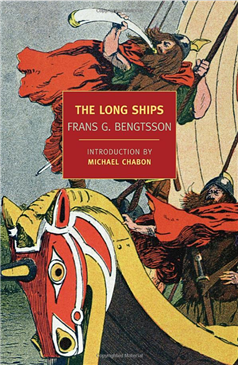
Day 496: My First Classics Club Review! The Long Ships

Cover for The Long ShipsBest Book of the Week!
Today I’m posting my first review for The Classics Club, the one chosen for me by the Classics Club Spin #5!  The Long Ships is a great start to the Classics Club for me. I found it to be a rousing adventure story full of deadpan humor.

This book is the result of Bengtsson’s desire to write a realistic novel about the Vikings. A poet, Bengtsson also wrote essays and a biography of Charles XII, but he became more widely known for The Long Ships.

His protagonist Orm Tostesson is only a boy when the novel begins. Orm is eager to go a-viking to Ireland with his father and older brother, but his mother tends to be protective of him, so he stays home. Shortly after the men leave, he attempts to stop some sheep stealing on the part of a group of Vikings from Lister and is kidnapped by them. The Vikings soon find him an able and intelligent companion, so he becomes part of their crew rather than being kept a slave.

In the course of their adventures down the western coast of Europe, they are initially successful but eventually are captured and sold as galley slaves. In return for a service they performed for a Jew from Córdoba, they are freed to serve as bodyguards for lord Almansur, the regent and imprisoner of the young Caliph of Córdoba. There they serve for years until circumstances force them to flee for home.

This voyage is the first of three related in the novel, during which “Red” Orm meets his bride to be, loses her when his best friend Toke steals her father’s concubine, goes a-viking to England to try to retrieve her from English priests, and many years later travels down the Dnieper to bring back a stash of hidden gold. Even when he is settled at home, he is involved in tiffs with his neighbors, attempts to murder him on the orders of the evil King Sven, visits from unusual acquaintances, rowdy celebrations, and a Thing, a convocation of various groups of Vikings for settling their differences.

There is plenty of action in this novel, but what I find most charming are its air of insouciance and its ongoing (although somewhat grisly) humor. It has a sense of playfulness, especially about the differences between the Norsemen’s old religion, Christianity, and Islam, to which Orm and his fellows are temporarily forced to convert. Take, for example, this passage from the prologue, about the arrival of the shaven men, or priests, in Skania:

They had many strange tales to relate, and at first people were curious and listened to them eagerly, and women found it pleasant to be baptized by these foreigners and to be presented with a white shift. Before long, however, the foreigners began to run short of the shifts, and people wearied of their sermons, finding them tedious and their matter doubtful . . . . So then there was something of a decline in conversions, and the shaven men, who talked incessantly of peace and were above all very violent in their denunciation of the gods, were one by one seized by devout persons and were hung up on sacred ash trees and shot at with arrows, and offered to the birds of Odin.

To give you another idea of the humor in this novel, a Viking tells a story of a wedding that broke up into a fight. When the bride sees the groom’s friends beating up one of her relatives, she hits the groom with a torch, which starts his hair on fire, beginning another fire in which 11 people are killed. Everyone agrees that it was the best wedding they ever attended.

The story of Red Orm is told in a detached manner but by a truly talented storyteller. It is full of sly humor and observations of human folly. I really enjoyed it.

Day 367: Between the Woods and the Water: On Foot to Constantinople: From the Middle Danube to the Iron Gates

Cover for Between the Woods and the WaterBest Book of the Week!

In December 1933, 19-year-old Patrick Leigh Fermor set out to walk from Amsterdam to Constantinople. He wrote about the first leg of this journey years later in A Time of Gifts, ending the book as he crossed a bridge from Czechoslovakia into Hungary. In 1986, he finished this memoir of the second leg of the journey, which begins on that same bridge in Esztergom the evening of Easter Sunday and ends in the early autumn of 1934.

In the second part of the journey, Leigh Fermor breaks his rule of making the entire trip by foot and also spends much of the time in more luxurious surroundings than he did in the first part. As he makes his way through Hungary and the Romanian border, as it was then, into Transylvania, he is passed by his growing list of acquaintances and friends from one kastély to another, spending days with a learned professor discussing languages and history, borrowing a marvelous horse from a count for part of the journey across the Hungarian plain, staying for weeks with a new friend named István in Romania, and dallying with a young married woman on a motor trip with István to Prague.

Leigh Fermor does not spend all his time in such exalted circles, though. He happily camps out with gypsies, spends the night outside a shepherd’s cottage, is hosted by a Jewish family after an afternoon spent discussing the Hebrew language, sleeps in a cave, and camps on an island in the Danube near a village inhabited by resettled Turks. On his way, he describes the scenery in lyrical terms, explains the ancient history of each area he passes through, and tells us about the people he meets and the sights he sees. His chronicle is supported by the notebooks he kept and a nearly photographic memory of a remarkable journey. In addition, he tells us that he revisited some of the areas 20 years later.

This memoir is beautifully written. Although relatively unacquainted with formal learning, having abandoned military school at that early age, Leigh Fermor has an astonishing range of interests, and he tells us all about them. He is constantly plunging into dusty tomes in his hosts’ libraries but is just as ready to dance and drink the night away. This is a delightful series of books, still full of the youthful joy and enthusiasm Leigh Fermor must have felt when he was 19 and 20 years old.

In the Appendix to this book, Leigh Fermor reflects on how many of the sights he writes about in this book are now under water, for the Danube valley that he traversed and the torrents and currents that once rushed along it as well as the Iron Gates themselves have been subsumed by a huge concrete dam and hydro-electric power plant. And of course there have been other causes of destruction since 1934.

Unfortunately, The Broken Road, the unfinished manuscript of the final portion of the journey, is being republished but is not available from Amazon until March of next year! (It may be available used from some other site.) I am so disappointed to find the book never gets us all the way to Turkey but stops in Greece.

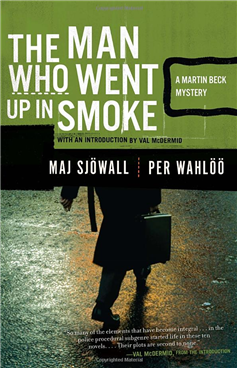
Day 350: The Man Who Went Up in Smoke

Cover for The Man Who Went Up in SmokeAt first, I thought this novel, written in 1966, was a little more dated than Roseanna, by the same authors. However, except for the formality in the characters’ dress, it stopped feeling dated after awhile.

Inspector Martin Beck has been on vacation with his family less than a day when he is called back to take charge of an unusual case. A Swedish journalist named Alf Mattson has been reported missing by his editor. The difficulty is that he disappeared in Budapest. There can be no official investigation because the Hungarian police have not received an official request for assistance, so Beck must travel to Budapest unofficially.

In Budapest Beck is able to retrace Mattson’s movements right up until he disappeared, one day after arriving. He visits a youth hostel where Mattson spent the first night and hears through his colleagues back in Sweden that Mattson claimed to have a girlfriend there. But when Beck finds her, she denies knowing Mattson.

Beck feels himself at a loss. His discussions with the Budapest police have not gone very far. The police can’t conduct a full-blown investigation until Mattson’s visa expires, but they have made some inquiries. It is not until Beck is viciously attacked that he understands he is getting somewhere.

Sjöwall and Wahlöö are known for having reinvented the police procedural, and many of its present-day conventions were first used in their novels. The novels are well written and deal with common people more often than with career criminals or gangsters.