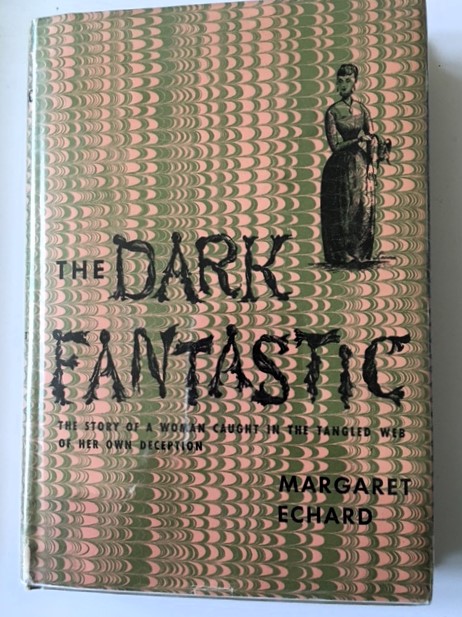
Review 2436: The Dark Fantastic

I was surprised by the direction that this novel took, but I would have been less surprised if I hadn’t missed a note from the author. It explained that although the characters were made up, the novel was inspired by events that took place at her great-grandparents’ home in rural Indiana.

In post-Civil War Terre Haute, Indiana, Judith Amory is defying convention by attending Macbeth without a male escort. She has recently been dismissed from her teaching position for being too advanced in teaching George Eliot, so she can’t really afford to go, but she thinks of herself as refined and cultured and is excited to see the performance of Edwin Booth.

At the performance, she ends up breaking convention again by speaking to her neighbor, a young man who has journeyed in from his farm just to see the play. Judith finds him handsome, prosperous looking, and eager to discuss literature, perfect for her idea of a husband—until he says he has a wife and three children. Then he mentions that the nearby town needs a teacher.

Judith is not dismayed. First, she intends to have that job even though it’s a bit beneath her. Then, she intends to have that man, Richard Tomlinson.

How she gets her Becky Sharpish way is one thing, but what happens afterward is quite unexpected. This is a pretty good, darkish novel that dabbles in the supernatural. Echard is good at setting her scene and presenting the dynamics of the Tomlinson family. She’s good at depicting the main characters, although I lost track of some of the secondary ones. This is a good one for those who like darkish tales. Warning for the politically correct—the one Black character is depicted stereotypically as isn’t surprising for a novel published in 1947.

Related Posts

Dark Enchantment

The Unforeseen

The Uninvited

Day 1226: Turtles All the Way Down

Cover for Turtles All the Way DownI’ve only read two books by John Green, but he seems to have the teenage sensibility down, as well as specializing in damaged heroines. In this case, the problem is mental illness.

Aza is subject to compulsive thoughts, so much so that at times she doesn’t feel in control of herself. Her obsessions center around the microbes in the human body.

Aza’s friend Daisy is a real firecracker who blogs romantic stories about Star Wars characters. She sets off the action in the novel by suggesting that she and Aza investigate the disappearance of Russell Pickett, a corporate CEO who is under investigation. The authorities are offering a reward of $100K for information leading to his discovery, and Daisy thinks they have an in because of Aza’s former friendship with Davis, his son.

Aza reluctantly goes along with Daisy’s idea to contact Davis but finds things complicated. Davis is glad their neglectful father is gone, but his little brother is suffering. To make matters worse, Aza is attracted to Davis, who knows very well the reason the two girls came calling.

Green seems to specialize in bitter-sweet, and this novel is no exception. It is very entertaining and ultimately touching. Aza’s problems are handled with understanding and delicacy. (It seems that Green also suffers from obsessive-compulsive disorder.) This is another winner for John Green.

Related Posts

The Fault in Our Stars

Tell the Wolves I’m Home

The Unraveling of Mercy Louis

Day 406: Annals of the Former World: In Suspect Terrain

Cover for Annals of the Former WorldIn the second book of Annals of the Former World, John McPhee returns east to examine the geology of the Appalachians along I-80. Beginning with the Delaware Water Gap, he travels along the highway with geologist Anita Harris exploring the road cuts to see what can be determined about how the landscape developed. The two continue on this route through Pennsylvania and into Ohio, where they explore Kelley’s Island, travel along the Cuyahoga River for a spell, and end at the Indiana Dunes.

Having explained the basics of plate tectonics in Basin and Range, McPhee now travels with a geologist who is skeptical of the broad application the theory has found, particularly in relation to the Appalachians. Harris takes issue with the idea that the mountains were formed by the ramming of the African coast up against North America. She believes that a study of the rocks does not support this concept.

In Suspect Terrain is deeply concerned with glaciation. As well as explaining how glaciers could have formed this area of folded and complex geology, McPhee breaks off to expatiate on how the theory of the Ice Age came about, among other geological ideas. He also tells how Harris herself figured out how to use the color of conodonts, a kind of fossil, to make it easier to find the conditions for oil.

I find it fascinating to try to imagine the pictures of the earth that McPhee describes, how different they are from the continent as it is today. McPhee tells us how rivers ran to the west instead of to the east, huge tropical seas took up the middle of the continent, the glaciers shoved rock down from Canada to create places like Staten Island.

McPhee is an extremely interesting writer. To be sure, the subject matter, the ideas it evokes, and the language he uses demand full attention, but this series of books is involving.