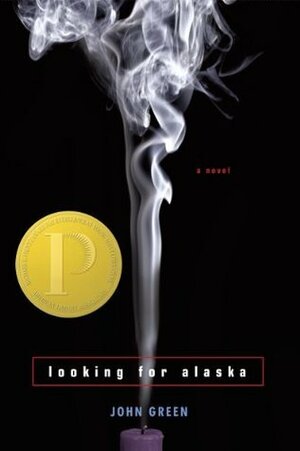
Review 2566: Looking for Alaska

The few John Green books I’ve read are aimed at teenagers (although some are excellent adult reading) and address, fairly subtly, an issue. For Looking for Alaska, it’s death and grief.

Sixteen-year-old Miles is miserable in his school. He has no friends, and the level of education is fairly low, so he convinces his parents to send him to a boarding school in Alabama that his father attended. He is hoping this change will initiate what he calls the Great Perhaps.

He is lucky enough to pull as his roommate a stocky kid named Chip (aka The Colonel). The Colonel is at first dubious of him until some other students overdo it with the initiation for new students. The custom is to haul Miles off in the middle of the night and drop him into the lake, but because The Colonel and his friends have lately pranked them, one of them wraps Miles up in duct tape and then they drop him in the lake. He is in danger of drowning, but he manages to float himself to shore and then get the tape off.

The Colonel is outraged by this prank because it was so dangerous. He has a running feud with the Weekday Warriors, rich kids who board there but return home every weekend to their parents’ homes in Birmingham. It was some of those kids who duct-taped Miles because of his association with The Colonel.

The Colonel nicknames Miles “Pudge” because he’s so skinny and introduces him to his friends, a Japanese boy named Takumi and a girl named Alaska. Miles is immediately smitten by Alaska, a cool girl but with an unstable temperament, usually out-going and dare-devilish but sometimes hysterically unhappy.

The group pals around, teaches Miles to smoke and drink and get into trouble, but they also take studying and grades seriously, especially The Colonel, who is on a scholarship and comes from a very poor home.

Then one of the friends dies.

For once, I thought Green got a little of this wrong. Some of the friends’ reactions didn’t read true, or maybe they did and I just don’t know teenagers. For example, throughout the novel, Miles is fascinated by the last words of famous people, so much so that he reads a lot of biographies. When the friend dies, he is upset, but he regrets he didn’t get to hear the friend’s last words. He is supposedly devastated by the death and blaming himself, so that seems like a flippant reaction, but Green mentions it twice.

Otherwise, Green does his usual masterly job of gaining your sympathy for his characters and presenting them with a difficult situation. He writes well, avoiding that stereotypical “teenage voice” that so many adult authors use; has a good sense of humor; and is good at depicting believable teenagers.

Related Posts

The Fault in Our Stars

Turtles All the Way Down

Tell the Wolves I’m Home

Day 1226: Turtles All the Way Down

Cover for Turtles All the Way DownI’ve only read two books by John Green, but he seems to have the teenage sensibility down, as well as specializing in damaged heroines. In this case, the problem is mental illness.

Aza is subject to compulsive thoughts, so much so that at times she doesn’t feel in control of herself. Her obsessions center around the microbes in the human body.

Aza’s friend Daisy is a real firecracker who blogs romantic stories about Star Wars characters. She sets off the action in the novel by suggesting that she and Aza investigate the disappearance of Russell Pickett, a corporate CEO who is under investigation. The authorities are offering a reward of $100K for information leading to his discovery, and Daisy thinks they have an in because of Aza’s former friendship with Davis, his son.

Aza reluctantly goes along with Daisy’s idea to contact Davis but finds things complicated. Davis is glad their neglectful father is gone, but his little brother is suffering. To make matters worse, Aza is attracted to Davis, who knows very well the reason the two girls came calling.

Green seems to specialize in bitter-sweet, and this novel is no exception. It is very entertaining and ultimately touching. Aza’s problems are handled with understanding and delicacy. (It seems that Green also suffers from obsessive-compulsive disorder.) This is another winner for John Green.

Related Posts

The Fault in Our Stars

Tell the Wolves I’m Home

The Unraveling of Mercy Louis

Day 477: The Fault in Our Stars

Cover for The Fault in Our StarsBest Book of the Week!
It seems as if I have read more books lately from which I do not get a sense of the characters’ personalities. I don’t feel as if they could be real people but just projections of the author’s plot. But that is not the case with The Fault in Our Stars, which creates for us some unforgettable personalities.

Hazel Lancaster is a sixteen-year-old with thyroid cancer that has spread to her lungs. Unlike the other kids in the support group her mom has talked her into attending, she doesn’t have any hope of survival. She just wants to live as long as she can. At the group, she meets Augustus Waters, a seventeen-year-old ex-basketball player who has lost one leg to osteosarcoma but has a generally good prognosis.

Hazel is witty, smart, and well read. She is obsessed with a novel called An Imperial Affliction by Peter Van Houten, which is about a young girl suffering from a fatal illness, and literally ends in the middle of a sentence. As she and Augustus discuss their favorite books, Hazel explains that she just wants to know what happened to everyone else in the novel. Augustus decides to use his wish from the Genie Foundation to take Hazel to Amsterdam, where she can meet Peter Van Houten and find out what happened after the novel ended.

This novel is about teenagers falling in love, and rarely has fiction depicted two more appealing people. My one very small criticism is that they are scarily smart and funny, in intelligence reminding me more of Salinger’s Glass family than of normal kids. But Green has got the juvenile speech patterns down.

Frightfully well written, touching, funny, and ultimately sad, this novel has much to offer teens, young adults, and adults. Hazel and Augustus are affectingly human, and even Hazel’s parents, those cumbersome quantities so often ignored or eliminated in children’s or young adult fiction (note, for example, how much we see of Bella’s father in Twilight), are deftly characterized by their affectionate jokey interactions with Hazel.

Again, I feel that my capabilities are stretched here in my inability to adequately express how good this novel is. When I first started reading it, I was afraid of manipulation, as there seem to be a lot of “affliction of the month” children’s books out there right now, but that feeling left me almost immediately.