Day 463: The Luminaries

Cover for The LuminariesBest Book of the Week! Year!

This last year I read several books that played wonderfully with structure. I’m thinking particularly of A Visit from the Goon Squad, a series of stories linked by their characters that somehow forms a whole, and Life After Life, in which the heroine’s life is repeated, with slight changes that lead to significant ones. I loved both of these inventive approaches to structure, and now I add to this list The Luminaries, the latest winner of the Man Booker Prize. This book is also my second recently reviewed novel set in New Zealand.

Walter Moody is newly come to the gold fields of the South Island of New Zealand in 1866. He has arrived in rough seas and is shaken by an apparition he has seen in the bowels of the ship. Seeking warmth and comfort, he checks into a seedy waterfront hotel and enters the parlor, where he accidentally interrupts the meeting of 12 other men.

After some initial hesitancy, the men begin telling him a series of tales, all interconnected, but the whole of which they cannot make out. The tales concern a missing trunk, a fortune found in a dead man’s cabin, the disappearance of a prominent citizen, the apparent attempted suicide of a whore. Each man at the meeting has his own part of the story to impart. Moody is able to make some sense of the story, but all go away from the meeting knowing that pieces are missing.

This section of the book is the longest, making up almost half its length. The cover of the novel, showing a waning moon, gives you a hint to its structure. It is divided into 12 sections, each one shorter than the one before but each one adding to the revelations of the original tales, until the final very short slivers of sections reveal all.

Each of these sections is also headed with an astrological chart that shows how the heavenly bodies are positioned within the signs of the 12 initial characters. This I did not understand at all, but Catton provides some indication at the beginning of the sections about what the astrology predicts.

The chapters of the novel are charmingly headed with old-fashioned descriptions of what happens in the chapter. Over time, the descriptions themselves begin to drive the narrative.

In The Luminaries, we’re presented with a novel that embodies a puzzle, a complex tale of villainy and foul crimes but also of love and loyalty. I was completely engrossed in  entangling the threads of this story. Despite its beginnings as a tale of cheats and chicanery, you may be surprised to find that you are reading a love story about two characters connected by their stars.

Day 456: Independent People

Cover for Independent PeopleBest Book of the Week!

Who knew that Iceland had a Nobel Prize winner for literature? I didn’t even notice with his novel in my hands, given to me by my Uncle Fred last summer. I just put it in my pile of books to be read. If I’d known it was so good, I would have paid more attention.

Oddly, I seem to be inadvertently in an islands phase. This is the second book I’ve reviewed recently about Iceland (see my review of Burial Rites), and I have another I will soon review about New Zealand, The Luminaries. (See my review of The Bone People.)

Bjartur Jónsson has worked for the Bailiff’s family for 18 years to earn enough money to buy a small farm and some sheep. He is determined from now on to be beholden to no one else, to be independent. Even though his holding is said to be cursed by the fiend Kolumkilli (Saint Columba) and the witch Gunnvor, Bjartur is not superstitious and refuses to cast a stone on Gunnvor’s cairn to appease her when he first crosses the ridge into his valley. He is determined to make a place for himself and his bride-to-be Rósa on his own efforts.

On his wedding night he has an unpleasant surprise. Someone has already been with Rósa, he claims. At first we’re not certain whether he is being perverse, but one night when Bjartur is out searching for a lost sheep (that Rósa ate out of desperation), Rósa dies in childbirth only a few months after the wedding. Bjartur finds the baby on the edge of death, protected by his bitch sheep dog. Bjartur is a singular character—a lover of the old sagas and a poet, obstinate to the point of stupidity, untrusting, ornery, thinking mostly of his sheep—but he immediately loves this little girl and names her Ásta Sólillja (beloved sun lily).

Although Bjartur soon marries Finna, the woman who comes to care for Ásta Sólillja, and we get to know her and her mother and the couple’s three sons, it is the characters of Bjartur and Ásta Sólillja that dominate the story. Bjartur is so heedless of anything but his own ideas that he refuses anything resembling a gift, even if it would keep his family healthy, and Ásta Sólillja is innocent and gentle as the little flower he calls her.

The time frame of this novel is vague, so we are startled two thirds of the way through to see references to World War I, for the life of these Icelandic farmers seems no different than it would have been in the Middle Ages. Laxness describes a hard, grim existence, where babies die of illness and malnutrition, where Finna lies in bed ill for weeks every winter, where the family lives in one room full of fleas.

This story is not a bleak one, however; rather it is comic, sad, and moving. The novel centers on a rift between Ásta Sólillja and Bjartur. In anger, he throws her out. Although he repents his action, he won’t admit it and stubbornly waits for her to come ask for forgiveness. Well, she will never ask.

Slowly, things begin going wrong for Bjartur. He has already lost his second wife and his oldest son because of obstinacy about a cow. His youngest son Nonni, a brilliantly drawn character whose mother told him he would “sing for the world” (and I think is meant to be Laxness himself) disappears from the novel when he gets a chance to go to America at a young age. Soon Bjartur is left with only his middle son Gvendur, a young man not given to introspection who only knows how to “keep on doing things.”

Along with the story of Bjartur’s family, we learn a bit about the history of Icelandic politics and economy, but the novel centers on this all too human and oddly endearing family. If you decide to read this poetic novel, I think you will have a wonderful and surprising experience. It looks like several of Laxness’s works are out in paperback. I’m going to be buying more.

Day 451: The Year of Magical Thinking

Cover for The Year of Magical ThinkingThe Year of Magical Thinking is Joan Didion’s candid account of the first year after the death of her husband, writer John Gregory Dunne, and the serious illness of their daughter Quintana Roo (which sadly resulted in her death after the time frame of this book).

The couple had just returned from the hospital, where their daughter’s illness had progressed from flu to pneumonia to septic shock. Dunne died in a manner that was so sudden, falling over forward on his face at the table, that Didion at first thought he was joking.

What follows is an honest description of Didion’s mental functioning and thoughts as she tries to deal with competing traumas in her life—the refusal to believe her husband might not be coming back (she won’t give away his shoes in case he needs them), the constant speculation about what she might have done differently that could have saved him (what if they stayed in Malibu? what if they moved to Hawaii?), the attempt to avoid anything that reminds her of time she spent with her husband. She makes a careful distinction between grief and mourning.

What characterizes this book is the unstinting look at the author’s experience, a willingness to document everything, without avoidance or euphemism. Didion’s intelligence shines through every passage as she contemplates our culture’s relationship with death—for one thing, the harm we have done by ridding ourselves of its ceremonies and even its trappings.

Day 450: The Bone People

Cover for The Bone PeopleThe Bone People is a very unusual novel, and I’m not sure what I think of it. I would give an unreservedly enthusiastic review except for one overriding facet of the plot and an ending that radically changes course.

Kerewin Holmes is a wealthy half-European, half-Maori woman who builds a tower on the New Zealand seaside. She clearly identifies more with the Maori culture than the European. Kerewin is an artist who for some time has been unable to create art and has separated herself from her family. She fills her tower with beautiful objects and oddities and stays away from people.

One day she comes home to find a young boy hiding in her house and quickly discovers he does not speak. The boy takes a liking to her, which turns out to be unusual. Although the boy appears to be purely of European descent, the man who eventually arrives to pick him up is a Maori man she has seen bragging in a local bar, Joe Gillayley.

The boy, Simon, turns out to have been a shipwreck victim as a very young child, the couple found with him not his parents. His identity has never been discovered, and Joe and his family adopted him. However, Joe’s wife Hana and son Timote died later from an illness.

Simon has an unruly streak, and Kerewin finds him spending the day with her at the tower when he decides to skip school. Kerewin feels there is something wrong about both the man and the boy, but soon begins to care about them and even tries to find out about the boy based on an unusual ring in his possession.

The blurb on this book calls it a mystery and a love story, but if you go into it with that kind of expectation, you are going to be confused. The narrative style is unusual. It is told from multiple viewpoints, although mostly from Kerewin’s, and Kerewin makes up poetry or sings little songs almost constantly. As the novel progresses, more Maori cultural references and mysticism appear.

Spoilers in this paragraph: I would normally not reveal this important a plot point, as it appears well into the book, but I feel I have to in order to explain my mixed reaction. It takes some time before Kerewin discovers that Joe, who usually treats Simon lovingly, sometimes beats him savagely in an attempt to control his behavior. Moreover, the whole town appears to be aware of this but does nothing. Kerewin is torn because she feels Joe really loves Simon and bitterly regrets these beatings, but she does not seem to realize (nor is there a sense of this in the book at all) that this is classic abusive behavior. So, no one turns Joe in to the authorities. Kerewin’s solution is to beat the crap out of Joe, as she has training in aikido, and then to make him promise not to discipline Simon without talking to her. This solution is obviously a stupid one, although it works for some time. When things come to a head, the result is horrendous.

Then the novel continues from there in another direction, which is disconcerting. I could not reconcile my feelings about what happens to Simon with my interest in the book up until that point. In fact, having the novel almost immediately shoot off in another direction was very distressing to me, and even though it eventually returns to the original events and ties everything up, the direction it goes in the closing sections seems to belong to a different novel.

If the child in peril theme is not one for you, I can tell you that the ending is unexpectedly and, I feel, unrealistically happy, and delves into the theme of a re-emergence of Maori culture. Maybe I am viewing this novel through some kind of cultural myopia, but the ending seems to me to magically wipe out a lot of problems, including legal complications. I understand that this novel was severely edited from its original form, much against Hulme’s wishes, which makes we wonder what the original novel would have been like.

Day 445: Annals of the Former World: Crossing the Craton

Cover for Annals of the Former WorldIn the final short book of Annals of the Former World, John McPhee examines the craton, the flat land that lies in the central Midwest of the continental United States. If you have read my reviews of the other books, you might remember that McPhee wrote each one about a separate geologic area near I-80, along which he traveled with different geologists telling the story of the formation of the country. Each of those four books was published separately, but Crossing the Craton was added when the complete volume was published, perhaps for completeness. (I think it was published separately at a later time.)

Because there are few outcroppings in the Midwest, little can be seen of the rock underlying this area, a thin veneer over the basement rock that comprises 90% of geologic time.  McPhee explains that until very recently this basement, or Precambrian, rock was neglected in geology texts. Because Precambrian rock by definition has no carbon in it from living things, carbon dating was not available. Nothing was known about the rock.  For a long time it was thought to have been there since the creation of the earth, but that idea has been found to be incorrect.

Just in the last 40 years or so, new kinds of dating methods and other technological advances have allowed geologists more insight into what is going on beneath the surface in these older rocks. Gravity maps have revealed a huge tectonic rift, for example, that runs from eastern Nebraska through Iowa, Minnesota, and Wisconsin and under Lake Superior, where it joins one rift shooting north into Canada and another running right through Michigan. This three-pronged rift is similar to the one that runs down the Red Sea to meet the rift in the Gulf of Aden and the East African Rift, only that one is much younger.

In this book McPhee explains how the Canadian Shield and the central portion of North America were mostly likely created. He also looks at recent technologies such as zircon dating and aeromagnetic mapping, and speculates on the discoveries about the basement rock that could emerge in the future.

Although this is the shortest book in the volume, more the length of an essay, its emphasis on technology makes the subject matter of lesser interest to me than that of the previous books.

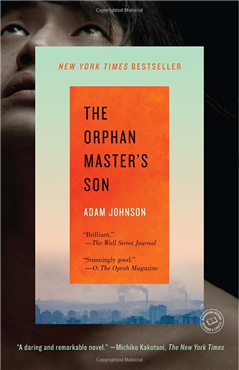
Day 432: The Orphan Master’s Son

Cover for The Orphan Master's SonBest Book of the Week!

I can tell before I even start that this is going to be one of those times where I have difficulty conveying just how good this novel is. It is going to sound dreary and painful, but it is a wonderful, wonderful novel.

For a long while I avoided this book, afraid that the subject matter would be too cold or too harrowing. However, it has earned so many honors that I felt I finally had to read it. It is harrowing, but it is so very human, and touching, and inspiring.

Pak Jun Do (note the purposeful echoing of our clichéd unknown man, John Doe) is the only boy with a father who was raised in an orphanage in North Korea, the orphan master’s son, or so he believes. Of course, many of the orphans actually have parents, who dropped them off because they couldn’t or wouldn’t feed them during the time of the great famine. The orphans, including Jun Do, are shamelessly put to hard labor deep in the mines, where our hero learns a skill that will come in handy, to get around in the dark.

Later, he is assigned to a kidnapping team, sneaking into Japan to abduct unwary Japanese citizens. You can see him quietly processing his opinions about this activity. From this position, he is sent to language school and ends up on a fishing vessel spying on radio transmissions from other countries and vessels, including, significantly, those of a young American woman who is rowing around the world with a partner. Jun Do begins showing himself to be observant, resourceful, and ethical in his own way.

Jun Do has had a difficult start in life in an environment that seems almost totally arbitrary, and as he experiences one event after another, he begins to develop in unexpected directions and to look at his environment with a skeptical and aware eye. After an encounter with an American ship, Jun Do and his shipmates fabricate a ridiculous lie to save themselves and their families. This lie inadvertently results in Jun Do being declared a national hero. From there his life begins a series of remarkable transformations.

I am feeling my inadequacies here, because I am not conveying at all how wrapped up I became in Jun Do’s story. It is told in many voices, including the daily loudspeaker broadcast of propaganda (which is frequently ridiculous) and the “biography” put together by a state inquisitor. Some of the events are difficult to read about, some frankly absurd, as when the Dear Leader Kim Jung Il decides to entertain some American dignitaries with synchronized fork lift demonstrations.

The novel tells a story of hope, mixed in with the grim reality and sheer ludicrousness of what seems to be a fully realized vision of North Korean existence, where people live in terror of innocently making some terrible error. The book tells this story with power, with pathos, with sly humor, and with irony.

This book is really, really great.

Day 428: Annals of the Former World: Assembling California

Cover for Annals of the Former WorldAssembling California is the fourth volume of McPhee’s massive book about the geologic structure of the country. It dwells mostly on how the ideas of plate tectonics by themselves do not explain the geology of California.

As explained in my reviews of the previous volumes, McPhee spent years traveling along I-80 in the company of different geologists with the aim of describing the geologic formation of the country. In this volume, McPhee continues his travels along I-80, this time with geologist Eldridge Moores. They begin a series of journeys at the eastern border of California near Donner Pass, crossing to the Oakland/San Francisco area.

McPhee introduces the concept of the ophiolitic sequence, a sequence of rock strata that has been found to originate from ocean floor crusts. These crusts were ripped from the floor and mashed upward when an island arc, like that of Japan, collided with the western coast of the continent. Thus the ophiolites, which are the oldest rock, end up on top of mountains. The theory is that three such island arcs joined with the continent over the ages to form California.

McPhee also travels with Moores to Cyprus and Macedonia, two areas with similar rock. He introduces some other structures that are not completely explained by plate tectonics, such as the whole of Southeast Asia, which appears to be a part of the continent that was pushed sideways by the impact of India smashing into Asia and creating the Himalayas.

McPhee finishes this book with a dissection of the 1989 earthquake in San Francisco-Oakland (which occurred after his initial visits). He returns to examine the damage and explain how the shockwave spread and why some areas were more damaged than others.

As in the other volumes, McPhee imparts a great many concepts and theories in clear and interesting prose. This series of books (or the larger volume) makes for reading that can be a little difficult to grasp, as plates and continents seem to whirl and gyrate all over the earth (only, of course, very slowly), but it is nonetheless fascinating.

Day 417: Annals of the Former World: Rising from the Plains

Cover for Annals of the Former WorldRising from the Plains was my favorite book of Annals of the Former World. In this third book of the series (or third section of the complete book), John McPhee examines the geology of Wyoming along I-80 and makes a side trip to Jackson Hole.

McPhee travels with geologist David Love, and he enlivens the geological discussion with a discursion on the settling of Wyoming, particularly with the history of Love’s own family. He begins with Love’s mother, Ethel Waxham, a Wellesley graduate who arrived in the wintery landscape by stage to take up work as a schoolteacher. Waxham kept absorbing journals that describe the harsh conditions as well as the striking characters she encountered. Waxham was courted and won by a rancher, John Love, a nephew of John Muir, the great writer and naturalist. McPhee has tales to tell of Love’s adventures, including his acquaintance with Robert Leroy Parker and Harry Longabaugh (Butch Cassidy and the Sundance Kid).

This book continues to explore questions raised by too comprehensive an application of the theory of plate tectonics. It introduces the concepts of hot spots and plumes and their involvement in the formation of structures.

The book delves deeper into the story of the discovery of oil shales and uranium in the area. It touches on issues of ecology and preservation of natural areas.

Of all the parts of Annals, Rising from the Plains is the widest in scope. McPhee has a talent for making his subjects understandable and readable–and very interesting.

Day 406: Annals of the Former World: In Suspect Terrain

Cover for Annals of the Former WorldIn the second book of Annals of the Former World, John McPhee returns east to examine the geology of the Appalachians along I-80. Beginning with the Delaware Water Gap, he travels along the highway with geologist Anita Harris exploring the road cuts to see what can be determined about how the landscape developed. The two continue on this route through Pennsylvania and into Ohio, where they explore Kelley’s Island, travel along the Cuyahoga River for a spell, and end at the Indiana Dunes.

Having explained the basics of plate tectonics in Basin and Range, McPhee now travels with a geologist who is skeptical of the broad application the theory has found, particularly in relation to the Appalachians. Harris takes issue with the idea that the mountains were formed by the ramming of the African coast up against North America. She believes that a study of the rocks does not support this concept.

In Suspect Terrain is deeply concerned with glaciation. As well as explaining how glaciers could have formed this area of folded and complex geology, McPhee breaks off to expatiate on how the theory of the Ice Age came about, among other geological ideas. He also tells how Harris herself figured out how to use the color of conodonts, a kind of fossil, to make it easier to find the conditions for oil.

I find it fascinating to try to imagine the pictures of the earth that McPhee describes, how different they are from the continent as it is today. McPhee tells us how rivers ran to the west instead of to the east, huge tropical seas took up the middle of the continent, the glaciers shoved rock down from Canada to create places like Staten Island.

McPhee is an extremely interesting writer. To be sure, the subject matter, the ideas it evokes, and the language he uses demand full attention, but this series of books is involving.

Day 400: Annals of the Former World: Basin and Range

Cover for Annals of the Former WorldBest Book of the Week!

Beginning in 1978, John McPhee began a series of journeys across the United States along the length of I-80. His goal was to form a picture of how the geology of the country evolved over time. This project proved to be so large that he ended up breaking it into chunks, publishing four books that he finally combined into one (with an extra section). Basin and Range is the first book of Annals of the Former World, the combined volume, for which McPhee won the Pulitzer. Although I am reading the large volume, I have decided to break up my review by the original works, as reading this book has involved a lot of concentration.

Although the book begins with the genesis of the idea during an outing McPhee took with a geologist in New Jersey and briefly covers other areas of the world, Basin and Range concentrates on the Basin and Range area of western Utah and eastern Nevada. McPhee is a journalist who majored in English, but his interests lead him to take courses in geology, among other sciences. To supplement his basic knowledge and interests, he traveled with and interviewed noted geologists.

Basin and Range discusses changes in basic geological theory from the 17th century, providing readers with a primer on plate tectonics by using examples of various structures in the Basin and Range. In the course of these discussions, McPhee expatiates on some of the larger debates in the history of the science and tells us about some of the more colorful characters. All the while, he conveys his fascination with geology and his appreciation of language. He finds inventive ways of suggesting the vastness of the time he is discussing and the relative rapidity with which major geological forces can create change.

I have an interest in geology that is only basically informed, mostly from a couple of classes, science TV programs, and a former job in a related industry. I always considered myself a dunce at science and so never followed up this interest seriously. McPhee throws around geology terms without always explaining them, so I found myself looking up terms like “oolite” and “craton,” but in general he is gifted with the ability to make this topic abundantly clear. Although I was not sure at the beginning of the book that I would read all the parts, I am certainly planning on continuing. I am finding it fascinating to try to imagine the changes in the Earth that he describes.