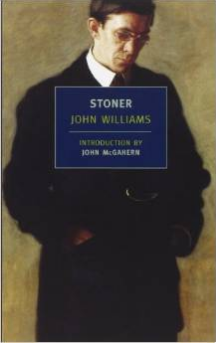
Day 556: Stoner

Cover for StonerBest Book of the Week!
When I first began reading Stoner, I was afraid it was going to be a bleak modernist novel. But it is the opposite of bleak. It is a novel about a shy, awkward man who loves. Williams called it “an escape into reality.”

Williams begins the novel by describing William Stoner’s career at the University of Missouri:

“He did not rise above the rank of assistant professor, and few students remembered him with any sharpness after they had taken his courses.”

It seems that Williams will be writing about a nonentity, but this is not the case.

On the surface, Stoner does not have a happy life. He is the son of a dirt-poor farmer who decides that William should attend college to learn new agricultural techniques. So, Stoner arrives at the University of Missouri a gawky, unsophisticated boy who has only a mild interest in his courses and begins an undistinguished career.

Then in his sophomore year, he takes a required English literature survey course. Although he is speechless in class, he realizes he has found the thing he loves and so changes his major. He eventually earns a doctorate and begins a teaching career at the university.

He makes an unfortunate choice for a wife, marrying a girl whose training makes her more suitable for a society wife than that of an impoverished instructor. It is not clear why Edith marries him except possibly to get away from home. She makes very clear how distasteful she finds sex, and he is too inexperienced to know what to do about it.

Edith’s sexuality changes briefly when she decides she wants a child. After their daughter Grace is born, though, Edith takes little interest in her or in him. Stoner, on the other hand, falls madly for Grace. He takes on almost all the care for her in her first five or six years of life. Then Edith does everything she can to separate them and mold Grace into the type of girl Edith thinks she should be.

Stoner’s solace is in his work, for which he eventually finds a talent for teaching Medieval literature. His progress in his career is hindered, though, by university politics. He finds himself in a dispute over the fitness of a student to enter the doctoral program. Although Stoner’s position is completely justified and his actions misrepresented, he earns himself the enmity of the student’s mentor, Hollis Lomax, who eventually becomes department chair.

Stoner falls in love and finds for awhile some tenderness, but he knows his relationship will be short-lived. It is also ended by university politics.

What Williams accomplishes in this novel is to turn that first assessment of Stoner on its head. Stoner is a flawed man who owes many of the difficulties of his life to inaction, but he is doing work he loves, he is completely conscientious in his efforts, and he even manages a minor victory over his enemy after years of patience. The introduction to the novel states that although readers think Williams is depicting a sad life, he sees it as a novel about love, all the forms it takes, and the forces against it.

You may think this novel sounds dreary. It is not, and it is not often that you feel as if you know and love a character so thoroughly.

Day 554: The Testament of Mary

Cover for The Testament of MaryIt is years after the crucifixion. Mary is living a quiet life in Ephesus, visited by two of her son’s disciples. It is clear their visits are unwelcome, as they have been trying to force her memories to agree with the documents they’re writing. But Mary has always seen her son’s followers as men with something lacking in them, and she insists on telling her her own truths.

This provocative novella takes the position that Mary was not a believer but was simply trying to save her son from his fate. She grieves his loss and regrets that at the end her courage failed her. While the disciples try to place her and Mary (Toíbín does not name anyone Mary Magdalene, but that is whom he means, I assume) at the grave witnessing a resurrection, they were actually fleeing for their own lives.

While the novella seems to accept some of the miracles, the raising of Lazarus is more of a horror than a wonder. Mary also notices that the jugs of water are brought forward quickly at the wedding at Cana and that only one of them was opened beforehand. Toíbín evokes an atmosphere of feverish excitement and hard fanaticism during these scenes, wherein both Jesus’ enemies and his followers push her son toward his fate.

This novella, which was shortlisted for the Booker Prize, is thought-provoking in its exploration of cult-like origins for Christianity and the shaping of Christian myth after Jesus’ death. As always with Toíbín, it is meticulously and beautifully written.

Day 553: White Oleander

Cover for White OleanderBest Book of the Week!
This reading of White Oleander is my second, for my book club, although I have not reviewed it before now. I believe I appreciated the novel even more on the re-read.

Astrid Magnussen nearly worships her poet mother Ingrid. At twelve years old, Astrid has already lived an unusual vagabond life with her mother. Now the two have settled for awhile in the dry heat of Los Angeles, reeking of creosote with the forests bursting into flame.

Ingrid, herself stunningly beautiful, believes that nothing is important but beauty. She tells Astrid stories of ruthless Viking ancestors who take what they want, for she sees weakness in Astrid and wants to root it out. She is clearly a narcissist. For pleasure, she brings home beautiful young men and then unceremoniously discards them. She keeps Astrid up all night looking at the stars. Although Astrid fears Ingrid will one day leave her, she is smart enough to realize that with her mother everything is always about Ingrid herself.

Then Ingrid falls in love with Barry, an ordinary man. For once, Astrid feels a little secure, as if she has a father. But when Barry dumps Ingrid for a younger woman, Ingrid becomes insane with rage and does something terrible. She ends up in prison, and Astrid is abandoned to the foster care system.

This novel is sometimes beautiful. The beginning dealing with the relationship between the two and their earlier lives is poetically told. Other times it is brutally powerful, as Astrid is torn from her precisely kept home and thrown into a series of horrendous foster homes. Even more heartbreaking is what happens when she finally finds a loving one.

White Oleander is original and gorgeously written, about the search for love and a safe harbor, about betrayal, madness, self-absorption, and self-discovery. The lovely but poisonous white oleander is a symbol for Ingrid’s motherhood, as Astrid finally realizes she will always ache for her mother’s love and never have what she wants.

Day 551: Mrs. Dalloway

Cover for Mrs. DallowayMrs. Dalloway is preparing for a party at her home. She goes out herself in the morning to pick up the flowers.

Clarissa Dalloway enjoys her walk. She loves the air, the invigorating city of London, the people. As she walks, she thinks about events from her past, particularly a summer when she was being courted by Peter Walsh at her home of Bourton.

On her walk, Mrs. Dalloway briefly encounters an old friend and we follow him and his thoughts for awhile. So through the day, the novel moves from the consciousness of one character to another, culminating in Mrs. Dalloway’s party. Thoughts and memories are triggered by random images, as Woolf tries to replicate human consciousness.

Woolf’s express purpose in writing this novel was to depict one day in a woman’s life. She also does a turn on the marriage plot—for we see thirty-some years later how that plot worked out.

Mrs. Dalloway harks back to her youth, when it seemed possible she would marry Peter. They argued a lot, though, and it seemed to her that he criticized her. We learn from Peter’s memories that he suddenly had the flash of a thought that she would marry Richard Dalloway. Convinced of this, he left for India. Now, he has returned to tell her he is in love again—with a much younger married woman who has children and is not of his class. Still, by the end of the novel it is as if he has forgotten his new love.

Clarissa married comfort and stability in Richard Dalloway. Instead of a challenging and more bohemian existence with Peter, she has a very structured life. But she is recovering from illness and sleeps in a narrow, prim bed in the attic. It is unclear whether she is happy, except in the delight of living she feels by her nature.

Septimus and Rezia Smith are a couple unknown to Clarissa who are also important to the novel. Septimus is suffering from a delayed shell shock and hallucinations from his experiences in World War I. Rezia, the wife he brought back from Italy, is taking him to see Sir William Bradshaw. Bradshaw is a Harley Street specialist who appears later at Mrs. Dalloway’s party.

As with other modernist novels, I sometimes felt I was missing something. At other times, though, I felt that my reaction was supposed to be something like “This is what life is.”

Having recently read The Hours (wrong way around, I know), Michael Cunningham’s tribute to the novel, I was fascinated by how, with slight adjustments of character and by breaking the novel into three time periods, he invokes even stronger feelings and gives us a fresh look at the material.

Day 548: The Good Lord Bird

Cover for The Good Lord BirdBest Book of the Week!
Henry “Onion” Shackleford is a boy working with his father in a barber shop when John Brown and his followers ride into town. He relates his story many years later when he is more than 100 years old.

Henry and his father are African-American slaves living in the Kansas Territory near Laurence, a hotbed during the Border Wars, referred to as Bleeding Kansas. Brown has come to help the Free Staters, those who want Kansas to be free of slavery. But Brown’s ultimate goal is to rid the country of slavery, and he doesn’t care how he does it. In the resulting fight, Henry’s father is killed, and Brown “frees” Henry by kidnapping him.

Because, as Henry points out several times in his narrative, John Brown sees only what he wants to see, he mistakes Henry in his potato sack clothing for a girl. From then on, Henry is a girl as far as Brown’s followers are concerned, and Brown calls him Onion.

What follows is an an account of the deeds of John Brown, leading up to the assault on Harper’s Ferry. This tale is often cynical or ironic, boundlessly energetic, irreverent, and funny as well as touching. Brown is depicted as a sort of half-crazed, raggedy zealot, who is capable of stopping midway across a stream while being pursued by his enemies to pray for half an hour. Only his son Owen is brave enough to interrupt him and try to get him on his way.

Onion and other slaves they encounter are reluctant to be freed, afraid they’re going to end up in hotter water than they started. They have some cause. Onion, in fact, is almost always planning how he’ll escape the group and does so several times. But he always ends up back with Brown. His adventures lead him to residence in a whorehouse, a visit with Frederick Douglass (who gets drunk and tries to seduce “Henrietta”), and a more impressive meeting with Harriet Tubman in Canada. All the while, Brown attempts to “hive the Negroes” to revolt at the appropriate time.

The wonder is that with all this poking fun, McBride somehow manages to make us care deeply for John Brown and to honor his place as a trigger for the Civil War. This is an unusual novel—highly entertaining yet also deeply serious.

Day 547: Signed Confessions

Cover for Signed ConfessionsI confess to only having read about half of the stories in Signed Confessions, which was not to my taste. The main characters in the first few stories are all unlikable men who have committed acts for which they desire forgiveness.

After his gay son’s suicide, an implacable attorney regrets how he treated his boy. He remembers an earlier time when as a young boy, he was cruel to a bereaved schoolmate and found how that cruelty gave him power. Another man deserts his family and then spends his time making up stories to tell in support groups.

These two stories are written in a virile style that seems like an imitation of writers like Philip Roth and Norman Mailer. The third comes from another genre—that of dark Jewish comedy. A Jewish man who plagiarizes insults ala Don Rickles to be funny is suddenly gripped with remorse and tries to beg forgiveness of some of his victims. I will admit that the results are a bit humorous.

Walker ties the first few stories together by giving a character in one story some characteristic that you can recognize and then bringing him in as an unnamed character in another story. In one case, the attorney of the first story throws legal terms into regular conversation, as does a member of a support group in the second story. My problem was that I couldn’t imagine a lawyer actually talking that way, especially one who was son of a lawyer. It seems more likely the behavior of someone who has taken one or two law courses.

In general, the stories are written in uninspired prose and show no signs of subtlety. The fourth story, “Ode to Billy Jeff,” is a little more thoughtful than the others. Nevertheless, I chose not to finish the collection.

A disclaimer here: I received this book from from the author in exchange for an honest review.

Day 546: Boy, Snow, Bird

Cover to Boy, Snow, BirdI find it fascinating when someone takes a well-known story and puts a wildly creative spin on it. Such is the case with Boy, Snow, Bird, Helen Oyeyemi’s re-imagining of the story of Snow White.

The story begins in the 1950’s with Boy Novak. Boy flees to a small town in New England to escape her verbally and physically abusive father. Although Boy is a strikingly beautiful icy blonde, she has no sense of herself, so much so that when she looks in a mirror, she sometimes cannot see herself.

Boy meets Arturo Whitman, a widower with a little girl named Snow. Although Boy believes she loves someone else, she marries Arturo. It is not until she has her own dark-skinned daughter, whom she names Bird at Snow’s suggestion, that she learns she has married into an African-American family passing for white.

Boy is appalled to learn that Arturo has a sister, Clara, whom she has never met. Arturo’s mother Olivia sent Clara away as a child because her features were too African-American.

Boy is also worried about Snow, a beauty who has always been fawned over by her family for her pale skin. Boy sees something hidden in Snow and begins to fear for Bird. Finally, she has Arturo send Snow away to live with Clara.

Bird takes up the story at the age of fourteen. She shares her mother’s problems with mirrors. She is a bright, lively girl who is intensely curious about her sister Snow. Soon she begins a correspondence with Snow. When Boy, Snow, and Bird are finally reunited and other secrets emerge, they are forced to explore the differences between appearance and reality.

The setting of this novel during the beginnings of the Civil Rights movement adds dimension to this truly original novel. It is also beautifully written. I felt it slowed down a little in the section where Snow and Bird are corresponding, but it was otherwise absorbing. Although the novel has a realistic setting, it harks back to its fairy tale beginning through dreams, a few hallucinatory moments, and the symbolism of the mirror.


Day 544: Death in Venice

Cover for Death in VeniceGustave Aschenbach is a renowned author who has devoted his life to intellectual pursuits and his art. He leads an orderly life, conscientiously applying himself to his work.

One day when he is feeling over-taxed, he goes out for a walk and spots a red-haired man dressed as a traveler. Although the man appears to view him with disdain, at the sight of him Aschenbach is suddenly possessed with the desire to travel.

After stopping a few days on an island in the Adriatic, he decides to go to Venice. The city is gray and unwelcoming. The air is miasmic, and he wonders if he should have come. Then at the hotel he sees a beautiful boy. At first he simply enjoys looking at him, but eventually he becomes erotically fixated.

In writing this novella, Mann wanted to examine the relationship between art and the mind, a life of the senses and a life of intellect. At first, Aschenbach tries to rationalize his obsession by philosophizing about it. Mann makes many allusions to Greek mythology and calls the boy’s beauty godlike. But Aschenbach is lead inexorably into mental degradation. On the boat to Venice he was repelled by an older man, hair dyed and face rouged, who was traveling with a bunch of students. By the end of the novella, he has become that man.

While respecting the merits of the novella, I found Aschenbach’s obsessions and rationalizations repulsive, but I believe that is what Mann intended. In many ways, the story has similarities to Nabokov’s Lolita. However, while Nabokov’s language was beautiful enough to make me somehow grasp what Humbert Humbert felt, Mann’s was written with a different intent, I think.

Day 542: The Burgess Boys

Cover for The Burgess BoysBest Book of the Week!
I had an unusual reaction to The Burgess Boys. Part of the way through, I was interested in how it would come out but at the same time wondered if I was liking it. By the end of the novel, though, I found it extremely satisfying.

The novel is about the clearly dysfunctional Burgess family, from a small town in Maine. When the three Burgess children were small, their father was killed in a freakish accident, run over by his own car rolling down the hilly driveway. All three kids were inside the car, and four-year-old Bob was behind the wheel when their mother came out to find their father dead. Mild-mannered Bob has carried this burden all his life, dealing with ridicule from his brother Jim and dislike from his twin sister Susan.

Jim and Bob long ago left Maine for New York City. But they are called back by a distraught Susan. Her son Zach has committed the inexplicable act of throwing a pig’s head into a mosque during Ramadan. Although Susan shows a good deal of ignorance about the local Somali population, the family cannot comprehend Zach’s action. He is a quiet misfit teenager, confused and pathetic, who has no friends. Unhappy especially since his father left for Sweden, he nevertheless does not seem to be angry or have any strong feelings at all except for being plainly terrified by the trouble he is in. He has a reason for his actions that is generally clueless, but it takes awhile for the family to discover it.

A former hotshot lawyer in Maine and famous for having won a high-profile case, Jim is the person Susan is relying on. Zach goes in to the police station to confess to the crime, and it seems as if the case will be handled quietly, but the civil liberties groups get involved and soon there is an uproar. When Jim’s grandstanding at a political event does more harm than good, Zach is charged with a hate crime.

As Jim takes charge while Bob tries to calm and comfort, the dynamics within the family emerge. At the same time, we learn a little about the terrified, disoriented Somali community. During the initial hearings, shopkeeper Abdikarim glimpses the true Zach and tries to help him.

As for the characters, I heartily disliked the person that everyone else admires. I think Strout intended that, and part of my satisfaction with the novel is about how that turns out.

Strout’s rich, detailed exposition is matched by her empathy for all her characters. Although I disliked some of them, they are complex and deeply human. This apparently simple story wisely examines the dynamics of guilt, family tensions, social isolation, and blind political correctness.

Life in the small Maine town seems gray and dismal at first, brightened only by the fall foliage and the hues of Somali garments. Jim and Bob have fled, and Susan and Zach are unhappy. There is little employment or hope for the residents. By the end of the novel, everyone has a little more hope.


Day 539: The Hours

Cover for The HoursBest Book of the Week!
One of our Pandora channels repeatedly plays Philip Glass’s music from the movie soundtrack of The Hours. So, as soon as I began reading it, the intricate notes of the score became a mental accompaniment to the novel. That is, I got an ear worm.

I came to the novel with the slight disadvantage of being unfamiliar with Mrs. Dalloway, having been traumatized by To the Lighthouse in a college English class. But you don’t have to be familiar with it to appreciate this lovely, cleverly constructed novel, an homage to Woolf’s own.

The novel begins with Virginia Woolf’s suicide. But later it returns to 20 years before, when she is writing Mrs. Dalloway.

First, though, we meet a middle-aged woman, Clarissa Vaughn, whose best friend calls her Mrs. Dalloway. Like her namesake, Clarissa is eagerly going out into a crisp, clear morning to buy flowers for her party. This is New York, though, in the late 1990’s, and Clarissa’s party is for her dearest friend Richard, a poet who is dying of AIDS. He has recently been chosen to receive a prestigious prize for poetry, and the ceremony is that night.

Back in 1920’s Richmond, England, Virginia Woolf is trying to decide the plot of Mrs. Dalloway. Someone will die, she thinks, but will it be Mrs. Dalloway herself? Woolf also copes with her own fears about her mental state, her yearning to return to living in London, and a visit from her sister Vanessa Bell.

In 1950’s Los Angeles, Laura Brown struggles with being a suburban housewife and mother. Although she loves her husband and small son, she feels unsuited to this life.

Cunningham presents us with three stories, and a theme of threes recurs. Woolf has bouts of mental illness, Richard suffers from dementia caused by his illness, and Laura is struggling with depression. The jellyfish shapes and voices of Woolf’s migraine visions appear in Richard’s episodes of dementia. And Laura briefly sees a grayish jellyfish cloud floating over her son’s head. A forbidden kiss and the color mustard feature in more than one story. And other links that I will not name are more intrinsic to the plot. The three stories are so cleverly interwoven, we’re not sure if the events of one cause the events of the other.

This is a novel of astonishing beauty, cleverly constructed and entertaining. I’m going to find a copy of Mrs. Dalloway.