Day 420: NW

Cover for NWI’m not sure what I think about NW. In reading a few reviews, I almost wish I had come to Zadie Smith first through one of her more traditional novels, as NW is almost a deconstruction of form.

NW is the postal code of an area of northwest London where Smith’s characters were brought up and reside. They were all raised in the same housing project, a group of towers that dominates the area of the impoverished and ethnically mixed Kilburn. In each section of the novel, we follow a different character.

Leah Hanwell has escaped the projects but lives within sight of them in a nicer neighborhood. She is of Irish and English heritage, married to Michel, who is half Algerian, half Guadaloupan. Her best friend Natalie Blake is first generation English of Caribbean origin. It seems that for every character in this novel, ethnic heritage is a mixed bag and not a way to find an identity.

Leah has come to resent Natalie, who has been the most successful of their acquaintances. Leah misses their former closeness and feels they now have little in common, especially since Natalie had children. The issue of children is a stressful one for Leah, who has been secretly taking birth control pills while her husband thinks they are trying to conceive. The only absolute and pure love Leah has to bestow goes to her dog Olive.

Leah is home alone when a woman comes to her door claiming to have an emergency. When the woman recognizes Leah as a former resident of the same building in the projects, all pretence of an emergency seems to disappear as they exchange information about common acquaintances. Even so, Leah impulsively hands over a fairly large sum of money. Afterwards, she vacillates between sympathy for this woman–a drug addict on the con–and a resentment that she’s been cheated. Telling Michel about it sets up a situation that ends badly.

In the second section of the book, Felix starts out his day of running a few errands in a cheerful mood. He is going to visit his father, say goodbye to an old girlfriend, perhaps buy a car. He is happy in his life. He has kicked a drug habit, is in love with his girlfriend, has a good job, and wants to lead a more productive life. We don’t anticipate what happens to Felix.

The bulk of the novel belongs to Natalie, who has remade her life, including changing her name from Keisha. She is a lawyer married to a day trader, with two children. She lives in a beautiful house in an upscale neighborhood. She is outwardly a confident, take-charge woman, but inwardly much more tentative. As one of her friends says, she’s been telling everyone all their lives that she is different from them. Yet surely, her impulse is more to fit in.

Natalie and her husband Frank pretend to be a loving couple, but when they are not out in public they spend little time with each other. Natalie doesn’t enjoy her children, either. Of all the characters, including a homeless drug addict named Nathan that Leah and Natalie had crushes on when they were all kids, she seems the most discontented. In one way, she has erased her former life. In another, she drags it along with her. All she enjoys is her work.

The novel is presented in a fragmented way. Conversations begin in the middle and sentences are cut off. Issues remain unresolved. Dialogue and descriptions are vivid but gritty, such as when Leah and Natalie push a stroller through a trash-lined neighborhood to find an ancient church in the middle of a traffic circle, its tombstones covered in graffiti. Smith’s novel is ambitious, an urban slice of several lives.

A little side note. The paperback copy of this novel has a typo on the back cover where it calls a character by the wrong name. I kept waiting for that character to appear until I figured out what was going on. That’s a pretty big mistake. Just sayin’.

Day 416: The Lowland

Cover for The LowlandBest Book of the Week!
Today we have a treat–one of the novels that made the short list for this year’s Booker Prize.

As boys in Calcutta, brothers Subhash and Udayan Mitra are inseparable, even though their personalities are so different. Udayan, the younger boy, is bold, reckless, and charismatic. Subhash is quiet and responsible.

As they reach college age, Subhash dedicates himself to his studies while Udayan becomes involved with the Naxalites, an obscure radical leftist group that takes its name from solidarity with the poor farmers of Naxalbari who rose up against their landlords in 1967. Subhash, who is apolitical, stays away from these activities and soon goes to Rhode Island to attend graduate school.

Subhash is called back to India because Udayan is dead. He returns to a home of grief, where his parents hardly speak to him or move from their balcony overlooking the street, where his mother goes out periodically to tend the small stone marker in the Lowland, a marshland where the boys had played and where the police shot Udayan in custody.

Subhash’s parents do not speak to his brother’s wife Gauri, and soon he understands that they hope to drive her away and take custody of her unborn child. So, Subhash offers to marry her and bring her back to the States so that he can care for her and the child. Gauri agrees.

Although Lahiri chooses to begin her novel in turbulent times, both in India and the United States, where demonstrations against Vietnam are taking place, her characters seem distanced from this activity, even though their lives are irrevocably changed by what happened in India. Incidents are described, but at a level that seems far removed from their reality. Only at the very end of the novel do we understand Udayan’s viewpoint, and it is just of the last few moments of his life.

I don’t know if this is a criticism, though. This novel is not so much about these political activities as about Udayan’s actions and their results, about the emotions that arise from them. The novel is about the complexities of grief and how they evoke other emotions–anger, isolation, inertia. As Maureen Corrigan remarks in her review of Unaccustomed Earth, “All that lushness electrifyingly evokes the void.” In The Lowland, we’re not so much faced with lushness as a marshy wasteland. This wasteland is in itself a metaphor. In the monsoon season it is one marsh, but when it becomes drier, it is separated into two ponds, just as Subhash and Udayan, and later Subhash and Gauri, are together and separate, each failing to comprehend the other.

Finally, the novel is about betrayal. Spanning more than 50 years and four generations, this novel, apparently broad in scope, is actually more concerned with private and personal tragedies. It evokes an atmosphere that is at once poignant and arid.

Day 415: Antony and Cleopatra

Antony and CleopatraOf the Shakespeare tragedies I have been reading, I think I have the least sympathy for the characters in Antony and Cleopatra (except perhaps for Othello–I have no sympathy at all for him). One of the problems is in, of course, how their relationship has historically been portrayed–with Cleopatra as a manipulative slut instead of a sovereign trying desperately to save her kingdom from being swallowed up by the Roman Empire. But the victors always get their way in portraying the conquered.

Antony and Cleopatra is, of course, the play about the last years of the relationship between Marc Antony and Cleopatra of Egypt, their political maneuverings with Rome and particularly with Octavius Caesar, and their deaths.

I believe the traditional way of looking at this play is of the great man brought down by his fascination with a rapacious woman. However, pay attention to the difference between how the characters talk about the nobility of the Romans and how the Romans actually act. I think something more subtle is going on here. I don’t see much evidence of a great man in this play. I see a soldier who pretends to be a noble Roman and is not. I see a female ruler who is more of an enigma, who controls her own shifting image, like a chimera.

image of The Death of Cleopatra by Reginald ArthurNot having the strongest grounding in classical literature, it is not always clear to me what is going on during the political maneuverings and battles, and which characters are on whose side. Of course, it is a historical fact that Cleopatra fled the battle of Actium with her ships at a strategic point, causing the battle to be lost. Why she did so is still a mystery.

For a different view of Cleopatra, although maybe a closer view than Schiff thinks, see Stacy Schiff’s excellent biography.

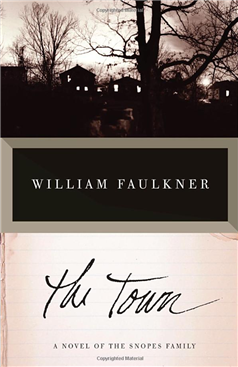
Day 403: The Town

Cover for The TownThe Town is the second of Faulkner’s “Snopes” novels about the rise to power of Flem Snopes in Jefferson, Mississippi. Written in a style that is remindful of a bunch of old Southern men sitting on the porch swapping stories, it is narrated by three different alternating voices. As a pioneer in novels with multiple narrators, Faulkner is a master.

One of the narrators is a character we met already in The Hamlet, V. K. Ratliff, the itinerant sewing machine salesman who is most knowledgeable about Snopes’ true character, having been deeply scorched by him. Ratliff enlists the Jefferson city attorney, Gavin Stevens, in his observations of Snopes. The third narrator is Charles Mallison, Stevens’ nephew, who tells us himself that he wasn’t even alive during the times of his first tales but was told the stories by his cousin Gowan.

The novel covers the events of nearly 20 years, from the arrival of the Snopes family in Jefferson to the events shortly following the death of Flem’s wife Eula. Although some of the events are tragic, the tone of The Town is more comic than that of The Hamlet, perhaps because the lives of the folks in Jefferson are not as grim as those of the poor sharecroppers in the first novel.

The novel focuses first on the young Gavin’s infatuation with Eula Snopes. Rumor has it that Snopes’ appointment as power-plant supervisor–highlighted by his attempted theft of all the plant’s brass fixtures accompanied by an effort to frame the plant’s two black firemen for the theft–is in return for him closing his eyes to his wife Eula’s affair with Manfred de Spain, the town’s mayor. Young Gavin, newly returned from university at the time, is incensed by this rumor and determined to protect Mrs. Snopes’ reputation. Later, as Eula’s daughter Linda grows up, Gavin tries to save her from “Snopesism” by helping educate her and trying to get her a place in an eastern university.

These two novels are fascinating because of Faulkner’s ability to make central a character who barely has a line of dialogue in either book. He effectively makes Snopes the major presence in the novels by having the other characters observe the results of his actions while endlessly speculating about what he actually does and why he does it. As always with Faulkner, the prose is beautiful.

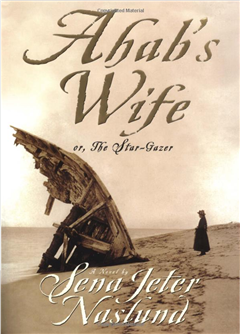
Day 401: Literary Wives: Ahab’s Wife Or, The Star-Gazer

Cover for Ahab's WifeToday I am doing something a little different–participating in a virtual book-discussion group with Literary Wives. Literary Wives is a group of bloggers who are wives and are reading books about how wives are depicted in fiction. Toward the end of my normal review of this month’s choice, I will answer some specific questions that appear in every Literary Wives review. Be sure to check out the other reviews by Audra of Unabridged Chick, Ariel of One Little Library, Emily of The Bookshelf of Emily J., Carolyn of Rosemary and Reading Glasses, Cecilia of Only You, and Lynn of Smoke and Mirrors.

I have quite got to like what appears to be a newish fashion of rewriting works of fiction from a different viewpoint. Although it has produced some mediocre results, it has also produced some gems, a few of which are Wide Sargasso Sea by Jean Rhys, The Solitary House by Lynn Shepherd, and now, Ahab’s Wife by Sena Jeter Naslund.

I was somewhat put off by Naslund’s writing style in her most recent novel, The Fountain of St. James Court; however, it is imminently suited to her most well-known novel, this one, which is a reworking of Moby Dick. This novel is truly an adventure. It begins with a brief look forward to Una Spenser’s delivery alone in a cabin in the wilds of Kentucky of Ahab’s child, which does not live long, and the subsequent discovery that her mother has died in the snow while going for help. If this isn’t enough going on, while she is in labor, Una also has an encounter with bounty hunters looking for an escaped slave. Later, she helps the slave girl escape.

After this glimpse ahead in time, the novel returns to take a relatively straightforward path, beginning with twelve-year-old Una’s banishment from this same cabin in Kentucky. Una has faced some abuse at the hands of her father because of a difference in religious beliefs, so her mother sends her to her Aunt Agatha and Uncle Jonathan, where they live on a lighthouse island off Massachusetts. So begins Una’s fascination with the sea.

Although not every 19th century woman would think life with a loving, thoughtful, intellectually curious family confining, Una eventually finds it so, when she is sixteen. Her feelings are complicated by the arrival of two young men who come to prepare for the installation of a new light for the lighthouse. They are best friends Giles Bonebright and Kit Sparrow. Una knows she likes them both but is not at first sure which one she likes best. This fateful meeting is to affect the rest of Una’s life.

But I am writing nothing here that reflects how unusual this novel is. First, it documents the extraordinary life of an extremely uncommon character. If some of the other characters are not so fully drawn, you really feel as if you know Una. Next, in its occasional long asides and fits of oratory, it is a fitting companion to Moby Dick, with its dissertations on bits of whaling gear and its exhortations by Ahab. If any woman is a match for Ahab, Una is. Finally, its language and ideas are lyrical and soaring, as Una grows intellectually, meets her own life full on, and becomes acquainted with historical figures from her time and place.

If I have a caveat, it is that I feel the exceptional Una would have had more problems of acceptance in the actual 19th century American setting. In keeping with a theme about the enjoyment of life, not only does Una throw off debillitating experiences with little trouble or regret, but she also finds warm friends and acceptance everywhere she goes. It would give away too many plot points to discuss why I find this unlikely.

For Literary Wives: What does this book say about wives or about the experience of being a wife?Literary Wives logo

This novel does not draw on a conventional idea of a wife, particularly for the time it is set. For Una, being a wife seems to mean giving unstinting loyalty up to a point, but this loyalty can vanish fairly quickly if the relationship becomes disrespectful, and Una’s natural ebulliance takes her over some terrible difficulties with relative (and perhaps unlikely) ease.

I don’t think Una lets the conventional notions of wifehood affect her at all. She just does what she wants and what she thinks is right, but her ideas of right are different from other people’s. For her, a husband seems to be the more modern idea of a partner. Certainly, mutual respect, sexual attraction, and love enter into this equation but not so much the typical 19th century idea of duty.

In what way does this woman define “wife”–or in what way is she defined by “wife”?

I don’t think Una is defined by “wife” at all. I think “person” is more what Naslund is interested in. In a review of this book, it was referred to as a feminist, earth mother, reinterpretation of Moby Dick. I don’t see the earth mother so much, but the feminism is certainly there. “What was a promise? A way to enslave the future to the past,” Una thinks at one point.

Day 395: Macbeth

Cover for MacbethAs with Hamlet and King Lear, the succession is a theme in Macbeth, even more so as the play was written in response to the Gunpowder Plot, in which Guy Fawkes and others attempted to blow up Parliament with King James I in it. This event was extremely traumatic for the British, as we can clearly imagine. Macbeth is, of course, Shakespeare’s famous tragedy about Macbeth’s attempt to usurp the throne of Scotland.

One theme of the play that harks back to the Gunpowder Plot is equivocation. Many of the statements in the play seem as if they mean one thing when they actually mean something else, from the witches’ predictions to Macbeth’s assurances. Equivocation was a Jesuitical doctrine that said that under examination, the truth could be substituted with “mental reservation,” in which one makes deceptive utterances but thinks the truth. It was used by Henry Garnet, the Jesuit Provincial, who learned of the plot as part of a confession. Edward Coke, a member of the Privy Council, which interrogated Garnet, called it “open and broad lying and forswearing.”

In fact, there are other references within the play that refer to James and demonstrate that the play was written in his support. Most obvious is James’s interest in witchcraft. He attended witch trials and in 1597 wrote Daemonologie, which Shakespeare used as source material for his scenes with the witches.

Banquo, Macbeth’s friend, whom Macbeth has murdered because of the witches’ prediction that Banquo will be the father of kings, was purportedly an ancestor of James I. Finally, there is the reference in the play to the healing of the king’s evil, a practice James observed that was followed after him by the British monarchy up to the Hanovers.

So, the play was written in honor of James I, to demonstrate the havoc wrought by breaking the succession. In the service of what is essentially historical propaganda, Duncan is made purer than he actually was and Macbeth more evil. The facts that Macbeth had a claim to the throne of Scotland and that the Scottish succession was not hereditary at the time are ignored. For an alternate interpretation of the story, see the wonderful King Hereafter by Dorothy Dunnett, one of the best historical novelists of all time, in my opinion.

But these facts don’t really spoil our appreciation of the play, which is one of Shakespeare’s most atmospheric, with its ghosts, witches, sleepwalking, murders, and walking wood. I think I prefer the directness of Macbeth to the convoluted plots of some of Shakespeare’s other tragedies. It is certainly a powerful play.

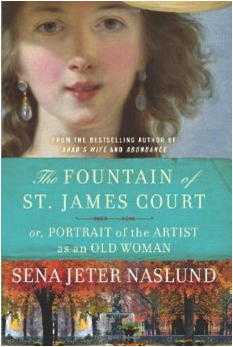
Day 394: The Fountain of St. James Court or, Portrait of the Artist as an Old Woman

Cover for The Fountain of St. James CourtI received this book in a First Reads giveaway from Goodreads. I haven’t read Naslund before, so I am not sure whether she adapted her writing style for this novel, but it took me awhile to accustom myself to it. She follows the activities of two artists, one Kathryn Callaghan, a fictional older writer in the current time, and the other a once-living person, Élisabeth Vigée-Le Brun, a painter known especially for her portraits of Marie Antoinette.

The modern-day story begins at midnight next to a fountain of Venus in a neighborhood of Louisville, Kentucky. Kathryn, or Ryn, is taking her newly finished manuscript to her friend Leslie’s door because she can’t wait to deliver it.

The novel’s structure is a book within a book. Chapters following one day in Ryn’s life are interleaved with chapters covering the whole of Vigée-Le Brun’s life, which are from Ryn’s book. Both stories are about the theme of what it means to be an artist and what you must give up of your personal life to pursue your profession. The novel is said to be a deliberate variation on Joyce’s Portrait of an Artist as a Young Man, but it has been so long since I’ve read it that I cannot comment on that.

This novel is contemplative, especially in the modern-day narrative, but the interleaving of stories in such short chapters slows down the pace too much. It literally takes until page 34 for Ryn to walk across the street and deliver the manuscript. Even with some chapters from the 18th century interleaved, the pace is frustrating. I found myself thinking, when is this woman going to make it across the street?

I found the story of Vigée-Le Brun’s life more compelling than the modern-day story, during which we follow Ryn’s every thought. She is an excitable, emotional woman who contemplates everything she looks at and repeatedly broods over the same things. We read about the russet and yellow fall colors or the appearance of the fountain many times. Nothing much happens all day until a late-night confrontation that seems artificially created to provide some tension.

I did not feel, however, that the two women, Ryn and Vigée-Le Brun, were two different people–they seemed to be the same person in different time periods. Vigée-Le Brun is slightly less emotionally excitable than Ryn, but their observations of the world around them, their attention to color and the details of design and structure, are very similar. Vigée-Le Brun’s narrative style, in first person where Ryn’s is in third person, is a little more formal as befitting an earlier age, but conversations in this story often sound stilted, and her first conversation with Marie Antoinette is positively sycophantic.

Naslund’s writing style, although sometimes vibrant and lyrical, often seems affected, particularly in the modern-day story. The copy I read was an advanced reader’s edition and it had quite a few typos, which I assume will be corrected. I was not quite as sure of some self-consciously unusual phrases, whether they were stylistic choices rather than errors. Naslund’s writing style tends to the unusual, to be sure, but I stumbled over some of these phrases. The only one I wrote down was an instance where some characters “made quick chat.”

I wanted to like this novel more than I did. I think the theme of women and art is worth exploring, although I’m not sure how much this novel actually explored this issue, despite its obvious intentions. I am actually curious about the alleged feminist leanings of Naslund and their effect on this book. Vigée-Le Brun has to put up with her father and then husband appropriating all her money and, in her husband’s case, only giving her a bit of it back as an allowance. When they divorce, he gets almost everything. Yet, she is determined not to let it bother her. I am not sure whether that is a feminist viewpoint or not.

However, the characters in this novel certainly reflect the “gift for pleasure” noted in reviews of Ahab’s Wife (which I am currently reading). The women go on pursuing their lives and dreams without much heed to their menfolk, they have cordial relations with those around them, they delight in color and the fineness of life. Their regrets and sorrows mostly focus on their children.

One thing that surprised me about the historical story was that Vigée-Le Brun hardly seemed to notice the causes of the French revolution or the revolution itself. There is one scene where a woman confronts her on the street and another where she grieves for the fate of so many. That’s about it.

Conversely, it is hard to believe that she would be shocked to the core by seeing a model of internal organs, as artists had been studying the body for hundreds of years. I do not know how much of this novel actually reflects Vigée-Le Brun’s true thinking and feeling. The danger when portraying a historical person is that you are imagining who the person really is–you don’t know–and you have no idea if you are doing them justice or injustice.

Day 391: Brother of the More Famous Jack

Cover for Brother of the More Famous JackBest Book of the Week!

It seems as if many American readers are not familiar with the British writer Barbara Trapido. She is one of my favorites and yet I sometimes find her books hard to come by. I think she is absolutely delightful. Brother of the More Famous Jack is her first book, but I have not run across it until now, when I explicitly searched for it.

Katherine Browne is a naive but stylish eighteen in the early 1970’s when she meets the family of her philosophy teacher, Jacob Goldman. She immediately falls in love with their untidy, chaotic household and their witty brilliance, but particularly with their oldest son, Roger. Jane is the dowdy, schoolmarmish, upper-crust wife and mother, who plays gorgeous duets with Roger and tends cabbages. Jacob is witty, sometimes vulgar, and subversive. He flagrantly fondles his wife over the kitchen sink. The beautiful Roger is studying to be a mathematician. Jonathan has large feet, loves to fish, and is somewhat gauche. Katherine finds him a bit alarming. And there are the littler ones, bright and noisy. Everyone speaks his or her mind without fear. To Katherine, brought up quietly by a middle-class, widowed mother, this is a heady environment.

After a summer in Kenya, Roger returns to begin at Oxford and immediately starts seeing Katherine. Their affair does not end well, however, for Roger has embraced the snobbery that the rest of his family disdains. When he drops her, he catalogues all her “faults,” including her lack of interest in math and science and her middle-class background. Katherine’s self-esteem plummets and she flees to take a position teaching English in Rome.

She does not return to England until, after ten years, a tragedy brings her home to her mother. Eventually she begins a renewed acquaintance with the Goldmans.

Written in a humorous, breezy style, the novel is still touching and affecting. The dialogue is the best part of it, vivid, witty, and literate. (The title of the novel is Jacob’s appellation for W. B. Yeats.) Katherine is an engaging heroine as she learns to find her own way through life. Full of high spirits and eminently readable, this novel is a gem.

Day 388: Wise Blood

Cover for Wise BloodFlannery O’Connor stated that she didn’t understand when her works were termed Southern Gothic or grotesque. She continued throughout her life to emphasize that the theme of her works is redemption. Nevertheless, Wise Blood is grotesque.

Hazel Motes has returned from the service after World War II to find his home town in Tennessee deserted and his house crumbling and decrepit, so he goes to live in the city, the fictional town of Taulkinham, Alabama. Having grown up in a fundamentalist environment, he has decided that Jesus was just a man and there is nothing from which to be redeemed. Soon, he is preaching outside movie theaters about the Church of Christ Without Christ.

Haze doesn’t see anything he’s looking at and doesn’t hear anything anyone says to him. He is totally wrapped up in his obsessions about religion. He becomes fascinated by Asa Hawks, an evangelist who supposedly blinded himself for Christ, and can’t see that this man is a con man who is not even blind.

He also meets Enoch Emery, a whining zookeeper who spends his days peeping out of the bushes at the women bathing in the park swimming pool. Enoch tells Haze that his family has “wise blood,” that is, his blood tells him where to go in life and what to do. Enoch’s blood is obsessed with a mummy in the museum, which he thinks would be a Jesus for Haze’s church, not seeming to fully understand the point of Haze’s church. But Enoch doesn’t see or listen either.

In fact, no one in this novel listens to what anyone else says, and all of the characters are incredibly ignorant and uncultured. They are all grotesque, repellent creatures. Although the novel is supposed to be comic, it only made me laugh despite myself, as the situation becomes more and more ridiculous. O’Connor’s humor is brutal.

Everything in this short novel seems significant, is to be paid attention to, even the characters’ names. Both of Hazel Motes’ first and last names refer to the eyes, and Haze can’t see. Enoch Emery is abrasive. Asa Hawks is the “blinded” con artist who can actually see, and his daughter Sabbath Lily is anything but a lily. Hoover Shoats and Onnie Jay Holy try to take over Haze’s church. And speaking of Shoats, keep an eye out for the pig imagery, and think about what pigs are a symbol for in the Bible.

This novel is deemed a work of “low comedy and high seriousness.” Just speaking for myself, the religious theme is not one I find interesting. Yet, when you read O’Connor, you can’t help but be drawn along to the end.

Day 386: Bridge of Sighs

Cover for Bridge of SighsOne of my favorite books from recent years is Richard Russo’s Empire Falls. Unfortunately, the problem with reading your favorite book of an author’s first is that the others may not quite live up to it. But Bridge of Sighs comes a little closer than some other Russo novels to my initial delighted feelings about Empire Falls. (I know, I’m a bit behind the times with this one.) This novel shares some of the same themes as Empire Falls and is set in a similar working-class, industrial small town, this time in upstate New York.

The novel is narrated principally by Lou Lynch, one of three main characters. Lou is writing a novel about his life, even though he admits it will probably be boring. The son of Lou, an optimistic, cheerful if not very bright milk man turned convenience store owner, and Tessa, a sharp, insightful bookkeeper, Lou has always felt as if his parents are in conflict, and he is on his dad’s side. We understand, though, that Tessa is not really in conflict with her husband and son, she just wants them to see reality as it is, not as they would like it to be.

Seeing things as they are is also a problem for Lou’s best friend Bobby. At least, Lou thinks of Bobby as his best friend, but that is one more thing Lou doesn’t see clearly. Bobby’s father bullies his mother, who is eternally pregnant. She runs away every time she gets pregnant, but he always finds her and brings her back. It isn’t until late in the book that we find there is more than one way to look at their relationship.

The book begins when Lou is sixty and traces back through his childhood and adolescence through the device of his novel. The adult Lou is married to his high school sweetheart Sarah, and they are soon to take a trip to Italy, hoping to visit Bobby, now Robert Noonan, a famous American painter who lives in Venice. But Robert isn’t answering Lou’s letters letting him know they are coming. This trip is an anxious one for both Lou and Sarah, Lou because he has hardly ever left his home town, and Sarah because she once had to decide between Lou and Bobby.

In the background is the story of the small town of Thomaston, an industrial backwater dominated by a tannery, the dyes of which used to color the river waters differently each day and resulted in high levels of cancer in the community. The town is dying. The tannery has finally closed.

The town is divided into three areas that are widely separated by class, even though Thomaston’s richest citizens are probably big fish in a small pond. As the story moves into the present time, the wealthier citizens begin moving away. But Lou doesn’t see any reason not to love his town or his life. Sarah has always wanted to travel and experience more, but they have stayed put.

The Lynch family, as Russo creates it, is a warm and welcoming one. Both Bobby and Sarah are attracted as youngsters to the little store by the promise of a substitute family, Sarah’s own being particularly bizarre. In the modern-time story, Lou’s father is dead, and his uncle Declan has gone away, but Lou’s son works in the store, and his mother still lives above it.

As the story moves back and forth in time, I felt myself occasionally tiring of Lou’s reminiscences, especially of junior high, where he spends an inordinate amount of time. As Bobby reflects when he returns to town during his senior year after being sent off to military school, he doesn’t understand why Lou continues to bring up those years as if they were good times when actually they were horrible and Lou was not treated well at school. I personally was much more interested in the current-time story, of which there is much less, even though I understood that its seeds are in the past. But then again, the fact that Lou dwells on the past is part of the point of the novel.

This novel possesses a few characteristics of postmodernism, without being exactly postmodern. Here perhaps Russo is dabbling in some of the techniques without going full-thrust for its inventiveness and irony. The alternating point of view among Lou, Bobby, and Sarah, the alternating time streams, the metafiction, and Lou’s essential untrustworthiness as a narrator, not because he is not truthful to us, but because he is not truthful to himself, all are postmodern techniques. Within the time and narrator changes, though, Russo proceeds with a traditional narrative style.

Russo’s writing is leisurely, and he likes to muse. Still, he creates some complex and attractive characters and makes you want to contemplate their lives with them. He is also one of the few writers willing to explore the theme of class in America, a theme that is very important to this novel.