Day 388: Wise Blood

Cover for Wise BloodFlannery O’Connor stated that she didn’t understand when her works were termed Southern Gothic or grotesque. She continued throughout her life to emphasize that the theme of her works is redemption. Nevertheless, Wise Blood is grotesque.

Hazel Motes has returned from the service after World War II to find his home town in Tennessee deserted and his house crumbling and decrepit, so he goes to live in the city, the fictional town of Taulkinham, Alabama. Having grown up in a fundamentalist environment, he has decided that Jesus was just a man and there is nothing from which to be redeemed. Soon, he is preaching outside movie theaters about the Church of Christ Without Christ.

Haze doesn’t see anything he’s looking at and doesn’t hear anything anyone says to him. He is totally wrapped up in his obsessions about religion. He becomes fascinated by Asa Hawks, an evangelist who supposedly blinded himself for Christ, and can’t see that this man is a con man who is not even blind.

He also meets Enoch Emery, a whining zookeeper who spends his days peeping out of the bushes at the women bathing in the park swimming pool. Enoch tells Haze that his family has “wise blood,” that is, his blood tells him where to go in life and what to do. Enoch’s blood is obsessed with a mummy in the museum, which he thinks would be a Jesus for Haze’s church, not seeming to fully understand the point of Haze’s church. But Enoch doesn’t see or listen either.

In fact, no one in this novel listens to what anyone else says, and all of the characters are incredibly ignorant and uncultured. They are all grotesque, repellent creatures. Although the novel is supposed to be comic, it only made me laugh despite myself, as the situation becomes more and more ridiculous. O’Connor’s humor is brutal.

Everything in this short novel seems significant, is to be paid attention to, even the characters’ names. Both of Hazel Motes’ first and last names refer to the eyes, and Haze can’t see. Enoch Emery is abrasive. Asa Hawks is the “blinded” con artist who can actually see, and his daughter Sabbath Lily is anything but a lily. Hoover Shoats and Onnie Jay Holy try to take over Haze’s church. And speaking of Shoats, keep an eye out for the pig imagery, and think about what pigs are a symbol for in the Bible.

This novel is deemed a work of “low comedy and high seriousness.” Just speaking for myself, the religious theme is not one I find interesting. Yet, when you read O’Connor, you can’t help but be drawn along to the end.

Day 386: Bridge of Sighs

Cover for Bridge of SighsOne of my favorite books from recent years is Richard Russo’s Empire Falls. Unfortunately, the problem with reading your favorite book of an author’s first is that the others may not quite live up to it. But Bridge of Sighs comes a little closer than some other Russo novels to my initial delighted feelings about Empire Falls. (I know, I’m a bit behind the times with this one.) This novel shares some of the same themes as Empire Falls and is set in a similar working-class, industrial small town, this time in upstate New York.

The novel is narrated principally by Lou Lynch, one of three main characters. Lou is writing a novel about his life, even though he admits it will probably be boring. The son of Lou, an optimistic, cheerful if not very bright milk man turned convenience store owner, and Tessa, a sharp, insightful bookkeeper, Lou has always felt as if his parents are in conflict, and he is on his dad’s side. We understand, though, that Tessa is not really in conflict with her husband and son, she just wants them to see reality as it is, not as they would like it to be.

Seeing things as they are is also a problem for Lou’s best friend Bobby. At least, Lou thinks of Bobby as his best friend, but that is one more thing Lou doesn’t see clearly. Bobby’s father bullies his mother, who is eternally pregnant. She runs away every time she gets pregnant, but he always finds her and brings her back. It isn’t until late in the book that we find there is more than one way to look at their relationship.

The book begins when Lou is sixty and traces back through his childhood and adolescence through the device of his novel. The adult Lou is married to his high school sweetheart Sarah, and they are soon to take a trip to Italy, hoping to visit Bobby, now Robert Noonan, a famous American painter who lives in Venice. But Robert isn’t answering Lou’s letters letting him know they are coming. This trip is an anxious one for both Lou and Sarah, Lou because he has hardly ever left his home town, and Sarah because she once had to decide between Lou and Bobby.

In the background is the story of the small town of Thomaston, an industrial backwater dominated by a tannery, the dyes of which used to color the river waters differently each day and resulted in high levels of cancer in the community. The town is dying. The tannery has finally closed.

The town is divided into three areas that are widely separated by class, even though Thomaston’s richest citizens are probably big fish in a small pond. As the story moves into the present time, the wealthier citizens begin moving away. But Lou doesn’t see any reason not to love his town or his life. Sarah has always wanted to travel and experience more, but they have stayed put.

The Lynch family, as Russo creates it, is a warm and welcoming one. Both Bobby and Sarah are attracted as youngsters to the little store by the promise of a substitute family, Sarah’s own being particularly bizarre. In the modern-time story, Lou’s father is dead, and his uncle Declan has gone away, but Lou’s son works in the store, and his mother still lives above it.

As the story moves back and forth in time, I felt myself occasionally tiring of Lou’s reminiscences, especially of junior high, where he spends an inordinate amount of time. As Bobby reflects when he returns to town during his senior year after being sent off to military school, he doesn’t understand why Lou continues to bring up those years as if they were good times when actually they were horrible and Lou was not treated well at school. I personally was much more interested in the current-time story, of which there is much less, even though I understood that its seeds are in the past. But then again, the fact that Lou dwells on the past is part of the point of the novel.

This novel possesses a few characteristics of postmodernism, without being exactly postmodern. Here perhaps Russo is dabbling in some of the techniques without going full-thrust for its inventiveness and irony. The alternating point of view among Lou, Bobby, and Sarah, the alternating time streams, the metafiction, and Lou’s essential untrustworthiness as a narrator, not because he is not truthful to us, but because he is not truthful to himself, all are postmodern techniques. Within the time and narrator changes, though, Russo proceeds with a traditional narrative style.

Russo’s writing is leisurely, and he likes to muse. Still, he creates some complex and attractive characters and makes you want to contemplate their lives with them. He is also one of the few writers willing to explore the theme of class in America, a theme that is very important to this novel.

Day 383: The Hamlet

Cover for The HamletWhen I got into The Hamlet a bit, I realized that a bastardized version of it had been released as a movie years ago called The Long, Hot Summer. But Paul Newman’s charming rascal is not at all the same animal as his original, Flem Snopes, a despicable man who rises in life using chicanery, cheating, and blackmail to wrest what he can from the poorest of the poor.

The Hamlet is part of a trilogy of novels about the history of the fictional Yoknapatawpha County, Mississippi, beginning shortly after Reconstruction. In particular, it is about the rise of Snopes, the son of an impoverished sharecropper. It begins when Jody Varner, the son of Frenchman’s Bend’s most powerful citizen, Will Varner, leases a property to Snopes’s father Ab, suspected of being a barn-burner. Jody thinks he’ll be able to cheat Snopes out of his yearly crop by alluding to his alleged crimes at the appropriate time. But soon he is more inclined to fear that Snopes will burn him out, so he offers Snopes’s son Flem a job as clerk in the Varner store as insurance.

Soon Jody has lost his own position as manager of the store to Flem Snopes and Snopes has apparently taken over Jody’s standing with his own father. Somehow Snopes begins accruing valuable property and gives away many of the jobs in the village, over which Will Varner has control, to Snopes cousins, whether they are capable of doing them or not. Eventually, he makes a deal to marry Will Varner’s young daughter, the voluptuous Eula.

Life among the Frenchman’s Creek sharecroppers is grim, and the story of the rise of this gray, tight-lipped, cold man is told through a limited third-person narration that moves from person to person. This narrative style creates a sort of plural viewpoint of all the village folk and is combined with the intelligent observations of itinerant sewing-machine salesman V.K. Ratliff, who alertly follows Snopes’s maneuvers and understands all his cheats–or so he thinks.

This novel is created from a series of tales, and it is really about how the tales of an area form its history. It is elegantly written, reflecting a formidable intelligence and education, and is sometimes grimly comic. It comments on the decay of the South in the aftermath of the American Civil War and the Reconstruction, as Frenchman’s Bend is a run-down little village built on the ruins of a once-stately plantation. The legend of gold supposedly buried on the grounds of the plantation plays a pivotal part in the story.

Day 365: Othello

Poster for OthelloI have been reading and viewing a few of Shakespeare’s tragedies lately. Othello, in contrast to Hamlet, seems to be about very little in terms of overarching themes. Whereas Hamlet makes observations about death, revenge, the place of women in society, the relationships between fathers and their children, Othello is about what? Perhaps trusting too easily? Perhaps trusting not enough? Of course, it is about racism, jealousy, and betrayal, but what does it say about them?

The plot, of course, is that Desdemona elopes to marry the Moor, Othello, having fallen in love with him as he told the tales of all his adventures. Iago sees this marriage as an opportunity to have his revenge on both Othello, who has given the position he expected to Cassio, and on Cassio himself. He does this by making Othello think that Desdemona has betrayed him with Cassio.

To me the play is mostly about trust. Desdemona is a fool, it seems, to entrust her life to a man who would doubt her on so little evidence, actually before there is any evidence. Why is Othello so quick to trust Iago, a man he has overlooked for promotion, who has reason to hate him, and yet so quick to distrust his wife, who has never given him reason to doubt? Of course, this contrast says something about society’s view of women at the time.

Perhaps also Othello is a good excuse to write the part of a truly evil villain, Iago. For certainly Iago’s is the most important part.

Why is this a tragedy? Is Othello a great man brought down? I suppose he is great by virtue of his military adventures, but he is brought down by his own stupidity and gullibility. Desdemona is nothing but a victim, completely helpless to control her fate. This is not my favorite Shakespeare play, filling us with dread as it does from almost the beginning.

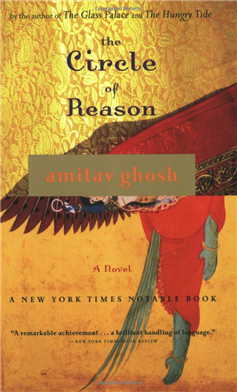
Day 361: The Circle of Reason

Cover for The Circle of ReasonBest Book of the Week!

Although magical realism is often mentioned in reference to The Circle of Reason, as Amitav Ghosh said himself in an interview for the New York Times review, there is nothing fantastical that happens in the book. Still, it continues to be compared to the works of magical realists such as Gabriel García Márquez or Salman Rushdie.

These comparisons may be because of the book’s rambling narrative style or its peculiar characters. The main character is Alu Bose, but we get to him only slowly through his uncle Balaram, a scholar turned teacher in a small village in India who develops a mania for the pseudo-science phrenology and worships Louis Pasteur. As Alu’s head is covered with odd-looking bumps, like a potato, he provides a subject of endless study for his eccentric relative.

Later, Balaram becomes obsessed with cleansing the village and begins a campaign to convince the villagers to coat every object with carbolic acid. His feud with the local politician combined with his obsession results in disaster, and Alu ends up fleeing India because of being mistaken for a terrorist. He is pursued by a policeman named Jyoti Das, who would rather be an ornithologist.

Thus begin Alu’s adventures, first in the Middle Eastern port of al-Ghazira, where he develops his own obsession for cleanliness, and then moving farther west, ending up in Algeria. On the way, readers encounter a myriad of other characters and stop to hear the stories of their lives or learn a little bit about weaving, say, or the history of al-Ghazira.

I was less reminded of magical realism than of One Thousand and One Nights, the tales of Scheherazade in which, in the middle of one tale, another begins. I attempted to read them at one time but despaired that I would ever get to the end of a tale or keep the various stories straight. Luckily, Ghosh’s narrative is a little more coherent, although not much. It is purposefully rambling, running off in delight to tell one fabulous story after another.

The novel is wonderfully well written, beautifully written, but sometimes I wondered where it was going or what the plot actually was. The feeling was only momentary, however, because I was always compelled onward. The ending is actually satisfying and less chaotic than I expected.

When I read that Ghosh wanted to write something like Moby Dick, that explained a lot about the novel’s narrative style. Fortunately for us, Ghosh’s style is a lot more accessible than Melville’s. Still, I prefer some of his more recent novels, particularly Sea of Poppies and River of Smoke. The Circle of Reason is Ghosh’s first novel, and he keeps getting better and better.

Day 358: People of the Book

Cover for People of the BookBest Book of the Week!

I read People of the Book several years ago and remembered that it was good, but when re-reading it for my book club, I enjoyed it even more. The novel is based on the history of a Hebrew codex known as the Sarajevo Haggadah. Part of the novel is envisioned based on what is known of the book’s history, while the rest is invented.

In the immediate aftermath of the Bosnian war, Hanna Heath, an expert in the restoration of old books, is asked to restore the priceless Sarajevo Haggadah, a famous book believed twice to have been destroyed by war that was both times rescued by Moslem museum curators. The book is especially important because of its beautiful illustrations, as before it was discovered, scholars believed that old Hebrew books did not contain such illuminations.

While Hanna is working on the book, she makes observations and collects artifacts that will help trace its history. She notes that the book once had clasps that are now missing, collects an insect wing, and scrapes residue from staining.

Hanna also becomes involved with the man who rescued the book, Ozren Karaman, whose wife was killed during the war and whose baby son is in the hospital with a brain injury. As Hanna was raised by an aloof and competitive mother, though, she is poor at forming attachments.

When Hanna finishes restoring the book, she follows up with research into the clasp and the artifacts she collected. As she finds out about each item, the novel goes farther back in time, explaining what happened to the book and telling the stories of the people involved with it, until the creation of the book in 15th century Spain.

A poor Jewish girl named Lola works for the partisans in the forest outside Sarajevo during World War II after the Jews are expelled from the city by the Nazis and her family is shipped off to camps. Later she is helped to safety by the Moslem curator of the museum, who also has a book to hide. A 19th century Viennese bookbinder who is dying from syphilis steals the beautiful silver clasps from the book to exchange with his doctor for treatment. In 1609 Venice, a priest working for the Inquisition saves the book from burning but confiscates it from its owner. A young girl saves the book as the Jews are expelled from Spain in 1492.

These are just the bones of some of the absorbing stories that draw you along as Brooks imagines the history of the book. Each tale is vividly imagined and skillfully told, and they are all held together by Hanna’s experiences. People of the Book is a gracefully written and imaginative novel that emphasizes the contributions of multiple cultures and religions to the book’s creation and safety.

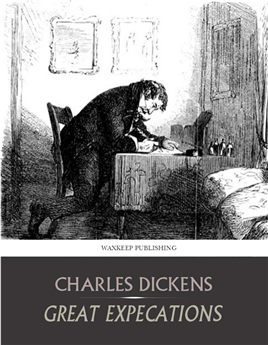
Day 356: Great Expectations

Cover for Great ExpectationsGreat Expectations has long been my least favorite of Dickens’ more substantial novels, because I dislike the character of Pip. However, upon my re-reading it after many years, I’ve changed my opinion, because only in this novel does the main character undergo a complete change of his assumptions and values.

The novel begins with Pip as a young boy growing up in a vast and desolate wasteland of marshes. He is cared for by his ambitious and abusive older sister and kindly brother-in-law Joe Gargery. In the opening scene he is in the cemetery looking at his parents’ graves when he meets the escaped convict Magwich.

Under Magwich’s instructions, the terrified boy steals some food from his sister’s pantry and a file from his brother-in-law’s smithy. Magwich might have got away, but Pip tells him he met another convict on the way, so Magwich throws away his chances of escape to fight the other man, his sworn enemy.

After this odd and atmospherically fraught incident, Pip is soon engaged to entertain the wealthy but deranged Miss Havisham, an old woman who was long ago deserted at the altar and has lived the rest of her life in her bride clothes with her wedding cake rotting away on the table. Miss Havisham introduces Pip to her beautiful ward Estella, and from that time he is captured. He fails to understand, however, that Miss Havisham has brought Estella up to enthrall and torture men.

Pip grows old enough to apprentice as blacksmith to Joe, but his association with Miss Havisham and Estella has made him discontented with his lot. Soon, though, he is informed that he has “great expectations,” that an unknown benefactor has chosen him for his or her heir, and he is to become a gentleman. Pip and his associates assume his benefactor is Miss Havisham, and Pip thinks that she intends Estella to be his.

With only a few qualms of guilt, Pip throws off his childhood, including his gentle, loving friend Joe, to become a gentleman and chase after the dream of Estella. It is only through a series of misfortunes that he realizes he must learn to look at his life differently than he understood it and comes to appreciate his true friends.

I am not at all sympathetic to Pip’s desires and think the pursuit of Estella is a worthless one, but Dickens’ strengths are in his characterizations and complex plots. In addition to a cast of unusual, lovable, or repellent characters, he does a masterful job of developing Pip into a wiser and more honest man.

Day 351: The Fixer

Cover for The FixerBest Book of the Week!

In 1911 Russia, Yakov Bok is tired of his difficult life in the shtetl. So, after his wife leaves him for another man, Yakov travels to Kiev in hopes of making a better living. When he helps a drunken man who is passed out in the snow, Yakov is offered a job supervising a brick yard. However, in order to take this job, Yakov must live in a part of the city forbidden to Jews.

It is this circumstance followed by a series of mishaps that ends up with Yakov being accused of murdering a boy he chased away from the brick yard. As the case continues, it becomes clear that the murder is being used by authorities an an excuse to trump up charges of ritual murder against the Jewish community.

The novel becomes more and more difficult to read as literally everything that happens to Yakov makes things worse for him. The gentiles he knows in Kiev tell lies about him. Once he is in prison, the jailers do everything they can to incriminate him, including trying to entrap him into breaking the rules or admitting his guilt.

Yakov goes into jail a nonpolitical, irreligious, naive man who hopes for justice, and the novel is partially about his development into an angry man who refuses to be beaten. Although almost nothing in the way of plot or action happens from the time he goes to jail, I was absolutely compelled to finish reading.

Written in a storytelling fashion that I associate with the tales of Sholem Aleichem or Isaac Bashevis Singer, this novel is more grim than most of the stories I’ve read by these other writers. However, both The Fixer and The Bloody Hoax, by Aleichem, are based on a true event from 1911 Kiev, called the Beiliss blood libel case.

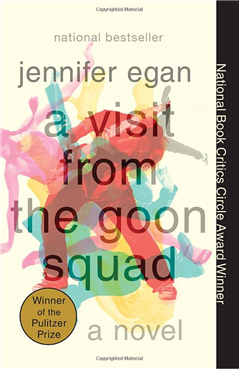
Day 339: A Visit from the Goon Squad

Cover for A Visit from the Goon SquadBest Book of the Week!

Describing this delightful and quirky novel is going to be difficult, so I hope curious readers will try it even if I am unable to convey a sense of it.

First, I call it a novel, but it can be just as accurately described as linked short stories. Each chapter is written from the point of view of a different character who knows one or more of the other characters. The chapters all center around the subjects of music and public relations.

The book begins in New York with Sasha, who is the assistant to Bennie, a music executive, sometime after 9/11. She is on a desultory date with Alex, but she also has a problem with kleptomania. While in the bathroom, she steals a woman’s wallet and then has to watch while Alex gets involved in helping the woman.

Next is a middle-aged Bennie, who torments himself with feelings of shame about past experiences. He takes his son to visit a sister act in order to fire them for not producing an album in the specified amount of time. He realizes he is beginning to see his legendary taste diverge from that of his younger coworkers.

Then we jump back thirty years to Rhea, a teenager in San Francisco who is a member of a punk rock band called the Flaming Dildoes with her friends Bennie (yes, the same Bennie), Scott, Alison, and Jocelyn. Rhea observes Jocelyn’s budding relationship with a middle-aged record executive named Lou, who will become Bennie’s mentor. Rhea is dismayed as Lou gives Jocelyn drugs and gets her to perform sexual acts in public.

These are just the first of the vignettes, which range forward and backward in time over 40 years and extend in structure to a touching PowerPoint presentation and a parody of a celebrity interview. They make stops in Arizona, Italy, and South America but somehow center on New York. Fans of Egan will already be familiar with a certain type of hip, aware New Yorker that appears in her fiction.

By turns funny, touching, and sharp as a razor, Egan’s observations are always entertaining and her intelligence apparent. An obvious theme of this work is the effect of time on characters but another one is how technology seems to have sped time up, the book ending in a futuristic world where public relations is centered on the tastes of babies. The PowerPoint chapter shows us that another theme is pauses, in music and in life.

One of the things I wanted to do when I finished reading A Visit from the Goon Squad was to read it again so that I could know what I was looking for from the beginning and fully understand all the connections. And that is what I plan to do, having inserted the book into my pile of future reading to enjoy again.

Day 328: Hamlet

Cover for HamletMy husband likes his jokes. When I told him I was re-reading Hamlet, he said, “It’s full of clichés, you know.” But it was amazing to see how many lines from this play are so familiar to all of us, have almost entered our societal DNA.

Everyone is familiar with the plot. Hamlet’s father, the King of Denmark, has died, and Hamlet’s mother Gertrude has married his uncle Claudius, his father’s brother, who is now king. Hamlet is in grief and dismay at his father’s death and his mother’s quick remarriage. In the first act of the play, Hamlet meets the ghost of his father, who tells him that Claudius murdered him by pouring poison in his ear as he slept. The ghost orders Hamlet to avenge his death.

One of the puzzlers for me about this play is the reason why Hamlet then chooses to fake insanity. It allows Hamlet to continually bait Claudius and Gertrude without consequences, but otherwise does not make sense to me.

An interesting point raised in the introduction of my version of the Collected Works is that Polonius, in appearance and behavior, is meant to be William Cecil, Lord Burghley, Queen Elizabeth I’s chief minister. The claustrophobic feeling in the play of not being able to trust anyone, of being spied on (depicted marvelously in the 2009 Royal Shakespeare Company production, starring David Tennant and Patrick Stewart), reflects the paranoid nature of Tudor society because of the prevalence of espionage at that time.

Of course, Hamlet’s musings on suicide, death, and the nature of revenge are a major focus of the play. An undoubted message seems to be of the unintended consequences of actions, particularly of revenge. Hamlet and Laertes are bent on revenge, but in obtaining it, they manage to wipe out both their families.

I have seen Hamlet played as a drooping figure of indecision, but I don’t think this is a correct interpretation. Hamlet is caught on the crux of a dilemma. He wants to do what is right but knows that whatever action he chooses, the results will not be pretty. Hence, the inaction.