Day 306: The Cat’s Table

Cover for The Cat's TableIn the early 1950’s, the 11-year old Michael Ondaatje set sail from his home in Sri Lanka for England to meet his mother and go to school. The Cat’s Table is a fictionalized tale of this journey, he tells us.

On board the Oronsay, Michael (nicknamed Mynah) becomes friends with two other boys–Cassius, a wild, rebellious boy from his school, and Ramadhin, gentle and contemplative, with a bad heart. Also on board is Michael’s cousin Emily, a 17-year-old beauty with whom he is close.

Although Michael’s father has arranged for an acquaintance to look after him, she is in first class and only summons him occasionally during the voyage. Michael and his two friends are assigned to the “cat’s table” with the most insignificant passengers on board–a tailor who never speaks; Mr. Mazappa, a jazz musician who admits he is “on the skids”; Miss Lasqueti, a seemingly colorless spinster; Mr. Fonseka, a literature teacher from Colombo; and Mr. Daniels, a botanist who is transporting an entire garden in the hold of the ship. Other important characters are a deaf Singhalese girl named Asuntha whom Emily befriends and a mysterious prisoner who is brought above board late each night and provides fuel for the boys’ imaginations. Michael and his friends find that no one is paying attention to them, so they run wild all over the ship.

At first this narrative proceeds more or less sequentially in a series of vignettes telling of different passengers or events. Later, the narration branches out, moving forward in time to later periods and incidents in Michael’s life related to the people he knew on the ship, and then back again. Toward the middle of the novel I felt confused, as if the narrative would never resolve itself into a coherent story.

But it does. Events on board the ship affect the future lives of several of the passengers, particularly those of Michael and Emily. In getting to that place, we experience the sights and sounds of this exotic and evocative passage across the Indian Ocean and the Arabian Sea, up the Suez Canal, and into the Mediterranean.

The novel is beautifully written, with the vignettes working together in the same way that Michael describes a series of paintings by Cassius, which he sees in a gallery years later. At first the paintings seem abstract, but if he looks at them from the right distance, he sees they perfectly depict the events of a particular night in their voyage together. The vignettes, like fragments seemingly disconnected and abstracted, slowly come together to show us a coherent whole, of Michael’s understanding of the events of the voyage, of his reinterpretation of those events later in life, of how they affect his life and those of others.


Day 297: Persuasion

Cover for PersuasionMost people have probably read Pride and Prejudice, which is a wonderful book, but if I had to pick my favorite Jane Austen heroine, it would be hard to decide between Elinor Dashwood of Sense and Sensibility and Anne Elliot of Persuasion. Probably fewer people are familiar with Persuasion.

Anne is no longer in the bloom of youth. Seven years ago she fell in love with a young naval officer named Frederick Wentworth, but Sir Walter, her superficial, supercilious father, did not approve. Perhaps the gentle Anne would not have been dissuaded from marriage, but her older friend and mentor, Lady Russell, talked her out of the engagement because of Wentworth’s lack of wealth and social position. Anne listened because she viewed Lady Russell as a surrogate mother, and she hasn’t heard from Wentworth since.

Now the family has fallen upon hard times, and Sir Walter is forced by his profligacy to lease their house and take rooms in Bath. He and Anne’s fashionable sister Elizabeth care very little for Anne, and they leave her to close up the house and make all the arrangements for its occupation by an Admiral Croft. Much harassed, she readies the house and tends to her hypochondriac, selfish sister Mary Musgrove. At least she enjoys the company of the children and Mary’s genial in-laws, with their two daughters Henrietta and Louisa and Anne’s brother-in-law Charles.

Anne meets the friendly Admiral and Mrs. Croft, and between their society and that of the Musgroves, begins to find a little pleasant enjoyment. However, she is soon dismayed to learn that Frederick Wentworth is Mrs. Croft’s brother, and he will be arriving soon. Wentworth is now wealthy and has retired from the service.

When he arrives, Wentworth pays little attention to Anne; in fact, she overhears him saying that she has changed so much he would not have recognized her. This remark distresses her very much, as her feelings have not altered. Soon he appears to be courting Louisa Musgrove. Anne finds it easiest to send Mary off into company while she stays home with her nephews.

After Louisa has a fateful accident on an outing in Lyme Regis, Anne finds herself taking charge and summoning help. Then she returns with Wentworth to notify Louisa’s parents. Feeling superfluous after the Musgroves leave with Wentworth for Lyme Regis, Anne decides she has no choice but to join her unpleasant father and sister in Bath.

What I love about Anne is her understated good will. Despite the insults by her family members and their general bad treatment of her, she tries to help them and to be a true sister and daughter to them. Despite Wentworth’s slights and attention to Louisa, she hides her feelings and remains faithful in her heart. Anne has much in common with Elinor Dashwood, except that Elinor is well regarded by her family and Anne is not. There is something delicate and understated in this novel, and in all of Austen’s work, that I appreciate in this more tempestuous modern world.

Day 295: The Gathering

Cover for The GatheringA large family in Ireland is gathering together for the wake of their brother, Liam, who drowned. Veronica Hegarty, his sister, travels to London to collect the body and keep vigil with it.

This novel follows her consciousness as she thinks about her relationships with her own husband and the rest of her family and considers why her brother’s life turned out the way it did. She describes Liam as a “terrible messer,” who was an alcoholic and finally put stones into his pockets and walked into the sea.

She also remembers her grandmother Ada, and imagines scenes involving her grandmother’s relationship to Veronica’s grandfather and to another man when she was a young woman. Veronica muses about life growing up in her grandparents’ house and the connection with her brother’s secrets and troubles. She feels guilty that she did not help him and that no one sympathized with him when he was alive.

This novel is angry, heavy, and sometimes repels the reader. By page 55, I felt that the narrator was inordinately concerned with the mechanics of men’s penises. Still, it is an evocative story about a woman’s grief and her struggle to understand her brother.

Day 281: Gilead

Cover for GileadBest Book of the Week!
Gilead is the novel that precedes Marilynne Robinson’s Home, although it is set in the same time frame and covers some of the same territory. This novel won the Pulitzer Prize for fiction.

John Ames is an elderly Congregationalist minister in 1956 who believes he is dying. He has a much younger wife and young son, a surprising blessing in his old age. The novel is in the form of a diary addressed to his son in the expectation that he will not live long enough to personally pass on his family history and advice.

Ames lives in Gilead, a small Iowa town on the prairie near the border with Kansas. The town was founded by abolitionists during the Free State wars in Kansas as a refuge for slaves and fighters the likes of John Brown. Ames’ grandfather, also a minister of the warrior-for-God ilk, had visions of God and once preached a sermon in a bloody shirt with a gun in his belt. With that upbringing, his son was naturally a pacifist, who left the church for awhile after that sermon to worship with the Quakers. One of Ames’ most powerful memories is of the journey he made with his father to Kansas, in terrible conditions, to retrieve the body of his grandfather, who had returned there.

Although Gilead is certainly about the history of the town–the wars, the Depression, the Dust Bowl years–it is more about the relationship between fathers and sons, both from the secular and religious points of view. Not only does it explore the relationships within Ames’ own family, but it also looks at that between Ames and the son of his best friend the Presbyterian minister–Ames’ surrogate son–John Ames Boughton.

The story of John Ames Boughton is the one more thoroughly explored in the sequel Home, although interestingly enough, Gilead tells Boughton’s story more explicitly, while Home, narrated by Boughton’s sister Glory, only hints at some of the facts.

The novel, a celebration of life and faith, is beautifully written and full of ideas to ponder. That being said, as I do not particularly have a religious background or bent, I did not fully understand some of the narrator’s ideas and preoccupations. I found Home, although told from the point of view of the same goodness and piety, a more accessible novel than Gilead.

Day 272: Moby Dick or, The Whale

Cover for Moby DickThose who know me well will be surprised to see me reviewing this book, because one of my stories is of my horror, when first trying to read it, to find an entire chapter about one rope. At that point, Moby Dick became the first book I ever stopped reading. However, I got interested in trying it again by listening to the Moby Dick Big Read. I listened to the beginning chapters and finally picked up a copy to finish it.

The plot, of course, is about the sailor Ishmael, who decides to go whaling for the first time, the people he meets, and his experiences–and about the obsession of his captain, Ahab, to kill the whale that took his leg.

Moby Dick is not for everyone. The novel is not simply an adventure tale about whaling but also a dissertation on whaling history, a series of philosophical essays, an explication on types of whales, on the different parts of a whale, on pieces of whaling equipment (hence, the chapter on the rope), even a musing on the color white.

The novel also has a sort of schizophrenic narration, starting out as first-person limited from the point of view of Ishmael, but then at other times taking the point of view of Ahab. The writing style rips back and forth from simple story telling to a kind of heightened, bombastic oratory. Characters do not so much speak as give speeches.

The novel is immense, but it is meant to be immense–the way Melville saw America and its possibilities. I have over the years read different interpretations of this work (the whale as a symbol of evil, etc.), but one that strikes a chord with me is that it is a reflection on some of the American political ideas of the time, particularly Manifest Destiny. While seeming to admire the grandiosity of such ideas, Melville is, with one whaling story, also warning of their possible effects and ramifications.

I can see why some academics have devoted their careers to this work, because it can be endlessly examined and interpreted. I finished reading it this time, but I can frankly admit that it is still a bit too much for me and is probably better suited for someone who is more contemplative in his or her reading.

Day 262: River of Smoke

Cover for River of SmokeA month or two ago I reviewed Sea of Poppies, Amitav Ghosh’s riveting first book in his Ibis trilogy. I have been waiting since then for a good opportunity to post my review of River of Smoke, the second book in the trilogy.

The various passengers and crew members of the Ibis have been separated and now several of them travel toward China on three different ships. Paulette Lambert has been taken on the Redruth by Filcher Penrose, a nursery man for a major botanical garden who hopes to exchange New World plants for those of China. He has hired Paulette, whose father was a renowned botanist, to help take care of the plants.

En route to China with a shipment of opium, the merchant Bahram Moddie, Ah Fat’s father, takes on the disgraced Raja Neel as a munshi, or clerk. Neel travels on the Anahita to Canton in Bahram’s entourage under the name of Anil Kumar.

The Ibis, now containing the owner Benjamin Burnham, is also on the way to Canton.

In Macao, Paulette meets a friend from her childhood, Robin Chinnery, the unacknowledged illegitimate son of a famous painter. As a woman, Paulette is not allowed into Canton. She can only go as far as Hong Kong, then a desolate, almost uninhabited island, where she searches for plants. But Robin goes on to Canton with a mission to try to find out for her and Penrose who painted a picture of a golden camellia and possibly to trade for such a plant.

Robin is in town during the unsettled days before the beginning of the Opium Wars, when the Chinese Emperor is trying to halt the opium trade into China, while the opium traders are purposefully trying to instigate war so that they can call for the intervention of the British navy. Robin’s entertaining letters to Paulette keep us informed about the political debate as he is befriended by Charles King, the only merchant of stature who believes China is in the right.

Bahram Moddie, a well-meaning man who loves Canton on sight, has unfortunately invested his entire fortune in this shipment of opium. He is caught between his conscience and his need to be successful as the Chinese government tries to keep the foreign ships at bay.

As rich in language and storytelling as the first book, this novel is completely engrossing, showing the American and British opium dealers as the venal, hypocritical men they are, with their self-serving arguments about Free Trade and their arrogant disdain for their Chinese hosts. I’m afraid it may be two or three years of waiting before I can read the final book in the trilogy.

Day 257: Galore

Cover for GaloreA whale comes ashore at the remote coastal town of Paradise Deep, Newfoundland, in the early 19th century. The people, who have been starving all winter, come out to scavenge what they can of the meat. When Devine’s Widow, an old Irish “wise woman,” cuts open the belly of the whale, a man falls out, pale as an albino, mute, but still alive. Although he stinks like a fish, the Devine clan gives him room in a shed and calls him Judah. Nevertheless, he is treated with dread and superstition until he goes out fishing one day with Colum Devine and they take a huge load of fish in waters that have been barren that season.

The Devines have been at odds with the powerful King-Me Sellers since he proposed marriage to a young Irish bondswoman years ago and she refused him rudely, then went off to marry Devine, practically the first young man she met. Their relationship was not improved years later when King-Me’s daughter Lizzy married Colum Devine.

When King-Me’s spite turns against Judah, the only way the Devines can save him is by marrying him to Mary Trephyna Devine, Colum and Lizzy’s daughter and King-Me’s granddaughter.

Michael Crummey’s multigenerational novel captures the relationships between these two families along with the history of the town, with all its eccentric characters, ghost stories, myths, and tall tales. The novel is fascinating, unusual, and beautifully written. I don’t usually enjoy magical realism, but in this novel it is handled so well that I accepted it and was engrossed in the story. Galore is probably unlike any novel you are going to read, although in its focus on a sea-going people and its occasional feel of a sea tale, it reminds me a bit of We, the Drowned  by Carsten Jensen.

Day 239: Lucky Jim

Cover for Lucky JimI hate to use the word “hapless” two days in a row, but here goes. Hapless Jim Dixon is an unhappily employed lecturer in history at a “new university” in England. (I believe even that phrase is supposed to be fraught with meaning, but I am not British, so I don’t know what it might be.) Uncertain of whether he’ll be keeping his job in the coming year, he is forced to listen with an attentive air to the endless prosings of his boss Professor Welch and to take on all the tedious chores he is assigned. He vents his frustration through silly pranks and grotesque grimaces when he thinks no one is looking.

He has also gotten himself entangled with Margaret, a manipulative coworker whom he pities because she recently attempted suicide when her fiancé left her.

During a stultifying weekend of amateur theatrics and madrigal singing at the Welch’s, Jim meets the beautiful Christine, the girlfriend of the horrible Bertrand, Welch’s pretentious and belligerant son. Jim is startled to find that perhaps Christine returns his interest.

Amis’ amusing skewering of academic life comes to a climax at Jim’s well-attended lecture on Merrie England. Amis’ novel is known both for being the first “campus novel,” one that takes the point of view of a lecturer rather than a student, and for its down-to-earth, witty writing style, an approach that was unusual at the time. Although it was published in 1954, it holds up pretty well in modern times.

Day 233: The Moviegoer

Cover for The MoviegoerWalker Percy’s classic novel The Moviegoer is a novel about alienation. Binx Bolling is an idle young man living in New Orleans during the late 1950’s. His experiences in the Korean War seem to have cast him adrift, or perhaps he has always been adrift. He spends his time chasing women and going to the movies. He cares for his cultured and prominent family, yet he seems strangely indifferent to them at the same time. He claims to be on a search, but it is not clear what he is searching for–perhaps a purpose, but his search is strangely aimless. Although he has a job as a stockbroker, he doesn’t devote much time or attention to it.

Kate, his cousin, is mentally ill in an undefined way. She and Binx seem to understand each other, and he genuinely cares what happens to her. From drifting for quite awhile in the same waters, the story finally moves forward when Kate insists on coming with Binx to attend a convention in Chicago, where he has an important work assignment.

New Orleans features as a colorful setting, but in some ways the city’s possibilities are neglected. Some of the most interesting scenes are set in a small house over a bayou, where Binx goes to visit his mother and younger siblings.

This is an existentialist novel that is supposedly heavily influenced by the writings of Søren Kierkegaard. Although Jack Kerouac’s On the Road reflects the alienation experienced by some young men following World War II, The Moviegoer shows that this alienation was still felt by young men following the Korean War, ten years later. Essentially, these two novels examine the same themes, only Binx’s explorations are followed in more socially acceptable ways.

I have to admit that these themes don’t personally strike any chords with me. For most of the novel I wasn’t that interested in Binx’s search or in the things that he finds interesting. However, I liked the ending of the book, when he finally accepts responsibility for something.

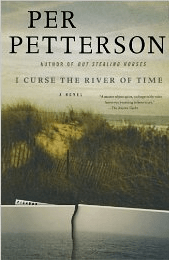
Day 226: I Curse the River of Time

Cover for I Curse the River of TimeI Curse the River of Time is a sad book about Arvid Jansen, a man trying to cross a divide between himself and his dying mother. At the same time his marriage is failing and the Berlin Wall is coming down. Things are coming to an end in his life.

Jansen remembers decisions he made, particularly the one to leave university and join the Communist party. As the wall falls, he considers his loss of faith in the party. 

In contemplating his failing marriage, he also remembers his courtship of a young girl, although it is not clear whether he is thinking about his wife. He goes to his mother’s home country of Denmark, to a beach house where his family spent the summers, and recalls his childhood bond with his mother.

The novel is moody and inconclusive, and for some reason I kept expecting it to become sinister, although it did not. Even though the novel is focused around his attempts to reconcile with his mother (although that is perhaps not the correct word since there has not been a falling out–she is simply cold and unresponsive to him), it seems to me that Jansen thinks about her too much, is too obsessed with her.

The writing is excellent, spare but full of details. However, the entire feel of the novel is tenuous. There does not seem to be much to fasten onto.