Day 911: A Place Called Winter

Cover for A Place Called WinterI read A Place Called Winter for my Walter Scott Prize project, the second book I’ve read for the 2016 list. Like one of the other books I read recently for that project, Arctic Summer, it has as a major theme the main character’s homosexuality. However, I found myself feeling much closer to the characters and more interested in the plot of this novel than I did for Arctic Summer.

At the beginning of the novel, Harry Cane is being treated, or rather mistreated, in an asylum in Canada. Shortly thereafter, he is transferred to an experimental center that treats the patients much more humanely. We understand that Harry has committed a crime, but we don’t know what it is. Between short chapters about his life at the center, we learn what brought him there.

The story of Harry’s life begins when his wealthy father dies. His brother Jack is still in school, and Harry undertakes his education and expenses. Harry is a man of no occupation who feels that he would like one, but he doesn’t know what to do about it. He feels vaguely that he would like to work an estate or a farm but thinks he has to be born to it. A shy man with an occasional stammer, he likes reading and horses. Eventually, he marries a shy woman, Winnie, who informs him on their wedding night that she loves someone else. Nevertheless, he cares for his wife and loves his daughter.

An investment recommendation by his brother-in-law takes a large part of Harry’s inheritance, and Harry and his family are forced to move in with his in-laws. He is an innocent-minded person, so it is not until he meets an actor named Browning that he realizes he is homosexual. He begins an affair with Browning, but then disaster strikes. His affair is exposed to his in-laws by a blackmailer and Harry is forced out of the family. Even his brother Jack, whom he loves, is pressured by his wife not to correspond with him.

Now totally alone, Harry emigrates to Canada and ends up in Saskatchewan, which is just being opened to settlement by the arrival of the Grand Trunk Railway. On shipboard, he meets Troels Munck, who finds him a position where he can learn farming and then helps him purchase a homestead. Munck, though, is a bully, and from the moment Harry meets him, we know that relationship will not end well.

link to NetgalleyHarry finds that a farmer’s life suits him. He settles in, works hard, and makes friends. But we know where he is at the beginning of the book, so the tension builds as we find out how he got there.

Although the time spent to get him to Canada, where the book really captured me, seems a little long, by the time he gets there, we know Harry very well. He is a kind and polite person, but he earns our respect when he finds his niche. Eventually, I became deeply involved in his story. It was also interesting in its details of early homesteading and treatment of mental illness.

Related Posts

Arctic Summer

This Godforsaken Place

Giants in the Earth


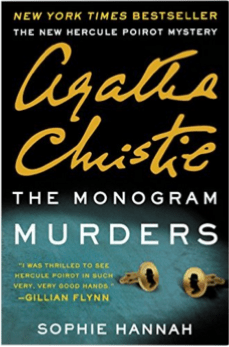
Day 900: The Monogram Murders

Cover for The Monogram MurdersThe Monogram Murders is the first Hercule Poirot mystery written since Agatha Christie’s death that was approved by her estate. It is written by the British thriller writer Sophie Hannah, whose books I have enjoyed. I was curious to see how authentic the novel seemed as a Christie mystery.

Hercule Poirot visits Pleasant’s Coffee House every Thursday night because he finds that its delicious coffee activates the little grey cells and he likes the astute observations of a waitress named Fee. One evening a regular patron comes in disturbed, behaving as if she fears for her life. When Poirot tries to convince her to confide in him or go to the police, she runs away. All Poirot can find out about her is that she works in some large house across town and her name is Jennie.

Hercule returns to his rooming house to confide in his fellow lodger, Mr. Catchpole, who works for Scotland Yard, but Catchpole is disturbed by having just attended the scene of a murder. Three people have been found dead at the exclusive Bloxham Hotel, and each had a monogrammed cufflink in his or her mouth.

Investigation soon finds that the two women victims, Harriet Sippel and Ida Gransbury, both lived in the small town of Great Holling. They traveled up separately to London and had rooms on different floors, but they both had tea with the third victim, Richard Negus, at 7:15 PM. They were all found dead in their rooms after 8 PM.

It soon becomes clear that the deaths have something to do with a tragedy years before in Great Holling, when lying rumors about the town’s vicar resulted in the loss of his reputation and the subsequent suicides of his wife and himself. The three dead were the couple’s biggest traducers, and a servant named Jennie Hobbs told the original lie. But who is the murderer? Some pieces don’t fit.

So, how does The Monogram Murders stack up against other Christie mysteries? It is certainly as complex as any other Poirot mystery and as difficult a puzzle. Hercule Poirot is very much himself. Catchpole is a suitably dense sidekick, a bit reminiscent of Mr. Watson in another series. The novel is engaging and interesting. The one distinctive characteristic of Christie’s novels that it lacks are her deft characterizations, her way of making readers be able to visualize them with just a few sentences. Still, this novel makes a fairly worthy entry into the series.

Related Posts

At Bertram’s Hotel

Death on the Nile

The Truth-Teller’s Lie

Day 894: Everyone Brave Is Forgiven

Cover for Everyone Brave Is ForgivenJust before I read Everyone Brave Is Forgiven, I began a couple of advance reading copies that were varying degrees of bad. I did not finish either one, but the characteristic that stood out most for me was that both were written without a shred of humor. That is not to imply that all books should be humorous, but humor certainly helps me enjoy a book.

So, as I seemed to be on a run of bad fiction, my hopes for Everyone Brave Is Forgiven were not high, even though I enjoyed Cleave’s previous Little Bee. Although I’ll sometimes read one delightful book after another, this was not one of those periods. Thank goodness, I found Cleave’s book not only interesting, but at times funny, at other times touching.

Cleave starts out with some information about his grandfather, who was stationed during World War II in Malta. He has used the relationship between his grandparents as a jumping-off point for his novel.

Mary North is a young socialite who wants to do something for the war. She envisions the war office sending her on some important mission, but she finds she has been assigned to be a school teacher. She enjoys teaching, but her methods are unorthodox. When her school is evacuated to the countryside, her headmistress decides they can do without her.

Tom Shaw isn’t really interested in going to war, but when the children in the school district he administers are evacuated, he starts wondering about his role. After his good friend Alistair Heath enlists, he tries to sign up but is found to be performing an essential job.

By then he has already met Mary, who comes to him asking for a class to teach. Although most of the children are gone, there are still some about, mostly kids who weren’t wanted by the people in the country. Finally, Tom lets her conduct a small class of children, mostly handicapped, and the American negro boy from her old class, Zachary.

Tom falls madly for Mary, who is bright, beautiful, and funny. Mary also cares for Tom, who although older and more steady is also more naive. When Alistair returns, already a bit damaged from the war, Tom and Mary arrange a double date with her friend Hilda. But it is clearly Mary that Alistair is struck by, and she with him. Still, she stays true to Tom.

Alistair is stationed on Malta, which was Britain’s sole air base in the Mediterranean for much of the war. Nothing much grows on it, though, and after it is blockaded, the soldiers starve.

link to NetgalleyWe like Tom, but it is clear from the first that Mary and Alistair are meant for each other. How they will end up together is one thread of this story, but it has others. It’s about racism in World War II, about how Mary comes to reassess some of her values, about the horrors of war.

The conversations and exchanges of letters in this novel are light and amusing. The themes of the novel are more serious, but it still fits in the category of light fiction. I really enjoyed this novel. Mary is a determined character, light in approach but trying to do the right thing, even if it seems eccentric to others. Alistair is fairly shattered by his war experiences but still amusing.

Related Posts

Little Bee

The Disorderly Knights

The Information Officer

Day 857: Dark Fire

Cover for Dark FireAt the start of this second Matthew Shardlake mystery, Matthew’s disillusionment with his master Thomas Cromwell has caused him to break free from Cromwell. He has had his own law practice for the past three years. The rumor now is that Cromwell may be failing in his influence over Henry VIII after he backed the marriage of Henry with Anne of Cleves. The political maneuverings around Cromwell overshadow the entire novel.

But first Matthew takes on a case for a friend, Joseph Wentworth, whose niece Elizabeth has been accused of murdering her 12-year-old cousin Ralph by pushing him into a dry well. Although no one actually witnessed the crime, both his sisters were on the scene shortly afterwards and say that Elizabeth was the only one there. Elizabeth herself isn’t talking.

Matthew goes to see her in prison and is struck by her expression of fury. In court, he tries to argue lack of competency, but according to the laws of the time, if she won’t speak, she must be pressed until she will, a cruel death by crushing. Matthew is unable to prevent her from being sentenced to be pressed.

Next, he is summoned to see Cromwell by a rude young man named Jack Barak. Matthew learns that Cromwell was offered the secret of a powerful weapon called Dark Fire, or Greek Fire. This secret was brought back from the East years before by a monk. A container of it was found by Michael Cristwood in a deconsecrated abbey, along with the formula, and he and his alchemist brother worked on the formula and a dispenser before demonstrating the weapon to Cromwell. Now Cromwell has promised a demonstration to the king in 10 days, but the Cristwoods have disappeared.

Cromwell wants Matthew and Barak to find the Dark Fire and the formula within ten days. He is counting on this discovery to save his position. Matthew makes a deal with Cromwell—if he will save Elizabeth from pressing, Matthew will look for the Dark Fire.

Matthew and Barak soon find Michael Cristwood dead but no sign of the apparatus or formula. Two thugs seem to be just ahead of them, murdering anyone who knows about Dark Fire and attempting to murder Matthew and Barak. Soon it becomes clear to Matthew that some powerful patron is behind the thugs, but who is it?

Although this Matthew Shardlake novel also has a powerful sense of place, London during a sultry 1540 summer, his investigation seems bogged down in this novel. He just seems to be questioning the same people over and over to little result. In any case, I was far more interested in the mystery of Elizabeth and her cousin, which was only incidental to the story. Some of the truth of that case seemed apparent almost at once, although not to our protagonist.

Still, I will continue with the series. I have as a goal to read all the Walter Scott Prize winners and nominees, and Samson’s Heartstone, the fifth in this series, is on the list. But I want to read the books in order. So, I’m committed to the series at least until book five.

Related Posts

Dissolution

Bring Up the Bodies

Wolf Hall

Day 831: Fresh from the Country

Cover for Fresh from the CountryOne of the pleasures I have not had for years is to read a novel by Miss Read, who wrote quite a few books over the course of 50 years, beginning in the 1950’s. Many of these novels are gentle stories about village life, but Fresh from the Country is about living in town.

Anna Lacey is a country girl who has recently finished training as a teacher and has taken a position as a primary school teacher in a new suburb of London. The school and the town are suffering the results of the post-war baby boom. Shoddy houses are going up quickly, and lodging is scarce. In the first scene of the novel, Anna inspects the grim quarters that will be her new home and is clearly cheated in her rent by her miserly landlady, who also underfeeds her throughout the novel.

The school, too, is crowded, as 48 children are crammed into her class in space meant for 20. The numbers in her class are a constant worry as she learns how to control the children, work in limited space, and keep the class productive. She also has to cope with the peculiarities of the various inspectors, since as a new teacher she is on probation.

Anna flees joyfully home on the weekends and holidays, to the large old farmhouse, her cheerful parents, and the beauties of the countryside. She finds the ugly scenery and the noise of the suburb hard to take.

Although Anna is a nice person, she at first tends to look askance at some of the foibles of her coworkers. It is her friendship with another teacher, Joan Berry, that teaches her not to be so hard on people who haven’t had the advantages of loving parents and a stable upbringing.

This is a gentle novel about the difficulties of being away from home for the first time, about learning new skills and learning to understand others, about the problems of the teaching profession. It has a tinge of light romance as well. It is mildly humorous, especially in the details of Anna’s life as a teacher.

Related Posts

South Riding

Miss Bunting

A God in Ruins

Day 822: Miss Pettigrew Lives for a Day

Cover for Miss PettigrewBest book of the week!
This novel is a confection. It is absolutely delightful.

Miss Pettigrew is a poor, middle-aged governess with no family who has been haunting an employment agency hoping for a job. This morning she is in luck. The agency has two openings, one for a maid and one for a nursery maid. The agency sends her off to interview with Miss La Fosse (by mistake).

Miss Pettigrew is received by a beautiful young woman in a negligee. She is clearly entertaining a young man. Miss Pettigrew has been brought up to be a proper lady, but instead of being shocked, she is entranced by this glimpse of an exotic lifestyle.

Without even inquiring who Miss Pettigrew is, Miss La Fosse asks her to find a way of getting her friend Phil to leave before her other friend Nick arrives. Miss Pettigrew is successful in doing this and begins to discover in herself an untapped capacity for organization. Soon, she is responding to Miss La Fosse’s pleas to stay with her during Nick’s visit. Miss Pettigrew sees that Nick is an attractive but dangerous man.

Over the period of a day, Miss La Fosse and her friends involve Miss Pettigrew deeper in their affairs. She is fascinated by this view into a more Bohemian existence, even though her mother would have considered her new friends vulgar. Attracted by their affectionate natures and their colorful lives, she decides that for one day she will enjoy herself and worry about the future tomorrow.

I thoroughly enjoyed this lovely novel about a timid spinster who learns to unfurl her petals. It is a Cinderella story with a 1930’s edge.

Related Posts

The Making of a Marchioness

Nightingale Wood

Love in a Cold Climate

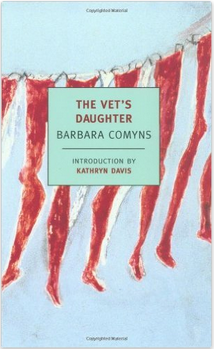
Day 763: The Vet’s Daughter

Cover for The Vet's DaughterIt was several days before the doctor came. It was my father who sent for him. Even he noticed something was wrong with Mother. When he saw her all doubled up over the dining room sideboard, he suddenly bellowed, “For Christ’s sake, woman, send for the doctor, and if he can’t put you right, keep out of my sight!”

Best Book of the Week!
Alice and her mother live in terror of her father, the vet, in this novel written in 1959. He ignores Alice and treats his wife with brutality and contempt. Alice is in her teens, living in a dreary house in a London suburb with only one friend, a deaf girl, when her mother becomes ill. The one bright light for Alice is it brings vulgar but kindly Mrs. Churchill to help.

Mrs. Churchill continues to come after Alice’s mother dies, but within weeks Alice’s father has brought his lover home to live there, so Mrs. Churchill leaves. Rosa Fisher moves into Alice’s mother’s room and stays until she tries to pimp Alice out to an acquaintance.

Alice occasionally seems to have what first appears to be some kind of fits. But they are actually the slow development of an uncanny ability.

As with Sisters by a River, the simple, innocent manner in which this novel is narrated gives it a distinctive tone. Alice is a naive and unsophisticated girl whose isolation from society means she doesn’t always understand very common things. The plot is impossible to predict, as it takes us to some unusual places. The Vet’s Daughter is another strange and vivid novel from Barbara Comyns.

Related Posts

Sisters by a River

The Lace Reader

The Death of Bees


Day 693: Fallout

Cover for FalloutMost of Fallout is told as a flashback, but the opening section is very short, so we can say we really encounter Luke Kanowski in 1961, when he is 14. He has busted his mother out of the mental asylum where she’s lived since he was five to take her to visit the art museum in London. The expedition is not a success, but while they are being questioned by a security guard, Nina Hollings notices them.

Nina is with her mother Marianne, a selfish woman who hands her off to her sister Mat when Nina is in her way but reclaims her before she can gain any stability. Later, she does other things to sabotage Nina’s self-confidence. Marianne works sporadically as an actress.

Luke is a young adult when he meets Paul Driscoll and Leigh Radley. He has been working at a mill, but shortly after he meets the two, he decides his life is harmful to him. Luke feels immediate friendship for Leigh and Paul and has soon moved to London. There the three of them work together with a few others to open a new theater.

Leigh has fallen immediately in love with Luke, but Luke is busy seducing practically every woman he meets, so Leigh becomes Paul’s girlfriend. Leigh’s father was unfaithful to her mother, so Leigh decides to stick with the man she feels is safe.

Then Luke meets Nina, who her mother has essentially pimped out to Tony Moore, a theatrical producer. Tony and Nina are soon married, Nina naively not realizing that Tony is using her as his beard. That is, she doesn’t realize until she finds him with two waiters during a party.

Luke’s first play is being produced as he and Nina begin an affair. This affair and the things Luke is willing to do to try to “save” Nina have repercussions for several people.

This novel is completely different from Jones’ The Uninvited Guests, which I enjoyed more. Although I was compelled to read the novel, I really don’t enjoy fiction where men betray themselves for a woman, or vice versa. Usually, the woman in these novels is bad. Nina isn’t, but she is weak and selfish and eventually asks Luke to betray his friends and his art.

Finally, I feel as if the ending of the novel is unrealistically hopeful and pat, when I think of the wreckage that has gone before. The background of the theater and play production with a bit about the politics of theatre is very interesting, though.

Related Posts

The Uninvited Guests

A Visit from the Goon Squad

The Cuckoo’s Calling

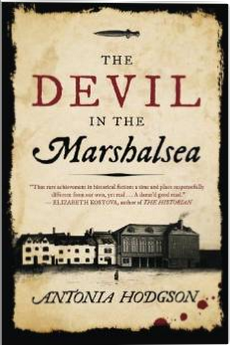
Day 692: The Devil in the Marshalsea

Cover for The Devil in the MarshalseaTom Hawkins has been leading a dissolute life ever since his ordination ceremony was sabotaged by his stepbrother’s reports of his behavior at school. In a desperate attempt to save himself from debtor’s prison, he goes out gambling with his disapproving friend Charles and manages to win enough money to save himself. But on the way home, he is attacked and robbed of everything. Soon, he is on his way to the Marshalsea.

In 1727, the Marshalsea is not the place Dickens described in Little DorritAlthough Dickens’ prison was a place of lost hope, in the early 18th century, the Marshalsea is a hell-hole run by a venal and vicious governor, Mr. Acton. Hawkins is astounded to find that it costs more to live in the Marshalsea than it does outside, and if you can’t pay your lodging you will be banished to the horrors of the Common Side, from which bodies are brought out daily. Hawkins has no money at all except what he gets for pawning his mother’s cross and a bit of money from Charles.

To support himself, Hawkins takes on the job of investigating the death of another debtor, Captain Roberts. Although Roberts’ death was deemed a suicide, it was almost certainly a murder, and his ghost is reported as roaming the prison.

Hawkins has taken Roberts’ room, so his roommate is Samuel Fleet, whom all of the prison inhabitants fear. Fleet claims to have been asleep when Roberts’ body was dragged from the room that night. But Hawkins soon observes that Fleet never sleeps.

This novel is terrific. It is thoroughly researched and richly imagined so that both the setting and characters come to life. Hodgson explains at the back of the book that many of the characters are based on actual historical figures. This is Hodgson’s first book, and I’ll be looking for more.

Related Posts

Jack Maggs

Great Expectations

The Solitary House

Day 637: The Quick

Cover for The QuickAt first, The Quick seems like a straightforward historical novel about a young writer in 19th century London. But it has a twist. To be honest, if I’d known what the twist was beforehand, I probably wouldn’t have chosen this novel to read, because frankly, I’m tired of this subject. That said, I’m glad I read the book, because it is absorbing, well written, and quite suspenseful.

James and Charlotte Norbury grow up neglected in a rambling house in Yorkshire. Their father rarely comes near them after their mother dies and seems to forget they might need attention or tutors or governesses. So, while the two children run wild, it is the older Charlotte who takes care of James and teaches him to read.

After their father’s death, James goes away to school while Charlotte stays in the care of Mrs. Chickering, an elderly relative. James eventually moves to London to try being a writer, but he is not wealthy and has difficulties finding acceptable lodgings he can afford. An acquaintance introduces him to Christopher Paige, a young aristocrat looking for someone to share his rooms. Although the more austere and shy James does not envy Paige’s life of frivolity, he slowly begins to realize that Paige is his first friend—then that he is more than a friend.

One night, though, a terrible event takes place. Christopher Paige is killed and James disappears. When James does not appear at Mrs. Chickering’s funeral, Charlotte travels to London to find him.

In London, Charlotte’s inquiries attract the attention of the members of a powerful and mysterious club, the Aegolius. There has been an unexpected event at the club, and other people are looking for James. Soon, Charlotte finds herself involved with a secret substrata of the city.

Owen depicts a wonderfully atmospheric London. Although I was at first disappointed with the direction the story took, I still was unable to put this book down.