Day 567: Jack Maggs

Cover for Jack MaggsBest Book of the Week!
Jack Maggs belongs in a growing genre of fiction that reinterprets a classic novel. In this case, the novel works in two ways: as another look at Great Expectations from the point of view of a different character and as a loose work of metafiction.

Jack Maggs is a convict illegally returned from Australia when he arrives at the door of a gentleman named Henry Phipps, only to find no one at home. The maid from a neighboring house, Mercy Larkin, thinks he has come to the wrong house as an applicant for a footman position in her own. Maggs decides to take the position so that he can watch the neighboring house for Phipps’ return.

Maggs’ employer is Percy Buckle, once a grocer, who inherited some money and fancies himself a patron of the arts. That night Buckle entertains at dinner a famous author, Tobias Oates, who dabbles in mesmerism. During dinner, Maggs is attacked by a horrible pain in his face, which makes him collapse. Oates hypnotizes him in an attempt to cure him but also gets him to tell some of his secrets.

Soon the two are locked in a struggle. Oates has mentioned knowing of a thief-taker, whom Maggs wants to employ to find Phipps. Oates only agrees to give him the name in exchange for two weeks of allowing him to mesmerize Maggs. Oates, who has realized quickly that Maggs is a fugitive, wants to learn about the criminal mind for an upcoming book. But Maggs becomes dangerous when he learns Oates has found out his secrets.

This tale is really gripping and ultimately suspenseful. It is also very Dickensian in nature—in its storytelling, its empathy for the poor, its dark London atmosphere, its character names, and its rather convoluted but satisfying plot. Our sympathy is all for Maggs, who has built up in his mind a fantasy about Phipps, whom he educated and made a gentleman, and who he does not realize is hiding from him in dread.

Oates is meant to be Dickens himself, and he is depicted less sympathetically. He misuses Maggs in service of his writing, but he is not much more responsible toward members of his own family.

Although Carey won a Booker prize for Oscar and Lucinda, I think Jack Maggs is much more powerful.

Day 528: A Tale of Two Cities

Cover for A Tale of Two CitiesIt has been a long time since I read A Tale of Two Cities, and I did not remember anything except its broadest outlines. The novel is unusual for Dickens in two respects. It is his only historical novel, and it is probably the grimmest. Although he handles some weighty subjects in other novels—the poor laws, the civil justice system, mistreatment of children, abusive schools—this novel about the French revolution shows little of his celebrated sense of humor.

The novel centers around a much smaller cast of characters than usual for Dickens. It begins with Dr. Alexandre Manette, long a resident in a French prison for reasons we do not learn until the end of the novel. When the book begins, he is free but severely disturbed from trauma. His daughter Lucie travels with his banker Jarvis Lorry from England to bring him back to London.

Five years later, he is living contentedly with his daughter in England. Their friend French émigré Charles Darnay is tried for treason on bogus charges, but he is released when his defense proves that the principal witness cannot tell him apart from Sidney Carton, a barrister. These characters will soon become well acquainted.

When the novel returns to France, it shows us the extreme poverty of the poor as well as grim depictions of their mistreatment by aristocrats. Darnay returns to France to meet his uncle, the Marquis St. Evrémonde, and renounce his inheritance. St. Evrémonde’s careless slaughter of a young child when he runs over him in his carriage and his disdainful treatment of his nephew are all we see of him before his murder.

Secretly, a revolutionary society is growing and taking note of atrocities such as those committed by Evrémonde. Wine shop owners Monsieur and Madame Defarge are involved, and at first we have sympathy with their cause.

Charles Darnay marries Lucie Manette in London, but Sidney Carton has fallen in love with her as well. Although he considers himself unworthy of her, he pledges to do anything he can for her or for anyone she loves.

Meanwhile, France falls into revolution and brutal chaos. It becomes a place where revenge is more important than justice.

The fates of the main characters reach a climax when Charles returns to Paris to help an old retainer and is denounced by the revolution. Although he has committed no crime, his relationship to St. Evrémonde puts him in peril. Dr. Manette’s sanity is also threatened when he, Lucie, and Jarvis Lorry travel to Paris to try to help Charles.

The novel is a little more melodramatic than I prefer, unleavened as it is by Dickens’ usual antics. Only a couple of major characters provide momentary relief, and Madame Defarge is like a heavy dark cloud hovering over everything. The novel is also a bit disjointed through moving back and forth between the two cities. Still, Dickens always manages to bring tears to my eyes.

Day 478: Mr. Timothy

Cover for Mr. TimothyAlthough not typical holiday fare, Mr. Timothy picks up some of Dickens’ characters about 20 years after A Christmas Carol and has the added similarity of being set at Christmas time. The main character is Timothy Cratchitt, familiar to us as Tiny Tim.

Timothy is depressed and aimless. The patronage of Ebenezer Scrooge, or Uncle N as he is known in this novel, has had the unfortunate effect of making Timothy dissatisfied with his roots while not fitting him for much else. Most of his family has died or moved away, and he is depressed about the death of his father six months before. In despair, he has left his usual haunts and gone to live in a brothel, where he teaches the owner, Mrs. Sharpe, how to read. Although he has some desire to make his own way, he lacks purpose and initiative, still accepting an allowance from Uncle N. He seems to be on his way down in life.

Timothy goes out dragging the river for bodies one night with his friend Captain Gully, and they pull out a young girl. She has an odd brand on her back, like a G with eyes. Timothy realizes he has seen this brand before, on another girl the police were examining as he went by, who was found dead in an alley.

Timothy has several times spotted another young girl around the city and tried to approach her, but she has always run away. With the help of a street urchin named Colin, he finally tracks her down. Philomela is Italian and has had something traumatic happen to her of which she will not speak. When Timothy tries to take her home to safety, two different parties attempt to remove her from his custody on the street. A charity worker insists she will take Philomela to a home, and a mysterious man in a coach tries to kidnap her. Philomela and Timothy get away, but now Timothy is determined to find out what is going on.

This novel is a slow starter and fairly depressing at the beginning. Although it is feasible to theorize that Scrooge’s help could result in such unhappiness (ala Great Expectations), I wasn’t sure I wanted to think of the original story in these terms. However, the novel successfully invokes a Dickensian atmosphere, including the comic characters and character names, and it picks up its pace as Timothy gets involved in the mystery. After the first 50 pages or so, I was involved and trying to figure out the mystery, which is as entangled as any Dickens effort.

Day 448: The Tiger in the Smoke

Cover for The Tiger in the SmokeI have only read one other Albert Campion novel, and that was so long ago that all I can remember is not having much of a sense of Campion. I can say the same thing after reading this novel, although it has other qualities. Perhaps one can only get an understanding of Campion through reading the series.

In this post-World War II novel, we get a feel for the effect of the war on London. The wealthier households no longer have servants, shoddy neighborhoods have sprung up near where service men used to gather, the ruins of bombed buildings are everywhere, as are groups of unemployed veterans. To this setting Allingham adds the further atmosphere of a heavy fog that persists over the course of the novel. This fog is vividly described and is almost a character in the novel.

Meg Elginbrodde, a young war widow, has recently announced her betrothal to Geoffrey Levett, a wealthy businessman. Beginning directly after the announcement, however, Meg receives poor-quality street photographs of someone who looks like her husband, Martin Elginbrodde, supposedly blown to bits during a battle. No message has arrived explaining these photos, and when we meet the engaged couple, Geoffrey is dropping Meg off for a rendezvous that Campion has arranged as a trap for the culprit.

Meg is to walk into the train station to meet the man, where Campion and the police will capture him. However, when Meg sees the man at a distance, his resemblance to Martin is so strong that she shouts his name and runs toward him, startling him away. Campion eventually captures him, and Meg is embarrassed and puzzled to find that close up, the man doesn’t look like Martin at all. He turns out to be a low-level criminal named Duds Morrison.

Campion and Detective Charlie Luke are fairly confident that someone hired Duds for the impersonation, but what was it meant to accomplish? Duds isn’t talking; in fact, he seems terrified, and rightly so. Within an hour of his release, he is found stabbed to death in an alley.

Campion notices one thing that helped Meg mistake Duds for her husband. He is wearing Martin’s distinctive coat. When Campion repairs to the unusual household of old Canon Avril, Meg’s father and Campion’s uncle, to investigate, he finds the coat was recently in the house. How could it have fallen into the imposter’s hands?

Soon the police find a connection between this case and the escape from jail of a very dangerous man, who calls himself John Havoc. Havoc murdered an eminent physician to escape and subsequently killed three people trying to break into the law office that handled Martin Elginbrodde’s estate. He did not escape, though, early enough to have killed Duds.

In the meantime, Geoffrey Levett is missing.

The plot of this novel, like many of those from the Golden Age of Detective Fiction, is absurd. However, the novel is notable for its strong and vivid characterizations—of one of fiction’s first sociopaths as well as of the many unusual and delightful characters living in Canon Avril’s house. Campion himself remains a quiet character instead of being a presence such as Lord Peter Wimsey or any of Christie’s detectives.

Day 420: NW

Cover for NWI’m not sure what I think about NW. In reading a few reviews, I almost wish I had come to Zadie Smith first through one of her more traditional novels, as NW is almost a deconstruction of form.

NW is the postal code of an area of northwest London where Smith’s characters were brought up and reside. They were all raised in the same housing project, a group of towers that dominates the area of the impoverished and ethnically mixed Kilburn. In each section of the novel, we follow a different character.

Leah Hanwell has escaped the projects but lives within sight of them in a nicer neighborhood. She is of Irish and English heritage, married to Michel, who is half Algerian, half Guadaloupan. Her best friend Natalie Blake is first generation English of Caribbean origin. It seems that for every character in this novel, ethnic heritage is a mixed bag and not a way to find an identity.

Leah has come to resent Natalie, who has been the most successful of their acquaintances. Leah misses their former closeness and feels they now have little in common, especially since Natalie had children. The issue of children is a stressful one for Leah, who has been secretly taking birth control pills while her husband thinks they are trying to conceive. The only absolute and pure love Leah has to bestow goes to her dog Olive.

Leah is home alone when a woman comes to her door claiming to have an emergency. When the woman recognizes Leah as a former resident of the same building in the projects, all pretence of an emergency seems to disappear as they exchange information about common acquaintances. Even so, Leah impulsively hands over a fairly large sum of money. Afterwards, she vacillates between sympathy for this woman–a drug addict on the con–and a resentment that she’s been cheated. Telling Michel about it sets up a situation that ends badly.

In the second section of the book, Felix starts out his day of running a few errands in a cheerful mood. He is going to visit his father, say goodbye to an old girlfriend, perhaps buy a car. He is happy in his life. He has kicked a drug habit, is in love with his girlfriend, has a good job, and wants to lead a more productive life. We don’t anticipate what happens to Felix.

The bulk of the novel belongs to Natalie, who has remade her life, including changing her name from Keisha. She is a lawyer married to a day trader, with two children. She lives in a beautiful house in an upscale neighborhood. She is outwardly a confident, take-charge woman, but inwardly much more tentative. As one of her friends says, she’s been telling everyone all their lives that she is different from them. Yet surely, her impulse is more to fit in.

Natalie and her husband Frank pretend to be a loving couple, but when they are not out in public they spend little time with each other. Natalie doesn’t enjoy her children, either. Of all the characters, including a homeless drug addict named Nathan that Leah and Natalie had crushes on when they were all kids, she seems the most discontented. In one way, she has erased her former life. In another, she drags it along with her. All she enjoys is her work.

The novel is presented in a fragmented way. Conversations begin in the middle and sentences are cut off. Issues remain unresolved. Dialogue and descriptions are vivid but gritty, such as when Leah and Natalie push a stroller through a trash-lined neighborhood to find an ancient church in the middle of a traffic circle, its tombstones covered in graffiti. Smith’s novel is ambitious, an urban slice of several lives.

A little side note. The paperback copy of this novel has a typo on the back cover where it calls a character by the wrong name. I kept waiting for that character to appear until I figured out what was going on. That’s a pretty big mistake. Just sayin’.

Day 402: Dust and Shadow

Cover for Dust and ShadowIn Dust and Shadow: An Account of the Ripper Killings by Dr. John H. Watson, Lyndsay Faye combines a great deal of research into the Jack the Ripper killings in 1888 with a vast knowledge of Sherlock Holmes literature to offer an entertaining solution to the crimes. The novel begins nearly 50 years after the events, when Dr. Watson places his narrative of the murders into a safety deposit box on the eve of war.

Inspector Lestrade comes to consult Holmes after the second murder, when police begin to realize the two deaths may be linked. Holmes immediately begins pursuing his usual means of detection–inspecting the body and the scenes of the crimes, trying to find out where the victims were last sighted, questioning the victims’ friends–and he very quickly figures out that another murder is related. He even hires an alert young prostitute, Mary Ann Monk, to make her own enquiries and observations after she identifies the body of her friend, Mrs. Nichols. However, he is soon frustrated by his lack of progress. The only lead Holmes has come across is the story of an elusive sailor, being sought by a friend who thinks he may have been involved in the first murder, that of Mrs. Nichols.

Soon Holmes and Watson have something else to worry about, for a member of the press is printing details of the crimes unknown to but a few. He has been alleging that Holmes himself may be the murderer.

Faye’s novel is atmospheric and absorbing. Its greatest accomplishment, though, is in successfully capturing the narrative style of Doctor Watson, making us believe that this could be a Holmes story. Although I was about 100 pages ahead of Holmes in solving the murder (which would never happen in a real Holmes story), I still found the solution ingenious as well as the reason why the crimes are recorded in history as unsolved (when, of course, Holmes solved them). This novel is a very good first effort. I have Faye’s next book awaiting me in my pile.

Day 359: The Yard

Cover for The YardThe Yard contains elements that should have made it interesting to me, particularly the period, but it didn’t really grab me.

The novel takes place shortly after the failure of Scotland Yard to capture Jack the Ripper, and the police are dispirited, while the public has grown scornful of them. The body of Detective Little turns up in a trunk at Euston Square Station. Detective Inspector Walter Day is put in charge of the investigation to the surprise of everyone, as he is new to the force.

We are not left in ignorance of the identity of Little’s murderer, as he is watching the case from the sidelines. He didn’t intend to murder anyone, but Little discovered his secret. Soon another officer stumbles onto his secret and also must be killed.

Constable Hammersmith is assigned to the case, but he becomes embroiled in another incident. A thief breaking into a house finds the body of a boy stuck in the chimney and stops Hammersmith on the street to tell him about it. Directed by his superiors to concentrate on the more important case of Detective Little’s murder–the death of a chimney sweep’s boy not being considered a crime–Hammersmith continues to search for the sweep on his own time.

Another case is preoccupying Inspector Blacker. Some men have been found murdered with their beards newly shaven. Blacker thinks it is unlikely that two serial killers are loose in London at the same time, but Day and Dr. Kingsley, the coroner who is interested in new forensics research, do not agree.

This first series book sets the stage for all the recurring characters as well as attempts to recreate the chaos of the Yard. I feel it is spread a bit thin. The writing is capable rather than brilliant, although I encountered enough clichés in the first few pages to irritate me. A technique used several times of flashing back to explain something right in the middle of the action seems very disruptive and only serves to stall the flow.

Some unlikely events disturbed me as well. That two police officers would stumble onto the killer’s secret in the space of two days seems completely far-fetched. A minor incident where a family claims to have made a day trip to Birmingham seems equally absurd. I can’t imagine even in these days that a trip from London to Birmingham and back would be something anyone would want to do in one day, but back then the trains were surely slower. Such a trip may have been possible, but that the police officers receiving this information don’t challenge it seems absurd.

Almost despite myself I found myself beginning to like the major characters, but I still don’t think I’ll be picking up the second book anytime soon.

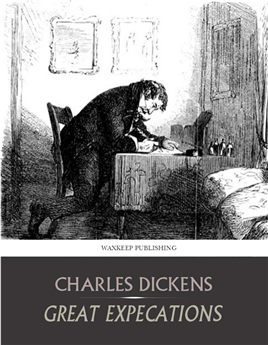
Day 356: Great Expectations

Cover for Great ExpectationsGreat Expectations has long been my least favorite of Dickens’ more substantial novels, because I dislike the character of Pip. However, upon my re-reading it after many years, I’ve changed my opinion, because only in this novel does the main character undergo a complete change of his assumptions and values.

The novel begins with Pip as a young boy growing up in a vast and desolate wasteland of marshes. He is cared for by his ambitious and abusive older sister and kindly brother-in-law Joe Gargery. In the opening scene he is in the cemetery looking at his parents’ graves when he meets the escaped convict Magwich.

Under Magwich’s instructions, the terrified boy steals some food from his sister’s pantry and a file from his brother-in-law’s smithy. Magwich might have got away, but Pip tells him he met another convict on the way, so Magwich throws away his chances of escape to fight the other man, his sworn enemy.

After this odd and atmospherically fraught incident, Pip is soon engaged to entertain the wealthy but deranged Miss Havisham, an old woman who was long ago deserted at the altar and has lived the rest of her life in her bride clothes with her wedding cake rotting away on the table. Miss Havisham introduces Pip to her beautiful ward Estella, and from that time he is captured. He fails to understand, however, that Miss Havisham has brought Estella up to enthrall and torture men.

Pip grows old enough to apprentice as blacksmith to Joe, but his association with Miss Havisham and Estella has made him discontented with his lot. Soon, though, he is informed that he has “great expectations,” that an unknown benefactor has chosen him for his or her heir, and he is to become a gentleman. Pip and his associates assume his benefactor is Miss Havisham, and Pip thinks that she intends Estella to be his.

With only a few qualms of guilt, Pip throws off his childhood, including his gentle, loving friend Joe, to become a gentleman and chase after the dream of Estella. It is only through a series of misfortunes that he realizes he must learn to look at his life differently than he understood it and comes to appreciate his true friends.

I am not at all sympathetic to Pip’s desires and think the pursuit of Estella is a worthless one, but Dickens’ strengths are in his characterizations and complex plots. In addition to a cast of unusual, lovable, or repellent characters, he does a masterful job of developing Pip into a wiser and more honest man.

Day 344: Tuesday’s Gone

Cover for Tuesday's GoneTuesday’s Gone is the second mystery/thriller featuring psychotherapist Frieda Klein in a series that is turning out to be quite exciting. A social worker calls on a mentally ill client for a first visit at a grimy, squalid hostel. The client, Michelle Doyce, leads her in to her apartment and introduces her to her guest–a naked man who has been long dead.

The police, embattled with cost-cutting measures, are inclined to close the case even though the victim has not been identified, but DCI Karlsson wants to see what Frieda Klein makes of Michelle, who seems to be talking nonsense. Frieda soon concludes that, rather than having strangled the victim, Michelle suffers from a rare disorder that makes her unable to distinguish the animate from the inanimate and was trying to help him.

When the victim is finally identified, he turns out to be Robert Poole, an apparently charismatic and charming con man and identity thief. He seems to have several potential murderers, but none of them appears to bear him any ill will.

In the meantime, Frieda is slowly beginning to realize that the case from the first book, Blue Monday, is not closed, because the murderer is not dead, as believed. Frieda is sure he is lurking somewhere nearby. She is also involved with troubles with her family and among her friends, as well as the return of her ex-lover Sandy from the US.

Frieda is an interesting character–a loner who likes to walk the streets of London at night and prefers to keep her own counsel yet has several close friendships. The mysteries are involving and complex, and although I figured out who the murderer was before the secret was revealed, it was only a bit earlier. Although the married writing team who calls itself Nicci French builds suspense slowly, the final chapters of the novel are quite thrilling.

Day 323: Oliver Twist

Cover for Oliver TwistOliver Twist was one of the first adult books I read as a child, although I believe that David Copperfield was the very first one. This book is, of course, Dickens’ famous indictment of the British treatment of and attitudes toward the poor, as followed through the adventures of Oliver Twist, an innocent and hapless young orphan.

Oliver is born in the workhouse after his mother dies in childbirth without identifying herself. He is named by the beadle and brought up at a baby farm, the intent of which seems to be to starve as many babies to death as possible. The story really begins when Oliver is 10 years old and is moved to the workhouse to begin an illustrious career picking oakum, which is unraveling and picking apart old ropes. There he is voted by the boys to be their representative in asking for another bowl of thin gruel at mealtime (or rather is the only one naive enough to agree to do it).

This act brands Oliver as a malcontent, and he is apprenticed out to a coffin maker with dispatch. His employer seems disposed to be kind, but he is bullied by a “charity boy,” Noah Claypole, as well as by the housemaid and the coffin maker’s wife. Finally, after being unjustly punished for standing up for himself, he runs away.

Oliver’s adventures lead him to London, where he innocently falls in with a gang of thieves lead by the infamous Fagin. Oliver’s struggles to make his way in life without becoming a criminal and the mystery of his identity are the focuses of the rest of the book.

Although this novel has a few amusing and lovable characters, it is fairly grim compared to some of Dickens’ later efforts. It is merciless in its satire of institutions such as the workhouse and the law courts. Oliver himself is more of a symbol for goodness than a fully developed character, yet we are touched by his plight.

It is a long time since I read this novel, and I found I had forgotten just how complex the plot is. Although I do not feel that it is as good as some of Dickens’ later works, as his first serious novel, it is compelling reading.