Review 2486: A Chelsea Concerto

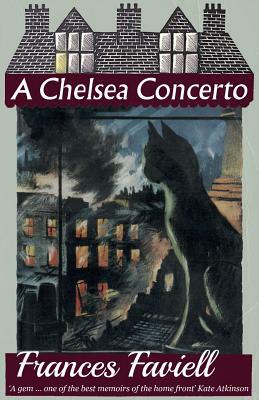
A Chelsea Concerto is Frances Faviell’s memoir of the Blitz. Although I have now read several memoirs and novels set during this time, this one is remarkable for its integration of war news and its detailed descriptions of air attacks and their results. Faviell lived in Chelsea during the Blitz—an area that was very hard hit—and the book ends with a massive bombing of the area.

The book begins before the official war, with Faviell getting involved with working with Belgian refugees because of her ability to speak several languages. It continues to follow events of the war and the Blitz. It’s so detailed as to indicate that Faviell must have notes or diaries to refer to, as the memoir was not published until 1959. The descriptions of damage caused by the bombings is very vivid.

Unfortunately, Faviell often assumes knowledge on the part of readers that they may not have, either because it was common knowledge at the time or that it was so familiar to her that she didn’t think it needed explaining. This problem includes unexplained abbreviations, people identified only by name with little context, and at the end of the book, a mysterious reference to some event three years after the events of the memoir.

Also, there are lots of people mentioned in the book but characterization of only a few of them. This led me sometimes to be confused about who they were.

Related Posts

Table Two

The House Opposite

Spam Tomorrow

Review 2466: Table Two

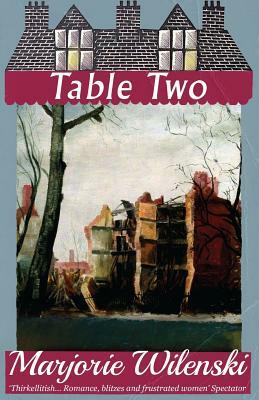
One of the main characters of Table Two is more of an antihero. It’s Elsie Pearne, a bitter, disillusioned middle-aged woman who works for the Translation Office of the Ministry of Foreign Intelligence. She is intelligent and hard working, but she has a chip on her shoulder and a tendency to paranoia and doesn’t understand that it’s her own behavior that makes people dislike her.

She works at Table Two of the translation office with some eccentric coworkers. One blasts the room with cold air every morning while another can’t stop talking. A third takes delight in others’ misfortunes.

At the beginning of the novel, London has not had much of a problem yet with bombing, so the Ministry employees are simply bored and frustrated during the frequent occasions when they have to take shelter during the workday. But soon that changes.

Offsetting the character of Elsie is that of Anne Shepley-Rice, a young woman of the upper class who comes to work in the department. Elsie takes a fancy to her and takes her under her wing. But although Anne is grateful, she is much less invested in the friendship than Elsie is.

In the workplace, a plot centers around who is going to be appointed the Deputy Secretary of Table Two once the competent Mrs. Jury leaves for family reasons. The question is important because the Director, Miss Saltman, although a pleasant manager, is hopelessly disorganized, and Mrs. Jury does most of her work.

On the personal front, Anne feels she is hopelessly in love with Sebastian Kimble, her long-time friend and neighbor. Not only does Seb show no signs of wanting to settle down, but Anne’s family has lost its money, so she feels she is no longer a catch.

Although I’ve read quite a few novels set during World War II that are contemporary to that time, this is the first one that deals so much with the workplace. It is acerbically funny but also could be about a modern workplace, dealing with the same concerns of getting along with disparate people.

Elsie is not likable, and she creates her own problems, but I couldn’t help feeling sorry for her at times. Anne is sympathetic but a bit milk-toasty.

Related Posts

Mrs. Tim Gets a Job

The Halt During the Chase

Forest Silver

Review 2463: The House Opposite

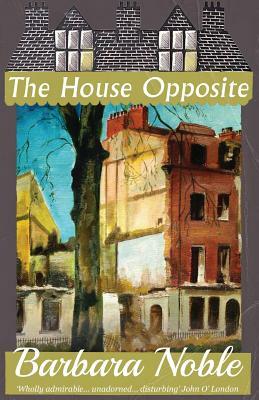
I didn’t like the main character of The House Opposite at first. Elizabeth is having an affair with her boss, a married man with two children, and she sees his wife and children only as people who get in the way of her happiness. She’s dating a young serviceman, Bob, simply to hide her affair. She apparently referred to the boy across the street as a “pansy” in his hearing, and the remark has made him doubt his sexuality.

Nevertheless, she’s friendly to her coworkers and as she begins to help with the war—working as a warden and helping in the hospital—she begins to grow on me. As warden, she is partnered with Owen, that same boy she insulted, and it is the developing friendship between the two that is a focus of the novel—that and her own self-evolution.

One of the interests of this novel is the detailed descriptions of what it was like to live through the Blitz in London. Although other novels recount an incident or two, most of the characters in this novel have chosen to stay in London and sustain many attacks, most of them even staying in their homes and feeling a little superior to those who seek shelter.

Although Elizabeth takes a long time to recognize that her lover is a stinker, she otherwise shows herself to be quite likable. There are a lot of themes, involving Owen growing up, Elizabeth humanizing her lover’s wife and children, Owen’s father’s involvement in the black market, and so on.

Related Posts

The Midnight News

Company in the Evening

Spam Tomorrow

Review 2457: Westwood

Margaret Steggles is a girl who yearns for beauty in her life. She is a schoolteacher moving to London for a new job, and she has been taught by her mother not to expect marriage. She tends to drift into reveries when contemplating beautiful scenery, literature, or music.

A small accident brings her into the chaotic household of Hebe and Alex Nislund. She finds Hebe beautiful but rude and is disappointed by Alex, who is a famous painter, because he seems so ordinary. Their housekeeper, Grantey, learning where Margaret lives, walks her home, because Grantey is returning to her primary place of employment, where she is an old retainer of Hebe’s parents, the celebrated playwright Gerard Challis and his wife Seraphina. Grantey invites her to stop by to visit at their home, Westwood, which is just up the hill from Margaret’s Highgate neighborhood.

A famous playwright is heady stuff for Margaret, who loves Challis’s plays. Although she doesn’t drop in on Grantey, she meets Zita, a German refugee and servant from Westwood, in the hardware story trying to find someone to mend a fuse before a party begins. The store can’t help, but Margaret can. She meets Gerard Challis and is struck by hero worship.

But Gerard is a pompous, humorless, unaffectionate, and selfish man who delights in carrying on chaste affairs with beautiful young women until they become demanding, at which point he dumps them without ceremony. He has coincidentally set his eye on Hilda, who just happens to be Margaret’s best friend. Hilda has plenty of admirers, though, and isn’t impressed, even though he is clearly wealthy and has told her he is single and his name is Marcus. This rejection of course makes him more eager.

Margaret is accepted into the Challis household as a friend and visitor, especially after the Nislund house is bombed and they all move in, too. Margaret enjoys being there even though they mostly treat her as a convenient person for helping take care of Alex and Hebe’s three small children. Margaret’s friendship with Zita can also be difficult because Zita is volatile, but they go to beautiful concerts together.

Margaret has also started helping John, a coworker of her father. He has been struggling to care for his mentally challenged daughter while his housekeeper is ill.

This novel made me laugh out loud sometimes, especially at the descriptions of the plots of Challis’s plays. The introduction tells us that Challis is based on a real person. I’d like to know who! (It turns out to be some guy named Charles Morgan.) In other respects, I really enjoyed this novel about Margaret’s development in self-respect and her shedding of her romantic myopia. This is a good one!

Related Posts

A Pink Front Door

Nightingale Wood

The Swiss Summer

Review 2455: Spam Tomorrow

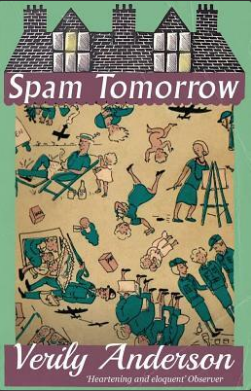
Spam Tomorrow is Verily Anderson’s memoir. Although it briefly hits other times of her life, it concentrates on the war years and ends shortly after D-Day.

The book begins with Anderson’s marriage to Donald, an event not encouraged by her parents because of his lack of wealth and an age difference that is unstated but I figure has to be at least 20 years.

At the beginning of the war, Verily, having already been warned off Donald , volunteers as an ambulance driver. At first, the drivers mostly just wait around to be dispatched, and later, she is erratic in her actual attendance at this job, getting very sick and later going off when she feels like it. She keeps running into Donald, though, who is found unfit for the military because of physical reasons and instead is working for the Ministry of Information. Finally, they decide to marry.

Most of the book has to do with the struggles—sometimes serious ones but related in a lighthearted manner—of living in London during the Blitz, of a difficult pregnancy, of motherhood, and of problems trying to find a suitable home to raise children when you’re not well off and being bombed.

Again, although sometimes concerned with serious problems, like Verily’s difficult first childbirth and subsequent illness, the memoir is related in a lighthearted manner and is often amusing. It provides yet another angle on British life during the war.

Related Posts

One Woman’s Year

Mrs. Tim Carries On

The Midnight News

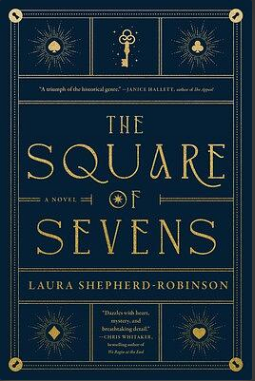
Review 2453: The Square of Sevens

Now, this is the kind of historical novel I like. The time period seems to be well-researched, the flawed heroine is still likable, and the plot is twisty and interesting.

Red tells us about her life in 1730, when she was seven. She has been traveling all her life with her father, a Cornish cunningman named John Jory Jago. But he believes his life is in danger so is using an assumed name. He has taught her to read fortunes using the square of sevens, a technique passed down in her family. She knows nothing of her mother except she is dead.

They meet Robert Antrobus at an inn. He is an antiquarian who is interested in the square of sevens. Her father tries to get him to take Red, but he refuses. Red’s father dies, and Antrobus returns to take her home to Bath and adopt her.

Now named Rachel Antrobus, Red begins as a young woman to try to find out about her family. The pack of cards she has always used has a Latin slogan on it that is the motto of the rich and powerful De Lacey family. That family is engaged in a legal battle over the estate between most of the De Laceys and Lady Seabourne, a sister of Julius De Lacey who is estranged from the family. The dispute is about a codicil that Nicholas De Lacey left, leaving the bulk of his estate to his first grandchild. Lady Seabourne’s son is that grandchild, but the rest of the family claims that Nicholas burned the codicil.

Red learns enough about the family to believe that she is the daughter of a runaway marriage between John Jory Jago and Patience De Lacey. Then she finds the codicil in the tube that contained the document explaining the square of sevens and realizes she is the first grandchild.

Fairly early on, we see another point of view. Lazarus Darke is working for Lady Seabourne trying to find the codicil.

Someone breaks into the house, killing the housekeeper, Mrs. Fremantle, obviously looking for something. Then Mr. Antrobus dies. Red has reason to believe that her new guardian, Henry Antrobus, has stolen her inheritance from Mr. Antrobus, and then he sells the codicil. Red runs away from home to London.

Red finds herself a job telling fortunes at a show, an illegal activity. The show was once a joint enterprise between John Jory Jago and Morgan Trevthick. Red, who has thought her mother dead, finds out that Patience De Lacey is Lady Seabourne. She presents herself to her, but Lady Seabourne throws her out. So, Red decides to infiltrate the De Laceys as a fortune teller for Mirabel Tremaine, who she believes is her grandmother. But can she find the codicil? And how will she prove that she and John Jory Jago lived instead of both going over a cliff when she was a baby, as everyone believes?

Soon, Red realizes she has entered a nest of vipers. But are they all or only some of them vipers? It seems as if I have told a lot of the story, but there is much more to come.

Related Posts

The House of Fortune

The Last Confession of Thomas Hawkins

The Clockwork Girl

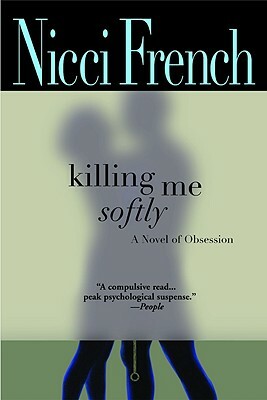
Review 2442: Killing Me Softly

Although I have lost track of it, I followed Nicci French’s series featuring psychoanalyst Frieda Klein for some time. So, when I was looking through my To Read list for books published in the missing years for my A Century of Books project, I picked out Killing Me Softly, which is a stand-alone.

Alice Loudon is bored with her job, but she is happily involved in a relationship when she locks eyes with a startlingly attractive man while crossing the street. When she comes out of her workplace later, he is waiting for her, and they begin a torrid affair. His name is Adam Tallis, and he is a well-known mountaineer. He is intent and possessive, but it’s as if Alice is possessed by him. At one point, she tries to break it off, but she ends up instead breaking up with her boyfriend.

Sex is an important part of their life, and Alice finds herself agreeing to practices that are farther and farther from the norm. She drops most of her friends and can’t concentrate at work. In addition, she and Adam are receiving threatening messages.

Alice finds that Adam is the hero of an incident he has refused to talk about, in which several people died on a mountaineering trip when a storm came up. But there’s a lot Adam won’t talk about, and Alice begins to believe that he has secrets.

Nicci French is a master at building suspense, and this novel is no exception. Although Alice is not an entirely likable character—she pulls several deceptions over people to get at the truth—we can’t help but be on her side.

Related Posts

Thursday’s Children

Friday on My Mind

Dark Saturday

Review 2439: Classics Club Spin Result! The Prophet’s Mantle

I picked this book out of my collected works of E. Nesbit for the Classics Club as one of her first novels for adults. In fact, it is her first novel. So, I wasn’t aware until I looked for a hardcopy that it was publicized under the name of Fabian Bland. In fact, I was confused, because some editions showed both names, so I thought they were two different people. I don’t agree with the custom some publishers use of listing works under the most well-known name just to make more money, but I have had to revise my listings of this work because of this error and listed both so as not to confuse.

In the prologue to this novel, Count Michael Litvinoff prevents Armand Percival from drowning himself after gambling away all his money. Litvinoff takes Percival as his secretary to Russia. But Litvinoff is the author of a pamphlet that the Russian authorities deem dangerous, so the two have to flee. On the trip, it is reported that the secretary is killed by their Cossack pursuers.

It takes a while to see the connection between this story and the body of the novel, which begins with two brothers, Richard and Roland Ferrier. Their father leaves his mill to both of them, hoping to keep them friends, as they are rivals for the same girl, Clare Stanley. If they can’t run it together, the business will fold.

However, Richard believes a rumor in the village that Roland is responsible for the disappearance of Alice Hatfield, the assumption being that she left because she was pregnant. When Roland learns this, the two become unreconciled and the mill is closed. It’s clear from the beginning that Roland knows nothing about Alice, though.

In London, we again meet Count Litvinoff, a Nihilist (although Nesbit doesn’t seem to understand what one is, and although there is a lot of discussion about revolutionary principles, no one actually states what the characters believe) who has published several books and has been speaking around town. Clare Stanley is in town, and she is trying to attract the count, but after she hears a talk by another Russian, Mr. Petrovich, she begins to be interested in the cause. It soon becomes clear that it is Litvinoff, not Roland, who is responsible for Alice’s plight.

It’s not long before several plots are going. Who will win Clare? What will happen to Alice? Who is the mysterious Petrovich? Is Litvinoff a hero or a villain? Will Richard and Roland make it up? And what about the poor mill workers?

Despite its revolutionary theme and good intentions, I fear the mill workers get the short shrift. This novel goes in too many directions to really do a satisfactory job in 159 (small print) pages. I guessed all its secrets almost immediately, and only Litvinoff has anything approaching a rounded character. The novel is supposed to have a stunning romantic ending, but I wasn’t interested enough in the characters to care much. I think Nesbit’s young revolutionary fervor (she was a Fabianist) gets in the way of this being effective fiction.

Related Posts

That Lass O’Lowrie’s

Challenge

Sofia Petrovna

Review 2437: The Guest Room

Tess’s grief over her sister Rosie’s murder four months ago is taking obsessive forms. First, she wanders all over London late at night hoping someone will try to attack her, as Rosie was found beaten to death on Hampstead Heath. She has moved into Rosie’s flat and is harassing Rosie’s ex-boyfriend. In addition, she constantly calls the police detective on the case offering obscure clues.

Unable to face Rosie’s bedroom, Tess offers it as a B&B, letting it out short-term to help make the mortgage. She has also taken a job at the Barbican, where Rosie used to work.

Tess leases the bedroom for a longer term than usual to a potter named Arran. As she does with all her tenants, when they are away, she looks through their stuff. In Arran’s things, she finds a diary about his infatuation with a woman. At times, it sounds like he is stalking her.

Tess doesn’t know it, but someone is stalking her. Is it her annoying downstairs neighbor, Luke? Her geeky across-street neighbor, Elliott? Or someone else?

This novel moved along pretty well and kept me interested, but Tess isn’t exactly a likable heroine. I was less bothered by that than my feeling that it was fairly easy to guess who Arran is writing about and although I wasn’t absolutely sure, the possibility of one character being the murderer occurred to me, and I was right.

Related Posts

Dark Side

The Girl on the Train

Accidents Happen

Review 2430: The Other Side of Mrs. Wood

In 1873 London, Mrs. Wood is the most successful medium in society. She is worried about the future, though, because her patrons are getting older and at 40, she doesn’t seem to be appealing to the younger folks. To make things worse, Mr. Larson, who takes care of her money, has just informed her that a large investment in a mine has been lost. Things are going to be tight until some ships he invested in arrive.

Mrs. Wood cuts where she can, but unfortunately her profession requires her to have an appearance of respectable wealth.

A girl has been hanging around outside her meetings, which are invitation only. When Mrs. Wood catches her, a Miss Finch, she learns that Miss Finch would like to become her student. She says she has some talent. Without consulting her friend and assistant, Miss Newman, Mrs. Wood decides to take her on, thinking that as a young, attractive girl, she will attract younger patrons.

Miss Newman distrusts Miss Finch, but Mrs. Wood goes ahead with her plans, even excusing some costly mistakes that Miss Finch makes. What she doesn’t know is that Miss Finch’s intentions are bad ones and that she knows more about Mrs. Wood’s past than Mrs. Wood thought anyone knew.

Without remembering any synopsis of this novel, I immediately distrusted Miss Finch, getting a growing feeling of dread that stalled me a bit in my reading. I also felt that the middle part of the novel went on a bit too long. However, when Mrs. Wood pulls herself together, the culmination is very satisfying. I think the very end of the book, though, was a bit unbelievable.

If you read my blog, you know I’m a stickler for accuracy in a historical novel, although not an expert in the details. However, just as a side note, Barker uses the word “twee” on page two, not in conversation but in the main character’s thoughts. I thought that seemed like a modern word, so I looked it up. Sure enough, it was not in use until 1905. Oops!

Related Posts

The Séance

The Haunting of Alma Fielding

This House Is Haunted