Review 2534: #ReadingAusten25! Sense and Sensibility

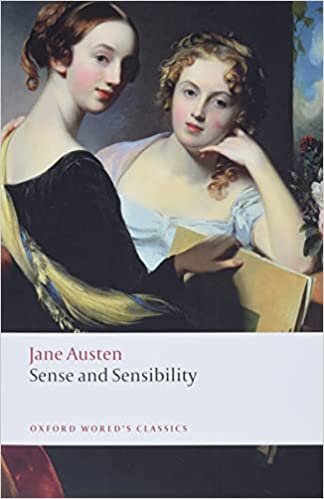
My original intention for ReadingAusten25 was to reread only the books I hadn’t reviewed yet. But I can’t resist Austen, so here I am reviewing Sense and Sensibility. I am not going to repeat my review of 2022, though, so you can find it here. Instead, I thought I’d look at whether the book struck me differently this time and a little at Claire Tomalin’s point of view (the wobble), as cited by Brona.

It did strike me differently. Although Elinor is still my favorite of the two sisters, they both struck me more extremely this time. Marianne seemed like a true modern teenager, not as much for her reactions to Willoughby but more in her sulking (call it what it is), her rudeness to various kind characters whom she thinks ill-bred, and so on. But the thing is, 16 in the early 19th century meant she was supposed to be an adult, or almost. (Of course, she is also under the influence of the Romantic movement in art, literature, and music.)

As for Elinor, sometimes I felt she carried her comments a little too far, into preachiness. I got a little tired of her dissections of other people’s behavior.

I also appreciate the wit of the novel more. Although I always find Austen witty, she has drawn us some priceless characters and written quite a few zingers.

I am not so sure about Tomalin’s “wobble.” I looked for it but didn’t find much evidence for it unless you count Elinor’s dash out of the room after she finds out Edward isn’t married. I’d like to hear if anyone was struck differently. I remember not agreeing with some of Tomalin’s interpretations when I read her biography of Austen.

Related Posts

Jane Austen: A Life

Jane Austen at Home

Persuasion

Review 2527: The Whole Art of Detection: Lost Mysteries of Sherlock Holmes

I knew this book might not be a good fit for me, because I usually feel that mystery short stories are too short to do much but pose puzzles, but more importantly, because I usually think it is unsuccessful when an author continues another author’s work. However, I have generally enjoyed Lyndsay Faye’s books, so I tried this one.

Purporting to be lost stories, notes, and diary entries, most by Dr. Watson but some by Holmes, this book’s 15 stories span the time from before the two met until 1902.

I am not going to run through a description of each story. Instead, I’ll comment on how authentic Faye’s stories seemed as stories about Holmes, keeping in mind that I haven’t read a Holmes story in years.

First, how much like the originals are Faye’s Holmes and Watson? Faye clearly is very familiar with the books (this applies to pretty much all the things I’ll look at, not just this one) because she makes lots of references to other cases and certainly has down Holmes’s characteristics. However, it seemed to me that her Holmes is more of a Benedict Cumberbatch Holmes than an Arthur Conan Doyle one. For one thing, he is much more expressive of emotions, more so even than Cumberbatch, especially as the book goes on. Watson seems himself, only even more flowery of description, but smarter. Also, like in the B. C. version mentioned above, his war service is stressed a lot more.

What about the mysteries? Well, you’re reading the words of a person who never once guessed the solution of a Sherlock Holmes story—until now. On the one hand, Faye’s stories are not nearly as ridiculously overcomplicated and unlikely as Doyle’s (spoilers for ACD!)—teach a snake to crawl down a rope? while dying, say “the speckled band” instead of “a snake bit me”? On the other hand, it seemed ridiculously easy to guess at least portions of the solution for most of the stories (unlike in Faye’s other mysteries—this is what I mean by mystery short stories—they’re either totally opaque or too easy). For instance, in “The Case of Colonel Warburton’s Madness,” I guessed immediately that (spoilers) gaslighting was involved and who was doing it. I just didn’t know how. Later in a story about identical twins, I knew immediately that the twins had switched.

Faye writes well and keeps up the interest. I just wish she’d write more of her own stuff.

Related Posts

Seven for a Secret

Back to the Garden

The Edinburgh Mystery and Other Tales of Scottish Crime

Review 2516: The Fountain Overflows

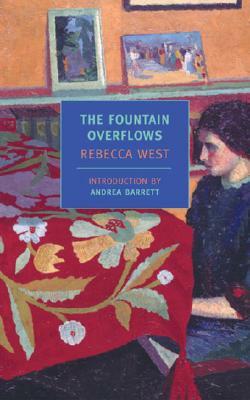
Rebecca West based The Fountain Overflows on her chaotic family life when she was a girl. I understand it is the first of an unfinished trilogy. If so, I’m interested in reading all of it.

Rose Aubrey is a daughter of an unusual couple. Her father Piers is a writer and editor whom many consider a genius, but he is a gambler who continually impoverishes his family. He has a pattern of collecting followers or benefactors who at first seem to worship him, but eventually they break with him, usually after lending him money. However, his family adores him. Her mother is a gifted pianist, formerly a famous concert performer, who is teaching Rose and her sister Mary with the expectation that they will become concert pianists, too. Their oldest sister, Cordelia, has no talent for music but doesn’t know it. She takes up the violin. Their younger brother Richard Quin is adored by all, a toddler at the beginning of the novel.

The novel covers about ten years of the family’s life. There is plenty of incident, from Mrs. Aubrey’s struggles to keep the family financially afloat to the girls’ struggles at school because they’re considered peculiar but also because they hate wasting time at school when they could be playing piano. Cordelia finds a mentor in one of her schoolteachers who encourages her in the idea that she is talented, which Mrs. Aubrey and the other girls deplore. Rose and Mary meet poltergeist activity at a friend’s house, and the family gets involved in a murder case. Also of importance is the girls’ cousin Rosamund.

It’s difficult to summarize this novel, but this family is so interesting, brilliant, chaotic, well-intended, and right behaving. I found the novel delightful.

Related Posts

Little Women

Apricot Sky

The Pursuit of Love

Review 2499: Novellas in November! Highland Fling

I read Highland Fling to fill a hole in my Century of Books project but found it also qualifies for Novellas in November!

The novel begins with Albert Gates, who almost on a whim, moves to Paris to become a painter. There, he at least seems serious about it and actually arranges a showing at a gallery in London before returning home to arrange his show.

Now the point of view shifts to that of Jane Dacre. She has been spending time with her married friends, Walter and Sally Monteath, who are having difficulty living on their incomes, Walter, a poet, apparently being unable to hold a job. The Monteaths are asked to travel to Scotland to host a house party at Dulloch Castle, Lord and Lady Craigdulloch having been called out of the country. They are not excited about it but agree thinking it will be a good way to save money. They invite Jane and Albert.

The rest is a no-holds-barred satire of country house parties, sporting people, Scottish customs, and surprisingly, the young people themselves. In Scotland, Albert comes off as an intellectual snob, his remarks rude and his likings absurd, his outfits unsuitable and ridiculous. (He reminded me of an obnoxious artist character in Angela Thirkell’s series, but try as I might, I cannot figure out which book he appears in. If anyone knows who I’m talking about, please tell me.)

Nevertheless, Jane falls in love with him and everything he says is wonderful. This plot point may be explained because Mitford herself fell in love with a young man on a similar Scottish visit, and they eventually split, possibly because he was gay.

This novel seemed a lot less polished than Mitford’s later ones, but it is her first. The caricatures are very broad, and the supposedly bright banter seemed puerile. However, there are some funny moments here, the description of Albert’s art being one of them.

Related Posts

The Pursuit of Love

Love in a Cold Climate

Pigeon Pie

Review 2486: A Chelsea Concerto

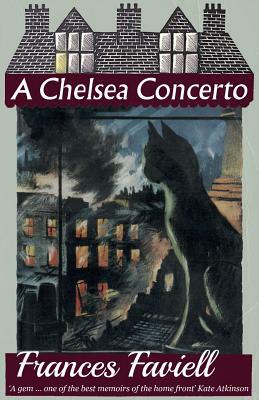
A Chelsea Concerto is Frances Faviell’s memoir of the Blitz. Although I have now read several memoirs and novels set during this time, this one is remarkable for its integration of war news and its detailed descriptions of air attacks and their results. Faviell lived in Chelsea during the Blitz—an area that was very hard hit—and the book ends with a massive bombing of the area.

The book begins before the official war, with Faviell getting involved with working with Belgian refugees because of her ability to speak several languages. It continues to follow events of the war and the Blitz. It’s so detailed as to indicate that Faviell must have notes or diaries to refer to, as the memoir was not published until 1959. The descriptions of damage caused by the bombings is very vivid.

Unfortunately, Faviell often assumes knowledge on the part of readers that they may not have, either because it was common knowledge at the time or that it was so familiar to her that she didn’t think it needed explaining. This problem includes unexplained abbreviations, people identified only by name with little context, and at the end of the book, a mysterious reference to some event three years after the events of the memoir.

Also, there are lots of people mentioned in the book but characterization of only a few of them. This led me sometimes to be confused about who they were.

Related Posts

Table Two

The House Opposite

Spam Tomorrow

Review 2466: Table Two

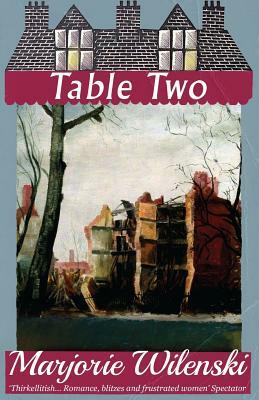
One of the main characters of Table Two is more of an antihero. It’s Elsie Pearne, a bitter, disillusioned middle-aged woman who works for the Translation Office of the Ministry of Foreign Intelligence. She is intelligent and hard working, but she has a chip on her shoulder and a tendency to paranoia and doesn’t understand that it’s her own behavior that makes people dislike her.

She works at Table Two of the translation office with some eccentric coworkers. One blasts the room with cold air every morning while another can’t stop talking. A third takes delight in others’ misfortunes.

At the beginning of the novel, London has not had much of a problem yet with bombing, so the Ministry employees are simply bored and frustrated during the frequent occasions when they have to take shelter during the workday. But soon that changes.

Offsetting the character of Elsie is that of Anne Shepley-Rice, a young woman of the upper class who comes to work in the department. Elsie takes a fancy to her and takes her under her wing. But although Anne is grateful, she is much less invested in the friendship than Elsie is.

In the workplace, a plot centers around who is going to be appointed the Deputy Secretary of Table Two once the competent Mrs. Jury leaves for family reasons. The question is important because the Director, Miss Saltman, although a pleasant manager, is hopelessly disorganized, and Mrs. Jury does most of her work.

On the personal front, Anne feels she is hopelessly in love with Sebastian Kimble, her long-time friend and neighbor. Not only does Seb show no signs of wanting to settle down, but Anne’s family has lost its money, so she feels she is no longer a catch.

Although I’ve read quite a few novels set during World War II that are contemporary to that time, this is the first one that deals so much with the workplace. It is acerbically funny but also could be about a modern workplace, dealing with the same concerns of getting along with disparate people.

Elsie is not likable, and she creates her own problems, but I couldn’t help feeling sorry for her at times. Anne is sympathetic but a bit milk-toasty.

Related Posts

Mrs. Tim Gets a Job

The Halt During the Chase

Forest Silver

Review 2463: The House Opposite

I didn’t like the main character of The House Opposite at first. Elizabeth is having an affair with her boss, a married man with two children, and she sees his wife and children only as people who get in the way of her happiness. She’s dating a young serviceman, Bob, simply to hide her affair. She apparently referred to the boy across the street as a “pansy” in his hearing, and the remark has made him doubt his sexuality.

Nevertheless, she’s friendly to her coworkers and as she begins to help with the war—working as a warden and helping in the hospital—she begins to grow on me. As warden, she is partnered with Owen, that same boy she insulted, and it is the developing friendship between the two that is a focus of the novel—that and her own self-evolution.

One of the interests of this novel is the detailed descriptions of what it was like to live through the Blitz in London. Although other novels recount an incident or two, most of the characters in this novel have chosen to stay in London and sustain many attacks, most of them even staying in their homes and feeling a little superior to those who seek shelter.

Although Elizabeth takes a long time to recognize that her lover is a stinker, she otherwise shows herself to be quite likable. There are a lot of themes, involving Owen growing up, Elizabeth humanizing her lover’s wife and children, Owen’s father’s involvement in the black market, and so on.

Related Posts

The Midnight News

Company in the Evening

Spam Tomorrow

Review 2457: Westwood

Margaret Steggles is a girl who yearns for beauty in her life. She is a schoolteacher moving to London for a new job, and she has been taught by her mother not to expect marriage. She tends to drift into reveries when contemplating beautiful scenery, literature, or music.

A small accident brings her into the chaotic household of Hebe and Alex Nislund. She finds Hebe beautiful but rude and is disappointed by Alex, who is a famous painter, because he seems so ordinary. Their housekeeper, Grantey, learning where Margaret lives, walks her home, because Grantey is returning to her primary place of employment, where she is an old retainer of Hebe’s parents, the celebrated playwright Gerard Challis and his wife Seraphina. Grantey invites her to stop by to visit at their home, Westwood, which is just up the hill from Margaret’s Highgate neighborhood.

A famous playwright is heady stuff for Margaret, who loves Challis’s plays. Although she doesn’t drop in on Grantey, she meets Zita, a German refugee and servant from Westwood, in the hardware story trying to find someone to mend a fuse before a party begins. The store can’t help, but Margaret can. She meets Gerard Challis and is struck by hero worship.

But Gerard is a pompous, humorless, unaffectionate, and selfish man who delights in carrying on chaste affairs with beautiful young women until they become demanding, at which point he dumps them without ceremony. He has coincidentally set his eye on Hilda, who just happens to be Margaret’s best friend. Hilda has plenty of admirers, though, and isn’t impressed, even though he is clearly wealthy and has told her he is single and his name is Marcus. This rejection of course makes him more eager.

Margaret is accepted into the Challis household as a friend and visitor, especially after the Nislund house is bombed and they all move in, too. Margaret enjoys being there even though they mostly treat her as a convenient person for helping take care of Alex and Hebe’s three small children. Margaret’s friendship with Zita can also be difficult because Zita is volatile, but they go to beautiful concerts together.

Margaret has also started helping John, a coworker of her father. He has been struggling to care for his mentally challenged daughter while his housekeeper is ill.

This novel made me laugh out loud sometimes, especially at the descriptions of the plots of Challis’s plays. The introduction tells us that Challis is based on a real person. I’d like to know who! (It turns out to be some guy named Charles Morgan.) In other respects, I really enjoyed this novel about Margaret’s development in self-respect and her shedding of her romantic myopia. This is a good one!

Related Posts

A Pink Front Door

Nightingale Wood

The Swiss Summer

Review 2455: Spam Tomorrow

Spam Tomorrow is Verily Anderson’s memoir. Although it briefly hits other times of her life, it concentrates on the war years and ends shortly after D-Day.

The book begins with Anderson’s marriage to Donald, an event not encouraged by her parents because of his lack of wealth and an age difference that is unstated but I figure has to be at least 20 years.

At the beginning of the war, Verily, having already been warned off Donald , volunteers as an ambulance driver. At first, the drivers mostly just wait around to be dispatched, and later, she is erratic in her actual attendance at this job, getting very sick and later going off when she feels like it. She keeps running into Donald, though, who is found unfit for the military because of physical reasons and instead is working for the Ministry of Information. Finally, they decide to marry.

Most of the book has to do with the struggles—sometimes serious ones but related in a lighthearted manner—of living in London during the Blitz, of a difficult pregnancy, of motherhood, and of problems trying to find a suitable home to raise children when you’re not well off and being bombed.

Again, although sometimes concerned with serious problems, like Verily’s difficult first childbirth and subsequent illness, the memoir is related in a lighthearted manner and is often amusing. It provides yet another angle on British life during the war.

Related Posts

One Woman’s Year

Mrs. Tim Carries On

The Midnight News

Review 2453: The Square of Sevens

Now, this is the kind of historical novel I like. The time period seems to be well-researched, the flawed heroine is still likable, and the plot is twisty and interesting.

Red tells us about her life in 1730, when she was seven. She has been traveling all her life with her father, a Cornish cunningman named John Jory Jago. But he believes his life is in danger so is using an assumed name. He has taught her to read fortunes using the square of sevens, a technique passed down in her family. She knows nothing of her mother except she is dead.

They meet Robert Antrobus at an inn. He is an antiquarian who is interested in the square of sevens. Her father tries to get him to take Red, but he refuses. Red’s father dies, and Antrobus returns to take her home to Bath and adopt her.

Now named Rachel Antrobus, Red begins as a young woman to try to find out about her family. The pack of cards she has always used has a Latin slogan on it that is the motto of the rich and powerful De Lacey family. That family is engaged in a legal battle over the estate between most of the De Laceys and Lady Seabourne, a sister of Julius De Lacey who is estranged from the family. The dispute is about a codicil that Nicholas De Lacey left, leaving the bulk of his estate to his first grandchild. Lady Seabourne’s son is that grandchild, but the rest of the family claims that Nicholas burned the codicil.

Red learns enough about the family to believe that she is the daughter of a runaway marriage between John Jory Jago and Patience De Lacey. Then she finds the codicil in the tube that contained the document explaining the square of sevens and realizes she is the first grandchild.

Fairly early on, we see another point of view. Lazarus Darke is working for Lady Seabourne trying to find the codicil.

Someone breaks into the house, killing the housekeeper, Mrs. Fremantle, obviously looking for something. Then Mr. Antrobus dies. Red has reason to believe that her new guardian, Henry Antrobus, has stolen her inheritance from Mr. Antrobus, and then he sells the codicil. Red runs away from home to London.

Red finds herself a job telling fortunes at a show, an illegal activity. The show was once a joint enterprise between John Jory Jago and Morgan Trevthick. Red, who has thought her mother dead, finds out that Patience De Lacey is Lady Seabourne. She presents herself to her, but Lady Seabourne throws her out. So, Red decides to infiltrate the De Laceys as a fortune teller for Mirabel Tremaine, who she believes is her grandmother. But can she find the codicil? And how will she prove that she and John Jory Jago lived instead of both going over a cliff when she was a baby, as everyone believes?

Soon, Red realizes she has entered a nest of vipers. But are they all or only some of them vipers? It seems as if I have told a lot of the story, but there is much more to come.

Related Posts

The House of Fortune

The Last Confession of Thomas Hawkins

The Clockwork Girl