Review 1836: Rhododendron Pie

Ann Laventie comes from an artistic and elegant family, all of whom are witty and have excellent taste. All, that is, except for Ann, who thinks they are wonderful but likes ordinary things and people. While her family disdains their solid Sussex neighbors and stays away from them, she likes them, especially the large and noisy Gayford family. Still, she feels she must be at fault.

A young film maker, Gilbert Croy, comes to stay and pays Ann a lot of attention. After Ann’s sister Elizabeth moves to London, Ann goes to visit her, convinced that she is in love with Croy and determined to come back engaged. But once in London, she begins to notice things. Her brother Dick’s sculptures, for example, all look alike. She absolutely adores a girl that everyone in her siblings’ group of friends shuns.

Rhododendron Pie is Margery Sharp’s first novel, and it’s quite funny as it explores the bohemian world of her upbringing versus the more mundane. Ann is an appealing heroine, and frankly I liked the Gayfords a lot better than the Laventies, especially in their reaction to Ann’s engagement. Her mother, though, an invalid who is mostly just a presence in the novel, gives a wonderful speech at the end. A fun one from Margery Sharp. I’m glad to have read it for my Classics Club list.

Related Posts

Harlequin House

Cluny Brown

The Stone of Chastity

Review 1811: The Blue Sapphire

Julia Harburn is sitting on a bench in Kensington Gardens waiting for her fiancé when a young man sits down beside her and tells her he is on a business trip from South Africa and doesn’t know anyone in London. He is perfectly polite and friendly, but when the fiancé, Morland Beverley, arrives, Julia can tell Morland isn’t pleased.

Julia is taken aback, then, when she comes home one day to find the man, Stephen Brett, having tea with her stepmother. But this isn’t a tale of a stalker—it’s the story of how Julia finds herself.

Julia was close to her mother, who died when she was younger. She has never felt that her father paid attention to her. In fact, he’s always been quiet and depressed. Since he remarried, she has felt in the way, and her stepmother encourages her to move out and find a job. Julia finally finds a room with an eccentric but friendly landlady, who gets her a job in a hat shop. Morland isn’t very happy with her decision, but he has been delaying their wedding until he gets a partnership in his father’s firm, and anyway he is in Scotland golfing.

Julia’s parents are away in Greece when she gets a letter from Scotland from an uncle she didn’t know she had—her father’s brother. He says he is ill and wants to see her, so she goes, even though Morland is very much against her doing so. Thus begins an even greater adventure for her.

This novel is just what you expect from D. E. Stevenson: a heroine who didn’t know she had it in her, some light romance, some self-discovery, and some entertaining characters. Even though I could foresee the result of the romantic angle from the first pages, it didn’t make reading any less enjoyable.

I received a copy of this book from the publishers in exchange for a free and fair review.

Five Windows

Winter and Rough Weather

Vittoria Cottage

Review 1807: Murder by Matchlight

It’s 1945, and London is in blackout during the period of the Blitz. Nevertheless, Bruce Malling is out for a stroll in Regent’s Park. He is sitting quietly on a bench near a footbridge when he sees a man pop over the railing and hide under the bridge. A few minutes later, another man strolls onto the bridge, calling out to ask if anyone is there. By the brief flicker of matchlight as the man lights his cigarette, Bruce sees another face above his. Then he hears a thud. Bruce runs up to find the man dead and then catches the other man as he comes up from under the bridge and tries to run away.

A police constable arrives on the scene as does a doctor, who pronounces the man dead. His ID identifies him as John Ward, but when Inspector MacDonald inquires about him, he can find no one who knows anything about him except that he was Irish, was charming, and had no visible means of support. Inquiries at his previous residence then reveal that he was not John Ward at all.

This novel is full of colorful characters that MacDonald meets at the victim’s boarding house. It is an interesting puzzle with lots of secrets. Being part Irish myself, I didn’t appreciate the aspersions cast on them in one passage, but otherwise I enjoyed this mystery.

I received a copy of this novel from the publishers in exchange for a free and fair review.

Murder in the Mill-Race

Two-Way Murder

The Lost Gallows

Review 1806: Harlequin House

When Mr. Partridge decides he needs a holiday, he just walks off from the Peters Lending Library, leaving it closed. He may be an older man with a shape like an egg, but he is lawless. Wandering around the seaside town of Dormouth Bay, he spots Lisbeth Campion and follows her. Lisbeth is the type of girl that men are always following. He not only follows her, he has tea with her and her aunt.

Later that night, he sees Lisbeth getting into a car with a man. He gets in the back. Finding they have landed in London at midnight, he learns that Lisbeth has been looking for her brother, Ronnie, who through a misunderstanding, of course, has been in prison for delivering cocaine and is just out. Ronnie claims he thought it was baking powder.

Although Lisbeth is engaged to a fine, upstanding captain in the army, Captain Brocard wants to ship Ronnie to Canada with a small pension, as he has never successfully kept a job. Lisbeth has other plans, though: to rehabilitate Ronnie so that the captain returns to find him an upstanding citizen with a job.

Using Mr. Partridge’s five pounds, the three find a modest lodging in Paddington and set out to find jobs. And they find very odd ones.

Harlequin House is a charming, silly comedy. It made me laugh.

Cluny Brown

The Stone of Chastity

Our Spoons Came from Woolworths

Review 1803: Five Windows

In Five Windows, D. E. Stevenson uses the metaphor of windows to reflect her main character’s growth, or change in mental outlook.

David Kirke (his last name again misspelled on the back cover of my Furrowed Middlebrow edition) begins his story as a young boy during World War II, the son of a rector of a small Scottish village. He comes from a happy home and loves rambling the countryside with his friend Malcolm, a shepherd, or Freda, a girl from a nearby farm.

David grows up a bit naïve, even after he goes to live with his uncle Matt in Edinburgh so that he can attend a better school. His eyes are opened to a less salubrious life when he moves to a London boarding house while he works as a clerk in a law office. That’s when he begins to learn that people aren’t always trustworthy or likable.

Five Windows follows David from childhood until just before he is married. It is pleasant, light reading about a likeable hero.

I received this book from the publishers in exchange for a free and fair review.

Winter and Rough Weather

Vittoria Cottage

The Baker’s Daughter

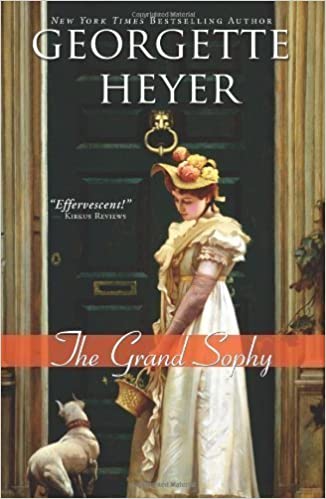
Review 1801: Classics Club Dare! The Grand Sophy

The latest Classics Club Dare is to read something romantic for February, so I have chosen The Grand Sophy from my list.

When Sir Horace Stanton-Lacey unexpectedly arrives at Lord Ombersley’s home to ask his sister to take charge of his daughter Sophy for a while, he discovers a depressed household. Lord Ombersley’s gambling debts had almost overrun the establishment until his son and heir, Charles Rivenhall, inherited a fortune from a distant relative. Charles “did something with the mortgages” and paid off the debts, and now he is trying to get the household to economize.

Charles is also engaged to Eugenia Wraxton, whose outward sweetness hides a self-righteous and meddling disposition. Her plans to occupy the family home after the wedding depress everyone except Charles.

By the time Sophy arrives, the announcement of her cousin Cecilia’s engagement to Lord Charlbury has been delayed by his having contracted mumps. Cecilia now thinks herself in love with Augustus Fawnhope, a devastatingly handsome but vague young man who fancies himself a poet.

Sophy arrives like a breath of fresh air. She brings a monkey and a parrot to entertain the children, a shy greyhound, and a fabulous black steed to ride. She immediately realizes that the family needs her help. And she never shirks her obligations.

Sophy is a firecracker of a heroine, and The Grand Sophy is one of Heyer’s most beloved novels. There is lots of fun to be had as Sophy’s stratagems twist and turn the plot. The novel is a re-read for me for the Classics Club, but I loved it this time just as much as I did the first time I read it.

Frederica

Venetia

Faro’s Daughter

Review 1776: Strangers

Anita Brookner is a writer I’ve sometimes considered reading but never have until now. I read Strangers for my James Tait Black project.

Paul Sturgis is a 72-year-old bachelor who leads a routine life. He has always wanted a family, but after his last girlfriend, Sarah, left him, he resigned himself to bachelorhood. Since his retirement, he has felt lonely and purposeless. He routinely visits an elderly cousin, but he always feels that he bores her. She asks him no questions and constantly talks about her social engagements.

He takes a trip to Venice and meets Vicky Gardner, a woman some years younger than he. In London they meet again and develop a sort of acquaintance that is characterized again by her talking about herself and asking favors but not asking about him. She is a free spirit of no fixed abode who asks him to take charge of some luggage.

He also meets his old girlfriend Sarah again. She is now a widow, and although she is 10 years younger than he, she has changed from an active, decisive woman to an old lady who is always thinking of her health. She also never asks him any questions.

Most of this novel is concerned with Paul’s ruminations about his situation and the past and his yearning for real company and a different kind of life. Although it is well written, it seemed slow moving and repetitive. The cover reviews refer to its wry humor, but I guess I missed it, because it just seems sad. Paul is eventually galvanized into action, but it takes a long time, and I’m not convinced that the new life he chooses will be much different from the old one.

Sweetland

The New Sweet Style

Outline

Review 1771: Umbrella

Some of the reviews of Umbrella refer to modernism, as in “a magnificent celebration of modernist prose.” This kind of encomium shivers me timbers. And then I think, isn’t modernism over? Aren’t we into postmodernism now? Apparently not.

Umbrella has a plot, but don’t expect the book to leap into action, because it’s more concerned with its devices. Self uses few paragraphs, and the ones he inserts aren’t necessarily making the expected division, some of them positioned in the middle of a sentence. Self uses three points of view, but they shift without warning, sometimes in the middle of a word. Stream of consciousness is used abundantly and confusingly, and Self loves his allusions, most of which I did not get. What Self isn’t very concerned with is being easy on his readers.

The novel is inspired by Oliver Sach’s Awakenings. In 1971, psychiatrist Zack Busner realizes he has a group of patients who are post-encephalitic, and they are stuck repeating activities that are meaningful to them but at such fast or slow speeds that they are difficult to detect. He gets permission to administer L-DOPA to them, and they unfreeze, or wake up. Among them is Audrey Death, the oldest patient in the mental hospital.

Aside from following Dr. Busner as a young psychiatrist, we also follow him as an old man. We see from Audrey’s point of view as a girl and a young woman and from her young brother Stanley’s during World War I.

Sometimes the narrative gets carried away into ridiculous flights that last for pages, such as the one involving Stanley falling into a subterranean existence. I didn’t know what to make of it. Although critics have foamed at the mouth in admiration of this novel’s style, I’d call it self-indulgent. I had to make two attempts before I finally managed to read this novel.

This is one of the books I read for my Booker prize project.

Ducks, Newburyport

There but for the

As I Lay Dying

Review 1769: The Man from St. Petersburg

Back in the days when Ken Follett and John Le Carré were the major names in the espionage genre, I used to read both and sometimes confuse them. However, at some point I realized that, of the two, Le Carré is really the master of the genre and the better writer, so I stopped reading Follett. When Pillars of the Earth came out, I read that and decided that historical fiction was not Follett’s genre (I know many would disagree), so I stopped reading him altogether. This is a long way of staying that I picked up The Man from St. Petersburg by mistake.

The premise is intriguing. It’s 1909, and Winston Churchill wants to avoid a war with Germany by making a pact with Russia. The czar wants Prince Aleksey Andreyevich Orlov to handle the negotiations, so Churchill wants Lord Walden, whose wife Lydia is Orlov’s aunt, to handle the British side. Back in Russia, the anarchists want a revolution, which they believe would be kicked off by a war, so they want the negotiations stopped. One of the anarchists, Feliks, must kill Orlov, and he goes to England to do so.

I thought that sounded interesting, but not too far in I felt like Follett was just putting his characters through their paces, making them do what he needed them to do. The diplomatic conversations lacked the subtlety they actually would have had. They just seemed crude and too direct. Finally, a major plot point that was supposed to be a surprise on about page 80 was too loudly telegraphed on page 10. I stopped reading about one third of the way into the book.

Code to Zero

Munich

The Revolution of Marina M.

Review 1757: To Bed with Grand Music

To Bed with Grand Music opens with Deborah Robertson in bed with her husband Graham swearing perfect fidelity before his deployment to Cairo during World War II. Graham more honestly doesn’t promise that but says he won’t sleep with anyone that matters. At first, Deborah contents herself at home, but when, in her boredom, she begins snapping at her little son, Timmy, her mother suggests she get a job.

Her mother is thinking about a job nearby in Winchester, but Deborah makes arrangements to visit a friend in London, Madeleine, and see about a job there. Intending to go home on the evening train, she ends up getting drunk and spending the night with a man.

Shocked at herself, Deborah is determined to stay home, but she has a talent for convincing herself that what she wants to do is right, so it’s not too long before she turns down a job in Winchester only to take a lower-paying one in London. From there, she begins a career of connecting with men of increasingly higher rank.

Deborah is definitely an antihero. She starts out selfish and nervous and becomes deceitful, amoral, and avaricious as she goes on. Her faint motherly instincts become almost nonexistent. This is an insightful, sardonic character study of a particular type of woman.

The Victorian Chaise-Longue

A Fugue in Time

Vanity Fair