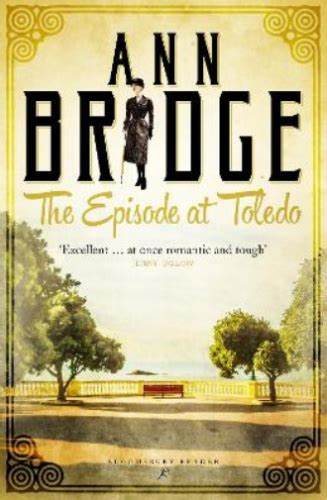
Review 2606: The Episode at Toledo

I have read two books before by Ann Bridge, and although the second was more action-oriented, they were both about women discovering themselves. When I looked for another book by Bridge, I wasn’t aware that she had a series of books around the character of Julia Probyn. This is one of them, about the sixth or seventh in the series, but Julia is a fairly minor character.

Although not necessary, it might have helped me to have read the series in order. I say this mostly because of the beginning and ending of this book, where Julia is ensconced in Scotland among a throng of characters who are briefly introduced but who I couldn’t keep straight.

Julia receives a guarded letter from her Hungarian friend, Hetty, who has married Richard Atherley, British Counsellor in Madrid. Hetta has asked that Julia send either her husband or another friend in Intelligence out to Madrid but doesn’t explain why. However, her friends speculate that it might have to do with a visiting admiral from the U. S. Understand that this is definitely a Cold War novel, and that in an earlier novel Hetta was kidnapped and drugged by Hungarian Communists.

Hetta is worried because she thinks she has recognized the American ambassador’s chauffeur as a Hungarian Communist who years ago closed down the Catholic school that Hetta attended and took delight in harassing the nuns. However, when Hetta’s friends check into it, they find he has been vetted by American security, so they dismiss her fears.

Of course, he is a bad guy, so Hetta does her best to keep the American admiral out of the ambassador’s car. On a tour to Toledo, Hetta suffers a broken arm after she delays the car, which has an accident trying to get to a rendezvous in time to be blown up.

After that, Hetta’s husband arranges for her to go to Portugal to stay with friends, as she is pregnant. But danger follows her.

For a suspense novel, there is a lot more inactivity than activity. Somehow the balance wasn’t right. There is also a lot of repetition as one group after another discusses the same incidents. Frankly, the last 20 pages or so, in which Hetta’s husband arranges for her to return to Scotland and she does, seem to have no relevance except to return to Julia and her confusing pack of relatives and friends. I would estimate that 50-75 pages of this novel are unnecessary.

Was Bridge tired of writing this series? She seems to have been trying to replicate the kind of books Mary Stewart wrote, combining suspense with lovely descriptions of the country. But Stewart did it better. This book also reminds me of the Cold War books of Helen MacInnes, only they have more romance.

To really evaluate this series, I think I would have to start with the first one, which I plan to do. In the meantime, I prefer her other books.


Related Posts

Illyrian Spring

A Place to Stand

Station Wagon in Spain

Review 1708: Leaving the Atocha Station

Adam Gordon is an American pursuing a project in Madrid in 2004. He only hints at the project’s purpose, but he spends most of his time taking drugs, visiting museums, and doing what he calls “translating,” in which he takes lines from other people’s works, substitutes words, and moves things around. He is supposed to be a poet on a grant to write a long poem about how the Spanish Civil War has affected poetry, but he is not doing any research and knows very little about Spanish poetry.

In fact, Adam lies almost all the time. He doesn’t consider himself a poet but a fraud. He is self-loathing and is constantly manipulating his face or thinking up things to say to seem deep. He talks about not feeling anything or experiencing the experience of the event rather than the event itself.

This novel, which seems more like a disguised memoir, is funny at times. It asks a lot of its audience intellectually, and at times I got lost in its logical circumlocutions. The narrator is not very likable, but he grows on you, and he undergoes a sudden transformation at the end.

Would I recommend this book? Only to certain people. I would like to say, though, that its cover design, which starts with snippets from The Garden of Earthly Delights on the right and then smears the colors of each snippet into a shape of a train, is fabulous.

This is a book I read for my James Tait Black Prize project.

Related Posts

The Lesser Bohemians

The New Sweet Style

All That Man Is

Day 213: The Monk

I don’t usually have problems with the language of the classics or with appreciating a book that is long out of its time, but I had one with The Monk. Although it is considered a classic gothic novel, published in the height of their popularity in 1796, I found it boring. I imagine that for its day it was very shocking.

Ambrosio is a monk at a Capuchin monastery in Madrid. Although he is considered to be almost a saint, he is full of vanity and lust. He becomes sexually obsessed with a woman who is disguised as a boy in the monastery, and succumbs to temptation. Then his eye lights on a pious virgin. Gradually, he becomes more and more debauched until he is completely given up to depravity.

What irritates me is the narrative, which is repeatedly interrupted by long and boring digressions, apparently to further the gothic flavor. An example is the story of the brave Lorenzo, who battles with bandits in the forests of Germany. The novel is also rabidly anti-Catholic, as almost all the representatives of the church are scheming, power-seeking, or just plain evil. Although the general over-the-top quality of the novel should have appealed to me, I found myself just not interested enough to finish it.