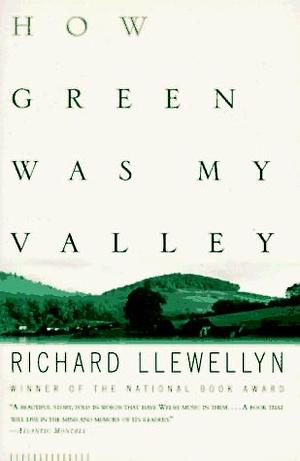
Review 2558: Reading Wales Month ’25! How Green Was My Valley

I didn’t intend to participate in Reading Wales Month ’25 this year, but when this novel fit into my A Century of Books project, I decided to fit it in for Reading Wales, too.

Such a lovely book this is, especially in the music of its language. It’s the story of the Morgans, a family of Welsh coal miners, told by one of its youngest members, Huw.

Huw is six when the novel begins. His family and those of the others in the valley are relatively prosperous, but there are signs that with the mine owners, profits are becoming more important than the lives of the men. Huw’s older brother Davy has been reading socialist literature and is talking about a union, but his father is against it.

It’s difficult to summarize this book because it’s full of family events, one of the first being Huw’s brother Ivor’s marriage to Bronwen. And there is the arrival of Mr. Gruffydd, the new preacher. But overarching everything for the men is the work, as pay gets lower and the valley begins experiencing periods of hunger and want.

I was as entranced by this novel as I ever was, the family so upright, god-fearing, and loyal, Huw’s experiences as he grows up. All the while, the fate of the valley is foreshadowed as Huw speaks from his 60s, returning just as his house is being destroyed by a mountain of slag.

It’s a real page-turner, not in terms of action, but for other reasons.

Related Posts

Germinal

That Lass O’Lowries

Country Dance

Day 985: That Lass o’Lowrie’s

Cover for That Lass O'LowriesThat Lass o’Lowrie’s is Frances Hodgson Burnett’s first novel, written in the style of Realism. It is set in a Lancashire mining town and features a lot of Northern dialect.

The lass in question is Joan Lowrie, a miner’s daughter. She is a tall, strong, proud woman who has survived years of abuse at the hands of her father. At the beginning of the novel, she dresses partly in men’s clothing and works in the mine as a pit girl.

She attracts the attention of a young mining engineer, Derrick, and his friend Paul Grace, a curate. Later, Derrick finds her injured by her father and helps her, after which she promises to pay him back for his help. When Derrick has a dispute with Lowrie, who would like to revenge himself by ambushing Derrick, she follows Derrick home in the dark every night to protect him.

Grace himself is in love with the rector’s daughter, Anice. But Paul Grace is small and unprepossessing and doesn’t hold out much hope. He also has problems being accepted by the miners, who distrust clerics and think he is too small and refined to heed.

This novel deals with the difficulties of the miners’ lives and of their grievances against the owners. Although it sympathizes with them, it’s true that the only bad men in the novel are Lowrie and his buddies, as well as one son of an owner, who debauches a foolish girl that Joan befriends. It is in taking care of this girl’s child that Joan begins to want to learn more womanly ways and arts.

This novel provides some interest, but it is not one of Burnett’s best. The dialect can get old. Unlike the other books in dialect I’ve read recently, the dialect is not confined to minor characters, since Joan is from a poor background (although it’s easier to understand than Walter Scott’s Scottish dialect). The only relief we get from it is from the upper-class characters, Derrick, Grace, and Anice.

Related Posts

The Making of a Marchioness

The Secret Garden

The Perpetual Curate