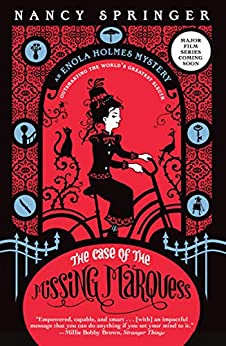
Review 1707: The Case of the Missing Marquess

My husband and I enjoyed watching Enola Holmes over the Christmas holidays, so I decided to give the first book in the series a try. I had assumed it would be YA, but it is actually marked for middle grades.

Enola Holmes, who is the younger sister of Mycroft and Sherlock, finds that her mother has disappeared on Enola’s 14th birthday. When her brothers, who have not come home for 10 years, respond to her telegram, they have some unpleasant surprises in store—Enola that Mycroft is more interested in sending her to boarding school than in finding their mother and Mycroft that the money he’s been sending for the upkeep of the estate has clearly not been spent on the estate. Sherlock is just determined to find their mother.

Enola is offended at some slighting remarks Sherlock makes about her intelligence and is determined not to go to boarding school. Having figured out that her mother has left her some clues and hidden some money, Enola disguises herself as a widow and leaves the house to search for her mother. On the way, she hears that the 12-year-old Marquess of Tewksbury has disappeared and finds the first clues to his disappearance.

I always judge books by how much they entertain me, and I have to say, this one is probably very entertaining for a 12-year-old but was lacking for me. I can’t tell whether this is because I recently saw the movie—which really only borrowed the concept from the book—or not. Certainly, I found the movie sharper in wit, more full of adventure, and more likely, at least in its conclusion. I also couldn’t help comparing this book to the Flavia de Luce series, which has a much more distinctive voice and is much funnier. However, as reading for kids this is good fun.

Related Posts

The Sweetness at the Bottom of the Pie

A Red Herring without Mustard

I Am Half Sick of Shadows

Review 1703: The Searcher

Best of Ten!

Tana French has gone slightly afield from her usual dark mysteries in The Searcher. For one thing, this novel doesn’t involve the Dublin Murder Squad. For another, although morally murky, the novel isn’t as dark as most of the others.

Cal retired to Western Ireland from the Chicago police force, because he felt himself losing his moral certainty. He has purchased a dilapidated farm, which he is fixing up, and he has formed a sort of friendship with Mart, an older neighbor.

Lately, though, he feels like he’s being spied on. One night when he has that feeling, he climbs out the bathroom window and catches someone looking in the living room window, but the person gets away. A few days later, while he is working outside, he hears someone approach and tells him to come out. The person is a boy, about twelve, named Trey. Cal gives him work to do, and it takes about three visits before Trey tells him what he wants. His brother Brendan, 19, has disappeared. Trey has heard Cal is a policeman and wants him to find Brendan.

Cal soon believes that Brendan got involved with some bad people from Dublin, but no one will tell him anything. Then he finds himself being warned off by different parties. At the same time, someone is killing his neighbors’ sheep.

French likes to work in the gray areas of morality, and The Searcher continues this interest. I think it is one of her best.

The Witch Elm

The Trespasser

The Secret Place

Review 1699: Two-Way Murder

The night of the Hunt Ball is a foggy one indeed. Nick Brent gives visitor Ian Macbane a lift to the dance. On the way home, though, he has a far different companion, Dilys Maine, a beautiful young woman whose strict father did not give her permission to go to the ball. In the fog, the car nearly runs over something huddled in the road. When Nick finds it is a body, he urges Dilys to run home by herself so she won’t have to give evidence.

Nick can’t turn around or back all the way down the narrow lane, so he goes to the nearest farmhouse to call the police, that of Michael Reeve. Finding no one home, he breaks in through a pantry window to make the call. However, someone comes in and attacks him.

Things don’t look good for Reeve. An older constable identifies the body as his brother Norman, who left ten years ago, but Reeve denies it is him. The body was almost certainly driven over by Reeve’s car, but Reeve says he often parks it on the verge with the keys in. His family having past run-ins with the police, he’s not inclined to cooperate.

But Inspector Waring of the C. I. D. thinks things are more complex than they look. He believes they center around Dilys Maine and the rivals for her affection.

The Introduction to this novel informs us that this is the first time it has been in print, the unpublished manuscript having been part of the author’s estate. That makes it a real prize for the British Library Crime Classics series. The Introduction further comments that for many years E. C. R. Lorac’s novels were only available to collectors. I’m enjoying them very much and am glad they are being republished.

I received this book from the publisher in exchange for a free and fair review.

Related Posts

Murder in the Mill-Race

Calamity in Kent

The Horizontal Man

Review 1698: Bad Debts

My husband and I binge-watched all of the Jack Irish series and movies early during the pandemic. That led me to look for the first Jack Irish book, Bad Debts.

Jack Irish is a lawyer who has moved from high-powered cases to investigations and more mundane law work after the murder of his wife. He doesn’t immediately return the call of an ex-client, Danny McKillop, because he frankly doesn’t remember him. He misses another phone call from McKillop saying he’s in trouble and asking Jack to meet him in a pub parking lot. Jack looks up his file and finds that McKillop was found guilty of a hit and run of a political activist, while he was drunk. When Jack tries to contact McKillop, he learns he is dead, having been shot by police in the parking lot where he asked Jack to meet him.

Jack figures he probably didn’t do a great job of defending McKillop, since he was drunk most of the time after his wife’s murder. The evidence against him seemed solid: McKillop was found passed out in his car with Jeppeson’s DNA on the hood. But when Jack talks to Danny’s brother, he says that Danny was seen passed out some distance from his car shortly before the hit and run. McKillop’s wife says he had been a model citizen since he got out of jail, contrary to the police explanation of the shooting.

Jack decides to investigate the original incident, opening up a big can of worms.

This is an enjoyable novel, tightly plotted, full of action yet witty and well-written, a little more hard-boiled than I usually read but with appealing characters. The setting is a gritty Melbourne, Australia. Unlike most investigators in fiction, Jack has a well-developed other life, working horse-racing deals with Harry Strang and his colleague Cam, hanging out with the guys at the local, and learning woodworking from a master. And he meets Linda Hillier, an attractive reporter. I will definitely read more.

Related Posts

Before the Poison

Playing with Fire

Jar City

Review 1691: The Norths Meet Murder

Mysterious Press has recently started bringing back the Mr. and Mrs. North series, which was extremely popular in the 1940’s and 50’s. Other bloggers’ reviews finally convinced me to try the first in this entertaining series.

Pam North has decided to have a party, and she thinks the empty apartment upstairs in their building would be a perfect place to have it. So, one afternoon Jerry and Pam North go up to look at it. There they find a man’s naked dead body in the bathtub.

Lieutenant Wiegand has some difficulty identifying the body, but it turns out to be that of Stanley Brent, a lawyer. Brent was a man disliked by many, part of a social set that intersects with that of the Norths. Pam North soon finds a clue, a paper with the name “Edwards” inserted into the mailbox to make it look as if the upstairs apartment is occupied. Wiegand is also able to find Clinton Edwards, a businessman and part of the same social set as Brent. Edwards claims to know Brent but to have few dealings with him.

But there are other suspects—Brent’s wife Claire; the Fullers, as Brent has been behaving as if he’s having an affair with Jane Fuller when he is not; maybe Mr. Berex or even Kumi, Edwards’ houseboy.

Mrs. North is an interesting character whose mind seems to always be ahead of her tongue. Mr. North is adept at interpreting what she means. There’s an awful lot of drinking going on in this novel, but it is humorous and engaging. It had fun reading it.

Related Posts

By the Pricking of My Thumbs

Weekend at Thrackley

The Billiard-Room Mystery

Review 1689: The Sleeping and the Dead

I have to say that it’s very unusual for me to guess the murderer in an Ann Cleeves mystery. For this standalone mystery, however, I guessed the culprit almost immediately, although not from any clues. Nor could I figure out how the person was connected to the murders.

The lake at an adventure camp is unusually low when one of the instructors takes her canoe out. It is so low that she can see a body underwater next to what used to be a pier. When the body is examined, it is deemed to have been in the water at least 10 years.

When Detective Peter Porteus’s team finally identifies the body, it belongs to a teenager named Michael Grey. Although he disappeared in the 1970’s, he was not even reported missing until his elderly foster parents died a few years later, leaving him their house. What is odder is that the team can find no evidence that he even existed before he attended school in Cranford.

Hannah Morton, now a prison librarian, was Michael’s girlfriend in school. The last time she saw him was at a cast party for the school play just before A level exams. But Porteus knows there is something she’s not telling him.

It is not too long before there is another death, but how can Porteus connect these two murders 40 years apart? Another good one from Cleeves.

Related Posts

The Long Call

The Darkest Evening

Wild Fire

Review 1688: The Chianti Flask

Did she or didn’t she is only part of the concern of this psychological drama that is more of an apres-crime novel. Or was it a crime?

The novel begins with Laura Dousland on trial for the murder of her much older husband. But whether he was murdered or committed suicide is really the question. It all seems to hinge on a missing Chianti flask that the police think may have been used to deliver the poison. Laura says they were out of Chianti, but their Italian servant says a Chianti flask was on the table during dinner. A search for the flask finds nothing.

Laura is found not guilty but is overwhelmed by the attention she continues to get. She has been left nearly penniless with only a gloomy and poorly maintained house to sell, as Fordish Dousland notoriously only spent money on his own interests and his income was only for his life. All the money Laura saved during her years as a governess was spent trying to maintain the household and feed them.

Laura just wants to be left alone after the trial, but her well-meaning but insistent ex-employer, Mrs. Hayward, thinks Laura would be better off engaged in society. Left ill from imprisonment, Laura begins to get worse.

Dr. Mark Scrutton, whom Laura knew slightly before the trial, makes it his business to get her out of the Hayward’s home and into an isolated seaside cottage owned by his family. But soon there is another conflict when Scrutton tells her he is in love with her.

The Chianti Flask is an effective psychological novel that really gripped me. I got so caught up in the couple’s difficulties because of Laura’s notoriety that I almost forgot I was reading a mystery.

I received this book from the publishers in exchange for a free and fair review.

Related Posts

Murder in the Mill-Race

The Murder of My Aunt

The Iron Clew

Review 1683: The Chalk Pit

Forensic anthropologist Ruth Galloway is asked to look at some human bones that were discovered in old chalk mining tunnels below Norwich. Although at first glance she believes they may be medieval, they also show signs of having been boiled. Tests show them to be more modern, perhaps 10 years old or less.

Around the same time, a homeless man named Eddie visits DCI Harry Nelson because he is worried about his friend Babs, who has not been around for two weeks. As the team asks around for Babs, Judy talks to another homeless man named Bilbo, who says Babs may have gone underground. Within a day Eddie is found stabbed to death in front of the police station and Bilbo has disappeared.

The team’s attention is taken away from these events by the disappearance of Sam Foster-Jones, a suburban housewife who vanished from her home after someone came to the door, leaving her four small children alone. Nelson has a feeling that this disappearance is related to that of Babs and the deaths of Eddie and Bilbo.

This series, always entertaining, has improved steadily, especially in regard to the difficulty of guessing the solution. Ruth remains a likable character, and I still enjoy all the secondary characters in the series.

Related Posts

A Dying Fall

The Outcast Dead

The Woman in Blue

Review 1680: The Darkest Evening

During a blizzard just before the winter solstice, Vera Stanhope misses a turn on the way home and encounters a car off the road with its door open. Inside is a baby. Vera realizes she is near the drive to her cousin Janet Stanhope’s stately home, so she takes the baby and goes to the house.

Once Vera has established that neither the Stanhopes nor their housekeeper Dorothy knows who the child is, she summons Holly to open up a case. Then Neil Heslop, the tenant farmer, comes in to inform them that he’s found a dead woman in the snow.

The woman, Lorna Falstoner, has been brutally struck in the head. She is established as the baby’s mother, but no one knows what she is doing on the property. She is unmarried, and the team can find no one who knows the identity of the baby’s father. Vera becomes convinced that finding this information will lead them to the killer.

With its frozen setting, The Darkest Evening is atmospheric and mysterious. I had no idea of the identity of the murderer. Cleeves is becoming a master of the red herring.

Related Posts

The Seagull

The Moth Catcher

Harbour Street

Review 1663: The Woman in Blue

Elly Griffiths is getting much better at fooling me than she was in the first few Ruth Galloway books, so that is all to the good.

Ruth’s friend Cathbad is house- and cat-sitting in Walsingham when the cat gets out one night and runs into the cemetery. There, Cathbad sees a young blond woman wearing a blue cloak. He is about to offer help when the cat trips him up and the woman disappears. The next morning she is found strangled.

That day Ruth has an appointment to meet Hilary, an old school friend, for lunch in Walsingham. She is astonished to find that her friend has become a priest. Hilary shows her some threatening letters she’s received, apparently because she’s a female priest.

When Ruth gives DCI Nelson the letters, he seems inclined to think they might be connected to the murder. A few nights later, the women priests, who are attending a conference, go out to dinner, a dinner to which Ruth is invited. Afterwards, one of them is found strangled.

Although Ruth uncovers a clue, she is not directly involved in the solution of the murders. That’s okay, though, because Griffiths has created an ensemble cast of strong characters. If Ruth isn’t out there sleuthing in every book, Griffiths gets around the problem of the unlikelihood of an amateur sleuth being involved in so many murders. The Ruth Galloway series continues to be interesting and engaging.

Related Posts

The Ghost Fields

The Outcast Dead

A Dying Fall