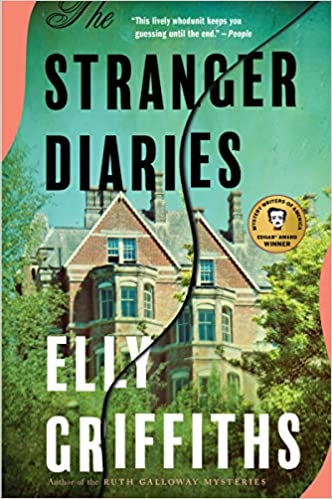
Review 1571: The Stranger Diaries

Here’s a final book for RIPXV!

I have been following Elly Griffiths’ Ruth Galloway mysteries, which I enjoy, but Galloway’s homage to the gothic novel, The Stranger Diaries, is something else again. I thought it was a stand-alone, but Goodreads has it marked as Harbinder Kaur #1, so perhaps there will be more.

Clare Cassidy is a schoolteacher who is writing a book about R. M. Holland, a Victorian gothic writer whose home is now occupied by Clare’s school. He was also the author of a horror story called “The Stranger.”

When she arrives at school, Clare is horrified to discover that her friend Ella was murdered in her home. Later, when Detective Sergeant Harbinder Kaur comes to interview her, Clare learns that a piece of paper with “Hell is empty” was found with the body. Although Clare tells the police that the quote is from The Tempest, she does not say that it is also used in “The Stranger.” Another thing that Clare doesn’t tell police is that Ella had a one-night stand with Rick Lewis, their married department head.
Later, when Clare goes to check her diary to see what she wrote about Ella and Rick, she finds that someone has written a message in her diary. When the handwriting is compared to that of the note by the body, it is the same.

This tribute to gothic literature is atmospheric and truly scary at times. I thought it was terrific.
Related Posts

The Fifth Petal

The Crossing Places

The Janus Stone

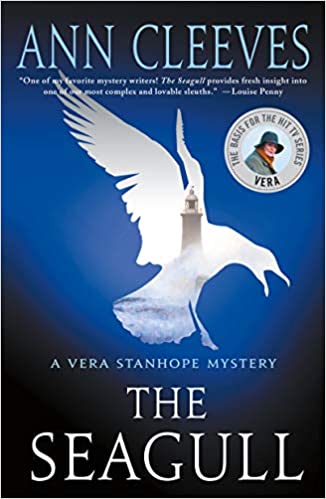
Review 1569: The Seagull

Here’s another book for RIPXV!

Disgraced former superintendent John Brace is dying in prison, so he asks Vera Stanhope to visit him. He tells her he has information about the disappearance years ago of Robbie Marshall. He will tell her where Robbie’s body is if she will check in on his daughter, Patty Keane, a single mother with mental health problems.

Vera does, so Brace tells her he discovered Robbie dead one night and buried him in a culvert on St. Mary’s Island. When the police investigate the scene, they find two bodies in the culvert, a man and a woman.

The team’s investigations seem to indicate that the female may be Mary-Frances Lascuola, the mother of John Brace’s daughter, a junkie who vanished a few years before Robbie did. Then, Gary Keane, Patty’s ex-husband, is found dead. A common denominator that seems to link all of the people the team is investigating is the Seagull, once an upscale nightclub that burned down years ago. Another common link seems to be the Gang of Four, a group of wildlife buffs whose members were John Brace, Vera’s father Hector, Robbie Marshall, and a shadowy character known as the Prof.

This is another complex and interesting mystery by Cleeves. Her novels are always atmospheric with believable characters and difficult mysteries.

Related Posts

The Glass Room

Harbour Street

The Moth Catcher

Review 1546: Murder in the Crooked House

I made several attempts to read Murder in the Crooked House, but it irritated me so much that I stopped even before the famed detective came on the scene. It was published in 1982, but it reminded me more of the super-complicated mysteries of 40 or 50 years earlier that concentrate mostly on the puzzle.

First, Shimada introduces the maze-like house built by the eccentric millionaire Kozaburo Hamamota, a house so absurdly unlikely that it is laughable. Then, he introduces us to a plethora of characters, barely bothering to differentiate them. By 100 pages in, I could only tell apart a handful of them.

Without further ado, including any explanation of the relationships between the characters, he has a strange phantom appear at an upper-floor window followed by the murder of the chauffeur. Two bumbling detectives arrive.

Even the way the characters are introduced, with one character giving an elaborate introduction of everyone else, seems totally contrived. I give up.

Related Posts

Number9Dream

1Q84

Thirteen Guests

Review 1542: Wild Fire

After a strange incident on the beach when kids taunted an autistic boy, that boy, Christopher, finds the nanny of another family hanged in an outbuilding on his family’s property. His parents, Daniel and Helena Fleming, have not found a welcome in the small village of Deltaness, especially since the previous owner hanged himself in the same outbuilding after they built their new house.

Jimmy Perez comes out to the scene and realizes immediately that the girl, Emma Shearer, was murdered, because there is nothing in the building she could have stood on to hang herself. She was the nanny for the Moncrieff children and had been with them since she was 17.

Jimmy summons the CSI team and his boss, Willow Reeves, to the scene. But when Willow arrives, she has news for him. She is pregnant, and he is the father. Jimmy, still confused by the death of his fianceé, Fran, has an unpredictable reaction.

Working on the case, the team has difficulty getting any sense of Emma. It is early established that she had a relationship with Daniel Fleming, but although he admits to having been obsessed with her, he claims they did not have an affair.

This was one of Cleeves’s difficult mysteries, especially as, although there are hints, the perpetrator is not very present in the book. Sadly, this is the last book in the Shetland series, but it’s possible that we’ll see more of Jimmy and Willow.

Related Posts

Cold Earth

Thin Air

Dead Water

Review 1541: The Sun Down Motel

Best of Ten!
In 1982, 20-year-old Viv has run away from her home in Illinois to go to New York City. Out of money, she stops in Fell, New York, and takes a job on the night shift of the Sun Down Motel. Very soon, two things become certain—the motel is haunted, and a lot of girls get murdered in Fell.

In 2017, Carly finds out after her mother’s death that her mother had a sister who disappeared in 1982. Carly decides to travel to Fell, New York, to try to find out what happened to her. When she makes a trip to the Sun Down Motel to ask about Viv, she ends up taking a job on the night shift. Soon, she is investigating a series of women’s deaths beginning in 1979 and ending in 1982.

I don’t very often give five-star ratings in Goodreads and especially not for genre fiction, but this one is terrific. It’s wildly atmospheric, with its haunted old motel, and it has an ending that puts it a step higher than most of the genre. It has a compelling mystery and two exciting endings, one in each time period. A touch of romance doesn’t hurt it, either. I had great fun reading this book.

Related Posts

The Broken Girls

Lost Among the Living

Silence for the Dead

Review 1540: The Uninhabited House

Miss Blake is an eccentric figure whose arrival is looked forward to by the clerks in Mr. Craven’s office, including Harry Patterson, the narrator. She only arrives when the tenants have unexpectedly left her niece’s house, which is all too often. For the house has a reputation.

Miss Blake and her ward Helena have been a charge on poor, kind-hearted Mr. Craven since the death of Robert Elmsdale, Helena’s father. Thought to be wealthy, he was found to be in considerable debt when he died. Now, the house in which he died is supposedly haunted. Mr. Craven doesn’t believe in ghosts and supposes someone is trying to keep the house from being occupied.

After a disastrous lawsuit resulting from the early vacancy of the house by a tenant, Miss Blake declares she will pay £50 to anyone who can solve the mystery of the house. Although Miss Blake has never paid any of Mr. Craven’s bills, Mr. Craven is so desperate to relinquish Miss Blake’s account that he vows to pay the money to anyone who can solve the mystery.

Patterson finds himself in need of money, because he has fallen in love with Helena Elmsdale. So, he volunteers to stay in the house and try to discover its secrets.

This is a joyful little novel despite its theme. Patterson tells the story with plenty of gentle, good-natured humor, and his affection for Mr. Craven is very clear. The mystery is perhaps not too confounding, but the book itself is a pleasure to read, with eccentric characters and lots of atmosphere. Is it a ghost story as well as a mystery? I’ll never tell.

Related Posts

The Uninvited Guests

Lincoln in the Bardo

All Done by Kindness

Review 1537: The Moth Catcher

The body of a young man is discovered beside the road in a remote valley near Kimmerston. He was house sitting for Major and Mrs. Carswell while they are in Australia. When the investigative team goes to the attic apartment where he was staying, they find the body of a middle-aged man in a suit.

The house sitter was a researcher named Patrick Randle, but Vera Stanhope’s team is unable for some time to figure out the identity of the second man or the order in which the two were killed. When they finally identify the second man as Martin Benton, the IT person for a local charity, they have a hard time figuring out what the two have in common. They eventually identify an interest in moths.

In this valley, the only residents are the owners of three barn conversions nearby. Yet, the six people who live there, three sets of retirees, claim not to know either Randle or Benton.

Cleeves always presents real puzzles, and this one’s a doozy. Although the clues are there, I couldn’t figure this one out at all. There’s a slight cheat, in that information discovered 50 pages from the end isn’t divulged until the end, but frankly, even if it was, I’m not sure I’d make the connection. A good mystery, as usual.

Related Posts

Harbour Street

The Glass Room

Silent Voices

Review 1535: The House at Sea’s End

Forensic archaeologist Ruth Galloway is called in by DCI Harry Nelson when a group of archaeologists studying a Norfolk cliff find a collapsed cleft containing bones. There are six bodies, their hands bound. Ruth thinks they are recent, within the last hundred years, and all men.

Ruth’s university determines that the men were German, and Harry’s team begins concentrating on a time during World War II when the Home Guard of the village, Broughton Sea’s End, was preparing for a German invasion. The Home Guard men were led by Buster Hastings, father of the current owner of Sea’s End House, near where the body was found.

In the meantime, Ruth is struggling with the balance between her work, at the university and for the police, and her baby daughter, Kate. She is also concerned because Michelle, Harry’s wife, has been trying to befriend her, unaware that Kate is the result of a harrowing night during Ruth’s first case with Harry.

Aside from one ridiculously easy clue, I found this mystery much harder to guess than the first two. I continue to be interested in the characters and the setting, although it looks like we may be in for major melodrama in the next book. I like the concept of this series, which is inspired by the profession of Griffith’s husband.

Related Posts

The Crossing Places

The Janus Stone

206 Bones

Review 1529: The Second Sleep

There are some authors whose books I’ll buy immediately, and Robert Harris is one of them. This means that I haven’t always read what the book is about, and I seldom read the jacket to remind myself before I begin reading, even if I did when I bought the book. Generally speaking, Harris writes excellent historical novels. So, I was reading along, thinking I was in the 15th century, when I suddenly realized I was reading a dystopian novel set far in the future.

After a cataclysmic event, the world has gone through another dark age, and England has emerged into a pre-industrial-age society ruled by the church with a culture that is superstitious and suspicious. Christopher Fairfax is a young priest who has been dispatched by the bishop of Exeter to a small village, Addison St. George, to see that the recently deceased local priest, Father Lacy, is buried.

Upon his arrival, he notices right away that Father Lacy was a heretic, for he finds a library and a collection devoted to the past, before the Apocalypse. Such studies are considered blasphemous, yet the father has a cache of such objects as plastic straws, Barbie dolls, and iPhones.

Fairfax also begins to fear that Father Lacy’s death may have been different than an accidental slip from a feared local structure called the Devil’s Chair. When he investigates, he finds a huge mass grave where Father Lacy had been digging, but it looks like Father Lacy was chased up the slope, which then collapsed.

This is an atmospheric novel, but I didn’t enjoy it as much as I have Harris’s previous novels. For one thing, the idea of the world going into a familiar religious-based Dark Age after a cataclysm isn’t exactly original. For another, the ending is quite abrupt, and I’m not sure how I’m supposed to interpret what Fairfax and the others ultimately find. It’s disturbing, yes, but what does Harris mean by it? I was also confused about something unexplained concerning the title. Harris includes a quote at the beginning of the book that tells us that Western Europeans used to sleep twice each night, waking and returning to sleep after midnight. During his first night in the village, Fairvax awakens to realize that the villagers have all gotten up and gone out, despite an apparent nationwide curfew. All along I was expecting some weird explanation for this. Instead, Fairfax himself is incurious about it, and what the villagers are doing is never explained. Yet there’s the book’s title, which I assume does not refer to this event but to the second dark age.

Related Posts

Oryx and Crake

The Testaments

Parable of the Sower

Review 1528: The Janus Stone

In the second Ruth Galloway mystery, Ruth is called to a dig at a site of a mansion being converted to luxury flats, because bones are discovered under a doorway. The bones are a child’s, and Ruth is inclined to believe that the grave is more recent than otherwise.

DCI Harry Nelson begins looking at the building’s past as a children’s home. During that time, a teenage boy and his five-year-old sister disappeared. But the teeth put the death a little earlier, when the original family resided there.

This case hits Ruth a little more personally because she is pregnant. The child is Harry’s, the result of an emotional night during the last case, but Harry is married. Then someone begins leaving unpleasant surprises for Ruth.

Like with the first book, I easily guessed who the culprit was, in fact, almost as soon as the character appeared. It is hard for me to tell whether this would be obvious to most readers. I am interested in the characters, though, so I enjoyed the novel and look forward to reading more of the series.

I do want to say something about my Quercus paperback edition, which was not impressive. About halfway through the book, I came across a sticker that was printed over by the text of the book. Later, a half page cut zigzag fell out of the book. When I turned to that page, I found that half of the text was on the zigzag page and half was on the page fastened into the book, which was whole, leaving a zigzagged half-blank page. If the loose half page had fallen out of the book before I got it, I would not have been able to read that page.

Related Posts

The Crossing Places

Red Bones

206 Bones