Day 475: The Beggar King

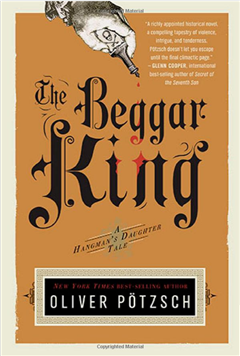
Cover for The Beggar KingBehavior is a problem in The Beggar King, the third of Oliver Pötzsch’s Hangman’s Daughter series, but the first I have read. Characters who are in peril of their lives stop running away from their pursuers to have arguments; characters who are fighting for their lives start flashing back to their pasts instead of concentrating on not being killed. To be very clear about this problem, the characters do what the plot requires. When the plot requires the three main characters to be apart, for example, Pötzsch has them begin arguing or just has someone walk off instead of finding a plausible reason for separating them.

The novel begins in 1662, when the Schongau hangman, Jakob Kuisl, gets a letter from his sister in Regensburg saying she is very ill. When he arrives at the bathhouse her husband owns, he finds her and her husband brutally slain. Immediately afterwards, the authorities rush in and arrest him. Now it is up to the Regensburg hangman to torture him into a confession.

In the meantime, back in Schongau Magdalena Kuisl and her lover Simon Fronwieser have run into trouble. As the hangman’s daughter, Magdalena is considered to be among the lowest rungs of society, and she is not allowed to marry Simon, a member of the middle class. A series of encounters with a group of bullies finally ends in the Kuisls’ house being set on fire. Instead of helping her mother and her eight-year-old twin siblings (who by the way behave more like four or five than eight) as might be expected, Magdalena and Simon decide to run off to Regensburg to start a new life.

I have been to Regensburg, which is a beautiful medieval city with an interesting history. We learn a bit about this history, and that is probably the most interesting part of this novel. The city is mostly described to us in terms of its mud and filth, however, not in terms of its lovely pastel stucco buildings decorated with beautiful medieval-era murals or winding cobblestone streets.

However unlikely, our three main characters have stumbled into two plots, one of revenge against Jakob for events during the Thirty Years’ War, the other involving an imminent threat to the Reichstag. Soon, all three protagonists are wanted by the authorities, Magdalena and Simon for arson after someone burns down the bathhouse with them in it, Jakob because he has escaped. Nevertheless, they chase all over the city without anyone noticing them unless Pötzsch needs them to be noticed. In the meantime, they unfailingly trust the wrong people and assault the ones who are trying to help them.

This novel is certainly full of frantic activity. Whether it is plausible at all is the question. I was particularly irked by the last 50 to 75 pages, in which all three characters are in peril in separate locations. Just as one scene reaches a climax, Pötzsch switches the action to another location. This tactic might foster suspense if done once, but Pötzsch uses this technique repeatedly over 50 pages simply to spin things out. I found this tactic so irritating that I almost quit reading at the end of the book!

Although the novel is written moderately well, the characters are one-dimensional and their behavior is driven by plot. The plot itself is ridiculous.


Day 462: The Return of Captain John Emmett

Cover for The Return of Captain John EmmettThe Return of Captain John Emmett is the first of Elizabeth Speller’s Laurence Bertram mysteries set just after World War I. I previously reviewed the second in the series, The Strange Fate of Kitty Easton.

Laurence Bertram has felt himself at a loss since the war ended. He is haunted by his memories of the war and also by guilt at his lack of grief over the deaths of his wife Louise and baby son, whom he never saw. Ostensibly writing a book about church architecture, he is finding it difficult to work. So, it is with a bit of relief that he responds to a letter from Mary Emmett, the sister of an old school friend John Emmett, in which she asks him to come visit her.

Laurence has fond memories of some school leave visits with the Emmetts after his parents died but feels Mary has misunderstood the depth of his friendship with John, whom he has not seen in years. Of course, he has heard of John’s death, an apparent suicide. Mary explains that John had been staying in a rest home because of mental disturbance following the war. Since he seemed to be improving, she and her mother cannot understand why he committed suicide. She asks John to find out what he can about John’s motives.

Laurence feels uncomfortable but agrees to look into it because he has always been attracted to Mary. With the help of his friend Charles Carfax, who gets his detective skills from reading Agatha Christie books, Laurence investigates the rest home and anything he can find out about John’s state of mind before his death. Included in John’s curious scraps of paper and photos is a list of the beneficiaries of his will, some of whom cannot be identified or located, and some photos from the war.

Laurence comes to believe that John’s death has something to do with his war experience, possibly with an execution over which he was forced to preside. And it seems John may not have committed suicide after all.

Speller takes her time with these mysteries. The settings are beautifully described and the period effectively evoked. A true sense of depth of character emerges. Even though I was about 100 pages ahead of Laurence, not in identifying the perpetrator but in realizing the motive, I enjoyed every bit of this novel.

In the last few months, I have read several historical mysteries where the author did little with the time or place, simply using the historical events to frame the plot. Thankfully, Speller has taken more care with this interesting period of history.

Day 460: March Violets

Cover for March VioletsThe blurb on Philip Kerr’s collection of three noir mysteries, Berlin Noir, compares him to John Le Carré and Alan Furst. I wouldn’t say that is an apt comparison. For one thing, the other two are writing in a different genre. For another, they are better writers. Still, if you like noir, March Violets has its own qualities.

This novel is the first in a series featuring private detective Bernie Gunther. It bears many of the hallmarks of a typical noir mystery. Its main character is a smart, wise-cracking tough guy who used to be a cop. It features beatings, untrustworthy dames, thugs, and murder. What makes it stand out is its setting in 1936 Berlin.

Bernie is hired by millionaire industrialist Hermann Six to find a family heirloom necklace. It was stolen from the safe of his daughter Grete and her husband Paul Pfarr when the two were brutally murdered in their beds and their bodies burned. Herr Six explicitly instructs Bernie not to look into their deaths but to find the necklace and return it to him. Of course, Bernie begins looking into everything.

Using credentials as a representative of an insurance company investigating the fire, Bernie soon finds out that Pfarr was a member of the SS, with a mission from Himmler to seek out corruption in the labor movement. That mission made him a lot of enemies. He also had some kind of friction with Herr Six, who is rumored to have ties to organized crime. In addition, there were unexplained problems in the Pfarr’s marriage.

Typical of noir fiction, the plot becomes very involved. The setting is convincingly evoked, especially the constant threat of violence for ordinary citizens under the Nazis. Bernie specializes in missing persons, and the novel makes clear that hundreds of people go missing from Berlin daily.

Since I am more familiar with classic noir, the novel occasionally struck me as too coarse, but that didn’t bother me as much as other uses of language. First, idioms with which I am unfamiliar are used constantly. Perhaps they are period German idioms, but they often seem clumsy and inapt, which idiomatic  language seldom does. Also clumsy and inapt are Kerr’s many metaphors, for example:

The butler cruised smoothly into the room like a rubber wheel on a waxed floor and, smelling faintly of sweat and something spicy, he served the coffee, the water and his master’s brandy with the blank look of a man who changes his earplugs six times a day.

Perhaps this style of writing is meant as a send-up of traditional noir style, but it is certainly overblown and irritating. (To be entirely dated in my references, it sometimes reminds me of the passages read by Jeff Goldblum’s character in the old TV series Ten Speed and Brown Shoe, but those were explicitly tongue in cheek, and I’m not as sure about Kerr’s writing style.) Although at one point I considered putting the novel aside, I finally decided to continue, and found the book moderately entertaining.

Day 453: Burial Rites

Cover for Burial RitesBest Book of the Week!

Based on the true story of the last woman to be executed in Iceland, Burial Rites is an unusual and original novel.

Agnes Magnúsdóttir has been found guilty of the murder of her employer, Natan Ketílsson, and another man when the novel begins. There is no doubt that Fridrik Sigurdsson committed the act, but Agnes and her fellow servant Sigrídur Gudmundsdóttir have also been found guilty on little more evidence than that they were present at the scene. The younger, prettier Sigrídur, who was Natan’s mistress and Fridrik’s fiancée, is being considered for a pardon, but Agnes is not.

Because Iceland does not apparently have facilities for housing criminals at the time, the District Commissioner Björn Blöndal decides to lodge Agnes until her execution at Kórnsa, the farm of the District Officer of Vatnsdalur, Jón Jónsson. Agnes has requested that the young Reverend Thorvardur Jónsson, newly ordained, supervise her spiritual welfare.

Jón Jónsson’s wife and daughter are horrified to learn they are to have a convicted murderess in their house. Reverend Jónsson, known as Tóti, is confused, feeling insufficiently experienced for the task and unaware that he has already met Agnes.

We first see Agnes on her way to Kórnsa. She has been kept in a storeroom, living in filth and seldom fed, since her conviction. When she arrives at the farm, she seems almost subhuman, grimy and greasy and so thirsty that she gulps down some dirty dishwater given her to wash in. Slowly, through her hard work and unobjectionable demeanor and their own basic decency, the family comes to believe Agnes may not be guilty of the crime.

Although the focus of this novel is the life on the farm and the evolving relationship between Agnes and the family of Jón Jónsson, we eventually learn the truth about the crime, as Agnes confides it to Tóti and the family.

Kent’s gift is for depicting the hard life of 19th century Iceland—the merciless fate of itinerant servants, the prevalence of gossip and superstition, the brutal conditions and physically demanding work. Kent also describes the mental landscape of Agnes, her memories, thoughts, and nighttime dreams, and less frequently those of Margrét, Jón Jónsson’s wife, and of Tóti.

This novel is evocatively written in beautiful, spare prose. It tells a heartbreaking and haunting story.

Day 448: The Tiger in the Smoke

Cover for The Tiger in the SmokeI have only read one other Albert Campion novel, and that was so long ago that all I can remember is not having much of a sense of Campion. I can say the same thing after reading this novel, although it has other qualities. Perhaps one can only get an understanding of Campion through reading the series.

In this post-World War II novel, we get a feel for the effect of the war on London. The wealthier households no longer have servants, shoddy neighborhoods have sprung up near where service men used to gather, the ruins of bombed buildings are everywhere, as are groups of unemployed veterans. To this setting Allingham adds the further atmosphere of a heavy fog that persists over the course of the novel. This fog is vividly described and is almost a character in the novel.

Meg Elginbrodde, a young war widow, has recently announced her betrothal to Geoffrey Levett, a wealthy businessman. Beginning directly after the announcement, however, Meg receives poor-quality street photographs of someone who looks like her husband, Martin Elginbrodde, supposedly blown to bits during a battle. No message has arrived explaining these photos, and when we meet the engaged couple, Geoffrey is dropping Meg off for a rendezvous that Campion has arranged as a trap for the culprit.

Meg is to walk into the train station to meet the man, where Campion and the police will capture him. However, when Meg sees the man at a distance, his resemblance to Martin is so strong that she shouts his name and runs toward him, startling him away. Campion eventually captures him, and Meg is embarrassed and puzzled to find that close up, the man doesn’t look like Martin at all. He turns out to be a low-level criminal named Duds Morrison.

Campion and Detective Charlie Luke are fairly confident that someone hired Duds for the impersonation, but what was it meant to accomplish? Duds isn’t talking; in fact, he seems terrified, and rightly so. Within an hour of his release, he is found stabbed to death in an alley.

Campion notices one thing that helped Meg mistake Duds for her husband. He is wearing Martin’s distinctive coat. When Campion repairs to the unusual household of old Canon Avril, Meg’s father and Campion’s uncle, to investigate, he finds the coat was recently in the house. How could it have fallen into the imposter’s hands?

Soon the police find a connection between this case and the escape from jail of a very dangerous man, who calls himself John Havoc. Havoc murdered an eminent physician to escape and subsequently killed three people trying to break into the law office that handled Martin Elginbrodde’s estate. He did not escape, though, early enough to have killed Duds.

In the meantime, Geoffrey Levett is missing.

The plot of this novel, like many of those from the Golden Age of Detective Fiction, is absurd. However, the novel is notable for its strong and vivid characterizations—of one of fiction’s first sociopaths as well as of the many unusual and delightful characters living in Canon Avril’s house. Campion himself remains a quiet character instead of being a presence such as Lord Peter Wimsey or any of Christie’s detectives.

Day 444: Murder at Mansfield Park

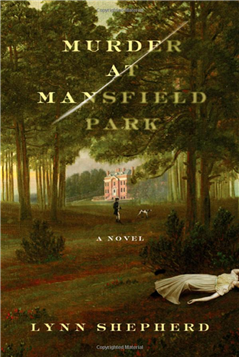
Cover for Murder at Mansfield ParkIt’s hard to explain my fascination with the books of Lynn Shepherd, even to myself, when she repeatedly skewers the books and some of the characters I love with her dark reinterpretations.

The cover of Murder at Mansfield Park quotes the literary critic Lionel Trilling: “Nobody, I believe, has ever found it possible to like the heroine of Mansfield Park.” Apparently, Shepherd shares his views.

That heroine, of course, is Fanny Price, and I have to admit I do like her in the original novel, even though she is not my favorite Austen heroine. Shepherd had to jump through some hoops in her recasting of Fanny, however, to get her to be really unlikable.

In Shepherd’s novel, instead of Fanny Price being the despised, impoverished orphan living with wealthier relatives, Shepherd transforms her into a spoiled heiress, whom the Bertrams and the dreadful Mrs. Norris treat better than their own children. Fanny’s marriage with her cousin Edmund Norris has long been planned, at least by Mrs. Norris.

Mary Crawford in the original novel was the worldly socialite whose lax views eventually shocked Edmund into dropping her, but in Murder at Mansfield Park, she is the heroine. Her brother has been hired to redesign the grounds of Mansfield Park. In this novel, she has switched positions with Fanny Price in that she and her brother have little money, and Mrs. Norris treats them with disdain.

Fanny shows little desire to wed the introverted Edmund and finds entertainment in filching suitors from her cousin Maria Bertram and being nasty to everyone. I would not usually give away an event that occurs well into the novel, but the blurb makes no secret that Fanny is eventually found murdered after going missing for some weeks. Suspects abound. Charles Maddox, Shepherd’s sleuth, arrives to solve the crime.

I don’t think I enjoyed this reimagining of Austen’s novel as much as I have some of Shepherd’s others, even though she is amazingly adept at recreating Austen’s writing style. I think my reaction is because she probably could have achieved a similar effect, more subtly, without changing so many aspects of the original story.

I don’t mean to imply, however, that I didn’t enjoy the novel. Shepherd has made a very interesting career for herself by putting a dark spin on classic novels, and it is always entertaining to read her. She is a wonderful writer, and she gets the period details and style of dialogue correct. I think my favorite of hers, however, is still her chilling rewrite of Bleak House.

Day 438: In the Lake of the Woods

Cover for In the Lake of the WoodsBest Book of the Week!

In the Lake of the Woods is a mystery, but not in the traditional sense. It is also a harrowing look at one man’s tormented psyche after the trauma of war.

It is September 1986. John Wade and his wife Kathy have retreated to a remote cabin on Lake of the Woods in far northern Minnesota after John sustained a brutal defeat in a state senatorial campaign. Wade had been beating his opponent handily until information about Wade’s past surfaced, or perhaps it was only rumor.

One day Kathy disappears. Thinking she is just out for a hike, Wade does nothing for awhile, waiting for her to return. Late that night he goes into the village for help.

This all seems fairly straightforward, but O’Brien periodically presents us with a story about what actually happened, only the story is different each time. As O’Brien reveals more, we learn that Wade was behaving oddly the night before Kathy disappeared–or did she disappear that night? Is she lost, did she leave on her own, did something happen to her? We learn that Wade has taught himself to forget anything he doesn’t want to think about–as if it never happened.

O’Brien shows us the psychological makeup of a man who has undergone a great deal of trauma–whose father committed suicide when he was ten, who spent his boyhood in the basement teaching himself magic tricks, who served in Vietnam. But he is also a man who periodically spies on his wife, who calls himself the Sorceror, who makes of himself a master manipulator, who has horrible nightmares.

O’Brien alternates chapters about the search with those that explore Wade’s past. He also includes chapters of excerpts from interviews of those involved and from other sources as diverse as books on psychology, biographies of politicians, and records of military massacres, such as the Battle of Little Bighorn and My Lai.

This novel is absolutely riveting, written in spare and beautiful prose, disturbing and powerful. It is not so much a mystery as a novel about mystery–why we find it fascinating and what we can never know, a single human soul.

Day 435: Literary Wives: The Wife, the Maid, and the Mistress

Cover for The Wife, the Maid, and the MistressToday is another Literary Wives posting, where along with several other bloggers, I post reviews of the same book with the theme of “wives.” For more information, see my Literary Wives page.

The famous disappearance of Judge Crater, who like Jimmy Hoffa was never heard from again, certainly has potential for a noirish whodunnit. I just wasn’t that satisfied with Ariel Lawhon’s version of the story.

For one thing, although the plot has all the elements of a noir mystery, the writing style doesn’t reflect the cold crispness and snappy dialogue I expect from noir. It is merely pedestrian.

At the beginning of the novel, Judge Crater’s wife Stella meets Jude Simon, the detective who was on the case, years later in 1969 to give him a confession. Then we return in time to 1930. The bulk of the novels flits restlessly between different days and times around and before this period, returning occasionally to 1969 to Stella and Jude’s meeting.

This time shifting was one of my problems with the novel. I do not remember dates readily, and it was difficult for me to keep my place in time. Possibly a fault that will be cleared up in the published book (I was reading an advanced reading copy) is the problem of the dates at the beginning of sections, which sometimes are there to signal a change in time and sometimes are not. The first time the time changed with no indication, I thought it was a mistake, but then it happened several more times.

In addition, a few scenes that return to an earlier time have no apparent purpose. Perhaps they are intended to establish something about the Craters’ relationship, but I find them unnecessary to the story. The example that comes to mind is a dinner scene where the judge tells Stella where he wants her to shop from then on.

For the plot, the judge disappears at the beginning of the book. His mistress Ritzi is hiding in the room when he is taken, so it is no surprise to find out who took him. His wife Stella and their maid Maria also have some guilty knowledge. Maria sees her husband Jude plant some money in the house after the judge’s disappearance, and Stella removes money from the house and all their assets from the bank before reporting the judge as missing.

Overall, I found the novel mildly entertaining. It does manage a surprise at the end, which I didn’t expect because the novel seemed otherwise predictable. I also think more could have been done to make the time period and the setting more evocative.

Now to our questions for Literary Wives.

What does this book say about wives or the experience of being a wife?

There are two prominent wives in the novel–Stella and Maria. The judge sees his wife’s role as being an ornament and an asset on his way to the top, and Stella seems to have agreed to take this role, although she obviously has lost her respect for him over time. There are some references to happier times, but we frankly can’t see that he has any redeeming qualities. Stella’s only other concern seems to be to make sure she has money after the judge’s disappearance.

Maria’s relationship is more loving. She seems to see her role as to protect and support her husband and to try to become a mother. However, we don’t really see very much of Jude and Maria together, and Jude seems to be preoccupied with his difficulties at work.

In what way does this woman define “wife” or is defined by “wife”?

Except for one central act, which I don’t want to give away, both women are essentially defined by their roles as wives, which are fairly stereotypical for the time. Stella is the society wife. Maria is the religious little woman. This defining act tells us there is more to both of them, but we don’t really understand these women very well as people, and this act is only revealed at the end of the novel, giving us no opportunity to view them in another way. I think Ritzi is the most fully developed character, and although she is actually a wife as well, that part of her character isn’t really explored.

Be sure to view the posts of the other “wives,” as follows. An interview with Ariel Lawhon is posted on Audra’s blog, Unabridged Chick.

Ariel of One Little Library
Audra of Unabridged Chick
Carolyn of Rosemary and Reading Glasses
Cecilia of Only You
Emily of The Bookshelf of Emily J.
Lynn of Smoke and Mirrors

Day 426: A Fatal Likeness

Cover for A Fatal LikenessIn A Fatal Likeness, Lynn Shepherd has created her own gothic horror around the mysteries in the real lives of two fans of the gothic, the poet Percy Bysshe Shelley and his wife, the writer Mary Shelley. It is not only a dark story, but some of it is relatively plausible, given the research Shepherd has done into their lives. Ever since I read Shepherd’s astounding reworking of Bleak House, The Solitary House, I have been a fan of her narrative skills, her writing skills, and her imagination.

Shepherd’s detective, Charles Maddox, is summoned to the home of Percy Shelley, the son of the deceased poet. Shelley and his wife have established a shrine to the poet’s memory and say they are worried about some papers someone is offering to sell them. Mrs. Shelley in particular has been responsible for destroying any papers that would tarnish Shelley’s legacy. They hire Charles to find out what is contained in these papers.

Charles has his own reasons for taking the job, for his beloved great-uncle, also Charles Maddox, the master detective who trained him and is his only family, suffered a stroke upon receiving a calling card bearing the name of his client. Charles learns from his assistant Abel that his great-uncle was employed on a case years before for William Godwin, the brilliant philosopher and Mary Shelley’s father. When the file on this case is located, though, some of the pages have been torn out.

Charles takes a room in the home of the person purveying the papers, whom Charles has been told is an Italian man, and it is not long before he realizes his landlady is Clair Clairmont. Clair, the step-sister of Mary Shelley, infamously ran off with Shelley and Mary when both the girls were only sixteen and Shelley was still married to his first wife, Harriet.

Charles is soon to realize that everyone involved in this case has ulterior motives, those of the Shelleys to find out whether a record of the earlier case still exists, as it certainly contains damaging information. With his great-uncle only slowly recovering, it is up to Charles to discover what mysteries lurk in the Shelleys’ past. As he investigates the earlier case, he finds records of an even earlier encounter with his great-uncle.

The Shelleys’ past is a rat’s nest, with two young suicided women, Shelley’s first wife and Mary’s other step-sister, with several dead infants, with Shelley’s own history of delusions, hallucinations, fits, and obsessions. Each person’s story of the fraught years of the Shelleys’ relationship is different, and it is difficult to know what or whom to believe. It is not long before Charles is to think Percy Shelley was something of a monster.

Doubles are a theme throughout the novel. Shelley is always involved with two women at once, two young women commit suicide, Shelley is obsessed with the idea of a doppelganger and thinks he has encountered a monster with his own face. Charles’ great-uncle was partially deceived long ago by the likeness he perceived between the young Mary Godwin and a lost love.

Shepherd’s writing style is distinctive. She writes in limited third person but overlays this voice occasionally with observations from a more knowing narrator of a later time, perhaps the present. The effect is slightly facetious and ironic in tone.

Her research into this time period and into the lives of the Shelleys is clearly extensive. She impressed me with The Solitary House and here she continues to do so with a fascinating, disturbing tale about some turbulent personalities.

Day 423: Accidents Happen

Cover for Accidents HappenKate Parker has lived the last five years in fear, not of something specific but of harm to herself or her son Jack. She believes she is cursed. First, her parents were killed in a freak accident on the night of her wedding, and then a few years later her beloved husband Hugo was viciously murdered by a gang of men who were trying to steal his car.

Since then, Kate has been obsessed with numbers, the odds of this or that happening that could hurt her or her son. She has gotten so fearful that her in-laws are threatening to sue for custody of her son, claiming she is harming his mental well-being.

Kate is not just being paranoid, though. Fairly early on, we learn that someone is regularly breaking into her house from the student rooming house that shares a wall.

Kate meets Jago Martin, a professor at Edinburg University who is visiting at Oxford. He has written a book that fascinates her on the statistics of events. Once he finds out her problem, he begins a series of unorthodox experiments with her to try to draw her out of her fears. Soon, she seems to be improving, and she is becoming attracted to Jago.

This novel does a fairly good job of building suspense. However, I feel the whole “treatment” idea to be unlikely, first that Kate would agree to do some of the experiments–actually any of them given how she was behaving before–and second that they would help her improve so quickly. There are other plot points I find unlikely, but I can’t discuss them without giving too much away. Let me just say that although the motivation for some actions may not be completely absurd, the chosen target makes no sense at all. Finally, after a villain comes into the open, given the time and effort expended on the tortuous plot, the manner of resolution seems too easy. With these mysterious comments, I will leave you to decide for yourself whether to read the book!