Day 352: Junkyard Dogs

Cover for Junkyard DogsI read this novel completely out of order with the others, but then I’ve been reviewing them out of order, too, so I guess that’s irrelevant.

First, old George Stewart, who owns the junkyard in Durant, Wyoming, is dragged behind a Toronado by his granddaughter. Then he is attacked by his neighbor. When Walt finds him in an attempt to investigate the first incident, he is dead, but not from these attacks. Someone has shot him.

Perhaps George’s death has to do with a new housing development next to the junkyard. The developer would like to remove the junkyard from the immediate vicinity of the homes he is building.

In the meantime, Walt is using the investigation of a severed thumb to try to keep his deputy, Santiago Saizarbitoria, who is considering quitting after being shot in the last book. Although Walt already knows that someone has claimed the thumb, he wants to keep Saizarbitoria busy and engaged in the hopes that he will stay.

Walt is also dealing with an eye injury and uncomfortable feelings about his daughter’s upcoming marriage to the brother of his other deputy, Victoria Moretti.

As I have said before, I think Craig Johnson is a great storyteller, and I love the setting of these modern-day western novels. To Junkyard Dogs, Johnson adds a touch of an offbeat sense of humor.

Day 350: The Man Who Went Up in Smoke

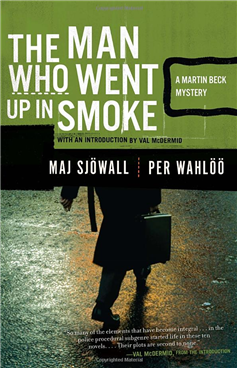
Cover for The Man Who Went Up in SmokeAt first, I thought this novel, written in 1966, was a little more dated than Roseanna, by the same authors. However, except for the formality in the characters’ dress, it stopped feeling dated after awhile.

Inspector Martin Beck has been on vacation with his family less than a day when he is called back to take charge of an unusual case. A Swedish journalist named Alf Mattson has been reported missing by his editor. The difficulty is that he disappeared in Budapest. There can be no official investigation because the Hungarian police have not received an official request for assistance, so Beck must travel to Budapest unofficially.

In Budapest Beck is able to retrace Mattson’s movements right up until he disappeared, one day after arriving. He visits a youth hostel where Mattson spent the first night and hears through his colleagues back in Sweden that Mattson claimed to have a girlfriend there. But when Beck finds her, she denies knowing Mattson.

Beck feels himself at a loss. His discussions with the Budapest police have not gone very far. The police can’t conduct a full-blown investigation until Mattson’s visa expires, but they have made some inquiries. It is not until Beck is viciously attacked that he understands he is getting somewhere.

Sjöwall and Wahlöö are known for having reinvented the police procedural, and many of its present-day conventions were first used in their novels. The novels are well written and deal with common people more often than with career criminals or gangsters.

Day 348: A Fatal Grace

Cover for A Fatal GraceIn this second novel of the series, Inspector Gamache is investigating the death of an old bag lady when he is called back to Three Pines to solve the murder of a very unpleasant woman. C C de Poitiers is a minor celebrity who is poison in the village because she treats others so callously. Now she has met an unusual and complicated death, electrocuted while watching a curling game on the day after Christmas.

Gamache has lots of suspects, including the victim’s hen-pecked husband and her daughter, whom she continually heckled about her weight. But as he investigates, he finds that Poitiers was not who she said she was.

In an ongoing plot, Gamache’s career is threatened by an old case where he took down some crooked officers high in the force. He has two new members of his team, local agent Robert Lemieux and agent Yvette Nichol, taken on because he likes to mentor young officers. However, one of them is working for his enemies by helping them sabotage his career.

It is always a pleasure to return to Three Pines, and I like the generous Inspector Gamache. Apparently some readers who were charmed by the picturesque village in the first novel were disenchanted by this sequel, but a mystery series about murders in a small town is bound to affect the atmosphere of the location. My favorite of the series so far is actually the one that took place in Quebec City, and it’s hard to imagine how many more people Penny can kill off in this village, but I still enjoy the series.

Day 346: Behold, Here’s Poison

Cover for Behold Here's PoisonAlthough Georgette Heyer’s Regency romances are some of the best historical fiction around, also entertaining are her few mystery  novels, set in the time period in which they were written (this one in 1936). The only problem with many of them is that the murderer is frequently the only unlikeable character (except the victim, usually) and therefore highly identifiable. However, Heyer’s novels are character driven, and her lifelike and amusing characters are what make them so enjoyable.

There are plenty of characters to dislike in Behold, Here’s Poison. Gregory Matthews is found dead at his country home. His family assumes the death is because of his bad heart, but the police find traces of nicotine poisoning.

Suddenly, all of the surviving Matthews are suspects, including the domineering Aunt Gertrude, hypocritical Zoë Matthews, and malicious nephew Randall. Inspector Hannasyde and Sergeant Hemingway find that one big stumbling block is their difficulty in figuring out how the poison was administered.

The dialog is especially witty in this novel and the characters lively. As always, Heyer is a brilliant writer.

Day 344: Tuesday’s Gone

Cover for Tuesday's GoneTuesday’s Gone is the second mystery/thriller featuring psychotherapist Frieda Klein in a series that is turning out to be quite exciting. A social worker calls on a mentally ill client for a first visit at a grimy, squalid hostel. The client, Michelle Doyce, leads her in to her apartment and introduces her to her guest–a naked man who has been long dead.

The police, embattled with cost-cutting measures, are inclined to close the case even though the victim has not been identified, but DCI Karlsson wants to see what Frieda Klein makes of Michelle, who seems to be talking nonsense. Frieda soon concludes that, rather than having strangled the victim, Michelle suffers from a rare disorder that makes her unable to distinguish the animate from the inanimate and was trying to help him.

When the victim is finally identified, he turns out to be Robert Poole, an apparently charismatic and charming con man and identity thief. He seems to have several potential murderers, but none of them appears to bear him any ill will.

In the meantime, Frieda is slowly beginning to realize that the case from the first book, Blue Monday, is not closed, because the murderer is not dead, as believed. Frieda is sure he is lurking somewhere nearby. She is also involved with troubles with her family and among her friends, as well as the return of her ex-lover Sandy from the US.

Frieda is an interesting character–a loner who likes to walk the streets of London at night and prefers to keep her own counsel yet has several close friendships. The mysteries are involving and complex, and although I figured out who the murderer was before the secret was revealed, it was only a bit earlier. Although the married writing team who calls itself Nicci French builds suspense slowly, the final chapters of the novel are quite thrilling.

Day 342: The Tryst

Cover for The TrystThe Tryst is an odd book by Michael Dibdin, the author of the Aurelio Zen mysteries. Although billed as a crime novel, it takes some time to get around to the crime. In fact, it misleads us into thinking it is one type of novel when it is actually another.

The novel follows the actions of two characters, a homeless boy and the therapist who is trying to figure out why the boy is pretending to be insane. Gary Dunn has come to the psychiatric hospital where Aileen Macklin works as a psychiatrist requesting institutionalization and insisting that someone is trying to kill him.

We find out that Gary, a glue-sniffing boy who lives with a bunch of junkies, has befriended an old man. Although Gary’s mates would like to rob the man, Gary has become involved in the old man’s long, involved story about a former employer who sees a beautiful woman no one else sees. In the story, the employer follows the woman to his death. This story eventually connects the fates of Aileen and Gary.

Ultimately, the novel doesn’t work that well, because it starts out being a crime thriller and turns into more of a gothic novel/ghost story. It is too much one kind of novel to work successfully as the other kind. Although the novel is well written and interesting, it reads almost as if Dibdin started with an idea and changed his mind in midstream. For a better example of a book that combines a crime story with a ghost story, read Johan Theorin’s fantastic The Darkest Room.

Day 340: Death on the Nile

Cover for Death on the NileIn this classic Agatha Christie mystery, Hercule Poirot observes a young couple at a restaurant in London and thinks their behavior indicates that the woman loves the man too much. A few months later he meets them again in Egypt, but the man, Simon Doyle, has married the woman’s rich friend Linnet. The first woman, Jacqueline de Bellefort, is haunting their every move during their honeymoon. Poirot thinks no good can come of it and tries to tell Jackie to leave the Doyles alone.

The Doyles sign on for the same Nile river cruise as Poirot. To their fury, Jackie appears on board. Also on board is Poirot’s friend Colonel Race. Race is hunting a criminal who has murdered several people. He believes the person is on board, but has not been able to identify him.

On a tour of some ancient ruins, a boulder falls, nearly missing Linnet and Simon. The obvious suspect is Jackie, but she was on the boat the entire time.

That evening, the drunken Jackie makes a scene in the lounge and then shoots Simon in the leg. The next morning Linnet is dead from a gunshot wound, but both Simon and Jackie seem to have solid alibis. The nurse was with Jackie all night, and Simon was incapacitated with his injury. Poirot and Colonel Race begin looking into other enemies that Linnet may have had.

I think Agatha Christie is the best of the “Golden Era” mystery writers at characterization. She quickly sketches convincing and sympathetic characters. Sometimes you even sympathize with the murderer. Her books are also often set in exotic locations and give you a flavor of a certain place and time. I always find Christie’s mysteries to be enjoyable, and they make fun beach reading.

Day 338: Raylan

Cover for RaylanMy husband and I recently got hooked on the TV show Justified, which is just as surprising to us as to anyone who knows us, because it is fairly violent. One of the things we like about it is the well written, darkly humorous script. After we watched a couple of episodes, I paid more attention to the credits and discovered that the series is based on stories by Elmore Leonard, which explains a lot. It was with interest, therefore, that I discovered this book, titled after the main character in the series, Raylan Givens.

Marijuana growing has become the cash crop for Harlan County, Kentucky. As a deputy US Marshall, Raylan Givens isn’t concerned with drug enforcement. But Dickie and Coover Crowe have decided to expand their drug business by dealing in body parts. When Raylan tries to serve a federal warrant against Angel Arenas, another marijuana dealer with ties to the Mexican Mafia, he finds him bloody in his motel room with his kidneys removed.

Raylan is on to Dickie and Coover very quickly, as they’re not the brightest of bulbs. He is more interested in catching the doctor who is removing the organs, figuring the Crowe boys aren’t smart enough to cook up this scheme themselves.

This case is solved about midway through the novel, and Raylan gets roped into providing security for Carol Conlan, a representative for a coal company that wants to blast the top off the last remaining mountain in the area. Raylan is not sympathetic, but he is more concerned about the old man who was supposedly shot to death by Boyd Crowder after firing his shotgun at Carol. The old timers who knew Otis claim that if he was shooting at Carol, she’d be dead.

The writing is darkly humorous, with the style of the local dialect skillfully recreated. My problem with this novel is it has no focus except perhaps around the character of Raylan. It reads as if it were quickly put together from several short stories rather than plotted out as a novel. I was a little disappointed.

Day 330: Adamtine

Cover for AdamtineAdamtine is the second of Hannah Berry’s moody noirish graphic novels after Britten and Brülightly. Whereas the first novel was a noir crime effort with a wry sense of humor (the detective’s partner is a tea bag), it is not clear to me whether Adamtine is a crime or a horror novel.

Four people who know something about an earlier series of disappearances are traveling home on a train when it stops in the middle of nowhere. At the time of the earlier crimes, a man named Rodney Moon was put on trial, but he claimed to have only passed notes to the victims. There are hints of the involvement of a large corporation.

The story is told with flashbacks to the previous crimes, although it was difficult for me to tell sometimes which scenes are those from the past and which are from the present. It was also unclear to me what exactly happens to the people, but perhaps the atmosphere created is of most importance.

The art is beautiful, with its muted, moody tones. I think this graphic novel is visually interesting and intriguing, but I find it difficult at times to completely understand the parts of the narrative that are told only in pictures.

Day 329: Still Life

Cover for Still LifeStill Life is the first of Louise Penny’s Inspector Gamache mysteries. It provides us an introduction to the kindly Gamache and his team and to the beautiful village of Three Pines, where many of the subsequent mysteries are set.

An elderly woman named Jane Neal is found dead in the woods near Three Pines, shot apparently by a careless bow hunter. Inspector Gamache and his team are initially called in to ascertain whether the suspicious death is an accident or a homicide. Gamache quickly determines that the death was a homicide and then begins to look for the murderer.

Although Jane was highly regarded by most folks in the village, one suspect is her cold and greedy niece, Yolande Fontaine, who can’t wait to get her hands on her aunt’s property. Her husband has a criminal record, and her son is a delinquent who may have been out with a bow on the day of the murder.

Through this novel we get to know the characters who recur throughout the series–Olivier and Gabri, the gay owners of the bistro and bed and breakfast; Clara and Peter Morrow, local artists; Myrna Landers, a former psychologist who owns the bookstore; and Ruth Zardo, an eccentric curmudgeon who turns out to be a famous poet. Another important character is Ben Hadley, Peter Morrow’s best friend for years, whose mother died a month before from cancer.

Penny’s mysteries have the feel of cozies set in a small village, like some of Agatha Christie’s Miss Marple books. Her characters are well developed and interesting. The peaceful atmosphere of the village is palpable. I had a disadvantage in reading this novel after most of the others, so it was clear to me that the murderer was someone who no longer lives in the village in the later books. This narrowed the field considerably. I would advise those who are interested in reading Louise Penny’s series to start with Still Life and try to move forward in order.