Day 273: Sun and Shadow

Cover for Sun and ShadowTwo people are murdered in their apartments and their heads exchanged. Erik Winter and his team try to figure out what this means, fearing that a serial killer is at work. At the same time, Erik tries to cope with his father dying in Spain and his girlfriend’s pregnancy.

Edwardson, as with other Scandinavian mystery writers, tends to depict police work more as a grind than as food for a thriller. In this case, suspense was generated because, from almost the beginning, I was convinced the murderer would kidnap Erik’s girlfriend.

The novel was also clever enough to trick me. I was sure that the murderer was a certain character, but the book made me think that the killer was another person. It turned out I was right all along.

If you are interested in a slower-moving mystery that grows organically and is probably more realistic than our American mysteries/thrillers, you may enjoy reading Ǻke Edwardson.

Day 271: The Abyssinian Proof

Cover for The Abyssinian ProofIn 19th century Istanbul, the magistrate Kamil Pasha  is assigned to find out who is stealing valuable relics throughout the city and selling them to London. He is instructed to find the relics and bring them back to where they belong. One of the relics is contained in a reliquary that has been guarded since the last days of the Byzantine Empire by a sect of Abyssinian descent called the Melisites. The relic is called the Proof of God.

Kamil is an upright and dedicated civil servant. While he is investigating, he learns about the history and beliefs of an odd group of people, the descendents of Abyssinian slaves who live in an abandoned cistern and are part of the city’s underworld.

In pursuit of the relic thieves and in investigation of some apparently related murders, we follow Kamil through the subterranean passages under Istanbul.

Kamil is also attracted to Elia, a refugee artist who lives in his sister’s house. Elia has suffered terribly, though, and is not really prepared to pursue more than friendship.

As with Barbara Nadel’s more modern Turkish mysteries, I find novels set in this exotic locale interesting, and the history presented in The Abyssinian Proof is fascinating. Sometimes, I wish that Kamil Pasha wasn’t quite such a serious man, however.

Day 268: Still Midnight

Cover for Still MidnightWhen I first started reading this crime novel, I had the feeling it would end badly. However, although it is very complex, it ties up loose ends in a satisfying way.

Alex Morrow is a bitter Glasgow cop who feels she has to compete with her male colleagues, especially with Bannerman, who is favored by her boss. It is her turn to take the next big case, but when an elderly Ugandan man is abducted from his home, the boss gives the case to Bannerman.

We follow the inept, amateurish kidnappers, who have smashed their way into the house demanding a person who has never lived there or been inside. On the other hand, we watch Morrow’s attempts to work on the case without letting Bannerman take the credit for all her breakthroughs.

I have long been a fan of Denise Mina, who has written several gritty series providing us fascinating glimpses of a grim urban Scotland.

Day 264: The Ballad of Tom Dooley

Cover for The Ballad of Tom DooleySharyn McCrumb has written several series of light mysteries, some better than others. I have usually enjoyed her “ballad” series–atmospheric, sometimes ghostly mysteries set in Appalachia and each named after a traditional folk ballad. The Ballad of Tom Dooley, despite a background of historical research (because this folk ballad is based on a true case), is not her best, however.

According to McCrumb’s notes at the end of the novel, she got interested in the story after researching it for an article and decided that the prevailing theories of the crime are not satisfying. So, she reconstructed her theory of the crime in this book. As such, it is not so much a mystery as an explication.

Most people vaguely know the story, that Tom Dooley (actually Dula) met Laura Foster “on the mountain/stabbed her with [his] knife.” Another defendant, Ann Melton, was let go. But McCrumb says most people in Wilkes County, where the crime occurred, will tell you Ann did it. To McCrumb, knowing that Ann was Tom’s long-time married lover, Tom being guilty didn’t make sense.

The novel is narrated by two characters who were actually involved in the incident: Pauline Foster, who was Ann Melton’s cousin and servant girl; and Zebulon Vance, the ex-governor and senator of pre-Civil War North Carolina who defended Tom. Pauline is an interesting character–McCrumb depicts her as a sociopath who manipulates the others and wants revenge for Ann’s slights.

The biggest fault in the novel is the narration of Zebulon Vance. At first, I thought McCrumb’s intent was to depict him as a maundering old bore, possibly even senile, as his section is so repetitive and adds so little to the narrative. It is mostly about himself and has little to do with the story. But then I read that Vance’s career was one reason McCrumb wanted to do the story. Instead of adding to it, it detracts from and drags against the impetus of the plot.

The fact is that none of the characters are likable people, and the crime isn’t particularly interesting. From the author of some haunting stories, this novel is a disappointment. If McCrumb wanted to write about Vance, she may have done better to write a biography.

Day 263: A Great Deliverance

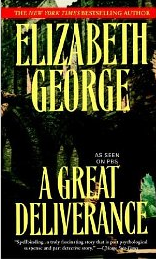
Cover for A Great DeliveranceAlthough Elizabeth George’s Inspector Lynley series seems to be floundering with the past few books, the first dozen or so were really good. A Great Deliverance is the first one in the series.

Father Hart comes to Scotland Yard to ask for help. Roberta Teys, the daughter of a farmer, has been found in the barn next to the bodies of her father and the family dog, both of whom have been attacked with an ax. Father Hart begs for someone to investigate the apparently open-and-shut case, as Roberta has confessed to the crime and now refuses to speak. Father Hart says he believes the girl, who seems to be mentally handicapped, is innocent. Barely registering in the background, someone is killing men on the subway.

Inspector Thomas Lynley is given the Teys case, and he has just been assigned Detective Sergeant Barbara Havers as his partner. Havers is a belligerent, untidy working-class woman who is being given a final chance, since she has failed to work well with other supervisors. She believes that the immaculate Lynley, the eighth Earl of Asherton, is nothing but an upper-class fashion plate, playboy, and womanizer.

Lynley is dealing with his own problems, because the woman he loves is about to marry his best friend, Simon St. James. He also bears guilt because St. James is crippled from an auto accident in which Lynley was driving. Lynley is actually relieved to be called away from the wedding reception to deal with the murder investigation.

Lynley thinks the roots of this murder may be in the past. Roberta’s mother disappeared when she was a child. Was she actually murdered? Roberta’s older sister also ran away from home. What happened to her?

This novel and the first books of this series perfectly meet my taste for mystery novels that are on the dark side. I find Lynley and Havers to be engaging, with fully developed personalities. The novels are complex and the plots exciting. I have not tired of the incidental characters, as I often do. I am just sorry that the more recent novels have taken some turns I do not find appealing or interesting, since for so many years, I could rely on an Elizabeth George mystery to be a great read.

Day 261: Blue Monday

Cover for Blue MondayI never read Nicci French before and was at first irritated by Blue Monday because the reader is introduced to several characters, using a shifting third-person limited narration, without understanding who they are or why they’re important. Eventually, though, I was able to fasten on Frieda Klein as the main character.

The novel begins in 1985, with nine-year-old Rosie going home from school, followed by her five-year-old sister Joanna. Rosie takes her eyes off Joanna briefly, and the little girl is gone.

Twenty-two years later, a little boy, Matthew Faraday, disappears on his way home from school after his mother is late picking him up. Although at first the crimes don’t seem to be connected, Detective Chief Inspector Karlssen thinks they may be.

Psychiatrist Frieda Klein has recently taken on a new patient, Alan Dekker, who claims to be having such troubling obsessions that he can’t sleep or function correctly. They are about having a son, a boy he can play ball with. He is unable to have children but he doesn’t want to adopt. He obsessively wants a son, one who looks like him as a boy–exactly like the missing Matthew Faraday.

Confidentiality laws apparently not being exactly the same in England as they are in the states, after some soul searching, Frieda feels she must go to the police. Karlssen is impatient with her until she tells him that Alan had these feelings once before about having a daughter but they went away–just around the time of Joanna’s disappearance.

This psychological thriller, which is the first in a series, turns out to have a couple of twists I have never before encountered, so proved to be very interesting. Frieda is an unusual heroine, a cold, analytical person who roams the streets of London at night because of insomnia. I think it would be well worth it to continue reading books in this series.

Day 258: Busman’s Honeymoon

Cover for Busman's HoneymoonI have always thought that, with a few exceptions, the arrival of Harriet Vane into the Lord Peter Wimsey series pretty much ruined it. Some of those mysteries are not so bad, and Have His Carcase (wherein Lord Peter meets Harriet) and Gaudy Night (wherein Harriet solves a mystery on her own) are very good, but Busman’s Honeymoon is just too sappy. It is hard to know if Peter and Harriet’s marriage is Sayers’ idea of an ideal relationship or a reflection of some relationship she actually had, but I find that Lord Peter’s galumphing happiness contrasts strangely with Harriet’s odd undertones.

Lord Peter and Harriet are married and travel for their honeymoon to a house they bought in the country. But when they arrive, they find the house is not ready for them and the previous owner, Mr. Noakes, is nowhere to be found–until next morning when Bunter finds him dead in the basement. In the meantime, the servants have been cleaning, and all the clues are gone.

One positive point for the novel is that the Dowager Duchess shows up, a favorite character. We also get a little more background on the relationship between Wimsey and Bunter.

I guess this isn’t the best selection for Valentine’s Day, since I’m criticizing it for sappiness, but if you have different tastes than mine, you might like it. I see that the reviewers on Amazon are remarking at how romantic it is. And also commenting on the subtle humor. Well, I didn’t find it so subtle.

Day 256: The Truth-Teller’s Lie

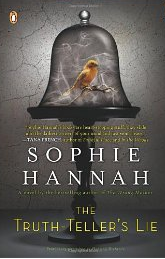
Cover for The Truth-Teller's LieIn The Truth-Teller’s Lie, Sophie Hannah has written another perplexing, dark tale. (Caution, book buyers: as with some other of Hannah’s book, this one was previously published under another title–Hurting Distance.)

Naomi Jenkins has a secret she has never told anyone–that a few years ago she was viciously raped. Lately, she has been having an affair with a married man, Robert Haworth. When he doesn’t turn up for their weekly meeting, she is convinced that something has happened to him, but she can’t get Detectives Charlie Zailer and Simon Waterhouse to do more than ask his wife about him. So, she decides to tell a bizarre lie–that Robert was the man who raped her.

When Simon searches Robert’s house, he finds him lying bleeding on the bed and his wife Juliet behaving strangely. Juliet refuses to tell what happened. As the police investigate, they begin to think that there is a serial rapist abducting women and raping them in front of an audience and that there is some connection between these incidents and the attack on Robert.

As usual in a Sophie Hannah novel, everyone is a bit strange. Even the innocent parties seem to be quite batty, and the police have their own, very odd problems. But her novels are dark and complex, and that’s what I like about them.

Day 254: Vulture Peak

Cover for Vulture PeakBurdett’s Bangkok series is dark, but Vulture Peak is much more twisted than the others. Detective Sonchai Jitpleecheep of the Royal Thai Police is ordered by his powerful superior, Colonel Vikom, to investigate a triple murder in a luxurious villa on Vulture Peak, a steep hill above the seaside town of Phuket.

Sonchai realizes that this investigation is linked to Vikom’s stated intention of wiping out trafficking in body parts, part of his campaign for governor of Bangkok. But Sonchai is puzzled by two things: he has never heard before that Thailand is a center of trafficking for body parts and he doesn’t understand why Vikom wants to be governor. Still, it is certainly true that the three bodies have been harvested of every possible organ, including their faces.

Sonchai believes the murders are connected to a trip he took at Colonel Vikom’s command a few weeks before, during which he was posing as an organ merchant. He was dispatched to Dubai to meet Lily and Polly Yip, a pair of Chinese twins who are rich, spoiled, and very odd–and engaged in organ trafficking.

Soon Sonchai is enmeshed in a complicated case that involves trips to Hong Kong and Shanghai, possible involvement of Colonel Vikom’s biggest rival General Zinna, a wandering lunatic with a badly disfigured face who is raping women in Bangkok, and a schizophrenic Chinese cop.

As usual, the pace is fast, the atmosphere is edgy, the characters are interesting, and the insight into Thai and Buddhist culture fascinating.

Day 252: The Demon of Dakar

Cover for The Demon of DakarA theme of this mystery novel is how crime affects the lives of innocent people. Manuel Alavez’s two younger brothers were lured from rural Oaxaca with the promise of money made by a fat man and a tall thin man from Sweden. Manuel turned down the offer and continued his hard labor on the family farm. His brother Angel was killed in Germany, and Patricio was arrested at the Swedish border carrying drugs he thought were important letters. Now, Manuel has traveled to Sweden to visit Patricio in prison and collect the money that was promised to him even if he failed.

Slobadan Andersson is the fat man, the owner of a restaurant named Dakar in Uppsala. He and his partner Armas, the tall man, also import and sell drugs. But Armas soon goes missing.

Eva Willman is the single mother of two teenage sons. She has been unemployed for a long time, ever since the post office laid her off, but she has heard that there is a waitress position open at Dakar. Shortly after she starts work, feeling a new sense of self-worth, she learns her oldest son Patrik was reported at the scene of the stabbing of a local drug dealer.

Johnny Kvarnheder is a chef who has just left his old life behind to start work at Dakar.

These characters and others are affected by the activities of the drug smugglers and sellers who are trying to open up the drug market in Uppsala. Ann Lindell and a host of her colleagues from several agencies end up trying to find out who murdered Armas, who stabbed the drug seller, and who is responsible for selling drugs to teenagers. At the same time, Ann still misses her ex-lover Edvard and tries to cope with the serious illness of her mentor.

This novel is more of an interesting police procedural than a mystery, since readers know who murdered Armas but don’t understand how all the pieces fit together. The fates of the Mexican men were especially compelling. One caveat is that there were far too many police officers to keep track of, which may be realistic but somewhat impedes the story.