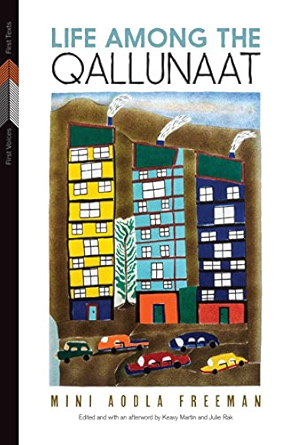
Review 2626: Life Among the Qallunaat

Life Among the Qallunaat is a memoir by Mini Aodla Freeman, an Inuit woman who became a translator and eventually a playwright, poet, and author, and respected elder of her people. This memoir begins when, at nineteen, she went to work as a translator in Ottawa, but then it returns to the events of her childhood and ends with her departure to Ottawa.

Mini was born on Cape Hope Island on James Bay, in what is now Nunavut. Aside from the nomadic nature of her family’s Inuit life, when she became older, she had many experiences away from her family. She was sent to school after her mother died at such a young age that she was the smallest child and was picked on by the others at the instigation of her cousin. Unlike the other children, she was not picked up by her family at the end of the year, so one of the teachers took her home. Then her father came to get her during the next term, and her family kept her home for the next year. Despite obstacles, she managed to finish eighth grade and did some schoolwork beyond that.

At 15 or 16, she helped out at the infirmary of her school and was encouraged to study nursing, so she did that for a while and later was hospitalized for tuberculosis. Yet after recovering, she stayed at the hospital doing nursing duties. During the stay in the hospital, she was called on to translate, because she spoke her dialect of Inuit as well as Cree, French, and eventually English. She lived with a family as a nanny for about a year but left after that same cousin made trouble for her. Instead, she took a job as a laundress at a school for a while, but she found it mentally unstimulating, so she switched jobs with a school house mistress who found it impossible to control her charges, a situation Mini had no trouble with.

This book is fascinating not only because of the details of Mini’s life but also for her explanations of Inuit customs and the differences between her people’s ways of thinking and behaving and our own. It is simply written, touching at times, and definitely an adventure to read. I believe I put this book on my list after last year’s Nonfiction November.

Related Posts

The White Bear

Minds of Winter

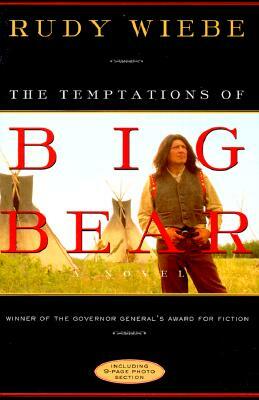
The Temptations of Big Bear

Review 2546: The Temptations of Big Bear

I can’t remember whether I found this book when looking for more about native peoples or for filling holes for my A Century of Books project. In any case, it does both.

Readers from the U. S. may not be familiar with the name “Big Bear,” but I’m betting Canadian readers are. He seems to have been their equivalent of Sitting Bull.

In The Temptations of Big Bear, Wiebe tells Big Bear’s story beginning in 1876, when the Cree, of whom Big Bear was a chief, along with other groups of native peoples and the Métis, meet to discuss a treaty with British officials. The treaty calls for the people to “sell” several hundred thousand acres to the government in exchange for small reservations and regular payments as well as assistance when they are hungry. Big Bear does not sign the treaty. He wants to wait to see what happens.

Within a few years, it becomes apparent that the buffalo, upon which the Cree depend, are dying out, so Big Bear signs the treaty. However, he does not select a reservation for his people. Instead, they continue to move among their usual environs.

This novel leads up to events at Frog Lake in 1888, where some of the Cree warriors attack the settlers, kill some, and take others prisoner. These attacks follow years of broken promises and starvation. Although Big Bear tries to stop them, he is disregarded. Of course, he is held responsible by the authorities and tried, despite all the white witnesses but one having testified for him.

This is an eloquently written novel. It is insightful and interesting, and Big Bear’s last speech at his trial made me cry.

Wiebe doesn’t cite sources, and it’s hard to tell whether some of the speeches and writings are verbatim from records or not.

Related Posts

One Thousand White Women

Mayflower: A Story of Courage, Community, and War

The Sentence

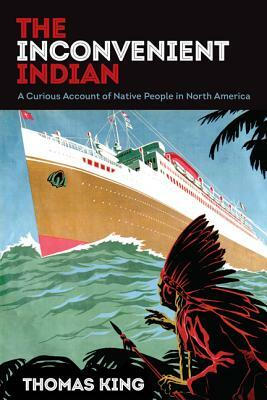
Review 2526: The Inconvenient Indian

For some reason when I bought this book, I thought it was fiction. It’s not, nor is it a history of the relationship between native peoples and the various entities that have ruled Canada and the United States. (King repeatedly calls these two countries North America. He doesn’t deal with the inequities and atrocities of Mexico, which of course is also in North America and probably has committed plenty.) It is a series of chapters on such topics as residential schools, government attempts at assimilation and allotment, treaties that have been ignored, and inequities under law.

Thomas King is a writer, speaker, and activist who is part Cherokee. Born in California, he is now a citizen of Canada and has won, among other awards, the Order of Canada.

His writing style is acerbically funny and more personal than you’d expect. He reminds me of Bill Bryson with more sarcasm.

This book is an eye opener for anyone who thinks that our native populations are no longer oppressed. It didn’t make me cry like Bury My Heart at Wounded Knee did when I read it years ago, but it gave me a lot to think about. King’s main message is that all government programs for our natives amount to land grabs.

Related Posts

Killers of the Flower Moon: The Osage Murders and the Birth of the FBI

Mayflower

There, There

Review 1695: The Bridge of the Gods

A friend who knew I was writing a story set locally before the arrival of white men gave me The Bridge of the Gods, which was written in 1899 as a result of Balch’s years of collecting Native American folklore and customs in Oregon. The novel is based on a legend about a bridge of stone across the Columbia.

The novel begins in 17th century Massachusetts, where Reverend Cecil Grey feels the mission to preach Christianity to the indigenous people of the West and dreams of a huge stone bridge over a river. His wife having died, he sets off to do just that, accompanied by his Native American nurse.

Eight years later, Multnomah, chief of the Willamette tribe, decides to test his allies. His tribe is the leader of a confederation united against their enemies, the Spokanes and the Shoshoni. The ascendancy of the Willamettes is prophecied to last until the Bridge of the Gods, a massive stone arch over the Columbia River, is destroyed. However, Multnomah has been hearing that some tribes want to leave the confederation. He decides to summon all of the tribes for a great council on Wappatta Island (now Sauvie Island).

Multnomah has a beautiful daughter, Wallulah, whose mother was an Asiatic princess shipwrecked at the mouth of the Columbia. Multnomah wants to betroth her to Snohomish, chief of the Cayuses, to cement their alliance. Wallulah, having seen Snohomish once, is not averse—until Cecil Grey comes on the scene.

I didn’t expect much from the attitudes of this book, considering when it was written, and I didn’t get much. Despite the young Balch having been interested enough to travel around and interview indigenous people, they are referred to constantly as savages, their traditions are treated with abhorrence, their villages are described as degraded, they are shown as violent and cruel. Even Multnomah, who compared to Snohomish is a good guy, is depicted as obdurate and cruel. Grey’s faithful nurse doesn’t even have a name.

Only Wallulah escapes this treatment, but note that she is half “Asiatic” (and a confused half at that, for her mother is said to have taught the Willamettes something about Buddha but calls god Allah). Her mother is described as white. Wallulah is herself a typical late 19th century romantic heroine, fragile and weak and a completely unlikely indigenous woman.

Although this novel is billed as a romance, Grey’s struggle is between his mission and Wallulah (even though they do not seem mutually exclusive), and since Grey is a zealot, Wallulah doesn’t have much of a chance. This is actually a romance in the older sense of the word, an adventure novel.

Since Balch went to so much trouble to personally speak to indigenous peoples and collect stories, I was hoping this book would be a little more enlightened—say, perhaps, written by someone who actually liked the people. It wasn’t. If you’re interested in an older book based in the life of indigenous peoples, I recommend The Loon Feather.

Related Posts

The Loon Feather

Caleb’s Crossing

One Thousand White Women

Review 1592: The Night Watchman

There is always something that keeps my attention in Louise Erdrich’s books, although often they are very sad. In 1953, the United States Congress announced a program of “emancipation” of more than 100 First Nations tribes that was expressed as a program to put indigenous people on an equal footing with other Americans but was actually a way to yet again abrogate treaties and take land. Louise Erdrich’s grandfather helped save the Turtle Mountain Chippewa from this fate all while working full-time as a night watchman. The Night Watchman is Erdrich’s novel about this event.

Thomas Wazhashk, a member of the tribal council, receives a copy of the bill and figures out its intent from its bland, bureaucratic language. He gets the council to collect signatures on a petition and begins collecting information to support the tribe’s stance that its members are too poor to care for themselves so local authorities will have to take on the burden if the federal government doesn’t, this obviously a ploy to get support from state and local authorities to oppose the bill. While he works, he is visited by an owl and the ghost of an old friend who died as a boy after being imprisoned in the basement of a state boarding school.

As usual with Erdrich, aside from the main plot, the novel is full of interesting characters and subplots. Pixie Paranteau takes time off from work to try to find her sister Vera, who has vanished in Minneapolis after leaving to marry her boyfriend. On the train, she encounters Wood Mountain, a young boxer on his way to a fight, but when the fight is cancelled, he decides to make sure Pixie is all right.

Millie Cloud is the woman whom Thomas asks to share the results of the survey on the living conditions of the tribe that she wrote for her doctoral dissertation. She is socially awkward and dresses in geometric patterns.

This novels felt more hopeful than some of Erdrich’s even though it also contained scenes of brutality. My attention was engrossed by it.

Related Posts

LaRose

The Round House

There There

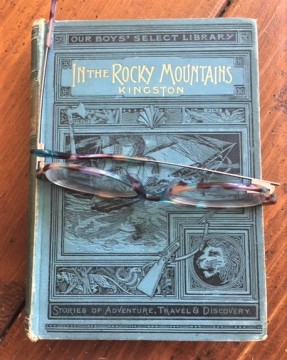
Review 1559: In the Rocky Mountains

Quite a few years ago, I bought an old 19th-century boys’ adventure book, On the Banks of the Amazon by W. H. G. Kingston. In reading it, I was struck by its combination of adventure, interesting information about plants, animals and natives of the area, and engraved illustrations. As a result, I put together a small collection of these books from the late 19th and early 20th centuries, trying to find ones in the Our Boys’ Select Library edition of the first one.  (In case you’re wondering why there is a ship and a lion on the cover of a book about the Rockies, they all have the same cover.) I intended to read them all but never got to any of the others. Then when we moved to Washington, they got lost.

That was four years ago, and a few months ago my husband finally unearthed them from an unpacked box of his books. He brought In the Rocky Mountains up to show me, and I decided to read it.

Before the action of this book, Ralph and his sister Clarise were on their way west with their parents to start a new life, but both their parents died en route. Their wagon train was rescued by a group of men, and one of them turned out to be their Uncle Jeff, who had gone west years before and not been heard of again. Now, Ralph and Clarice, Clarice’s servant Rachel, and Uncle Jeff and his men live on a commodious ranch in the foothills of the Rockies, and Uncle Jeff and his men help supply settlers coming through the nearby pass.

A friendly native named Winnemak comes to warn them that a large band of “Arapahas” (by which I assume he means Arapahos) and Apaches have banded together (did they ever, I wonder) and plan to attack their compound. At first, Uncle Jeff is unworried, but the ranchers, along with a small group of cavalry, are overcome and must flee into the wilderness.

Most of this action is designed to lead us to Yellowstone, for the pass to the fort is overtaken by the enemy, so Ralph and his companions must go north, where they end up stranded for the winter in Yellowstone Valley. This leads us into descriptions of the wonders of Yellowstone.

This novel was published in 1901, a good 20 years after the other one I read, and I fear it isn’t quite as good. For one thing, although I try not to judge books by their times, there is a good deal more judgmental treatment of the indigenous peoples than in the book about the Amazon even though it is mixed with having some “good” native characters (which is of course defined by their friendliness to the “harmless” whites). It also expresses an uncritical affirmation of Manifest Destiny, containing a statement (sorry, I didn’t mark the passage to be able to quote directly) that the white men were doing nothing more than trying to get themselves some land when viciously attacked by the natives.

Okay, so maybe all that is to be expected, as well as the stereotypical treatment of the African-American servant and the Irish and German soldiers. On the other hand, the friendly natives express themselves in fluent and educated English, which is surprising for this book, with the exception of saying “Ugh!” as a greeting. (Did they really do that, do you think?)

A fairly minor error is made in illustrating and naming various deer Ralph sees. He talks about seeing wapiti, which is another name for elk, but the illustration is more like a standard deer. Then he clearly describes and illustrates a moose but calls it an elk. Oh dear. As far as I know, those names are not interchangeable. (A friend tells me now that this may be a mismatch between American names for these animals and British ones; however, the book is set in the U. S., so I think it should use the American names.)

I think the thing that for me interfered most with this adventure was a strong Christian message that comes through especially at the end. Ralph and Clarice convert Winnemak from his wicked ways, with no acknowledgment that these peoples have their own beliefs and religion that are just as valid, and Winnemak becomes a missionary. Ugh, as they (don’t) say. I can only suspect that as Kingston got older, he felt compelled to add a moral message. I don’t remember anything like that in On the Banks of the Amazon and I hope I don’t see it in the others, which I still intend to read.

I wrote my review a few months ago, and since then I read an old copy of Walter Scott’s The Talisman, also marketed as a boys’ book and published in 1907. I was really interested to notice in the advertising pages at the back of the book a title In the Heart of the Rockies by G. A. Henty, which appears to have at least a partially identical plot to W. H. G. Kingston’s book only calls its hero Tom instead of Ralph. I looked to see if the names were pseudonyms of the same writer, and they were not. The Kingston book was published a few years before the Henty book, so I’m wondering if a little plagiarism wasn’t going on.

Related Posts

The Loon Feather

Treasure Island

Immortal Wife

Review 1552: The Beadworkers

The Beadworkers is a collection of short stories but also some poems and a play about the experience of American indigenous peoples in the Northwest, past and present. These works provide insight into religion, thinking, and beliefs of these peoples. Most of the stories are set in Oregon.

Many of the stories center around feasts. The first entries, a poem called “Feast I” and a story called “Feast II,” are about the importance of water. “Feast III” is about Mae, a woman who has decided to become a migrant laborer after the death of her husband.

“The News of the Day” is set in 19th century Boston, where Charles and his roommate are studying. On the same day, they receive news of family deaths, Marcel’s father from illness in Paris, Charles’s family in a battle of the Indian Wars.

In “Fish Wars,” set in the 1970’s, a schoolgirl fears her parents are getting a divorce. In actuality, her father is fishing and getting arrested for it in hopes of winning rights to fish in ancestral waters.

One of my favorites was “Beading Lesson,” in which an aunt instructs her niece in how to make beaded earrings, all the while mildly regretting that her sister, the girl’s mother, never learned to bead. In “wIndin!” an artistic young woman designs a Native American version of monopoly and tells about her relationship with Trevor, a Yakama gay man. Another favorite is “Katydid,” about the relationship between two young women, one who has abandoned her family because of their brutality, the other who has been abandoned by them.

Many of the stories evoke a sense of loss, as in “Falling Crows,” about the family’s reaction to a young man returned maimed from war, but most of them end in affirmation of some kind.

These stories are powerful and sparely written. Except for the final play, a reworking of “Antigone,” I really enjoyed them.

Related Posts

There There

The Round House

Folktales of the Native American

Review 1353: There There

Cover for There ThereThere There is about the life of urban Native Americans. Set in Oakland, it follows numerous characters who plan to attend a powwow. However, we know from the beginning of the novel that some men are planning to rob the powwow.

The novel begins with a Prologue about depictions of Native Americans in popular culture. Then we meet Tony Loneman, a low-level drug dealer who is being compelled by his contacts to help them rob the powwow. Tony was born with fetal alcohol syndrome, so his thinking processes are not great, but when he puts on his regalia to attend the powwow, he sees a dancer in the mirror.

Dene Oxendene makes a presentation to a grant committee to get funding for a project to record the stories of Oakland Native Americans. The powwow is a good place to find them, and it’s not hard to image that Dene is Orange himself.

Next, we meet Opal Viola Victoria Bear Shield as a child in the late sixties, taken by her mother to occupy Alcatraz. With her is her sister Jacquie Red Feather, who is raped by a boy named Harvey. In the present day, Opal doesn’t plan to attend the powwow until she learns that her great nephew, Orvil Red Feather, plans to dance. Ultimately, Opal’s entire family, including Jacquie and Jacquie’s children, ends up at the powwow.

Another important character is Edwin Black, a young man who has spent his time since college trolling the internet and gaining weight. When he finds out that his father, Harvey, is a powwow emcee, he gets a job helping organize the powwow.

Although this novel is an angry one, it at least has a hopeful ending. However, it was marred for me by the promise of violence. Of course, that was the way to lend it suspense, but I had the same reaction to it as I did as soon as I saw the gun in Thelma and Louise. Although these people have a tough life, there isn’t any gun violence in it (although there is domestic violence) except for this plot device. I wish Orange had found a different way to hold his stories together.

Related Posts

A Brief History of Seven Killings

Telegraph Avenue

LaRose

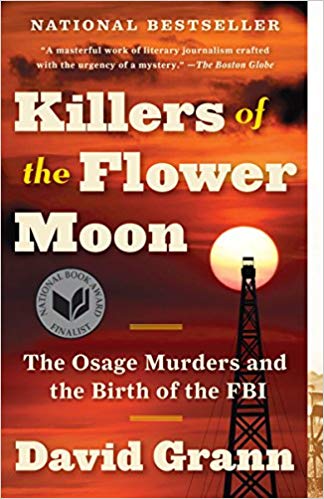
Review 1335: Killers of the Flower Moon: The Osage Murders and the Birth of the FBI

Cover for Killers of the Flower MoonDavid Grann’s book Killers of the Flower Moon details a past that was once infamous but now almost forgotten except in Osage country. In the 1920’s, the Osage nation in Oklahoma was the richest population per capita in the United States. This phenomena was a result of wise decisions by the tribal leaders during the 19th century land grab by the whites. They voluntarily moved from their homelands, purchasing land in Oklahoma that they thought white men would deem worthless. Then oil was discovered on their property. Because the nation had purchased the property, it couldn’t be taken back.

However, the federal government, in its infinite wisdom, deemed the Osage unfit to handle their own money. So, they appointed white guardians for them. As you can imagine, there were many eager to cheat these people out of their headrights, as were called their shares of the tribal fortune.

The Osage began dying. Grann centers much of his book on Mollie Burkhart, the Osage wife of Ernest Burkhart. One by one, her family started dying. First, her sister, Annie, was found shot in the head. Then her mother, Lizzie, died of a mysterious illness, believed by many to be poison. When her sister Rita’s husband, Bill Smith, tried to investigate, he and his wife and servant girl were killed one night when their house exploded. Other Osage were dying, too, and investigators either came up with nothing or were themselves murdered.

As the FBI was in its infancy and trying to figure out its own jurisdictional powers, new director J. Edgar Hoover decided that the Osage murders, which were becoming infamous as indicators of failure and corruption, would be good ones to solve. So, he sent out a former Texas Ranger, Tom White, to investigate.

Grann follows their investigation, and it is a fascinating one. This is a shameful period in our history that should not be forgotten. Grann goes further than the FBI, though, by looking into other deaths that were not investigated.

This book tells a mesmerizing story about a shocking time not so far in the past.

Related Posts

The Lost City of Z: A Tale of Deadly Obsession in the Amazon

The Midnight Assassin: Panic, Scandal, and the Hunt for America’s First Serial Killer

The Wicked Boy: The Mystery of a Victorian Child Murderer

Day 1211: Days Without End

Cover for Days Without EndI so much enjoyed Sebastian Barry’s On Canaan’s Side when I read it for my Walter Scott Prize project that I was excited to see his Days Without End on the shortlist, too. Again, his protagonist is an Irish immigrant to the U. S., but this time a man, Tom McNulty.

Tom and his best friend, John Cole, enlist in the army sometime in the mid-nineteenth century. Their job in Daggsville has disappeared with the miners. That job, which they have had since they were boys, was to dress up like women and dance with the miners.

Tom and John enjoy the army but have some difficult experiences when their unit is sent west to deal with Native Americans. After some brutal experiences, they leave the army, taking with them a little Native American girl they call Winona. Although she is purportedly their servant, they treat her as a daughter.

Tom and John are lovers, and they have adventures that have raised some skepticism among other bloggers, particularly when Tom goes back to cross dressing to entertain miners in Grand Rapids. Some commenters did not believe this act would be accepted so easily during that time. I’m not sure what I think about that, except that Barry presented it in a convincing way.

In Tom, Barry creates an engaging character, and his descriptions of events, many of them horrific, as Tom and John go from serving in the Indian Wars to the Civil War, is masterful. However, none of the other characters in the novel were fully developed, including John.

This lack, and my doubts about the probabilities of some of the situations in which the pair find themselves lessened my enjoyment in this novel. It is certainly worth reading, but I didn’t like it as much as On Canaan’s Side.

Related Posts

On Canaan’s Side

Neverhome

A Place Called Winter