Day 1190: LaRose

Cover for LaRoseSet in 1999 on a North Dakota reservation, LaRose is about how a community, but in particular two families, are affected by a horrible accident. Out hunting a deer on his property, Landreaux Iron kills Dusty, the young son of his best friend, Peter Ravich, when Dusty falls out of a tree as Landreaux takes his shot.

To try to make amends, Landreaux, who has turned to the old ways to throw off addiction and straighten out his life, offers the Ravich family his own young son, LaRose, to raise. Nola Ravich, Dusty’s mother, is eaten up with hatred against the Irons, even Emmaline, who is her half sister. But having LaRose helps. Emmaline, however, can’t be expected to give up her son forever.

LaRose is the latest in a long line of LaRoses, all of whom had a special connection with the spirit world. LaRose finds himself able to help Nola and her neglected daughter, Maggie, even though he is only a small boy.

Another significant character is Romeo, who long ago was Landreaux’s best friend. He bears Landreaux a grudge because of an incident years before. Slowly, he works at his resentment despite the Irons having taken in his son Julius to raise.

Although I occasionally got distracted by how diffuse the plot is and how many directions it goes, in the main I enjoyed this novel. It isn’t nearly as depressing as a lot of Erdrich’s work, and it paints a powerful portrait of these two families. Dealing with forgiveness, of oneself and others, grief, guilt, and other human complexities, it is a strong novel.

Related Posts

The Round House

Shadow Tag

The Hour I First Believed

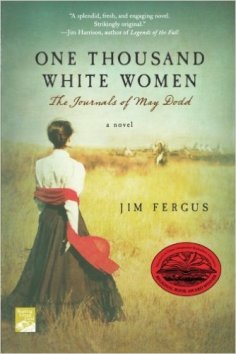
Day 1020: One Thousand White Women

Cover for One Thousand White WomenWhen I first began reading One Thousand White Women, I didn’t think I was going to like it. I was unconvinced, under the circumstances, by its narrator’s facetious tone, and I felt that the way some characters told her their deepest secrets on first meeting was unrealistic. I was also afraid that most of the characters would turn out to be caricatures of real women. However, I eventually changed my mind from my first impressions.

This novel is a completely fictional imagining of what would have happened if an actual event had taken place. During an 1854 peace conference, a Cheyenne chief suggested that the United States trade 1000 white women for horses, reasoning that this assimilation of cultures would ultimately result in understanding between the two. This suggestion was indignantly received, but Fergus’s novel imagines what would have happened if the experiment were tried.

In 1874, May Dodd is one of those women. She has decided to participate to escape from a mental institution to which her family committed her after she had children outside of marriage with a man they found socially inferior. With her on the train west is a colorful group of women, some of them fleeing ruined lives and others hoping for a family.

On the way out, May falls in love with Captain John Bourke, in charge of their escort from Fort Laramie. Unfortunately, Captain Bourke is engaged to be married, and May feels herself pledged to the mission, which has been presented to the women as a patriotic one.

May is chosen as the bride for Little Wolf, a respected chief of the Northern Cheyenne. He is an older man with two current wives, but he is a man May can respect.

Fergus is strongest in his descriptions of the western landscape and life among the Cheyenne. As I mentioned, at first all the women seem like types, but eventually I came to care for most of the major characters, from the timid Martha to the African-American Amazon, Phemie. And the major Cheyenne characters are sympathetically depicted.

Of course, we know what kinds of things were going on in the West at this time (and if you don’t, I recommend Dee Brown’s excellent and affecting Bury My Heart at Wounded Knee). This novel is a sensitive and powerful depiction of the native American life and struggles of the time.

Related Posts

True Grit

Appaloosa

The Loon Feather

Day 965: Strange Company

Cover for Strange CompanyI read about half of Strange Company but decided not to finish it. It just wasn’t the book for me. I thought it might be interesting because it is about Native Americans during the Civil War.

Roderick “Dhu” Walker is a member of a group of the Cherokee Nation called the Pins, for pins they wear under their lapels. They are traditional Cherokees on the side of the Union who begged the government to protect them from the Confederates under the terms of their treaty. The government did nothing, though, and the Confederacy has forced the Pins to fight on its side.

Before a battle in Missouri, some of the Pins decide not to fight but instead to kill Confederate soldiers during the battle. Dhu kills a couple men but mostly because they get in his way while he’s trying to escape. Later, though, he is captured by the Confederates as a deserter.

As a prisoner, Dhu is teamed up with a Union soldier and forced to fight him at the instigation of Captain Gordon Early. This amusement is only stopped by the intervention of the Colonel. When the Union soldier, Ben Lacey, tells Dhu that Early is off to escort a load of gold from Mexico, Dhu talks Ben into escaping with the idea that, along with some other Cherokees, they’ll intercept the shipment.

The novel moves along fast enough but does little else. There seems to be no idea of characterization. Sentences are short and choppy. Although the writing is grammatical, it is not polished by any means. Any metaphors are clichés. In short, the novel is not very good. If you are interested in reading a Western, you’ll be much better off with one of the “Related Posts” at the bottom of this post.

Disclosure: This eBook was sent to me by the publisher in exchange for an honest review.

Related Posts

The Son

Appaloosa

The Sisters Brothers

Day 810: The Round House

Cover for The Round HouseThe Round House looks back to 1988, to traumatic events in the life of 13-year-old Joe Coutts and his family. Joe has had a comfortable life for a kid living on the reservation. His father is a tribal judge, and his mother is a social worker. They live in a homey, not fancy house, and his mother keeps a beautiful flower and vegetable garden.

Joe is enjoying the summer as any 13-year-old might, sometimes running around with his friends, sometimes helping out at home. One Sunday he is digging out saplings that have worked their way into the foundation of their house. His mother has run out to the office to pick up a file. She is usually very punctual, but he and his father realize she has not returned at her usual time. The two decide to go get her.

They pass her coming home, but it is not until they arrive home that they discover something horrible has happened. Joe’s mother has been raped and brutally beaten. They rush her to the hospital.

When the police come, she will not talk about what happened except for the broadest outlines. She was kidnapped from the old ceremonial Round House and taken somewhere else to be assaulted. She escaped after her attacker doused her with gasoline and went for matches. After she returns from the hospital, she retreats to her room.

Because of complicated laws related to who has jurisdiction over what type of crimes and where they are committed, Joe’s father begins trying to sort out how a prosecution could be pursued when they find the rapist. This task is made more difficult by the insistence of Joe’s mother that she doesn’t know where she was when she was raped. Joe himself starts looking for evidence of who could have committed the crime.

Like most of Erdrich’s novels set on the reservation, this novel is as much about heartbreaking experiences as anything else. Erdrich points out in the Afterword that up to 1/3 of Native American women are raped on the reservation, mostly by men who are not Native American. She says that this number is almost certainly an understatement, because Native American women don’t want to report rape. Many of these incidents cannot be prosecuted because of jurisdictional problems.

There were a few things that bothered me about this story, particularly that Joe doesn’t connect some money he finds near the scene of the crime with the crime or that he and his friends drink some beer they find even though they think it is connected with the crime and could be a clue. Even at 13 and in 1988, they had to have watched more crime shows than that.

In general, though, this is compelling reading, about the change in Joe’s family, about how fast he is forced to grow up, about the limitations of justice on the reservation.

Related Posts

Shadow Tag

Once Upon a River

Swamplandia!


Day 643: The Orenda

Cover for The OrendaBest Book of the Week!
The Orenda is a powerful novel about the death of a people. At times it is difficult to read, but do not let that stop you from experiencing this novel.

Father Christophe, one of the first French priests to evangelize the Indians of Canada west of Kebec, finds himself at the beginning of the novel captive to a group of Huron warriors. The group is returning from a trading expedition, but they recently attacked a family of Ojibway, their enemies. Bird, the leader of the party, is seeking revenge for the killing of his wife and daughters by the same group. He keeps one young girl, Snow Falls, to be his daughter but kills the rest of the family.

The novel is narrated in turn by Bird, Father Christophe, and Snow Falls. Father Christophe, whom the Hurons call the Crow, finds life in the village brutal and the customs of the people barbaric, but he is determined to learn the people’s language and convert them.

Bird continues to grieve for his wife and addresses his sections of the book to her. He is concerned about the problems of the village and his people, and not least with his difficult new daughter.

Snow Falls is determined to escape and to at all times demonstrate her defiance.

The novel covers about ten years, during which things go well and then badly for this group of Huron people. A combination of disease from contact with the French and the hostilities between the Hurons and their enemies eventually have results that presage what will happen on a larger scale throughout North America.

The novel paints a fascinating picture of the daily life among the Huron and of the misconceptions and misunderstandings between the native people and the Europeans. It is a wonderfully involving book.

Day 408: Folktales of the Native American

Cover for Folktales of the Native AmericanI have read some of the folk tales of the Celtic peoples (mostly Irish and Welsh) and the Norse and Russians as well as the more recent ones of the Grimm brothers. Last year, I reviewed Robert Graves’ book about Greek myths. Except for the really amusing and cynical fairy tales of Charles Perrault, I find them almost uniformly violent–full of murders, rapine, and theft. (Of course, kids love that kind of stuff.)

What strikes me about the Native American tales assembled and retold by Dee Brown is that even though some are about battles, they do not focus on the gruesome, as European tales are prone to do. More of them are about how things were created or how some animals got their markings, or they are comic tales about trickery and deceit. The stories seem to be more similar to the few African ones I have read than to European myths.

The tales are simply told, most of them no more than two or three pages long. I think in general folk tales suffer from not being told aloud. In print they lack the tale teller’s expression and gestures.

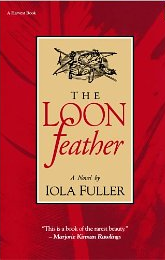
Day 236: The Loon Feather

Cover for The Loon FeatherBest Book of the Week!
The Loon Feather by Iola Fuller is one of my favorite books from when I was a girl, and I still read it every few years. A fascinating story set on Mackinac Island, it compelled me to visit every spot mentioned when I was on the island during a vacation.

Set in the early 1800’s, the book starts with the birth of its heroine Oneta. She is Ojibway and the (fictional) daughter of Tecumseh, the famous Shawnee leader. A prophecy at her birth says that she will bring a husband to her people who will be more powerful than a warrior. No one knows what that means, but prophecies are apparently always right.

The beginning of the book traces the seasonal nomadic life of her people, followed during her early childhood. Tecumseh is killed fighting for the British against the Americans in the War of 1812 when Oneta is young, and she is raised by her mother and her grandfather. A wise woman, Marthé, is also important to her as a young child, but Marthé leaves them all to marry a French trapper.

The Ojibway make a yearly trip to Mackinac Island, where part of the settlement from the war is payment of reparations from the Americans. The island is a fascinating mix of Native American, French, and American cultures. Here Oneta and her mother encounter Marthé, who lives on the island with her husband and young daughter, and they gladly visit back and forth. But before the tribe departs for the year, Oneta’s mother becomes ill, and Oneta is left there to care for her until her grandfather returns the next year. After Oneta’s mother recovers, she works as a maid up at Fort Mackinac and meets a French accountant for the Astor Fur Company, Pierre, who marries her.

At first we see things only from Oneta’s point of view as a Native American. As Pierre’s fastidiousness and different tastes clash with his bride’s customs, misunderstandings arise. However, Oneta is eventually sent away to a convent school to be raised as a French girl.

When she returns to the island as a proper young woman, she is at first inclined to disdain her true heritage and must find a balance between it and what she owes to Pierre and Madame, his mother. She also witnesses the struggles of Pierre and her younger brother Paul, who prefers his Native American roots and envies Oneta her heritage.

The colorful setting is populated by French voyageurs, American soldiers and capitalists, and the Native American tribes, who begin to become aware how the workings of history are fundamentally changing their way of life.

Day 179: Shadow Tag

Cover for Shadow TagWhen Irene America takes out her diary one day, she realizes that her husband Gil has been reading it. She is outraged, so she starts another diary, a true one, which she keeps in a safe deposit box at the bank. In her original diary, she begins inserting falsehoods to torment Gil. The disintegration of their marriage is the plot of the disturbing Shadow Tag by Louise Erdrich.

Irene wants to leave Gil. He is manipulative and abusive to her and their three children. His moods are mercurial–even the dogs are wary of him. He is obsessively jealous, to the point of resenting the attention Irene gives their children.

Irene is not perfect either. She drinks too much and resorts to subterfuge and manipulation. She is alternately endeared and repelled by Gil’s attempts to win her back.

Gil is a successful Native American artist who has painted only Irene for years, but now she finds his depictions of her degrading. Still, she doesn’t have the courage to leave him, which will have fateful results. The tension in the novel builds to a surprising and tragic finish.

A detached omniscient narrator alternates telling the story with the two diaries written by Irene. You do not find out who the omniscient narrator is until the last chapter.

I can’t help but wonder how much of this psychological novel is a fictionalized account of Erdrich’s marriage to Michael Dorris. I see now that a review in the Washington Post agrees. If so, it is a masterly and brave work of self-exposure that faithfully shows the unpredictability of marital relationships. It is extremely well written and very sad. If you require likeable characters in your fiction, you won’t find them here, however.

Day 145: Mayflower: A Story of Courage, Community, and War

Cover for MayflowerMayflower: A Story of Courage, Community, and War is an eye-opening history of the Pilgrims, starting with their journey to America in 1620 and ending roughly 50 years later with King Philip’s War. King Philip’s War began as a small local conflict between the Plymouth Colony and King Philip, the sachem of the Pokanokets, and ended as a regional war that killed, author Nathaniel Philbrick reveals, a higher percentage of the population than any other American war.

What makes Mayflower most interesting is how Philbrick takes on the old myths–Plymouth Rock (if a rock was used, it wasn’t that one), the first Thanksgiving (actually begun by Abraham Lincoln, although there was a feast in early fall), Squanto (not such a nice guy), the courtship of Miles Standish–and provides new ways of looking at what happened.

Although the book touches on many aspects of the Pilgrims’ lives, a major theme is their relationship with the native people. The very bonds formed when Massasoit and the Pokanokets saved the original settlers from starvation and illness, when broken by the Pilgrims’ sons, are those that resulted in the destabilization of the entire New England region for years to come.

The book provides fascinating insights into these people, who had a mission for their own lives but little tolerance for others, who bravely founded a successful colony but fathered offspring whose greed, rigidity, and racism almost destroyed the results of those efforts. With his focus on relations with Native Americans, Philbrick skims over some other important elements, for example, the Pilgrims’ dissident faith, the expulsion of Roger Williams, the relationship between Plymouth and the colonies founded by Puritans and others. However, the book is focused on a topic that is interesting to a 21st century audience and has not had much discussion.

Day 39: Away Off Shore: Nantucket Island and Its People, 1602-1890

Cover for Away Off ShoreIn Away Off Shore, Nathaniel Philbrick explores the history of Nantucket Island, from the first boat of British people leaving the restrictions of the mainland to the final death throes of the whaling industry.

This book could probably be called a microhistory because it is the history of one small island. I had a feeling when reading it that it might be one of Philbrick’s earlier books, and sure enough it was written in 1994, well before his other books. It was apparently reprinted on the shirttails of his more recent, very successful histories.

Philbrick explains how different Nantucket was from mainland New England even from its beginnings. It was occupied by Wampanoag Indians when the Pilgrims arrived to find the rest of the coast almost empty of Native Americans. These people were first treated well by the new settlers, who even purchased their land from one of the two groups (the wrong one, however), but this relationship slowly changed. The Indians were eventually enslaved to some of the other islanders by incurring debts they could not pay, for which an exorbitant amount of work was demanded in return. The islanders’ isolation from the mainland, their strong Quaker roots, and their eventual success in the whaling industry as the first men to go after sperm whales singled them out from other New Englanders.

Philbrick relates the history of the island largely by focusing on a few colorful individuals and families, and principally on two antagonistic factions. Although that strategy makes the book interesting, I’m not sure it provides a true reflection of the island through time.

I felt that the book makes assumptions about the readers’ knowledge of Nantucket, as if it was written for the inhabitants or at least those who are frequent visitors. He often makes comments like “the house was located where the post office is now.”

This last comment is a minor criticism, but it relates to a more major one, which is the lack of good maps and pictures. The book has two reproductions of old maps, but they are so small and fuzzy as to be unreadable. I am a  map person, so when Philbrick is describing where things are, I want to see them on the map. That was almost always impossible. In addition, most histories of this type contain reproductions of paintings or old photographs so that we can see what some of the people or the old town looked like, but this book has none. Indeed, Philbrick actually compares photographs of two men, but the photos do not appear in the book. It would have been nice if the book contained pictures of some of the people and places.

Philbrick is known as an expert on Nantucket, and the book certainly shows meticulous research. It is very interesting, but also frustrating at times.