Day 386: Bridge of Sighs

Cover for Bridge of SighsOne of my favorite books from recent years is Richard Russo’s Empire Falls. Unfortunately, the problem with reading your favorite book of an author’s first is that the others may not quite live up to it. But Bridge of Sighs comes a little closer than some other Russo novels to my initial delighted feelings about Empire Falls. (I know, I’m a bit behind the times with this one.) This novel shares some of the same themes as Empire Falls and is set in a similar working-class, industrial small town, this time in upstate New York.

The novel is narrated principally by Lou Lynch, one of three main characters. Lou is writing a novel about his life, even though he admits it will probably be boring. The son of Lou, an optimistic, cheerful if not very bright milk man turned convenience store owner, and Tessa, a sharp, insightful bookkeeper, Lou has always felt as if his parents are in conflict, and he is on his dad’s side. We understand, though, that Tessa is not really in conflict with her husband and son, she just wants them to see reality as it is, not as they would like it to be.

Seeing things as they are is also a problem for Lou’s best friend Bobby. At least, Lou thinks of Bobby as his best friend, but that is one more thing Lou doesn’t see clearly. Bobby’s father bullies his mother, who is eternally pregnant. She runs away every time she gets pregnant, but he always finds her and brings her back. It isn’t until late in the book that we find there is more than one way to look at their relationship.

The book begins when Lou is sixty and traces back through his childhood and adolescence through the device of his novel. The adult Lou is married to his high school sweetheart Sarah, and they are soon to take a trip to Italy, hoping to visit Bobby, now Robert Noonan, a famous American painter who lives in Venice. But Robert isn’t answering Lou’s letters letting him know they are coming. This trip is an anxious one for both Lou and Sarah, Lou because he has hardly ever left his home town, and Sarah because she once had to decide between Lou and Bobby.

In the background is the story of the small town of Thomaston, an industrial backwater dominated by a tannery, the dyes of which used to color the river waters differently each day and resulted in high levels of cancer in the community. The town is dying. The tannery has finally closed.

The town is divided into three areas that are widely separated by class, even though Thomaston’s richest citizens are probably big fish in a small pond. As the story moves into the present time, the wealthier citizens begin moving away. But Lou doesn’t see any reason not to love his town or his life. Sarah has always wanted to travel and experience more, but they have stayed put.

The Lynch family, as Russo creates it, is a warm and welcoming one. Both Bobby and Sarah are attracted as youngsters to the little store by the promise of a substitute family, Sarah’s own being particularly bizarre. In the modern-time story, Lou’s father is dead, and his uncle Declan has gone away, but Lou’s son works in the store, and his mother still lives above it.

As the story moves back and forth in time, I felt myself occasionally tiring of Lou’s reminiscences, especially of junior high, where he spends an inordinate amount of time. As Bobby reflects when he returns to town during his senior year after being sent off to military school, he doesn’t understand why Lou continues to bring up those years as if they were good times when actually they were horrible and Lou was not treated well at school. I personally was much more interested in the current-time story, of which there is much less, even though I understood that its seeds are in the past. But then again, the fact that Lou dwells on the past is part of the point of the novel.

This novel possesses a few characteristics of postmodernism, without being exactly postmodern. Here perhaps Russo is dabbling in some of the techniques without going full-thrust for its inventiveness and irony. The alternating point of view among Lou, Bobby, and Sarah, the alternating time streams, the metafiction, and Lou’s essential untrustworthiness as a narrator, not because he is not truthful to us, but because he is not truthful to himself, all are postmodern techniques. Within the time and narrator changes, though, Russo proceeds with a traditional narrative style.

Russo’s writing is leisurely, and he likes to muse. Still, he creates some complex and attractive characters and makes you want to contemplate their lives with them. He is also one of the few writers willing to explore the theme of class in America, a theme that is very important to this novel.
Day 373: Tell the Wolves I’m Home

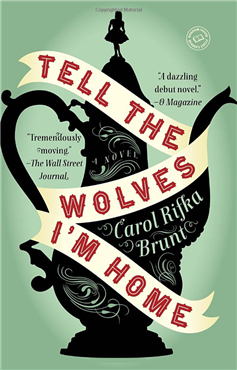
Cover for Tell the Wolves I'm HomeBest Book of the Week!

Although I think Tell the Wolves I’m Home is classified as a young adult novel, it has much to offer adults, too, in reading pleasure. Carol Rifka Brunt gives us a novel in which the voice of the narrator is so strong and the sense of her personality so developed that it is really outstanding.

Fourteen-year-old June Elbus is an unusual girl–a loner who likes to go to the woods and pretend she is living in the middle ages. She loves her Uncle Finn more than anyone and believes he is the only person in the world who understands her. She used to be close to her older sister Greta, but for some reason Greta has started treating her badly. So, when Finn dies of AIDS, June feels as if she has no one. The situation is made worse because it is the 1980’s, and no one understands the virus.

Something strange happens at Finn’s funeral. A man June has never seen before appears and tries to get her attention, but her sister hustles her away. Days later her uncle’s favorite teapot arrives for her with a note in it. The writer explains that he is a friend of Finn’s and asks to meet her. But Greta has told her that this friend, Toby, killed Finn.

A problem is posed by the portrait Finn spent the last months of his life painting. It is one of June and Greta, although Greta acted as if she didn’t want to sit for it. The Elbuses have the portrait in their living room until an article appears about lost works of art, including a picture of the portrait and reporting that its title is “Tell the Wolves I’m Home.” Until then, June didn’t even know her uncle was a famous artist. And who could have photographed the portrait and sent the article to the magazine?

June agrees to meet Toby but becomes jealous of him when she realizes how close he was to Finn. She is shocked to find they were partners for nine years, and she never knew he existed. June is torn because of her ambivalent feelings about Toby and the fact that they are keeping their acquaintance a secret from her parents, until she finds a note to her from Finn in a book, asking her to take care of Toby because he has no one.

Infused throughout with the voice of its teenage narrator, a girl like so many others struggling with feelings of self-doubt, trying to figure out what is right, this novel is beautiful and moving without being in the least sappy. It is really a wonderful book.

Day 339: A Visit from the Goon Squad

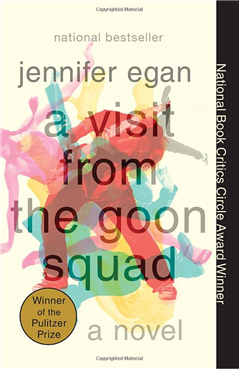
Cover for A Visit from the Goon SquadBest Book of the Week!

Describing this delightful and quirky novel is going to be difficult, so I hope curious readers will try it even if I am unable to convey a sense of it.

First, I call it a novel, but it can be just as accurately described as linked short stories. Each chapter is written from the point of view of a different character who knows one or more of the other characters. The chapters all center around the subjects of music and public relations.

The book begins in New York with Sasha, who is the assistant to Bennie, a music executive, sometime after 9/11. She is on a desultory date with Alex, but she also has a problem with kleptomania. While in the bathroom, she steals a woman’s wallet and then has to watch while Alex gets involved in helping the woman.

Next is a middle-aged Bennie, who torments himself with feelings of shame about past experiences. He takes his son to visit a sister act in order to fire them for not producing an album in the specified amount of time. He realizes he is beginning to see his legendary taste diverge from that of his younger coworkers.

Then we jump back thirty years to Rhea, a teenager in San Francisco who is a member of a punk rock band called the Flaming Dildoes with her friends Bennie (yes, the same Bennie), Scott, Alison, and Jocelyn. Rhea observes Jocelyn’s budding relationship with a middle-aged record executive named Lou, who will become Bennie’s mentor. Rhea is dismayed as Lou gives Jocelyn drugs and gets her to perform sexual acts in public.

These are just the first of the vignettes, which range forward and backward in time over 40 years and extend in structure to a touching PowerPoint presentation and a parody of a celebrity interview. They make stops in Arizona, Italy, and South America but somehow center on New York. Fans of Egan will already be familiar with a certain type of hip, aware New Yorker that appears in her fiction.

By turns funny, touching, and sharp as a razor, Egan’s observations are always entertaining and her intelligence apparent. An obvious theme of this work is the effect of time on characters but another one is how technology seems to have sped time up, the book ending in a futuristic world where public relations is centered on the tastes of babies. The PowerPoint chapter shows us that another theme is pauses, in music and in life.

One of the things I wanted to do when I finished reading A Visit from the Goon Squad was to read it again so that I could know what I was looking for from the beginning and fully understand all the connections. And that is what I plan to do, having inserted the book into my pile of future reading to enjoy again.

Day 312: Castle

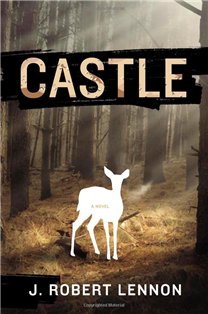
Cover for CastleEven from the first moments of reading the unusual Castle, the novel seems to be about more than is on the surface. That notion turns out to be the case.

Eric Loesch returns to the town where he grew up and buys a large piece of property outside of town. Then he starts fixing up the farm house. He almost immediately becomes fixated on a large rock on the property and eventually finds the ruins of a castle behind it.

This activity seems all very straightforward, but something more is going on, we’re sure. Loesch is an unusual man, as demonstrated throughout by his thoughts and actions. His reactions to seemingly ordinary conversational gambits seem extreme. His emphasis on privacy seems excessive. We also feel, although we don’t know why, that he may have a military background.

Castle is a novel that unfolds slowly but keeps your attention throughout. It becomes clear that there are painful incidents in Loesch’s past, but the novel takes its time getting to them, and Loesch seems to be in denial about some of them.

The writing is skillful, particularly in delineating Loesch’s character through his behavior. In fact, I don’t know when I’ve understood the personality of such an unusual character so particularly before without the author actually telling me about it.

The revelations at the end of the novel are not, for the most part, foreseeable, although I could eventually predict at least one important plot point. All-in-all, Castle is a disquieting, dark tale.

Day 267: Black & White

Cover for Black & WhiteI had an ambivalent reaction to Dani Shapiro’s Black & White. By coincidence, while I was reading it, I read an article about adult survivors of child abuse that helped me focus on what was bothering me about the themes and conclusion of this novel. I’ll talk about that later.

Clara Brodeur has not seen her mother since she left home at the age of 18. She is a seemingly ordinary housewife with a nine-year-old daughter, but she has a secret. Her mother is Ruth Dunne, a world-famous photographer who made Clara’s childhood miserable by documenting it with evocative, nude photos.

Clara’s life is interrupted by a phone call from her older sister Robin telling her that their mother is dying, and she can’t cope anymore. Despite herself, Clara finds herself in New York City, where she is forced to face her feelings about her mother.

The strength of this novel is its finely observed descriptions, especially of Clara’s memories of the photo shoots–both from the point of view of a young child and then overlaid with adult awareness. Shapiro accomplishes the difficult task of explaining only with words both how striking Ruth’s photos must be and why they are disturbing. Clara feels that she has had her life stripped bare for the entire world and her relationship with her mother destroyed because of Ruth’s obsessions.

Of course, the novel evokes questions about art and its importance, whether the creation of an object of art justifies Ruth’s treatment of Clara, the impact of abuse upon the family, and so on. Perhaps I should warn now about spoilers, although I will try not to reveal too much.

Emily Yoffe’s article in Slate deals with how there is often a societal pressure put upon adult survivors of child abuse to reconcile with their abusers  and bring them back into their lives as the abusers get older. She points out the possible destructiveness of this expectation as well as the possibility of more harm to the original victim, or as she puts it better, “the potential psychological cost of reconnecting.”

One of my problems with this book is that it buys wholeheartedly into this assumption that reconciling with and forgiving one’s abuser is automatically healing for the abused, with a much too indulgent and simple-minded conclusion. Robin has been telling Clara “it’s not about you,” and suddenly she realizes that is true. But it is about Clara. Moreover, when Clara asks why her mother didn’t stop, her husband answers “Because she couldn’t.” I’m sure that is true, and Ruth’s form of abuse is admittedly different than sexual or physical abuse, but if you ask a sex offender why he or she doesn’t stop, you’re going to get the same answer.

Shapiro’s novel provides too facile an answer to her heroine’s problems and then wraps everything up in a pretty package. Not a satisfying or particularly realistic ending to a novel of promise.