
Review 2278: The Romantic

In the 19th century, Cashel Greville grows up in Ireland under the care of his aunt, who is governess to Sir Guy Stillwell’s family. But it’s clear to the reader, if not to Cashel, that all is not what it seems. Sure enough Cashel’s aunt moves them to Oxford, where they take up residence with Sir Guy under the name of Ross, and Cashel’s aunt Elspeth gives birth to twins, Hogan and Buckley. It is not until Cashel is 15 that Elspeth reveals she is his mother and Sir Guy his father.

Outraged, Cashel runs away from home and joins the army as a drummer boy. If you think I’m giving too much away, this all happens within the first 50 pages of this 450-page book, in which Cashel is on the field at Waterloo, hangs out with the Shelleys and Lord Byron, writes a best-selling novel but is cheated by his publisher and ends up in the Marshalsea, attempts to form a commune in Massachusetts, and so on. Oh yes, he also meets the love of his life in Ravenna, Italy, but she is married to a rich old man.

Cashel’s eventful and perhaps not altogether believable life (he claims to have discovered the source of the Nile before Speke and to have thwarted an antiquities smuggling scheme with the help of Sir Richard Burton) is supposedly documented by an autobiography and other papers that came into Boyd’s possession. With this claim, Boyd begins another of his “whole life” novels, maybe the most picaresque and least believable.

I usually like Boyd’s novels—in fact, some of them I have loved—but I had trouble connecting with this one. I’m not sure why, especially since it received uniformly positive reviews. It is fast moving despite its length. Maybe too fast. I didn’t feel like I got to know Cashel or really any of the characters. All of the women are ciphers, even Cashels’ great love. Boyd spends more pages on a sexual encounter with her than on Cashel’s marriage and its subsequent breakup.

Given Boyd’s plans for the adventures in this novel, maybe he needed to make it a lot longer.
Related Posts

Love Is Blind

Sweet Caress

Passion: A Novel of the Romantic Poets

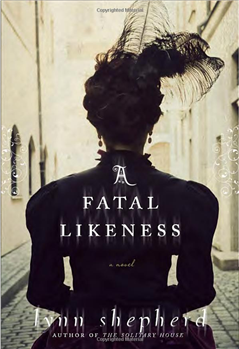
Day 426: A Fatal Likeness

Cover for A Fatal LikenessIn A Fatal Likeness, Lynn Shepherd has created her own gothic horror around the mysteries in the real lives of two fans of the gothic, the poet Percy Bysshe Shelley and his wife, the writer Mary Shelley. It is not only a dark story, but some of it is relatively plausible, given the research Shepherd has done into their lives. Ever since I read Shepherd’s astounding reworking of Bleak House, The Solitary House, I have been a fan of her narrative skills, her writing skills, and her imagination.

Shepherd’s detective, Charles Maddox, is summoned to the home of Percy Shelley, the son of the deceased poet. Shelley and his wife have established a shrine to the poet’s memory and say they are worried about some papers someone is offering to sell them. Mrs. Shelley in particular has been responsible for destroying any papers that would tarnish Shelley’s legacy. They hire Charles to find out what is contained in these papers.

Charles has his own reasons for taking the job, for his beloved great-uncle, also Charles Maddox, the master detective who trained him and is his only family, suffered a stroke upon receiving a calling card bearing the name of his client. Charles learns from his assistant Abel that his great-uncle was employed on a case years before for William Godwin, the brilliant philosopher and Mary Shelley’s father. When the file on this case is located, though, some of the pages have been torn out.

Charles takes a room in the home of the person purveying the papers, whom Charles has been told is an Italian man, and it is not long before he realizes his landlady is Clair Clairmont. Clair, the step-sister of Mary Shelley, infamously ran off with Shelley and Mary when both the girls were only sixteen and Shelley was still married to his first wife, Harriet.

Charles is soon to realize that everyone involved in this case has ulterior motives, those of the Shelleys to find out whether a record of the earlier case still exists, as it certainly contains damaging information. With his great-uncle only slowly recovering, it is up to Charles to discover what mysteries lurk in the Shelleys’ past. As he investigates the earlier case, he finds records of an even earlier encounter with his great-uncle.

The Shelleys’ past is a rat’s nest, with two young suicided women, Shelley’s first wife and Mary’s other step-sister, with several dead infants, with Shelley’s own history of delusions, hallucinations, fits, and obsessions. Each person’s story of the fraught years of the Shelleys’ relationship is different, and it is difficult to know what or whom to believe. It is not long before Charles is to think Percy Shelley was something of a monster.

Doubles are a theme throughout the novel. Shelley is always involved with two women at once, two young women commit suicide, Shelley is obsessed with the idea of a doppelganger and thinks he has encountered a monster with his own face. Charles’ great-uncle was partially deceived long ago by the likeness he perceived between the young Mary Godwin and a lost love.

Shepherd’s writing style is distinctive. She writes in limited third person but overlays this voice occasionally with observations from a more knowing narrator of a later time, perhaps the present. The effect is slightly facetious and ironic in tone.

Her research into this time period and into the lives of the Shelleys is clearly extensive. She impressed me with The Solitary House and here she continues to do so with a fascinating, disturbing tale about some turbulent personalities.