Review 2424: The Bookbinder

Pip Williams revisits the Oxford University Press and the themes of World War I and rights for women in The Bookbinder. Again, she shows her skill as a storyteller.

Peg Jones has grown up around the Oxford University Press, but she’s a representative of town rather than gown. She works at the press as a bookbinder, but she has always yearned for more education and an opportunity to attend Somerset, the women’s college. Aside from the social and educational restrictions, she has been held back by a feeling of responsibility for her special needs identical twin sister Maude.

World War I has just started, and Peg gets an opportunity to apply for one of the positions on the men’s side, but she doesn’t take it. In a link back to The Dictionary of Lost Words, Peg helps Esme’s lover bind a printed copy of her collection of women’s words.

After the invasion of Belgium, Belgian women come to work at the press, and Maude becomes close to one of them, Lotte. Peg goes to volunteer at the hospital and is teamed a reader/letter writer with Gwen Lumley, an upper-class girl who becomes her friend.

Peg is torn between her feeling of responsibility for Maude and her resentment of it. She is both grateful to Lotte for helping with Maude and jealous.

Her contact with Gwen along with the help of her supervisor, Mrs. Stoddard, leads her to an opportunity to apply for a scholarship to Somerset. But she must pass two series of exams.

Williams is skillful at involving readers with her characters’ ups and downs as well as their self-development. I enjoyed this novel very much.
Related Posts

The Dictionary of Lost Words

High Wages

Weatherley Parade

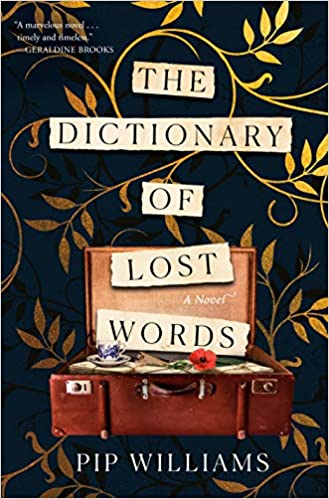
Review 1641: The Dictionary of Lost Words

After reading The Professor and the Madman, Pip Williams got interested in the ways that gender affected the original edition of the OED. She wrote The Dictionary of Lost Words to honor the women who helped produce the dictionary.

As a little girl, Esme becomes fascinated with the strips of paper used to keep track of different uses of words. Her father is the assistant to Dr. Murray, who is in charge of the OED project, and she spends a lot of time sitting under her father’s desk at the Scriptorium. One day, she finds the strip for the word “bondwoman” and puts it in her pocket. She begins collecting duplicate strips or words that will not be included in the dictionary and puts them in a trunk.

As a young woman, she begins working in the Scriptorium. She becomes fascinated with the idea that some words are not allowed in the dictionary because they don’t have a written source. Many of these words, she notices, are related to the poor and to women—words for women’s body parts, professions, epithets for women. She begins collecting her own words from Lizzie, the Murray’s maid, and from common people in the market.

link to Netgalley

This novel not only reflects the love of words but also the events of the time—the battle for women’s suffrage and eventually World War I. At first, I had difficulty getting into it, but that may in part have had to do with my problems with eBooks. Eventually, I was sucked in and found the novel touching, even though a few plot points are predictable.

I received this book from the publisher in exchange for a free and fair review. I had this review already scheduled for posting when I learned that the book made it to the shortlist for the Walter Scott Historical Fiction Prize.

Related Posts

Charlotte and Emily

The Adventure of English: The Biography of a Language

Dreyer’s English: An Utterly Correct Guide to Clarity and Style