Day 679: The Bees

Cover for The BeesThe Bees is a collection of more serious poems than those included in The World’s Wife, also by British poet laureate Carol Ann Duffy. This collection is more diverse in subject matter and quite varied in form, containing sonnets, haiku, free verse, and even drinking songs. And many of the poems are about bees.

In “Bees,” Duffy even presents her poems as bees: “brazen, blurs on paper,/besotted; buzzwords, dancing/their flawless, airy maps.” In this poem she finishes with “and know of us;/how your scent pervades/my shadowed, busy heart,/and honey is art.” My niece, a beekeeper, would especially appreciate that.

I understand that after Duffy’s mother died, she did not write for some time. Especially touching are some of the poems about her mother. In one, she gives her dying mother a last drink of water and remembers the times her mother brought her water when she was a child. In another, a remembered kiss from her mother after she was out in the cold as a child makes her think of kissing her dead mother’s lips.

Some of the mythological figures visited so vividly and amusingly in The World’s Wife, Sisyphus and Achilles among them, are revisited more seriously here.

The poetry is lyrical. It is sometimes harder to understand than the works in The World’s Wife, but it always sings.

Related Posts

The World’s Wife

The Greek Myths

The Selected Poetry of Edna St. Vincent Millay


Day 623: The Goblin Market and Selected Poems

Cover for The Goblin MarketI don’t know much about the life of Christina Rosetti. I know a little more about her brother, the artist Dante Gabriel Rosetti. The introduction to this book of her poems says that something happened to her when she was 15 that changed her from a mercurial child into a controlled, careful young woman. Certainly, her poetry shows a preoccupation with religion and death. It is also brimming with life, full of nature and love.

In “The Goblin Market,” for example, her descriptions of the goblin’s fruit are luscious. But though I understand the introductory comments about the poems being too sexually explicit for Victorian tastes, I see this poem as more about the pleasures and temptations of life versus spiritual values.

Some of the poetry in this collection dwells on themes I am not that fond of, but there is no doubt that the language is vivid and gorgeous. I don’t know if the poems are arranged sequentially, but some of the earlier ones remind me somewhat of traditional folk songs. Her sonnets employ an unusual rhyme scheme, close to Petrarchian, but with the last six lines using a different scheme.

One of my favorite poems was “In an Artist’s Studio,” about how the artist paints and repaints his model:

Lizzie Siddal
Dante Gabriel Rosetti portrait of Lizzie Siddal

He feeds upon her face by day and night,
And she with true kind eyes looks back on him
Fair as the moon and joyfull as the light:
Not wan with waiting, not with sorrow dim;
Not as she is, but was when hope shone bright;
Not as she is, but as she fills his dream.

I know that Dante Gabriel occasionally painted Christina when she was young, but this poem made me think of how he obsessively painted his mistress, Lizzie Siddal.

Day 606: Beowulf

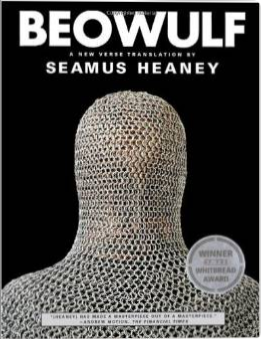
Cover for BeowulfI’m planning this post for Halloween, so I decided to write about the quintessential monster tale. I’m not enough of a poetry reader to easily read an extended poem. Still, Beowulf is considerably more accessible than I expected.

The poem is, of course, the oldest known work in Old English, or Anglo-Saxon, written sometime between the seventh to early eleventh centuries. It is the story of the feats of Beowulf, a Scandinavian hero. It is also a poem written by a Christian poet looking back to a time of paganism. I read the award-winning translation by the Irish poet Seamus Heaney.

For me, the interest in the story is not the tale of battling monsters but the glimpses into a different past and mindset. For this poem is about right and proper behavior. The hero honors his lord and behaves rightly to him. When Beowulf is rewarded for killing Grendal and his mother, he rightfully takes his treasure back to his own chief. Later in the story, when all of Beowulf’s guard except Wiglaf desert him in the face of the dragon, Wiglaf is steadfast by his chief’s side to the end.

The poem is melancholy, for it tells of the end of the Geats, Beowulf’s people, when they are left leaderless after his death. It also stops several times to relate tales of revenge and blood money.

I barely remember a semester of Old English classes in graduate school, but it was enough to occasionally pass my eyes over the Old English side of this bilingual edition and recognize some similarity to modern English, an interesting pastime in itself.

Day 573: The Selected Poetry of Edna St. Vincent Millay

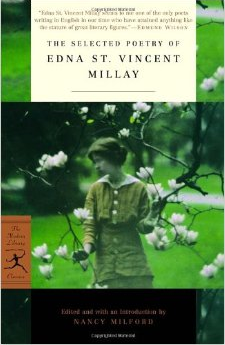
Cover for The Selected Poetry of Edna St. Vincent MillayPoetry is not really my expertise, so I feel awkward trying to write this. Of course, I came to this book familiar with a few of Millay’s most well-known poems, particularly “First Fig.” The poem that made Millay’s reputation was “Renascence,” about a person who is buried in the earth alive and springs back out.

I think this is an interesting book for someone not familiar with Millay. It contains most of her best-known poems from several different collections.

Although Millay was known as a master writer of sonnets and this book contains many sonnets, I think I prefer some of her less formal, cheekier poems, for example, “Thursday.” I also liked the poems that reflect her familiarity with old Celtic and British folk ballads—whose rhythms sound like someone singing a ghostly Border ballad.

After reading in Milford’s biography about Millay’s wonderful voice, I looked for a recording on YouTube. I was delighted to find an atmospheric performance of “The Ballad of the Harpweaver,” recorded for radio.

You might be interested in reading my review of the biography of her life.

Day 566: Savage Beauty: The Life of Edna St. Vincent Millay

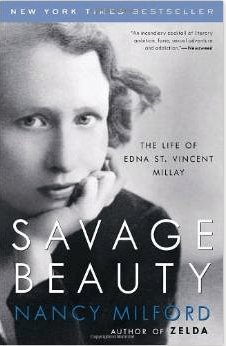
Cover for Savage BeautyNancy Milford, author of an acclaimed biography of Zelda Fitzgerald, was able to gain unlooked-for access to Edna St. Vincent Millay’s papers to write this compelling biography. She explains in the prologue that she stopped by the house of Millay’s sister Norma in 1972, hoping to talk her into working with her on a biography. Norma, who had all along refused access to her sister’s legacy, decided it was time.

The result is a riveting biography, full of excerpts of letters—some never sent—poetry and scraps of poetry, and notes. It is unflinching in looking at Millay’s lifestyle and addictions.

Millay, of course, is famous as the voice of a newly liberated youth, particularly of women, in the Jazz Age. She began publishing her poetry at a young age and became famous after her first book, when she was in her early twenties. For a long time, she was wildly popular—movie star popular—which is interesting in a nation that generally doesn’t love poetry. And, like many a modern idol, she had a lot of attention paid to her appearance, which was small, with fiery red hair, and sprite-like.

That is about all I knew about her—that and a bit of her verse. Her childhood was hard. Her mother left her father when Edna and her sisters were young and was away much of the time trying to make a living for them as a nurse, while the girls fended for themselves. Still, she brought the girls up with a love of music and poetry. Millay published a few poems in a children’s poetry magazine and won all their awards, but her big break came when she attracted the attention of a wealthy patroness, who arranged for her to attend Vassar.

I am not going to relate Millay’s life story in this review—you can read the book for that—but instead ruminate on some ideas this book made me consider. One is the strange relationship Millay had with her mother Cora and her sisters Norma and Katherine. For Cora, her letters always expressed much affection, often resorting to baby talk. Yet increasingly, Millay kept her mother at arm’s length, sending money instead of visiting her.

With Norma, too, the messages were affectionate, but the visits were few. In her case, there seems to be fair enough evidence that Edna’s husband Eugen Boissevain acted as a barrier between Millay and some people, including her family. As time progressed, for example, almost all of Norma and Katherine’s letters to Edna were answered by Eugen.

Katherine’s case was different, a life that seemed to be an attempt to compete with Edna in her own backyard, and failed. Edna’s patroness also saw Katherine into Vassar, from which she failed to graduate. She published a couple of prose books and some poetry, but her work was deemed too similar to her sister’s to succeed. This evaluation must have been disheartening, but in later years she claimed that Edna stole her ideas, an allegation that was patently absurd, especially as they had barely been in touch for years. Katherine’s relationship with Edna toward the end consisted solely of letters that were a combination of vituperation and demands for money. Like Edna, Katherine was an alcoholic, although not apparently a high-functioning one.

Edna’s relationship with her husband was unusual, too. After a gay and determinedly single life including many affairs with both men and women, Millay married not long after the failure of an affair with another man. Eugen is frequently described as a man who did everything for Edna, including absenting himself so that she could have an affair with a much younger man. Her family and some of her friends seemed to blame him for keeping her apart from them, but I can’t help feeling that most of that was at her desire, since she seemed to see who she wanted to see.

All of this makes me wonder how far a creative person can go in selfishness—how acceptable that is in the service of art. Millay was certainly one of those extremely charismatic people who attracted others like moths. How often such people are completely self-absorbed, even if they are not geniuses. If a person’s genius is fueled by intense emotion, is it okay to fire that  emotion at the expense of others? To blow hot and cold on people’s passions until they are madly in love and then discard them? I don’t really know. Many of Millay’s lovers remained her lifelong friends after the affair was over, but it seems that charismatic people are more often forgiven their actions than others. I haven’t come to any conclusions on this. These ideas are just some the biography made me consider.

I read this book in tandem with The Selected Poetry of Edna St. Vincent Millay. Review to come.


Day 564: Literary Wives: The World’s Wife

Today is another posting for Literary Wives, where a group of bloggers get together to discuss the same book about wives and invite others to join in the conversation. Please take a look at the reviews of the other members, listed below.

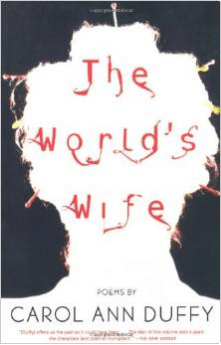
Cover for The World's WifeMy Review

My relationship with poetry is not so comfortable that I expect to burst out laughing when reading it. But that’s exactly what I did several times when reading The World’s Wife.

This book contains a clever, brilliant collection of poems united by a single conceit. Duffy looks at legendary figures, that is, some figures of myth and fairy tale and a few from real life, from the points of view of their wives. Occasionally, male figures become females. In any case, the result is to turn the myth, be it legendary or real, on its head.

The first time I laughed out loud was when reading the Poem “from Mrs. Tiresius.” Regrettably, I did not know who Tiresius was, so I looked him up. It turns out he was a blind prophet who managed to offend Hera, so she turned him into a woman. In the poem, when Tiresius comes back as a woman, his wife at first tries to help him, takes him shopping, teaches him to blow-dry his hair.

Then he started his period.

One week in bed.
Two doctors in.
Three painkillers four times a day.

That’s when Mrs. Tiresius loses patience, and I laughed.

These poems are cheeky, earthy, inventive, and sometimes extremely powerful. Although many of the wives view their men’s activities with cynicism, the poems are not always so, as in the beautiful sonnet called “Anne Hathaway,” in which Hathaway fondly remembers the activities that took place in the second best bed. I love this book.

What does this book say about wives or the experience of being a wife? In what way does this woman define “wife”—or in what way is she defined by “wife”?

Literary Wives logoThere are 30 poems in this collection, each of them from the point of view of a different woman. The most common viewpoint is a certain cynicism about the wives’ husbands or their activities, but that is by no means true of every poem. In many, though, the man or the love of man is a source of pain.

At first, Penelope looks for her husband and waits for him to come home. Then she gets involved in her embroidery and meets his return with a certain dismay. Mrs. Sisyphus laments that ever since he started pushing that stone up the hill, he’s been ignoring her for his work. Mrs. Midas cannot believe the greed and stupidity that made her husband wish for something that keeps him from eating or touching her ever again. Mrs. Aesop is bored stiff by her husband’s constant platitudes. Naive Little Red Cap let the wolf seduce her with poetry, but ten years later she sees he is a dog with no new tricks.

Some of the poetry can be somewhat misandrist, and most of it ends in some sort of triumph for the woman, occasionally one that is gruesome.

The Wives

Be sure to read the reviews and comments of the other wives!

Day 418: Old Possum’s Book of Practical Cats

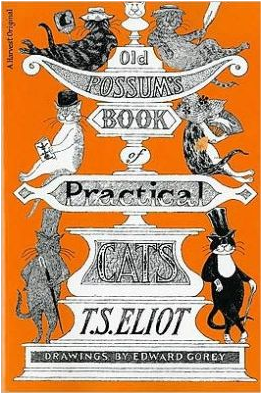
Cover of Old PossumIt took me longer to find this wonderful book than to read it. I came across it months ago in a used book store, bought it, and immediately opened it up. After I read the first poem, I got interrupted and put it down. Shortly thereafter, my husband, in a fit of tidiness, put it “somewhere safe.” He finally found it again, months later.

Some of you may know that T. S. Eliot’s Old Possum’s Book of Practical Cats is the source material for the musical Cats. Since the book is not as well known on this side of the pond as I assume it is on the other, I had not read it until lately and was frustrated during the musical at not being able to understand most of the words, much less which cat was which.

But these poems are delightful. They zip along with the kind of rhythm and rhyming that smaller children adore, and although I don’t think they’ll understand all the vocabulary, that can be explained to them. I was wondering whether modern children would understand or care about things like the clubs along St. James, but I decided that was unimportant. They would focus instead on Macavity, who isn’t there (I have a cat like that), on the names like Rum Tum Tugger that roll around in your mouth awhile, and on the proper way to address a cat (“O Cat”).

A comment on the cover I have shown here. This cover is not for the copy I bought, which was illustrated by Axel Scheffer. I thought Scheffer’s illustrations were cute, but it was hard to tell one cat from another. The reason I’ve attached the cover with Edward Gorey’s illustrations to my review is that Gorey’s version was the one I chose to buy for my young niece.

Day 210: White Heat: The Friendship of Emily Dickinson and Thomas Wentworth Higginson

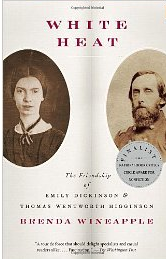
Cover for White HeatBest Book of the Week!

White Heat is an unusual biography that focuses on the friendship between Emily Dickinson and Thomas Wentworth Higginson. The book is unusual because so little is known of the daily life of Dickinson and much is known of that of Higginson. Brenda Wineapple has pieced together the story of their relationship from what is left of letters (Higginson’s to Dickinson were destroyed with much of Dickinson’s correspondence, but there are letters to others) and from poems sent to Higginson by Dickinson. Wineapple is the author of an admired biography of Nathaniel Hawthorne.

Their relationship was almost entirely in letters. By the time they began their correspondence, Higginson was a well-known writer of essays on nature and politics but was even better known as an ardent and radical abolitionist and advocate of women’s suffrage. He ran guns to Kansas during the free soil days and helped encourage many women poets and got them published. Later, he formed the first African-American regiment in the Civil War. On the other hand, Dickinson had published one or two poems and frankly didn’t seem much interested in publishing more, but preferred to send them off to friends. She remained obscure and unknown, in her later years not even leaving the grounds of her father’s house in Amherst.

Dickinson initiated the correspondence by sending Higginson a flattering letter containing a few poems and asking him to be her preceptor–to tell her if her poems “sing” and to give her advice. Of course, she knew her poems sang and apparently had no intention of taking his advice, so it can be assumed that she wrote hoping to start a correspondence.

Although Higginson has been criticized as too conservative in his poetic tastes and as a bungler for his role in Dickinson’s legacy, part of Wineapple’s purpose is to rehabilitate his reputation, for he was in his own time a brave man of principle whose poetic instincts far surpassed his own abilities as a writer. He found Dickinson’s poetry both shocking in its unconventionality, especially of form, and breathtaking in its beauty.

The two remained friends for the rest of Dickinson’s life, although they only actually met twice. Their letters were sometimes flirtatious, but Wineapple convincingly suggests that most likely neither of them had any intentions beyond friendship and esteem. Higginson was married to a lifelong invalid and seemed to be too upright to consider the idea of dalliance. When his wife Mary died, he shortly remarried a younger woman in the hopes of finally having a family. Later, Dickinson became enamored with and probably engaged to a much older man who unfortunately died.

One purpose of Wineapple’s book is to show what actually happened to Dickinson’s poems after her death, when they were published in two volumes in an edited form, with grammatical, punctuation, and even wording changes by Higginson and Mabel Todd. Higginson has been excoriated for this, but Wineapple suggests that Todd did most of the editing, some of which Higginson strenuously objected to. Certainly Todd alone released a third volume of poetry that was even more heavily edited. Higginson seemed unaware that Todd was handling Dickinson’s poems (with her sister’s permission) as an act of both self-aggrandisement and of petty revenge against Sue Dickinson, Emily’s good friend and sister-in-law, and the wife of Todd’s lover.

Wineapple’s biography is engrossing and occasionally poetic in its own right. It is an excellent analysis of this unusual friendship.