
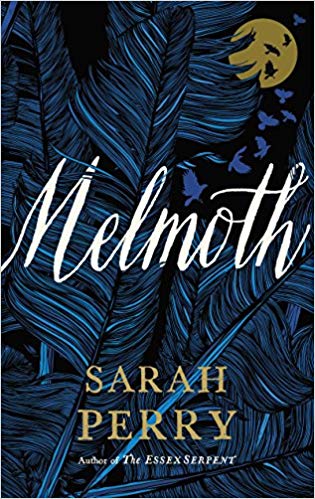
 Helen Franklin is an Englishwoman living in Prague who leads a willfully colorless and drab existence. She dresses and behaves as if she wants no one to notice her and makes a living translating brochures. In nine years in Prague, she has made only two friends, Karel and Thea, a couple.
Helen encounters Karel one night, looking ill. Thea was recently stricken by multiple sclerosis, and Helen assumes he is worried about her. He tells her the story of a manuscript he’s been given that documents sightings of Melmoth. In the legend of the novel, Melmoth (who seems in actuality to be based on a male character in an Irish Gothic novel) witnessed Christ arisen from the grave but denied it. In this novel, Melmoth is an evocatively described woman, a suggestion of tattered sheer silks, who is fated to witness man’s inhumanity. She appears to those who have entered the depths of despair and asks them to keep her company.
Through the manuscripts, we learn the stories of several people who have caused the sufferings of others and who have met Melmoth. Both Karel and Helen are immediately obsessed with this vision and imagine Melmoth stalking them.
The novel is tied together by the gradual exposure of Helen’s own crime, but the themes of the novel center around the history of man’s inhumanity and the importance and difficulty of witness.
This novel was certainly a departure from Perry’s The Essex Serpent, and I wasn’t sure how much I liked it. It has a deeply Gothic atmosphere, suitable for its setting in Prague, but I didn’t understand its characters’ fascination with Melmoth. Also, I had little sympathy for most of the characters whose crimes are related in the manuscript, even though I was sympathetic to Helen. Although this novel has more serious intentions, I have to say I preferred The Essex Serpent.
Related Posts

 What? Me Read?