Day 432: The Orphan Master’s Son

Cover for The Orphan Master's SonBest Book of the Week!

I can tell before I even start that this is going to be one of those times where I have difficulty conveying just how good this novel is. It is going to sound dreary and painful, but it is a wonderful, wonderful novel.

For a long while I avoided this book, afraid that the subject matter would be too cold or too harrowing. However, it has earned so many honors that I felt I finally had to read it. It is harrowing, but it is so very human, and touching, and inspiring.

Pak Jun Do (note the purposeful echoing of our clichéd unknown man, John Doe) is the only boy with a father who was raised in an orphanage in North Korea, the orphan master’s son, or so he believes. Of course, many of the orphans actually have parents, who dropped them off because they couldn’t or wouldn’t feed them during the time of the great famine. The orphans, including Jun Do, are shamelessly put to hard labor deep in the mines, where our hero learns a skill that will come in handy, to get around in the dark.

Later, he is assigned to a kidnapping team, sneaking into Japan to abduct unwary Japanese citizens. You can see him quietly processing his opinions about this activity. From this position, he is sent to language school and ends up on a fishing vessel spying on radio transmissions from other countries and vessels, including, significantly, those of a young American woman who is rowing around the world with a partner. Jun Do begins showing himself to be observant, resourceful, and ethical in his own way.

Jun Do has had a difficult start in life in an environment that seems almost totally arbitrary, and as he experiences one event after another, he begins to develop in unexpected directions and to look at his environment with a skeptical and aware eye. After an encounter with an American ship, Jun Do and his shipmates fabricate a ridiculous lie to save themselves and their families. This lie inadvertently results in Jun Do being declared a national hero. From there his life begins a series of remarkable transformations.

I am feeling my inadequacies here, because I am not conveying at all how wrapped up I became in Jun Do’s story. It is told in many voices, including the daily loudspeaker broadcast of propaganda (which is frequently ridiculous) and the “biography” put together by a state inquisitor. Some of the events are difficult to read about, some frankly absurd, as when the Dear Leader Kim Jung Il decides to entertain some American dignitaries with synchronized fork lift demonstrations.

The novel tells a story of hope, mixed in with the grim reality and sheer ludicrousness of what seems to be a fully realized vision of North Korean existence, where people live in terror of innocently making some terrible error. The book tells this story with power, with pathos, with sly humor, and with irony.

This book is really, really great.

Day 428: Annals of the Former World: Assembling California

Cover for Annals of the Former WorldAssembling California is the fourth volume of McPhee’s massive book about the geologic structure of the country. It dwells mostly on how the ideas of plate tectonics by themselves do not explain the geology of California.

As explained in my reviews of the previous volumes, McPhee spent years traveling along I-80 in the company of different geologists with the aim of describing the geologic formation of the country. In this volume, McPhee continues his travels along I-80, this time with geologist Eldridge Moores. They begin a series of journeys at the eastern border of California near Donner Pass, crossing to the Oakland/San Francisco area.

McPhee introduces the concept of the ophiolitic sequence, a sequence of rock strata that has been found to originate from ocean floor crusts. These crusts were ripped from the floor and mashed upward when an island arc, like that of Japan, collided with the western coast of the continent. Thus the ophiolites, which are the oldest rock, end up on top of mountains. The theory is that three such island arcs joined with the continent over the ages to form California.

McPhee also travels with Moores to Cyprus and Macedonia, two areas with similar rock. He introduces some other structures that are not completely explained by plate tectonics, such as the whole of Southeast Asia, which appears to be a part of the continent that was pushed sideways by the impact of India smashing into Asia and creating the Himalayas.

McPhee finishes this book with a dissection of the 1989 earthquake in San Francisco-Oakland (which occurred after his initial visits). He returns to examine the damage and explain how the shockwave spread and why some areas were more damaged than others.

As in the other volumes, McPhee imparts a great many concepts and theories in clear and interesting prose. This series of books (or the larger volume) makes for reading that can be a little difficult to grasp, as plates and continents seem to whirl and gyrate all over the earth (only, of course, very slowly), but it is nonetheless fascinating.

Day 417: Annals of the Former World: Rising from the Plains

Cover for Annals of the Former WorldRising from the Plains was my favorite book of Annals of the Former World. In this third book of the series (or third section of the complete book), John McPhee examines the geology of Wyoming along I-80 and makes a side trip to Jackson Hole.

McPhee travels with geologist David Love, and he enlivens the geological discussion with a discursion on the settling of Wyoming, particularly with the history of Love’s own family. He begins with Love’s mother, Ethel Waxham, a Wellesley graduate who arrived in the wintery landscape by stage to take up work as a schoolteacher. Waxham kept absorbing journals that describe the harsh conditions as well as the striking characters she encountered. Waxham was courted and won by a rancher, John Love, a nephew of John Muir, the great writer and naturalist. McPhee has tales to tell of Love’s adventures, including his acquaintance with Robert Leroy Parker and Harry Longabaugh (Butch Cassidy and the Sundance Kid).

This book continues to explore questions raised by too comprehensive an application of the theory of plate tectonics. It introduces the concepts of hot spots and plumes and their involvement in the formation of structures.

The book delves deeper into the story of the discovery of oil shales and uranium in the area. It touches on issues of ecology and preservation of natural areas.

Of all the parts of Annals, Rising from the Plains is the widest in scope. McPhee has a talent for making his subjects understandable and readable–and very interesting.

Day 406: Annals of the Former World: In Suspect Terrain

Cover for Annals of the Former WorldIn the second book of Annals of the Former World, John McPhee returns east to examine the geology of the Appalachians along I-80. Beginning with the Delaware Water Gap, he travels along the highway with geologist Anita Harris exploring the road cuts to see what can be determined about how the landscape developed. The two continue on this route through Pennsylvania and into Ohio, where they explore Kelley’s Island, travel along the Cuyahoga River for a spell, and end at the Indiana Dunes.

Having explained the basics of plate tectonics in Basin and Range, McPhee now travels with a geologist who is skeptical of the broad application the theory has found, particularly in relation to the Appalachians. Harris takes issue with the idea that the mountains were formed by the ramming of the African coast up against North America. She believes that a study of the rocks does not support this concept.

In Suspect Terrain is deeply concerned with glaciation. As well as explaining how glaciers could have formed this area of folded and complex geology, McPhee breaks off to expatiate on how the theory of the Ice Age came about, among other geological ideas. He also tells how Harris herself figured out how to use the color of conodonts, a kind of fossil, to make it easier to find the conditions for oil.

I find it fascinating to try to imagine the pictures of the earth that McPhee describes, how different they are from the continent as it is today. McPhee tells us how rivers ran to the west instead of to the east, huge tropical seas took up the middle of the continent, the glaciers shoved rock down from Canada to create places like Staten Island.

McPhee is an extremely interesting writer. To be sure, the subject matter, the ideas it evokes, and the language he uses demand full attention, but this series of books is involving.

Day 400: Annals of the Former World: Basin and Range

Cover for Annals of the Former WorldBest Book of the Week!

Beginning in 1978, John McPhee began a series of journeys across the United States along the length of I-80. His goal was to form a picture of how the geology of the country evolved over time. This project proved to be so large that he ended up breaking it into chunks, publishing four books that he finally combined into one (with an extra section). Basin and Range is the first book of Annals of the Former World, the combined volume, for which McPhee won the Pulitzer. Although I am reading the large volume, I have decided to break up my review by the original works, as reading this book has involved a lot of concentration.

Although the book begins with the genesis of the idea during an outing McPhee took with a geologist in New Jersey and briefly covers other areas of the world, Basin and Range concentrates on the Basin and Range area of western Utah and eastern Nevada. McPhee is a journalist who majored in English, but his interests lead him to take courses in geology, among other sciences. To supplement his basic knowledge and interests, he traveled with and interviewed noted geologists.

Basin and Range discusses changes in basic geological theory from the 17th century, providing readers with a primer on plate tectonics by using examples of various structures in the Basin and Range. In the course of these discussions, McPhee expatiates on some of the larger debates in the history of the science and tells us about some of the more colorful characters. All the while, he conveys his fascination with geology and his appreciation of language. He finds inventive ways of suggesting the vastness of the time he is discussing and the relative rapidity with which major geological forces can create change.

I have an interest in geology that is only basically informed, mostly from a couple of classes, science TV programs, and a former job in a related industry. I always considered myself a dunce at science and so never followed up this interest seriously. McPhee throws around geology terms without always explaining them, so I found myself looking up terms like “oolite” and “craton,” but in general he is gifted with the ability to make this topic abundantly clear. Although I was not sure at the beginning of the book that I would read all the parts, I am certainly planning on continuing. I am finding it fascinating to try to imagine the changes in the Earth that he describes.

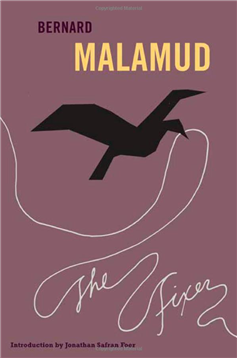
Day 351: The Fixer

Cover for The FixerBest Book of the Week!

In 1911 Russia, Yakov Bok is tired of his difficult life in the shtetl. So, after his wife leaves him for another man, Yakov travels to Kiev in hopes of making a better living. When he helps a drunken man who is passed out in the snow, Yakov is offered a job supervising a brick yard. However, in order to take this job, Yakov must live in a part of the city forbidden to Jews.

It is this circumstance followed by a series of mishaps that ends up with Yakov being accused of murdering a boy he chased away from the brick yard. As the case continues, it becomes clear that the murder is being used by authorities an an excuse to trump up charges of ritual murder against the Jewish community.

The novel becomes more and more difficult to read as literally everything that happens to Yakov makes things worse for him. The gentiles he knows in Kiev tell lies about him. Once he is in prison, the jailers do everything they can to incriminate him, including trying to entrap him into breaking the rules or admitting his guilt.

Yakov goes into jail a nonpolitical, irreligious, naive man who hopes for justice, and the novel is partially about his development into an angry man who refuses to be beaten. Although almost nothing in the way of plot or action happens from the time he goes to jail, I was absolutely compelled to finish reading.

Written in a storytelling fashion that I associate with the tales of Sholem Aleichem or Isaac Bashevis Singer, this novel is more grim than most of the stories I’ve read by these other writers. However, both The Fixer and The Bloody Hoax, by Aleichem, are based on a true event from 1911 Kiev, called the Beiliss blood libel case.

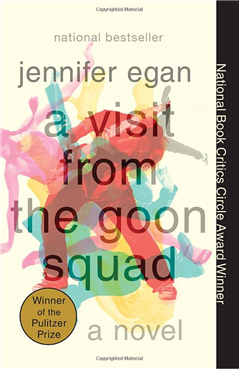
Day 339: A Visit from the Goon Squad

Cover for A Visit from the Goon SquadBest Book of the Week!

Describing this delightful and quirky novel is going to be difficult, so I hope curious readers will try it even if I am unable to convey a sense of it.

First, I call it a novel, but it can be just as accurately described as linked short stories. Each chapter is written from the point of view of a different character who knows one or more of the other characters. The chapters all center around the subjects of music and public relations.

The book begins in New York with Sasha, who is the assistant to Bennie, a music executive, sometime after 9/11. She is on a desultory date with Alex, but she also has a problem with kleptomania. While in the bathroom, she steals a woman’s wallet and then has to watch while Alex gets involved in helping the woman.

Next is a middle-aged Bennie, who torments himself with feelings of shame about past experiences. He takes his son to visit a sister act in order to fire them for not producing an album in the specified amount of time. He realizes he is beginning to see his legendary taste diverge from that of his younger coworkers.

Then we jump back thirty years to Rhea, a teenager in San Francisco who is a member of a punk rock band called the Flaming Dildoes with her friends Bennie (yes, the same Bennie), Scott, Alison, and Jocelyn. Rhea observes Jocelyn’s budding relationship with a middle-aged record executive named Lou, who will become Bennie’s mentor. Rhea is dismayed as Lou gives Jocelyn drugs and gets her to perform sexual acts in public.

These are just the first of the vignettes, which range forward and backward in time over 40 years and extend in structure to a touching PowerPoint presentation and a parody of a celebrity interview. They make stops in Arizona, Italy, and South America but somehow center on New York. Fans of Egan will already be familiar with a certain type of hip, aware New Yorker that appears in her fiction.

By turns funny, touching, and sharp as a razor, Egan’s observations are always entertaining and her intelligence apparent. An obvious theme of this work is the effect of time on characters but another one is how technology seems to have sped time up, the book ending in a futuristic world where public relations is centered on the tastes of babies. The PowerPoint chapter shows us that another theme is pauses, in music and in life.

One of the things I wanted to do when I finished reading A Visit from the Goon Squad was to read it again so that I could know what I was looking for from the beginning and fully understand all the connections. And that is what I plan to do, having inserted the book into my pile of future reading to enjoy again.

Day 281: Gilead

Cover for GileadBest Book of the Week!
Gilead is the novel that precedes Marilynne Robinson’s Home, although it is set in the same time frame and covers some of the same territory. This novel won the Pulitzer Prize for fiction.

John Ames is an elderly Congregationalist minister in 1956 who believes he is dying. He has a much younger wife and young son, a surprising blessing in his old age. The novel is in the form of a diary addressed to his son in the expectation that he will not live long enough to personally pass on his family history and advice.

Ames lives in Gilead, a small Iowa town on the prairie near the border with Kansas. The town was founded by abolitionists during the Free State wars in Kansas as a refuge for slaves and fighters the likes of John Brown. Ames’ grandfather, also a minister of the warrior-for-God ilk, had visions of God and once preached a sermon in a bloody shirt with a gun in his belt. With that upbringing, his son was naturally a pacifist, who left the church for awhile after that sermon to worship with the Quakers. One of Ames’ most powerful memories is of the journey he made with his father to Kansas, in terrible conditions, to retrieve the body of his grandfather, who had returned there.

Although Gilead is certainly about the history of the town–the wars, the Depression, the Dust Bowl years–it is more about the relationship between fathers and sons, both from the secular and religious points of view. Not only does it explore the relationships within Ames’ own family, but it also looks at that between Ames and the son of his best friend the Presbyterian minister–Ames’ surrogate son–John Ames Boughton.

The story of John Ames Boughton is the one more thoroughly explored in the sequel Home, although interestingly enough, Gilead tells Boughton’s story more explicitly, while Home, narrated by Boughton’s sister Glory, only hints at some of the facts.

The novel, a celebration of life and faith, is beautifully written and full of ideas to ponder. That being said, as I do not particularly have a religious background or bent, I did not fully understand some of the narrator’s ideas and preoccupations. I found Home, although told from the point of view of the same goodness and piety, a more accessible novel than Gilead.

Day 157: Empire Falls

Cover for Empire FallsBest Book of the Week!

I’ve been picking up Richard Russo novels at the bookstore for years and putting them back down because I wasn’t sure I’d like the subject matter, but now that I’ve read Empire Falls, I wish I’d been reading them all along.

Miles Roby’s life hasn’t been going too well. He quit college to run a diner in his dying home town in Maine when his mother was ill, and 20 years later he’s still flipping burgers. His wife Janine has left him for her dim-witted personal trainer. He has been in love with one of his waitresses, Charlene, since high school but sees no sign that she returns his feelings. He has an uneasy relationship with the owner of the diner, Mrs. Whiting. The only thing that seems right in his life is his teenage daughter Tick, and she is having problems at school.

Miles’s father is an alcoholic ne’er-do-well who was hardly ever around when he was a child. He comes around when he wants to earn a few dollars or hit up Miles for money. The mill has been shut down for years, and most of the townspeople don’t feel like they have much of a future.

Miles’s brother David is recovering from a drug habit, but his cooking and new ideas have recently been responsible for an increase in the diner’s business, and he wants Miles to move the business to a larger restaurant. Miles has been avoiding a decision. He has only been hanging on because he doesn’t know what else to do and because Mrs. Whiting long ago promised to leave him the diner in her will. She owns most of the town and behaves as if she owns him, too.

Miles doesn’t realize it, but his fortunes have been stymied for years because of events in the past. His only clue to these events is his recollection of a summer spent with his mother on Martha’s Vineyard when he was a small boy.

A pleasure of this book is its myriad of small-town characters and the warm, witty way that Russo depicts them. Russo is skilled at involving you in the fortunes of Miles, his friends, his family, and even his town. This novel is delightful.