Review 2588: Bluebird, Bluebird

Black Texas Ranger Darren Mathews is on suspension after he went to the aid of Rutherford McMillan, a man who has worked for his family for years. He is also having trouble with his wife, Lisa, who wants him to return to law school. Then a friend, Greg Heglund, an FBI agent in Houston, asks Darren to look unofficially at a situation in Lark in East Texas. There, the body of a Black man, an outsider, was found in the bayou and later the body of a White woman, a local, was also found there. Usually in that part of the country it’s the other way around, plus Lark hasn’t had a murder for years.

An interest for Darren is the Aryan Brotherhood of Texas, and he finds in tiny Lark a major presence. The only two businesses in town are Geneva Sweet’s café with mostly Black patrons and an icehouse up the road packed with members of the ABT. When he arrives at Geneva Sweet’s Sweets, he finds the locals nervous and unwelcoming. Missy Dale’s body was found right behind the café. At Jeff’s Juice House, just up the road, where Missy was a waitress, he finds the all-White clientele belligerent and violent.

Then Rainie Wright arrives. She’s the widow of Michael Wright, the first victim, and she is distraught. She worries Darren, because she is from Chicago and has no idea how to behave in the rural South (and no, this novel is not set in the past).

A person Darren finds of interest is Wally Jefferson, a rich White man whose mansion is right across the highway from Geneva’s café and who treats her and the café with a proprietorial air. But Geneva is prone to telling him to get out of her place.

Darren is inclined to suspect Missy’s husband of the murders, since Missy was seen talking to Michael at the icehouse. But that doesn’t quite satisfy him. There are connections here that he doesn’t understand.

I’ve been looking around for a new mystery series to follow, and this novel by Locke has me wanting to look for more. I am familiar with East Texas, and she has the atmosphere down. There is plenty of action and some suspense in this novel. I have to admit that my suspicions fell on a culprit pretty quickly, and I sensed that the story would have something to do with an earlier crime, which it did. But I certainly had some surprises coming. The only think I didn’t like was the cliché of the cop who drinks too much. Bluebird, Bluebird is listed as the first of Locke’s Highway 59 series, so I’m not sure if the others feature the same protagonist or just the locale or both. I have driven on that highway so many times!

Related Posts

The Trees

Raylan

The Devil All the Time

Review 2221: The Expendable Man

Young Doctor Hugh Denismore is driving through the California desert to Phoenix to attend a family wedding when he sees a teenage girl on the highway hitchhiking. He doesn’t want to pick her up but is worried she’ll meet with trouble on the deserted road, so he gives her a ride to Blythe, as he’s not about to cross the state line with her.

On the way, she tells him a pack of lies and claims to be broke, so he buys her a bus ticket to Phoenix when he drops her in Blythe and stops at a motel for the night.

To his dismay, when he reaches the Arizona border the next morning, she is waiting for him and asks for a ride to Phoenix. He drops her off at the Phoenix bus station, but later she finds him at his motel and asks him to give her an abortion. He throws her out.

He has a bad feeling about all of this, but why is he so worried? After her body is found murdered in a canal, his fears are confirmed and the reader realizes he’s a Black man. If the police find out he gave her a ride, he’s sure they’ll try to pin it on him. And they do.

Hughes builds up a great deal of suspense in this one, and she also vividly describes 1960s Phoenix. I have liked her way of introducing strong women in the two books I’ve read by her so far. In In a Lonely Place, two women team up to expose a serial killer, and in this novel, Denismore gets vital assistance from Ellen, another wedding guest. I also thought it was a brave and unusual choice at this time to have a Black protagonist. This is a real nail-biter.

Related Posts

In a Lonely Place

The Horizontal Man

Laura

Review 2220: Our Missing Hearts

After reading two pretty good domestic dramas by Celeste Ng, I wasn’t really prepared for a dystopian novel. Although I occasionally read dystopian fiction, it’s not really my thing. And this one gave me more trouble than most.

Bird is an 11-year-old biracial boy whose Chinese mother, a poet, disappeared from the lives of himself and his father years ago. They are living in difficult times because of PACT, a law that requires everyone to watch others for un-American activities and codifies racism against Asians, particularly those of Chinese ancestry. The historical record for many periods has been blacked out, and lots of books are banned. Bird’s mother Margaret’s poem has become a rallying cry for those against this system, especially against the removal of children from the care of parents deemed unsuitable. Bird doesn’t see that his father—demoted from a linguistic professor to a library book shelver presumably because of his marriage—has been trying to protect him by teaching him not to stand out.

After his best friend’s disappearance, Bird receives a message from his mother. He begins trying to remember her and eventually to find her.

My biggest problem with this book is its dual nature. Young adult novels, except really great ones, tend to have a certain style, and the first part of this novel is so much in that style, written from Bird’s point of view, that I finally googled it to see what genre it fell into. Then Bird finds his mother, and the next section is supposed to be Margaret telling Bird about her life. It is not written as dialogue, and there is a lot of information there that a mother would not tell her 11-year-old son. Okay, I get it—it’s her memories, but the novel keeps repeating that she’s continuing her story. And it’s way too long with too much extraneous information that’s inappropriate for this purpose. About her wild days? Her lovers? The bite marks she made on his father’s neck? Come on.

I was about 2/3 through the novel, but it lost me there. This was a DNF for me.

Related Posts

Everything I Never Told You

Little Fires Everywhere

To Paradise

Review 2211: Horse

This novel tells the story of a famous racehorse and the people connected to him evoked through some objects—his own skeleton and three portraits of him. Although the main characters in the novel are fictional, many of the historical characters are not. The horse, Darnley, who is renamed Lexington, is still considered one of the best racehorses of all time, and many of his offspring have been champions.

In 2019 Theo is a Nigerian graduate student of art history at Georgetown. He plucks a painting out of the trash of his neighbor. It is of a horse, and he recognizes that it is well painted, so he decides to write an article about having it cleaned and valued.

Jess is the head of a lab at the Smithsonian that cleans and articulates animal skeletons for display and study. She has recently located the skeleton of the famous race horse Lexington for a scholar studying equine bone structure when Theo brings in his cleaned painting. Jess recognizes it immediately as one of Lexington painted by Thomas J. Scott, a 19th century horse painter.

In 1850, 13-year-old Jarrett is a slave working with horses for Dr. Warfield in Lexington, Kentucky. Jarrett’s father, Harry Lewis, is a well-known horse trainer who has bought his own freedom and is saving to buy Jarrett’s. Jarrett is with Alice Carneal when she gives birth to Darnley, the horse that will be renamed Lexington. After a promise from Warfield to give Darnley to Harry instead of his yearly wage, Jarrett develops a close relationship with the horse.

Thomas J. Scott is a young artist who specializes in painting horses and is hired by Warfield to paint some of his horses. While he is there, he paints a copy of his picture of Darnley and gives it to Jarrett. Later, he returns to paint an older Lexington.

These are the characters whose points of view are used to tell the story of Lexington. Brooks’s story is based on what is known of the real horse and characters with some inventions. It’s an interesting story with vivid descriptions of the races, of 19th century New Orleans, and of the racing industry of the time. It also has strong themes of the effects of slavery, racism, and cruelty to animals.

Related Posts

Horse Heaven

The Sport of Kings

People of the Book

Review 2144: The Underground Railroad

Cora is a slave on a brutal Georgia plantation. When a new slave on the plantation, Caesar, tells her he is going to escape and invites her to come, she at first refuses. But later her master’s brother inherits the plantation and sets his eye on her, so she and Caesar escape using a branch of the underground railroad.

Up to this point the book is grim and realistic, but Whitehead makes his underground railroad an actual train, destination unknown, and here the novel departs from reality so that Whitehead can make points about the evils of slavery and racism in all its incarnations.

Caesar and Cora arrive in what seems to be a utopian South Carolina, where the state has decided to educate and train slaves who have been freed. But there’s a deeper, darker subtext to the plan.

Determined to capture Cora is Ridgeway, an infamous slave-catcher. Cora’s mother Mabel disappeared when Cora was a girl, never to be seen again, and he took it as a personal failing. So, he’s determined to catch Cora, and he eventually turns up in South Carolina.

I have to admit I have problems sometimes with magical realism, and the combination of a real train and a South Carolina that never existed ground me to a halt. However, as Cora’s adventures continued, eventually I was charmed again and found the novel a powerful work of imagination.

Related Posts

Washington Black

The Nickel Boys

Harlem Shuffle

Review 1845: The Nickel Boys

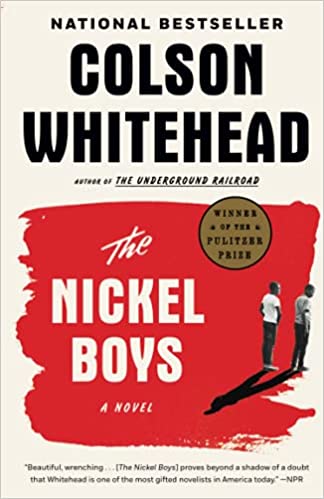
The Prologue of The Nickel Boys is chilling in and of itself. The novel is based on investigations into the Dozier School for Boys in Florida, which turned up evidence of mistreatment, torture, and even murder of young boys.

Set mostly in the early 60s, the novel follows Elwood Curtis, a black boy who has been taught to do what is right and who has been inspired by the speeches of Martin Luther King, Jr. His attitude seems to be working. He is doing well in high school, he has a job with a good boss, and his presence at some demonstrations for equality has earned him an invitation to take college courses.

He is on his way to college for the first night of classes when he accepts a ride from a stranger. Next thing he knows, the car has been pulled over as stolen and he’s been sentenced to the Nickel Academy for Boys.

On his second day, still trying to make sense of things, Elwood steps in to stop some bullying and ends up being beaten senseless by the Director. He spends some time in the infirmary, where the doctor only prescribes aspirin no matter what the problem is.

When he gets out, Elwood is befriended by Turner, who tries to show him how to get by. Turner gets him on Community Service detail, where Elwood observes all the food for the school being sold to restaurants, boys being sent to homes of the board members to do yard work and painting, and other signs of graft and corruption. Elwood writes them all down.

This novel is a searing record of the recent racial history of our country as well as being a story of friendship. It’s a powerful book. It makes me wonder why I haven’t read any Whitehead before.

Related Posts

NW

The Cold Millions

The Goldfinch

Review 1763: Jack

Jack tells more fully the story of Jack Boughton, whose tale was first alluded to in Robinson’s Gilead and whose fate was more fully explored in Home, which takes place chronologically after Jack. Jack is the hapless ne’er-do-well prodigal son in Home, but Jack explores his relationship with Della Miles, a romance with a young black woman that is forbidden in 1950’s Missouri.

Jack is living in St. Louis at the beginning of the novel, just barely hanging on to the fringes of society. He is drunk part of the time and owes money that he can’t repay. He is fresh out of jail and living in a cheerless rooming house.

He has already met Della at the beginning of the novel and has fallen instantly in love with her, but he is minutely aware of himself and his unsuitability. She is a young woman, educated, a schoolteacher, and she is black. It’s against the law for him to consort with her, and just being seen with him will ruin her reputation. For his part, he’s an older man, an ex-con, a bum.

Della gets accidentally locked in a cemetery one night where he sometimes sleeps. So, the first part of the novel is a long conversation at night.

Robinson is finely tuned to the condition of the human heart, as becomes obvious as we watch Jack, overly sensitive to every nuance of a situation. True to his upbringing by a devout Presbyterian minister, Jack frequently engages in theological discussions odd for an atheist. We watch Jack try to defeat his feelings for the sake of his beloved and fear that any small disappointment will send him on a downward spiral, for he is so fragile.

Robinson is a wonderful writer with a deep understanding of human nature. Although these Gilead books can be difficult, they are rewarding.

Gilead

Home

Lila

Review 1728: A Sin of Omission

A Sin of Omission opens with Stephen Mzamane making a long journey to see his best friend, Albert Newnham, across the region known in the 19th century as Kaffraria on the Cape of South Africa. During this journey, the novel looks back on his life.

Picked up as a starving child in the bush by Reverend Basil Rutherford, Stephen is raised at a mission to become an Anglican priest. Once his family learns where he is, his father brings his older son, Mzamo, there too, reasoning that the boys will not succeed unless they learn to be English. The Ngqika tribe has been driven off its lands by the British, and because of a prophecy that foretold the British would leave if the people destroyed their crops and animals, his father has killed his cattle and burned his crops. Although he is an important man, he has to work on the roads to avoid starving.

The Church is making it a practice to raise the sons of important natives as British clerics in an attempt to convert the people. Both Stephen and Mzamo are intended for this program. However, Mzamo is rebellious while Stephen is dedicated and devout, so Mzamo is ejected from the program.

Stephen is eventually sent to Canterbury to be educated at the Missionary College. There, although he is a fish out of water, he becomes best friends with a fellow student, Albert Newnham. Unfortunately for this friendship, Albert eventually chooses to marry a girl who is completely unsuited to be a missionary’s wife and is racist.

Things begin to go wrong after the young men take an ill-considered shortcut so as not to be late for tea, but Stephen only begins to learn the fruits of this event when he returns to Africa. Although he still needs to pass Greek and Latin exams to become a priest, unlike his white fellows, he is given a post far from any libraries or tutors. The job he expected to get working at the missionary college with his beloved Mfundisi Turvey, principal of that college, eventually goes to Albert. Instead of being give a post together, as promised, they are separated. In fact, Stephen is alone because the nearest cleric to his post is racist.

Stephen is also no longer a part of his own people, although his brother plays a large part in his fate. The major events of this novel are initiated when he learns of his brother’s death.

This novel is partially based on the life of Stephen Mtutuko Mnyakama, a missionary of the Anglican Church of the Holy Trinity. Although it didn’t initially pull me in, I eventually found it absorbing and heart-rending. This is a novel I probably wouldn’t have discovered had it not been for my Walter Scott project.

Related Posts

Things Fall Apart

The House Gun

Sex and Stravinsky

Review 1686: You Don’t Have To Live Like This

Greg Marnier in his 30’s finds himself at loose ends. He has been in Wales teaching history classes as an adjunct during the last few years but has moved back home to Baton Rouge and can’t find a job. He is an overthinker, who seems generally clueless and inert throughout the novel.

Marny, as his friends call him, went to Yale with Robert James, who has made a fortune and now claims to want to do some good. It’s 2011, and property is cheap in deserted Detroit. Robert wants to buy a large number of houses and sell them to people who want to change their lives, fix up the houses, and create communities, thereby forcing urban renewal. Marny decides he’s in.

This idea is sort of interesting, but Marny right away struck me as deficient in something. For example, he doesn’t seem to think there’s anything wrong with Robert’s company having tried to force some of the original occupants in the five neighborhoods, most of whom are black, out of their houses, to displace them with newcomers who are mostly white. Marny makes tentative friends with an angry black Detroit native named Nolan, but when his friend Tony won’t let his small child play with Nolan’s small child because Tony is a racist, he says nothing and continues to be friends with both.

Marny half-heartedly pursues a black schoolteacher named Gloria romantically and then doesn’t seem to know what to do with her once he’s got her. But like all the conversations in this novel, their discussions of race seem strangely unfinished and unsatisfying.

In general, Markovits’s handling of the book’s themes of racism and gentrification seems deficient and naïve. Nothing much happens for a long time except an exhaustive retelling of Marny’s day-to-day life until there’s a series of events and a trial that change everything.

Markovits has a background in magazine writing, which I wouldn’t mention if it didn’t affect the novel. Just like in a magazine feature, Marny describes each character as he or she comes into the story and provides a short background. This is not an organic outgrowth of the novel, where it is more usual to find out about a character’s background through a conversation or some other organic construct (research on the part of another character, for example) unless the novel is omnisciently narrated. It seems very artificial in fiction as it does not in a magazine article, and frankly, some of the characters seem stereotypical. There are also a lot of them, as there are a lot of those unsatisfying conversations, many of which have little to do with the story.

I think that the subject matter of this novel is important, but I don’t think Markovits is the person to handle it, at least not judging by this book. Including its clumsy title (which seems to be a thing these days), his novel was not one of my favorites from my James Tait Black project.

Related Posts

The Long Take

We Need New Names

Broken Monsters

Review 1596: Her Father’s Daughter

When I was a girl, I discovered some old Gene Stratton-Porter books of my mother’s, and I just loved them. Later, in high school, I had a job at the public library, so I resolved to read all of her books. However, one of those books put such a bad taste in my mouth that I stopped reading her.

Skip forward 50 years and I found an old copy of one of her books in good shape in a used bookstore, so I bought it. I finally got around to reading it, only to discover on the very first page that this was the same book that turned me off in the first place. How did it strike me now? You shall see.

Linda Strong is in the halls of high school in Los Angeles when she is accosted by an upperclassman, Donald Whiting, who asks her why she wears such odd shoes. She in turn raises an issue with him that I will address in a bit.

Linda is an independent girl who was brought up by her father exploring the desert environs of Southern California, learning how to identify and use plants and how to live in the wilderness. Her parents died four years ago, and she has been living with her older sister, Eileen, who has been systematically robbing Linda of her inheritance to pay for her own clothes and entertainment. Hence, Linda in high school makes a shabby, eccentric appearance, but her shoes are for comfort.

Eileen has also deprived her best friend, Marian, of her boyfriend, which she did as soon as John became successful. Marian is leaving for San Francisco, where she has a job in an architect’s office and has entered an architectural contest. But the plot takes a turn when John brings over an old friend, writer Peter Morrison, who is looking for a place to settle, and Henry Anderson, an architect.

This book is really almost all subplots. I was going to say that the main plot was the relationship between Linda and Eileen, but that plot goes into abeyance for quite some time. There is a romance of some uncertainty, of course, and a plot about a stolen drawing of Marian’s. But my objection to the novel mostly concerns Linda’s issue with Donald. For this novel contains a ridiculous, racist subplot about Japanese adults being sent to attend California high schools so that they can best the American students academically and make them feel inferior. It is one of the stupidest plots I have ever read, and the book is one of the most racist I have ever read, a blueprint to the thinking of white supremacists. Not only does Linda believe all kinds of paranoid things about the Japanese, but she lets others have it as well—African Americans, Mexicans, and Communists. I usually try not to judge books out of their time, but I’ve read plenty of books from this time period (1921), and this one is just despicable. All these horrible attitudes are expressed by an otherwise appealing heroine, which I think makes it worse. I am again disappointed in this author, who has written several really good books for young adults.

Related Posts

Michael O’Halloran

The Web of Days

My Mortal Enemy