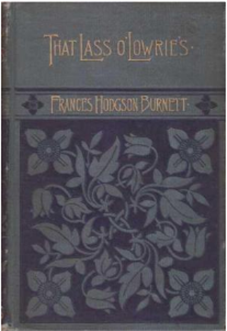
Day 985: That Lass o’Lowrie’s

Cover for That Lass O'LowriesThat Lass o’Lowrie’s is Frances Hodgson Burnett’s first novel, written in the style of Realism. It is set in a Lancashire mining town and features a lot of Northern dialect.

The lass in question is Joan Lowrie, a miner’s daughter. She is a tall, strong, proud woman who has survived years of abuse at the hands of her father. At the beginning of the novel, she dresses partly in men’s clothing and works in the mine as a pit girl.

She attracts the attention of a young mining engineer, Derrick, and his friend Paul Grace, a curate. Later, Derrick finds her injured by her father and helps her, after which she promises to pay him back for his help. When Derrick has a dispute with Lowrie, who would like to revenge himself by ambushing Derrick, she follows Derrick home in the dark every night to protect him.

Grace himself is in love with the rector’s daughter, Anice. But Paul Grace is small and unprepossessing and doesn’t hold out much hope. He also has problems being accepted by the miners, who distrust clerics and think he is too small and refined to heed.

This novel deals with the difficulties of the miners’ lives and of their grievances against the owners. Although it sympathizes with them, it’s true that the only bad men in the novel are Lowrie and his buddies, as well as one son of an owner, who debauches a foolish girl that Joan befriends. It is in taking care of this girl’s child that Joan begins to want to learn more womanly ways and arts.

This novel provides some interest, but it is not one of Burnett’s best. The dialect can get old. Unlike the other books in dialect I’ve read recently, the dialect is not confined to minor characters, since Joan is from a poor background (although it’s easier to understand than Walter Scott’s Scottish dialect). The only relief we get from it is from the upper-class characters, Derrick, Grace, and Anice.

Related Posts

The Making of a Marchioness

The Secret Garden

The Perpetual Curate

Day 893: Classics Club Spin! A Wreath of Roses

wreath-of-rosesToday is another Classics Club Spin, and the book that was chosen for me from my Classics Club list is A Wreath of Roses by Elizabeth Taylor. Compared to the other two books I’ve read by Elizabeth Taylor, this novel seems less blighted in its setting. It takes place in a countryside that is lushly described. But before we get there, a shocking event occurs in the railway station that foreshadows the atmosphere and events to come.

Camilla is on her way for her annual holiday, which she has spent for years with her closest friend Liz and Liz’s former governess, Frances. Frances has become a famous painter, and they stay with her in her home. But this year things are different. First, Camilla has met a man, Richard Elton, on the train. Although she ordinarily wouldn’t have even spoken to him, categorizing him as a certain type, the incident at the train station has shocked them both. Then, Liz has brought along her baby Henry. Liz’s marriage to Arthur, whom Camilla dislikes, has created distance between the two women, and Camilla isn’t interested in the baby. Finally, Frances is looking like an old woman. She has difficulty painting, and has radically changed her style.

But the focus of the novel is on Camilla’s relationship with Richard Elton. When we see him on his own, we realize he is a liar who has difficulty telling his own lies from the truth. He may also be dangerous. He has told Camilla stories about violent activities during the war, but they seem unlikely. And he keeps reading in the paper about the murder of a woman.

Camilla is both repelled by and attracted to Richard. At first, she agrees to see him only to irritate Liz, but then she begins to feel sorry for him. Also, she sees herself drawing ever closer to a sort of dried-up spinsterhood, while Liz is positively blooming in her fecundity.

Although some of Taylor’s other novels are depressing in their realism, A Wreath of Roses is much darker. It juxtaposes the heat and lushness of its country setting with Camilla’s feelings of sterility and the themes of murder and suicide. The novel is disturbing yet compelling.

Related Posts

Mrs. Palfrey at the Claremont

A View of the Harbour

The Moviegoer