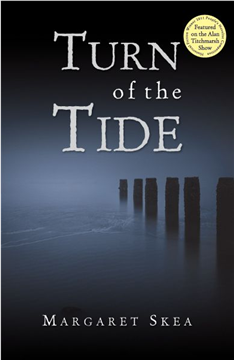
Day 595: Turn of the Tide

Cover for Turn of the TideTurn of the Tide is a historical novel set in the 16th century that centers around a long-running feud between two Scottish families, the Cunninghames and the Montgomeries. The feud and some of the events are factual, although the main character and his family are not.

The novel begins when the Cunninghames summon Munro. Not a Cunninghame himself, he is a minor laird who owes them allegiance. But he is not happy when he finds the plan is to massacre a bunch of Montgomeries on their way to meet with the king.

Although Munro’s wife Kate is angry when she finds he took part, she is even more angry when she finds out later that he has befriended some of the Montgomeries. This apparent change of loyalties could cause even more problems for their small family. King James has forced the two families to make peace, but it is an awkward one, with both families jockeying for position in court.

Munro is most wary of his uneasy relationship with William Cunninghame, the Earl of Glencairn’s heir and a brute. As Munro becomes closer to the Montgomeries and William’s eye alights on Sybilla Boyd, the fiancée of Munro’s brother Archie, the relationship between Munro and William becomes dangerous.

This novel never quite gets off the ground for me. Although I don’t demand action from every book, this one has very little going on for much of the time. Skea does so little to differentiate some of the characters that I kept getting confused about who they were. The novel begins with the massacre and ends with some action that is not really satisfactory. In between it concerns itself with grown men literally jostling for position with King James, the form of which seems silly, although probably exactly what went on.

The novel is also about Munro’s family life, mildly interesting but not compelling. It is nicely written with some Scots dialect. It just isn’t very tightly plotted.

Day 587: Harvest

Cover for HarvestBest Book of the Week!
Harvest seems to be concerned with exploring the dark side of human nature. Set in an unspecified time in the past, it focuses on unusual events in a small, remote village.

The villagers are celebrating the harvest. They are so busy drinking and eating that they forget to appoint their harvest queen. Groggily awakening the next morning, they spot two fires. One is green wood burning in the distance, a signal that some new family is establishing itself. The other is the master’s resented dovecote and the stables. Someone has set fire to the dovecote, and the fire has spread.

The novel’s narrator, Walter, noticed three young men return the night before with a load of hallucinogenic mushrooms and a dried puffball. He knows there is no use for the puffball except to spread a fire. Still, he decides to say nothing.

After the fire is out, Walter notices how the men he believes guilty behave over-helpfully to Master Kent and insist that the newcomers must have set it. So, the master and some of the villagers go off to see them.

Walter has injured his hand in the fire, so he stays home. But he soon hears how the villagers caved in the roof of the hovel so that it injured the young woman inside and how the master sentenced her two companions to a week in the stocks.

For some reason I felt dread from the onset of this novel, and this feeling was not wrong. Although the villagers have already started trouble by not confessing their actions, much worse is to come. For kind Master Kent has lost his property through an entailment to his wife’s cousin, a ruthless and cruel young man who is only interested in enclosing the common land and putting it to sheep. Now that he is master, it is up to him to mete out justice when the next incident happens.

Although Walt’s main fault is inaction, he soon finds himself being treated like a stranger again, for he came to the village long ago as a servant to Master Kent. Soon the village he loved is unrecognizable.

This novel is masterfully written, about how greed and ignorance can destroy a community. It is a dark and twisty tale.

Day 553: White Oleander

Cover for White OleanderBest Book of the Week!
This reading of White Oleander is my second, for my book club, although I have not reviewed it before now. I believe I appreciated the novel even more on the re-read.

Astrid Magnussen nearly worships her poet mother Ingrid. At twelve years old, Astrid has already lived an unusual vagabond life with her mother. Now the two have settled for awhile in the dry heat of Los Angeles, reeking of creosote with the forests bursting into flame.

Ingrid, herself stunningly beautiful, believes that nothing is important but beauty. She tells Astrid stories of ruthless Viking ancestors who take what they want, for she sees weakness in Astrid and wants to root it out. She is clearly a narcissist. For pleasure, she brings home beautiful young men and then unceremoniously discards them. She keeps Astrid up all night looking at the stars. Although Astrid fears Ingrid will one day leave her, she is smart enough to realize that with her mother everything is always about Ingrid herself.

Then Ingrid falls in love with Barry, an ordinary man. For once, Astrid feels a little secure, as if she has a father. But when Barry dumps Ingrid for a younger woman, Ingrid becomes insane with rage and does something terrible. She ends up in prison, and Astrid is abandoned to the foster care system.

This novel is sometimes beautiful. The beginning dealing with the relationship between the two and their earlier lives is poetically told. Other times it is brutally powerful, as Astrid is torn from her precisely kept home and thrown into a series of horrendous foster homes. Even more heartbreaking is what happens when she finally finds a loving one.

White Oleander is original and gorgeously written, about the search for love and a safe harbor, about betrayal, madness, self-absorption, and self-discovery. The lovely but poisonous white oleander is a symbol for Ingrid’s motherhood, as Astrid finally realizes she will always ache for her mother’s love and never have what she wants.

Day 518: The Fall of the House of Walworth: A Tale of Madness and Murder in Gilded Age America

Cover for The Fall of the House of WalworthJust a quick note before I get started about the Classics Club Spin #6. The spin selected #1, so I’ll be reading Herland, by Charlotte Perkins Gillman!

The Fall of the House of Walworth begins in the 1950’s with Clara Walworth living in a crumbling mansion in Saratoga Springs. She obsessively goes through the possessions of her once-eminent family, not realizing that its members have hidden from her a shocking truth. Her father was once imprisoned for the murder of his own father.

The book then returns to trace the history of the Walworths, a family of prominent figures who became New York state aristocracy. In particular, it looks at the career of Reuben Hyde Walworth, the last Chancellor of New York. It was his younger son Mansfield Walworth who was murdered in a New York City hotel room by Mansfield’s own son Frank, then only 19 years old.

The book relates the story of the marriage of Mansfield and Ellen Hardin. Ellen was Mansfield’s step-sister after the marriage of his father to her mother, Sarah. As a young girl, Ellen was apparently carried away by Mansfield’s streak of romanticism. But she did not realize he had already gained a reputation as a wastrel and a bully. O’Brien theorizes that the family may have hoped the love of a good woman would help him to reform.

The book examines the history of Mansfield and Ellen’s marriage and the reasons the situation reached such heights of drama, including a strain of mental instability in the family. Mansfield was an author of overblown romantic novels, who saw himself as a misunderstood genius. O’Brien’s comments about his dreadful writing and excerpts from his novels show us how deluded Mansfield was about his own talents, even in a sentimental age. They also provide a hint of amusement to the book.

Cultural historian O’Brien has written an interesting true story of an unusual crime that shocked the country. Frank Walworth’s trial provided the test case for the new concept in law of second degree murder. The book also provides insight into the views and treatment of epilepsy, at the time considered a mental illness.

Day 434: Coriolanus

Cover for CoriolanusCoriolanus is one Shakespeare tragedy with which I was previously unfamiliar, and it is a powerful one. More than any other Shakespeare play I’ve read, it is about politics, class dissension, and the fickleness of popularity. It is also about excessive pride.

The play has references to events of the time it was written, for it begins with a riot over corn, the like of which had taken place in Warwickshire the year the play was written. Its war between the Romans and the Volscians is also a reference to the war the English and Spanish had been carrying on intermittently.

Caius Marcius is a warrior who has spent most of his life as a soldier and has no social graces. He is proud and arrogant and disdains the common man. After he soundly beats the Volscians in battle, particularly his bitter enemy Aufidius, and conquers their city of Corioles, the Roman generals rename him Coriolanus and the senate wants to award him a consulship. This office as ruler of Rome is the one that all great men aspire to. Unfortunately, to have the office, Coriolanus must beg the honor from the public and show them his wounds gained in defending the state.

He is reluctant to do so, knowing that he is unable and unwilling to ask for what he thinks he deserves, but his austere mother Volumnia and his supporters talk him into it. Two jealous tribunes, who are representatives of the people, are afraid that Coriolanus will strip them of their offices. So, the two, Brutus and Sicinius, work to enrage the people after they have already sworn to support Coriolanus.

The result is another riot, and instead of receiving the high honor, Coriolanus is declared a traitor. The tribunes even try to have him executed, but he is banished.

The seeds of Coriolanus’ downfall are sown both by the treachery of his rivals and by his own hubris. Things go downhill from there.

It is interesting that in the class divide, Shakespeare’s sympathies seem to align with the men of power even while he deplores Coriolanus’ flaws. There are several speeches about the public not being able to make a decision, about their fickleness, and so on, and the actions of the public seem to bear these ideas out. You can image what Shakespeare would think about a democracy or about our current political situation.

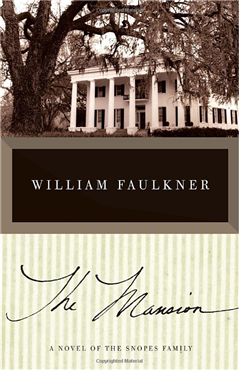
Day 430: The Mansion

Cover for The MansionBest Book of the Week!

The Mansion is the compelling final novel in Faulkner’s Snopes Trilogy, a series remarkable for the way Faulkner is able to focus the activity on a character, Flem Snopes, who is less and less present in each novel. Told again by multiple narrators, each unreliable in his own way (they are all male), the story’s truth is one we don’t begin to really understand until the final omniscient chapters.

This last novel concludes the events of the previous two and in many ways reinterprets them. It begins with Mink Snopes, serving 20 years for a murder he committed in The Hamlet. This event, not so important in the first book except for demonstrating the sheer cussedness of the Snopes clan, becomes the focus of the third book. The Town related how Mink paid no attention to his own murder trial, simply waiting for his powerful cousin Flem to arrive and get him out of his mess. But Flem never arrived, respectability having bitten him by then, and Mink went to jail vowing to kill Flem when he got out.

The beginning of The Mansion returns us back a few years in the events covered by The Town to when Mink is two years from freedom, having rigorously followed the advice he was given when he went in, to do everything he is told to do and not try to escape. Mink has been concentrating all this time on one thing, getting out and having his revenge.

As he is also a Snopes, Flem knows this, so he frames another cousin, Montgomery Ward Snopes, for an offense that is worse than the one Montgomery actually committed, to get him in to the penitentiary. Then Flem pays Montgomery to convince Mink that Flem is helping him escape, further humiliating Mink by getting him to make the attempt in a dress, and then turning him in during the attempt. Mink earns himself twenty more years in the pen–or Flem earns it for him.

The middle portion of the novel focuses on Linda Snopes, Eula’s daughter, who thinks Flem is her father, and her relationship with the upright Gavin Stevens. Stevens helped her escape Jefferson in The Town, and the largest portion of The Mansion covers her life before and after her return to Jefferson from a more exotic life in New York City. Despite her willingness, Stevens refuses to marry her because of the 20 years difference in their ages. She embarks on an apparently naïve and bumbling career of good works.

Finally, the novel comes back to Mink, as he unexpectedly learns he may be eligible for parole two years early, if only he can find a relative to sign for him. His wife died years ago, his children are long dispersed, but a relative does sign for him, Linda Snopes. The novel builds to a climax after his release, following Mink as he tries to get his final revenge against Linda’s father Flem and Gavin Stevens tries to prevent it.

I think the achievement this trilogy represents is astounding, written as if it were gossip told around an old country store (and later in Gavin Stevens’ law office), centering on one man but leaving that man an enigma, almost a ghost in his own life. Events are told and retold, interpreted and reinterpreted, and so this “oral” history of Faulkner’s fictional county in Mississippi is created.

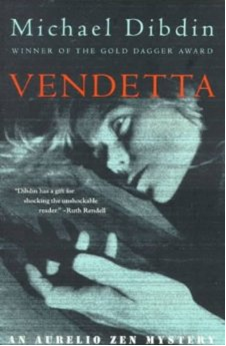
Day 384: Vendetta

Cover for VendettaAurelio Zen is faced with a seemingly insoluble mystery in Vendetta, and the hapless detective falls into the solution, this time literally. Some government ministry officials assign him to the murder of an eccentric billionaire, Oscar Burolo, whose corrupt dealings have made many Italian politicians wealthy. The chief suspect is a friend of one of the politicians. They want Zen to find a murderer–just about anyone except the suspect will do–and if he has to frame someone, that’s fine, too.

The problem is that Burolo was killed on his seemingly impregnable estate in Sardinia, where every room is monitored by video. Burolo’s death is plainly visible on the cameras, but not his murderer.

Before Zen leaves for Sardinia, though, some odd things happen. He thinks someone may have been following him, and someone has been in his house. A criminal he put away has just been released from jail, and a magistrate has been slain, but he sees no connection between these two incidents. It takes awhile, but Zen figures out that someone is stalking him. His growing relationship with his coworker Tania is also complicated by his being forced to go out of town.

On the scene of the crime, Zen finds an odd care-taking couple and learns that the chief suspect was probably not the murderer. Everyone that was on the scene was killed with a shotgun, and no one else appears to have been in that part of the house. Yet, the estate’s safeguards make it next to impossible for someone to have sneaked in from the outside, it appears.

In his bumbling way, Zen remains incorruptible while managing to stumble into a solution of the crime that makes everyone happy. Dibdin’s mysteries always cynically expose corruption in the Italian government. Zen is a somewhat befuddled detective, nattily dressed, and Dibdin takes great pleasure in occasionally covering his impeccable detective with muck. Vendetta is no exception. Zen’s romances and his difficult relationship with his nearly senile mother are important components of the series, which is occasionally funny and furnishes a clever puzzle to work out.

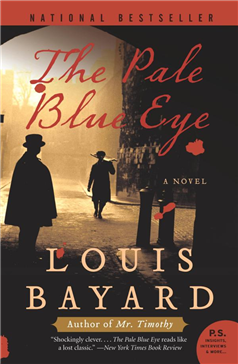
Day 366: The Pale Blue Eye

Cover for The Pale Blue EyeGus Landor, a retired New York police detective, is dying, and he writes the account of his last case in The Pale Blue Eye. Gus is a lonely widower who earlier moved up to the mountains near the Hudson Valley with his wife and daughter to help improve his lungs. But his wife died within a year, and his daughter left him soon after. So, Gus lives as a veritable hermit.

On an October morning in 1830, an officer from West Point fetches him. The body of a cadet named Fry was found hanged the night before, presumably a suicide, but during the night his body was stolen and later he was found with his heart removed. Superintendent Thayer and Commander Hitchcock wish to hire Landor to find who stole the heart. Landor is quick to figure out that Fry did not commit suicide but was murdered. A mysterious message clutched in his hand seems to indicate an assignation.

Landor soon realizes that his investigations on the reservation will be sorely hampered without the assistance of an inside man. So, he asks for the help of an unusual cadet he has met who is not in good favor with the academy–Cadet Edgar Allan Poe.

This is a clever novel with a macabre mystery that would have been completely to Poe’s taste. Just when we think everything is figured out, Bayard presents us with a twist. His portrait of the young Poe, bombastic, ridiculously romantic, and fearfully intelligent, is a great pleasure.

I would only fault the novel for a slow-paced middle section, and only because Landor doesn’t seem to be doing anything. Most of the plot is driven forward by Poe’s reports, which begin to dwell on his infatuation with a lovely young woman, Lea, the daughter of the post doctor, who unfortunately suffers from the “falling sickness,” or epilepsy.

Of course, Landor is doing something–he’s deciphering Fry’s diary–but since he doesn’t relate its revelations, his investigation seems to flag, and he barely seems to look into a second death, with a second missing heart. Otherwise, the novel is well written, with well-developed and interesting characters and a surprising ending.

Day 365: Othello

Poster for OthelloI have been reading and viewing a few of Shakespeare’s tragedies lately. Othello, in contrast to Hamlet, seems to be about very little in terms of overarching themes. Whereas Hamlet makes observations about death, revenge, the place of women in society, the relationships between fathers and their children, Othello is about what? Perhaps trusting too easily? Perhaps trusting not enough? Of course, it is about racism, jealousy, and betrayal, but what does it say about them?

The plot, of course, is that Desdemona elopes to marry the Moor, Othello, having fallen in love with him as he told the tales of all his adventures. Iago sees this marriage as an opportunity to have his revenge on both Othello, who has given the position he expected to Cassio, and on Cassio himself. He does this by making Othello think that Desdemona has betrayed him with Cassio.

To me the play is mostly about trust. Desdemona is a fool, it seems, to entrust her life to a man who would doubt her on so little evidence, actually before there is any evidence. Why is Othello so quick to trust Iago, a man he has overlooked for promotion, who has reason to hate him, and yet so quick to distrust his wife, who has never given him reason to doubt? Of course, this contrast says something about society’s view of women at the time.

Perhaps also Othello is a good excuse to write the part of a truly evil villain, Iago. For certainly Iago’s is the most important part.

Why is this a tragedy? Is Othello a great man brought down? I suppose he is great by virtue of his military adventures, but he is brought down by his own stupidity and gullibility. Desdemona is nothing but a victim, completely helpless to control her fate. This is not my favorite Shakespeare play, filling us with dread as it does from almost the beginning.

Day 312: Castle

Cover for CastleEven from the first moments of reading the unusual Castle, the novel seems to be about more than is on the surface. That notion turns out to be the case.

Eric Loesch returns to the town where he grew up and buys a large piece of property outside of town. Then he starts fixing up the farm house. He almost immediately becomes fixated on a large rock on the property and eventually finds the ruins of a castle behind it.

This activity seems all very straightforward, but something more is going on, we’re sure. Loesch is an unusual man, as demonstrated throughout by his thoughts and actions. His reactions to seemingly ordinary conversational gambits seem extreme. His emphasis on privacy seems excessive. We also feel, although we don’t know why, that he may have a military background.

Castle is a novel that unfolds slowly but keeps your attention throughout. It becomes clear that there are painful incidents in Loesch’s past, but the novel takes its time getting to them, and Loesch seems to be in denial about some of them.

The writing is skillful, particularly in delineating Loesch’s character through his behavior. In fact, I don’t know when I’ve understood the personality of such an unusual character so particularly before without the author actually telling me about it.

The revelations at the end of the novel are not, for the most part, foreseeable, although I could eventually predict at least one important plot point. All-in-all, Castle is a disquieting, dark tale.