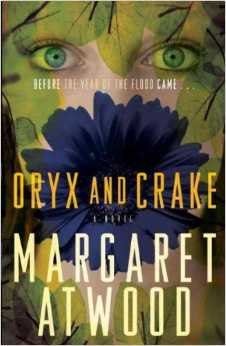
Day 516: Oryx and Crake

Cover for Oryx and CrakeBest Book of the Week!
Snowman may be the last human left on earth after the plague. He is not alone, though, because nearby is a race of human-like beings that his friend Crake bioengineered. Snowman himself lives like a vagrant—wearing nothing but a sheet in the unbearable heat from global warming, scrounging through the detritus of a lost civilization for food.

Snowman soon realizes that he will starve if he doesn’t return to the compounds for food. Not long before, he lived in a world where the privileged workers for the biochemical industry and their families lived apart in their own secure compounds. The other people, called pleeblanders, could fend for themselves. Gene splicing to create new species was rampant without regard for any consequences, and greed and consumerism all-important.

As Snowman makes his journey, he recalls his childhood with an embittered mother and oblivious father and his long friendship with Crake. Most fondly he remembers Oryx, the love of his life. Through these memories we learn how the world got into this dire situation.

This novel is both inventive and absorbing. Although Atwood’s descriptions of the pre-plague world with its abominations of nature seem comic at times, they are still horribly believable. This is dark humor with a knife edge about a world that has lost its sanity.

Oryx and Crake is the first of a trilogy, and I am looking forward to reading the other two volumes.


Day 491: The Here and Now

Cover for The Here and NowI know that Ann Brashares is a popular author of books for teens and young adults, although I have not read her before. The Here and Now is a departure for her, though, because, although set in the present, it is in the science fiction genre.

Prenna and her people are from the future. They migrated back, fleeing from horrible conditions in our future, including a starving planet and a virulent disease called the blood plague that kills virtually everyone who is exposed to it. Prenna and her mother live with the others who came with them, and although they interact with “time natives,” they must obey stringent rules about staying uninvolved with them. Prenna finds this irksome and is aware of people being sent away for innocent mistakes.

Although she flies below the radar at school, Prenna has one friend, Ethan, who behaves sometimes as if he knows something about her. He does. She does not remember, but he witnessed her arrival a few years before. Prenna likes Ethan, but she is forced to keep their friendship on a superficial level.

Prenna’s contact with a homeless man sets up an unexpected chain of events. While trying to discover the cause of the man’s death, she and Ethan begin to believe they can change the course of the future by preventing one act.

I have written before about some characteristics of much young adult/teen fiction that I find annoying. One is a certain style of first-person narration that sounds too much like an adult trying to sound like a teen. It is used in this novel, only it is made worse by the preponderance of choppy sentences, especially in the dialogue. If Brashares believes teens can’t think and talk in complex sentences, she should read the dialogue in The Fault in Our Stars (which admittedly may be too sophisticated but strikes me as authentic). This tendency is worsened by the use of the present tense, almost always a poor choice for fiction.

But let’s look at the plot and characters, since those are what teens will think about. The only characters who are more than moderately developed are Prenna and Ethan. Brashares makes the mistake of believing we will automatically care about Prenna before we really get to know her. As for the other characters, Prenna’s mother is a total enigma who won’t even eat dinner with her daughter, although that is never explained. The other adults in Prenna’s group are basically cartoon villains.

http://www.netgalley.comWhether you can enjoy the plot depends on how much you can suspend your disbelief. I will just point out two things, as vaguely as possible. The first is the unlikelihood of Patient #1 of the blood plague being the same person whose totally separate act causes potential massive efforts to stop the horrible effects of global warming to be stillborn. (And by the way, I didn’t really appreciate the lecture about global warming that suddenly pops into the dialogue.) The second is the completely unbelievable results of Prenna and Ethan’s adventure.

I frankly had a very difficult time getting through this short novel. Teens may enjoy it, but I did not.

Day 200: Stranger in a Strange Land

Cover for Stranger in a Strange LandDay 200 for the blog!

First, let me preface this review of Robart A. Heinlein’s Stranger in a Strange Land by saying that I know this is a cult classic and my review may offend some die-hard Heinlein fans, if I have any readers who are die-hard Heinlein fans. So, let that be your warning.

The first sentence in my notes is “What an overrated book.” I read this novel long, long ago, and I vaguely remember thinking the first part was interesting but disliking the second part. Other than the barest outlines of the plot, that’s all I remembered. This time through, I liked the first part less and hated the second part.

Valentine Michael (Mike) Smith is the only survivor of the first manned mission to Mars. He was born on the mission to two of the astronauts and raised by Martians. Since that mission disappeared without a trace, no one knew he existed, so he is only discovered when a second mission goes to Mars. He is brought back as a young man, and political shenanigans ensue, especially when he turns out to be heir to a fortune. Besides these plot elements, the first portion of the novel deals, sometimes cleverly, with his adjustment to life on Earth. In the second part of the novel, he decides to start his own religion, which practices free love and teaches the psychic abilities he learned from the Martians.

The novel does not translate very well to the 21st century because of its blatant sexism and use of slang that I suspect was out of date when the book was published. The sexism is ironic in a way, because I believe that Heinlein would have thought his book was sexually liberating. Frankly, though, I don’t think that patting your female employees on the butt was considered liberated even in the early 1960’s.

Another criticism is that Heinlein appears to have no coherent vision of what a future world would be like. The novel reads as if he came up with a few ideas that he thought would be cool and interesting but not as if he sat down and imagined what fundamental changes might have taken place. For example, carpets are made of real grass, but he lacks the imagination to figure out that computers wouldn’t always need punch cards and we might not be using typewriters forever. As far as futuristic prescience is concerned, I would give a better grade to Jules Verne. My final point in this regard is that for a science fiction writer, he seems to know very little about science, and I mean the science that was known in his own time.

I think I could bear with these things because I generally have a rule not to judge a book on standards that are not of its own time. But the worst feature of the book for me was the hundreds of pontificating speeches made by Jubal Harshaw, a crusty author who I’m sure is meant to be Heinlein himself. Despite being presented in a conversation style, the speeches are pompous and pedantic and go on for pages and pages. Heinlein seems to be very proud of the ideas expressed and of the world Mike creates with his religion, but I think the environment in his church would give most people the creeps.

I made a good faith effort to finish the book, but I finally gave up less than 50 pages from the end. And if anyone says “grok” to me ever again, I’ll scream.

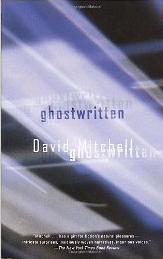
Day 163: Ghostwritten

Cover for GhostwrittenBest Book of the Week!

Ghostwritten, one of David Mitchell’s earlier books, is about the nature of fate and the strange interconnections between people and events in the modern world. In this unusual novel, Mitchell illustrates his points through the narrations of nine different characters, who at first seem only vaguely connected.

The novel begins with the crazed Quasar, a member of a religious cult who has fled to Okinawa after placing poisonous bombs in the Tokyo subway. As his sect falls apart, he waits for word and instructions from his leader, His Serendipity.

In Tokyo, Satoru, a teenage employee of a record store, falls in love with a pretty customer. In Hong King, Neal Brose, a financier who has conducted some shady business with a mysterious Russian, is letting his life fall apart after his wife leaves him.

In China, an old lady lives through the various upheavals of the 20th century while she tries to keep her tea shop on a sacred mountain from being destroyed, again. In Mongolia, an entity that can move from one human being to another tries to find out what it is and where it came from.

In Russia, Margarita Latumsky, a woman who has made her way in life by seducing powerful men and has landed a job at the Hermitage, is plotting with her gangster boyfriend to steal a Delacroix. In London, Marco Chance is a drummer, ghostwriter, and womanizer whose day isn’t going very well.

Mo Muntervary is a world-famous physicist who returns home to a remote Irish island after fleeing from the CIA for several months. Her decision to stop running has fateful results. Finally, Bat Segundo is a late-night DJ in New York who begins getting annual phone calls from the mysterious Zookeeper.

As these characters pursue their own activities and thoughts in a way that seems completely organic to their natures, Mitchell slowly and skillfully weaves their stories into a dystopian nightmare that works in actual events from the late 1990’s, when the book was written.

I am continually amazed by Mitchell’s imagination and intellect and his ability to write novels that are completely engrossing. Although not every technique he uses is completely successful–for example, there are real and metaphorical ghosts in the novel (in addition to the entity, whatever it is)–his approaches are all still interesting. Ghostwritten reminds me a bit of one of his later books, Cloud Atlas, which I admire very much.