Day 638: The Singing Sands

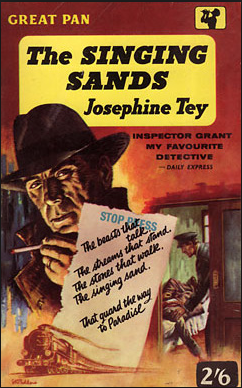
Cover for The Singing SandsEvery once in awhile, I like to read a classic mystery, and I have only read a few by Josephine Tey. Tey’s novels acted as a bridge between the Golden Age of mysteries and the modern mystery, when the genre moved toward more realism.

The overworked Inspector Grant is on his way to a holiday in Scotland and is concerned because he has developed a debilitating claustrophobia. Upon leaving the train at Euston station, he comes across a porter trying to rouse an apparently inebriated passenger. Grant sees right away that the man is dead. When he examines the body, he drops some of his own papers, and while picking them up, accidentally removes the dead man’s newspaper.

Relaxing at his cousin’s house in the Highlands and preparing to go fishing, Grant checks the paper the next day to see what it says about the dead man. His face has stuck in Grant’s mind. He finds that the man has been identified as a Frenchman named Charles Martin. He has already discovered the man’s newspaper, with some verse scratched on it referring to animals that talk, streams that stand, stones that walk, and singing sand. He recognizes the man’s handwriting as the unformed style learned by British schoolboys, and he can’t imagine that the dead man was French. So, he decides to look into the death a bit more.

Except for The Daughter of Time, Tey’s most well-known book, I have only read a couple of Tey’s one-off novels, not her Inspector Grant mysteries. After reading this one, I think I’ll look for more. Inspector Grant is interesting and likable, as are the relatives he visits. The mystery is involving without being so overcomplicated as to be unlikely, as Golden Age mysteries often are. When Grant travels to the island of Claddagh (referred to as Cladda in the novel) in search of the singing sands, we also get to explore a new landscape.

Day 595: Turn of the Tide

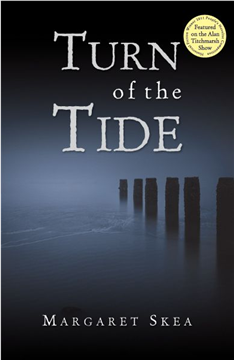
Cover for Turn of the TideTurn of the Tide is a historical novel set in the 16th century that centers around a long-running feud between two Scottish families, the Cunninghames and the Montgomeries. The feud and some of the events are factual, although the main character and his family are not.

The novel begins when the Cunninghames summon Munro. Not a Cunninghame himself, he is a minor laird who owes them allegiance. But he is not happy when he finds the plan is to massacre a bunch of Montgomeries on their way to meet with the king.

Although Munro’s wife Kate is angry when she finds he took part, she is even more angry when she finds out later that he has befriended some of the Montgomeries. This apparent change of loyalties could cause even more problems for their small family. King James has forced the two families to make peace, but it is an awkward one, with both families jockeying for position in court.

Munro is most wary of his uneasy relationship with William Cunninghame, the Earl of Glencairn’s heir and a brute. As Munro becomes closer to the Montgomeries and William’s eye alights on Sybilla Boyd, the fiancée of Munro’s brother Archie, the relationship between Munro and William becomes dangerous.

This novel never quite gets off the ground for me. Although I don’t demand action from every book, this one has very little going on for much of the time. Skea does so little to differentiate some of the characters that I kept getting confused about who they were. The novel begins with the massacre and ends with some action that is not really satisfactory. In between it concerns itself with grown men literally jostling for position with King James, the form of which seems silly, although probably exactly what went on.

The novel is also about Munro’s family life, mildly interesting but not compelling. It is nicely written with some Scots dialect. It just isn’t very tightly plotted.

Day 563: The Scottish Chiefs

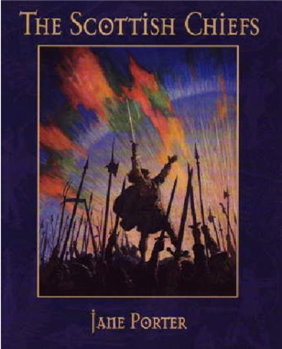
Cover for The Scottish ChiefsWritten in 1810, The Scottish Chiefs tells the romanticized story of William Wallace, the Scots hero we know today as Braveheart. Jane Porter was a contemporary and acquaintance of Sir Walter Scott, who deemed her the first author of historical fiction, then went on to write some himself.

The novel begins in 1296 and covers roughly eight years. After the untimely death of Alexander III, Scotland could not decide between two claimants to the throne—Robert Bruce or John Baliol—and called upon its neighbor, Edward of England, to adjudicate. He chose the weakest candidate, Baliol, and shortly afterwards seized the country for England. At the start of the novel, his governors have been mistreating Scotland for two years by imprisoning its leaders and taking their property for themselves.

William Wallace has been minding his own business and trying to stay out of trouble when he is summoned to meet with Sir John Monteith. Monteith passes him a metal box given to him by Lord Douglas before Douglas was kidnapped by the English. Monteith’s home is overrun by English soldiers, and he is afraid someone will discover the box, so he asks Wallace to remove it. However, the soldiers glimpse it under his plaid, and assuming it is treasure, they soon arrive at his home to take it. Wallace escapes, but his wife Marion is murdered by the dastardly Heselrigge, English governor of Lanark.

After his wife’s murder, Wallace vows to devote his life to freeing Scotland from the English. The novel follows his adventures and his defeats of the English in battle. Wallace’s victories are muddied by the jealousy and treachery of many of the Scottish chiefs, who refuse to believe the purity of his motives and fear his growing power over the populace.

The novel is written in the overblown style of Romanticism. It features a godlike Wallace, heroic figures like beautiful and saintly Helen Mar and faithful Edwin Ruthven and villains such as the perfidious Lady Mar and vicious Heselrigge. The dialogue is florid. However, the deeds described are truly exciting, and Porter manages at times to build quite a lot of suspense. The introduction by Kate Douglas Wiggan, educator and author of Rebecca of Sunnybrook Farm, relates how her copy of the novel was in tatters from re-reading when she was a child and how she would beg for ten more minutes of reading time when called to supper.

While reading this novel, I was trying to decide whether a modern youngster would love it or be bogged down by its style and length. I am not sure, but children read for plot, and there is much in this tale to make it a page-turner. That it is about a man who was truly a hero should make it even more exciting to them. In any case, if the writing style of early 19th century Romanticism doesn’t bother you, I think anyone might enjoy reading this novel.

Day 526: King Hereafter

Cover for King HereafterBest Book of the Week!
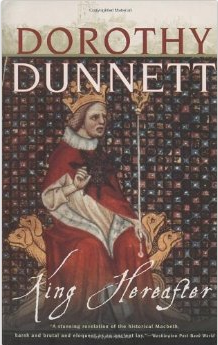
What most of us know of Macbeth, King of Scots, is taken from Shakespeare, from a play he wrote in honor of King James I of England. It is perhaps no coincidence that James I was a descendant of one of Macbeth’s enemies. King Hereafter presents an interpretation of Macbeth’s life from the master of historical fiction, Dorothy Dunnett, herself a Scot. You may well imagine that the Scots have a different version of the story than did the English and Shakespeare.

For some way into this novel, you may wonder when Macbeth will even appear, for it begins in Norway with a Viking and his foster son. Thorkel Admundason has left his foster son Thorfinn in Moray with his stepfather Findlaech for a few months while Thorkel attends the Norwegian court. Thorfinn is one of what had been three earls of Orkney—Thorkel recently killed one of them and is at court to learn his punishment. But Thorkel soon hears that Brusi, the other earl, has arrived to complain to the throne that Thorfinn has demanded half of the islands from him.

Thorkel is angry at the behavior of his 13-year-old foster son, who may have gained what he wanted if it was approached another way. In the end, not only does Thorfinn not receive more of Orkney, but he is forced to pledge himself as King Olaf’s vassal.

Thorkel has almost broken with Thorfinn entirely when he learns why Thorfinn fled to Norway. While Thorfinn was in Moray with his stepfather, Findlaech was burned to death in his hall by his two nephews. Thorfinn ends their conflict by begging Thorkel to teach him to think like a man.

Of course, Thorfinn is the young Macbeth, or rather Macbeth is the Christian name he takes later. In Thorfinn’s time of the 11th century, Christianity was not widespread in northern Scotland.

Thorfinn straddles cultures and religions. He is mostly of Celtic descent and was raised partly in his Celtic stepfather’s house, but as an Orkney man he is a Viking. He eventually comes to rule an area incorporating Scots, Norse, Irish, and Saxon subjects. He must speak Gaelic, Norse, and Saxon to rule them.

By the time his grandfather Malcolm, King of Alba, dies, Thorfinn is ruler of part of Orkney and of Moray. He has avenged his stepfather’s death by burning his enemies and has consolidated Moray by marrying Groa, the wife of one of his victims.

However, only when his cousin Duncan, by that time King of Alba, attacks Moray in an attempt to take it from Thorfinn does Thorfinn fight and kill him. With Alba part of Thorfinn’s dominion, he realizes he must learn to rule differently, to try to make of the entire territory of Scotia something resembling a nation instead of a collection of settlements with no towns or roads.

Fans of Dorothy Dunnett’s other novels will not be surprised at the meticulous research that went into this novel. Nor will they be surprised to find that Thorfinn is immensely capable and intelligent but frequently misjudged. This novel is wide ranging in scope, as Thorfinn masters the politics of Europe and struggles with the various intrigues between the Irish and Latin churches. For he must decide which religion will unify his people and serve them best.

Since Dunnett is a master of characterization as well as historical detail, the novel is full of vibrant characters. Thorfinn at first merits the respect and eventually the love of his followers. He has a handful of friends who are important characters. Although they misunderstand each other at first, he eventually enters into a deep love and partnership with his wife Groa.

No witches are part of this novel, but there is Luloecen, his stepson with second sight. He tells Thorfinn his fate very soon upon meeting him.

Yes, the woods of Dunsinane play a pivotal part in the plot. If you enjoy historical novels that are rich in detail and steeped in their time period, you will like this book. Like all of Dunnett’s novels, it is complex, yet full of excitement and adventure. King Hereafter is a clever, romantic, and intricately plotted novel.

 

Day 523: Corrag

Cover for CorragBest Book of the Week!

Corrag tells two tales, both based in history. One is the story of the witch Corrag, a woman about whom little is known except in lore. The other is the story of the infamous massacre at Glencoe, where at the orders of King William, British soldiers attempted to murder an entire clan after accepting hospitality from them.

The Reverend Charles Leslie arrives in the town of Inverary looking for information about Glencoe, because he thinks that public knowledge of the event will help the Jacobite cause. He hears that the witch Corrag, awaiting her trial by burning, was present at the event, so he goes to see her. He is repulsed by her, a tiny young woman with pale eyes who is filthy, with matted hair. As a religious man, he is horrified to be in the same room with a witch. But she agrees to speak to him about Glencoe if he will hear the story of her life.

So, Corrag begins telling her story. She is a gifted story teller who loves the beauties of the world, and we can see Leslie’s changing attitude toward her in the letters to his wife that begin each chapter. She is the daughter of Cora, a persecuted “witch” of northern England. Sensing the end, Cora sends Corrag off to ride north and west for safety. After much hardship and poor treatment, Corrag finally arrives in the valley of Glencoe, where she is left alone at first and eventually earns a place because of her healing skills.

This novel is haunting and at times almost poetic in style. I was in tears most of the time I read it. Corrag tells affectingly about her feelings for the world and particularly for one man. Glencoe is the only community that ever accepted her, and she loves it. She is finally able to repay the people of the glen by saving some of their lives.

The real Charles Leslie anonymously published a pamphlet about Glencoe that struck the world with horror. This reimagining of the circumstances around the event is fascinating, especially for those interested in Scottish history. The novel is also extremely touching.

Day 519: Northanger Abbey

Cover for Northanger AbbeyNorthanger Abbey seems to be the Austen novel people like least. Perhaps this is because Catherine Morland is an ordinary girl, naive and not overly bright, so the opportunity for witty conversation is lost. But Austen has some fun with the fad for Gothic novels at the time. One of young Catherine’s misadventures results from her dreaming up a lurid past for her new friends’ family, her imagination influenced by her choice of reading. Austen also creates some broadly comic characters in the greedy and crass Isabella and John Thorpe.

When I learned that Val McDermid was attempting an update, I was intrigued, because McDermid is better known for her chilling thrillers. She places her updated version of the novel in Edinburgh during the festival. This could have been an inspired choice if she had made more use of the setting.

Cat Morland is attending the festival as the guest of her neighbors, the wealthy Allens. She meets Bella Thorpe, who befriends her because she likes Cat’s brother James (although this is not of course obvious to Cat). Bella’s brother John in turn begins pursuing Cat. Cat, though, is already interested in Henry Tilney, son of General Tilney, the owner of Northanger Abbey.

Much of the plot of Austen’s original book rides on the Thorpes’ assumption that Catherine is the Allens’ heir. McDermid implies a similar motive for their friendliness.

McDermid has not changed the plot of Austen’s novel in any major respect, except for the reason why General Tilney throws Cat out of the house in the middle of the night. In that instance, she chooses to pursue a theme that has been cropping up a lot in her later fiction, and the choice is unfortunate. She has set us up to expect something else, and the motive she chooses doesn’t fit in well with anything that has already happened. It is clear that General Tilney is unusually friendly with Cat because he thinks she is wealthy, so to alter the reason for this dramatic scene at the last moment throws us off.

Although the novel seems promising at first, with some witty observations about the festival attendees, we soon fall into the banalities of conversation and texts between vapid young women. Cat just loves vampire fiction and actually believes vampires might exist. You can see where this might lead in terms of the original novel, if McDermid had given it a bit of a twist. I am sick of vampire fiction, but I was almost hoping one would appear in the darkness of an Edinburgh street.

http://www.netgalley.comCat and the Tilney siblings are likable, but Cat doesn’t capture my sympathy as much in her current guise. Again, I’ll stick with Austen.

Just as a side note, those wily internet marketers must have noticed my searches for Northanger Abbey, because I got an email about the Complete Northanger Horrid Novel Collection. This collection includes all of the gothic novels referred to in Austen’s novel. All mine on my iPad for a mere $.99! Well, why not? I’ll be reporting back later.


Day 505: The Red Road

Cover for The Red RoadIt is 1997. Young Rose Wilson is waiting for her pimp Sammie one night when Pinkie Brown, a young man she knows, asks her to hide a knife for him. Although she has had a crush on him, she suddenly understands he is attempting to use her. She tries to push him away and ends up accidentally stabbing him to death. Terrified about what Sammie will do to her, she attempts to hide from him that she is covered in blood as they drive away from the area. But he finally sees the blood, so she attacks him in panic, killing him. Then she realizes she has nowhere to go and no way to hide her crime, so she sits in the car and waits for the police.

In the present time, Detective Inspector Alex Morrow is set to testify against Michael Brown. He was found guilty years ago of the murder of his older brother Pinkie. Now he is up on weapons charges, as caches of guns with his fingerprints on them were found buried in his back yard. But Alex soon learns something puzzling. Brown’s fingerprints were found at the scene of a murder that happened three days before in an abandoned building on the Red Road, when Brown was in custody. Although Alex is inclined to believe this is some ploy by Brown’s defense, Anton Atholl, she can’t figure out what they have to gain from it. In any case, court is dismissed because of news of the death of another defense attorney, Julius McMillan.

Back in the past, it is Julius McMillan who saves Rose. After Rose admits everything she did, he figures out a way for her to serve minimal time for Sammie’s death, as long as no one connects her to the killing of Pinkie Brown. To save her, he is forced to make a deal with some powerful but unscrupulous men.

Alex’s investigation is taking some unexpected detours, and eventually she figures out that there was a conspiracy to pin Pinkie’s murder on Michael years ago. Michael’s fingerprints were switched for those of the real murderer, who has just killed again. Although Alex begins to realize she will be up against some powerful people, she just can’t let something like that go.

Denise Mina’s mysteries are set in a gritty Glasgow. Alex is an abrasive and stubborn heroine whose career keeps being dead-ended because she insists on going up against corrupt politicians and police. The novels are smart and interesting, with convincingly drawn characters.

Day 474: The Travelling Hornplayer

Cover for The Travelling HornplayerThe Travelling Hornplayer revisits some of the characters I loved in Brother of the More Famous Jack. But first it starts with Ellen. Ellen has always had a close relationship with her sister Lydia, and the two girls’ adolescent silliness and charm is vividly depicted early in the novel in lively dialogue. But Lydia dies at age 17 while Ellen is away at university. She runs unexpectedly out into the street from the home of the man Ellen and Lydia call The Novelist and is hit by a car. Lydia has been consulting him about (well, actually cribbing from him) her essay for her A levels on Wilhelm Müller’s Seventy-Seven Poems from the Posthumous Papers of a Travelling Hornplayer. It takes awhile before we find out the cause of her death.

The Novelist is Jonathan Goldman, whose family so charmed Katherine, the heroine of Brother of the More Famous Jack, now his wife. Jonathan and Katherine have only one child, Stella, whose childhood illnesses and learning disabilities have led Katherine to do everything for her. Finally almost on her own at university in Edinburgh, where she becomes Ellen’s roommate (almost on her own because her mother arrives periodically to do the cleaning), Stella makes a series of spectacularly poor decisions that result in tragedy for herself and others and a separation from her family.

This sounds like a sad tale, and in some ways it is, but it is told lovingly and movingly, with intelligent characters and witty dialogue. Trapido depicts characters of surprising depth and complexity. She is a really beautiful writer, and I love her work.

My cover of The Travelling HornplayerA word about this cover. I was unable to find a good-sized picture of my book’s cover without the Amazon Look Inside logo on it. That cover, which shows two young girls comparing their identical outfits, conveys the feel of the novel much more successfully than the one above, which looks like children’s fiction or chick lit to me. Here it is in a smaller size.

Day 452: Under the Wide and Starry Sky

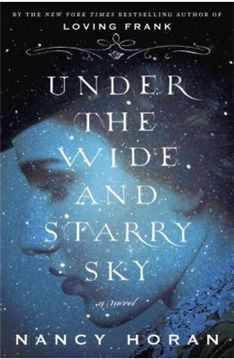
Cover for Under the Wide and Starry SkyUnder the Wide and Starry Sky traces the relationship between Robert Louis Stevenson and his wife Fanny from shortly before the two meet. At that time, he was a young man still trying to decide his profession and she was a married woman, although separated from her husband, ten years his senior and with children.

Fanny Osbourne has a great creative urge, and she has moved to Paris for art lessons for both herself and her grown daughter Belle, leaving her philandering husband in America. Fanny meets Stevenson while on a recuperative visit to southern France after the death of her youngest son.

The novel follows closely the entirety of their relationship from courtship to his death and her life afterwards, mostly from Fanny’s point of view. They separate because Fanny wants to give her marriage another chance, but they finally come together again. Stevenson, called Louis by his friends, is a sickly man, and his health often requires them to move to climates that are better for his lungs. When it seems as though he cannot live much longer, they find that his health revives on ocean voyages, so they go to sea and finally settle in Samoa until his death.

Although Horan appears to follow faithfully the course and events of the couple’s life together, and the novel is interesting from that standpoint, she never really brings the characters or settings to life. Aside from Fanny’s devotion to Louis, Horan concentrates on her frustration at not being able to live her own creative life. The characters seem relatively flat.

http://www.netgalley.comI was struck also by how, on the original voyage to the South Seas, Horan describes almost nothing but one chieftain until they get to Samoa. If she was working from journals or letters, surely she could have researched further to find out or even imagine what the islands would have been like for Louis and Fanny, seeing them the first time. Instead, we come into their voyage toward the end, as if all the sights and experiences are routine. I’m missing the sense of wonder. Although this novel should have been fascinating in its focus on some amazing lives, it generally does not fulfill its promise.

Day 395: Macbeth

Cover for MacbethAs with Hamlet and King Lear, the succession is a theme in Macbeth, even more so as the play was written in response to the Gunpowder Plot, in which Guy Fawkes and others attempted to blow up Parliament with King James I in it. This event was extremely traumatic for the British, as we can clearly imagine. Macbeth is, of course, Shakespeare’s famous tragedy about Macbeth’s attempt to usurp the throne of Scotland.

One theme of the play that harks back to the Gunpowder Plot is equivocation. Many of the statements in the play seem as if they mean one thing when they actually mean something else, from the witches’ predictions to Macbeth’s assurances. Equivocation was a Jesuitical doctrine that said that under examination, the truth could be substituted with “mental reservation,” in which one makes deceptive utterances but thinks the truth. It was used by Henry Garnet, the Jesuit Provincial, who learned of the plot as part of a confession. Edward Coke, a member of the Privy Council, which interrogated Garnet, called it “open and broad lying and forswearing.”

In fact, there are other references within the play that refer to James and demonstrate that the play was written in his support. Most obvious is James’s interest in witchcraft. He attended witch trials and in 1597 wrote Daemonologie, which Shakespeare used as source material for his scenes with the witches.

Banquo, Macbeth’s friend, whom Macbeth has murdered because of the witches’ prediction that Banquo will be the father of kings, was purportedly an ancestor of James I. Finally, there is the reference in the play to the healing of the king’s evil, a practice James observed that was followed after him by the British monarchy up to the Hanovers.

So, the play was written in honor of James I, to demonstrate the havoc wrought by breaking the succession. In the service of what is essentially historical propaganda, Duncan is made purer than he actually was and Macbeth more evil. The facts that Macbeth had a claim to the throne of Scotland and that the Scottish succession was not hereditary at the time are ignored. For an alternate interpretation of the story, see the wonderful King Hereafter by Dorothy Dunnett, one of the best historical novelists of all time, in my opinion.

But these facts don’t really spoil our appreciation of the play, which is one of Shakespeare’s most atmospheric, with its ghosts, witches, sleepwalking, murders, and walking wood. I think I prefer the directness of Macbeth to the convoluted plots of some of Shakespeare’s other tragedies. It is certainly a powerful play.