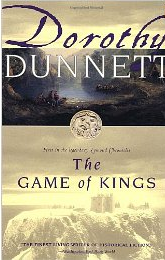
Day 61: The Game of Kings

Cover for Game of KingsBest Book of Week 13!

If you love an authentic, well-researched, exciting historical novel that makes you almost feel like you are in the period, then I can’t recommend a better author than Dorothy Dunnett.  I have been trying to get people to read her for years with the caveat that her books are challenging, not for the reader of light romantic history.

Lady Dunnett is described on her Wikipedia page as a “leading light in the Scottish arts world and a renaissance woman.” Her books are loaded with detail about medieval customs, dress, politics, religion, food, and literature, and have labyrinthine plots full of action. She is most renowned for two series, the Lymond Chronicles, written in the 1960’s and 70’s and set in 16th Century Europe and Africa, and the House of Niccolò, written in the 1980’s and 90’s and set in 15th Century Europe, Asia, and Africa. Dunnett died shortly after finishing the last book in this series.

Game of Kings is the first book in my favorite series, the Lymond Chronicles. Francis Crawford of Lymond makes a rollicking and disruptive re-entrance into his home country of Scotland despite the charge of treason hanging over his head. He forms a band of outlaws and begins roaming around the countryside, sneaking across the border to play tricks on the British and harassing his own family. For quite some time, you don’t know whether he is a hero or a villain. He never explains himself, so it is left up to the reader (and the other characters) to figure out his motives for sometimes seemingly wrongful acts. His enemies think he is responsible for the explosion that killed his sister and is trying to murder his older brother Richard so he can inherit the estate. His friends are absolutely devoted to him but suffer doubts when he misbehaves, as he often does. His brother doesn’t know what to think, and his mother, Sybilla, is silent.

Francis is a mimic and a rogue, a musician and a polyglot, a poet and a swordsman, as swashbuckling a character as you will ever meet with in a novel. In among the action of cattle raids, impersonations, intrigues, duels, and archery contests, you actually learn a lot about Scottish history and politics.

Game of Kings is Dunnett’s first book, and my only criticism of it is that Lymond is a bit too fond of quoting poetry in antique languages. Most of it is incomprehensible unless you are a medieval scholar, but skipping over it does not hurt your understanding of the novel. Dunnett does this much less in the other books in the series. If you read this book and continue with the series, by the second book you won’t be able to stop.

Day 35: The End of the Wasp Season

Cover of End of the Wasp Season I have long been a fan of Denise Mina’s gritty mysteries, set in Glasgow. The End of the Wasp Season begins with two seemingly unrelated deaths: in Strathclyde, a crooked ex-millionaire banker named Lars Anderson commits suicide, and a young woman, Sarah Errol, is brutally murdered in a Glasgow suburb. Sarah was home temporarily taking care of her mother’s estate, and the wealthy suburban neighborhood is terrified by the seemingly random attack by hoodlums.

We know from the beginning that Sarah Errol was killed by two boys, but we don’t know exactly what happened or why.

As Detective Inspector Alex Morrow investigates, she runs into an old friend, the murdered woman’s housekeeper. Later Morrow’s friend Kay is accused of stealing from the dead woman’s estate. Kay’s teenaged boys are then arrested for the murder. Alex is convinced that her friend and the boys are innocent and tries to prevent a travesty.

DCI Morrow finds that one of the boys who broke into the home was the son of Lars Anderson, and that he mistakenly believed Sarah was his father’s mistress. As DCI Morrow investigates, she finds out about the boy’s horrible home life. Eventually we are lead to believe that the boys broke into Sarah’s house to scare her, and that the Anderson’s son stood there in horror and watched his companion go berserk. But the evidence is confusing.

I have been impressed by Mina’s work since I read the Garnethill series, her first three books. Her books feature strong women from working class backgrounds and criminal families who are trying to make their way on the right side of the law. Alex herself has a stepbrother who is a crime kingpin, from whom she has been trying to keep her distance.

Day 29: The Winter Sea

Cover for The Winter SeaLet me start out by saying that this is not my kind of book. There are carefully researched and plausible historical novels that make you feel like you understand the time and place and that may or may not include a romance. Then there are romance novels that just happen to be placed in a historical time but otherwise read as if the writer did not bother looking up a single fact. And there are all ranges in between. Despite the notes from Susanna Kearsley about her research, I would locate The Winter Sea closer to the latter end of this range.

Carrie is a writer working on a novel about one of the Jacobite rebellions. She has been living in France where all the intrigue went on, but she isn’t getting into her novel. On a visit to her agent in Scotland, she is attracted to a ruined castle. When she hears that part of the rebellion was based there, she decides to move to the nearby village, and on a suggestion by her agent, make her main character a woman. She arbitrarily picks Sophia Paterson, her own ancestor.

She begins to imagine vivid scenes, which interleave the modern story. But when she checks the facts surrounding these scenes, she finds the details are actually correct. After awhile she decides the explanation must be that she carries her ancestor’s genetic memory in her DNA, an explanation so absurd that it dumbfounded me.

The modern author’s romance with her landlord’s son is interspersed with the story she is writing about Sophia’s romance with a young Jacobite. Although the story reflects some historical research, the focus is on the romance. The dialogue in the historical section is awful, as if the writer thought all she had to do to make it authentic was stick the word “did” in constantly. (“I did arrive from Edinburgh last month.”) I almost quit reading because I could barely stand to read the dialogue. I would rather have the writer use modern English than patently fake and unconvincing archaic English.

Had the author based the writer’s insights on some form of second sight–they are in Scotland after all–I would have found that explanation more acceptable than the pseudo-scientific claptrap. Avoid this one unless you absolutely don’t care about any historical or scientific authenticity.

Day Six: Waverley

Cover for WaverlyI have been trying to offer a mix here, not just mystery mystery mystery, and so far I have just reviewed books I’ve liked. But I plan to also review books I didn’t like. This book isn’t one of them; I’m just warning you.

I had a hard time even getting interested in reading anything by Sir Walter Scott after having been forced to plow through the dreaded and deadly dull Ivanhoe in high school. I tried rereading it again some years ago because sometimes things you find dull in high school are more interesting when you’re older, but it wasn’t. I have often wondered what criteria high schools use when picking the English curriculum, when there are much more vibrant classics available. I can only suppose that they thought a tale of knights, derring-do (whatever that is), and Richard the Lionheart would interest high school students. When you read Ivanhoe, it’s hard to imagine that at one time Scott’s books were waited for with bated breath by the whole family.

But most of us probably haven’t tried to read his Scottish novels, or the Waverley novels, as they are called. This review is about the novel called Waverley, presumably the one the others are named after. It was written in 1814 but is set in 1745. Scott’s Scots dialects are a little difficult—a glossary would be nice—and he can occasionally be a bit long-winded, but his Scottish novels are much more interesting and amusing than Ivanhoe.

Waverley is a dreamy, wealthy youth brought up in England who has been neglected by his father and raised by his uncle, a man of Jacobite sympathies. A romantic man of undetermined principles, he cannot decide what to do with himself, so he is sent off by his uncle to join the army.

On leave from a regiment stationed in Lowland Scotland, he goes to visit an old friend of his uncle. He makes a visit to the Highlands out of curiosity and ends up embroiled in the Jacobite conspiracy. He is charged with desertion and treason, mostly because he’s in the wrong place at the wrong time.

Part of Scott’s intent, I believe, was to show the British of the times that the Highland Scots were not just a bunch of savages and to depict them realistically.

The book is entertaining and humorous at times, and also occasionally a little ponderous. Waverley is a hapless hero who finds himself drawn into one fix after another, which perhaps makes him a more modern protagonist than you would expect.