
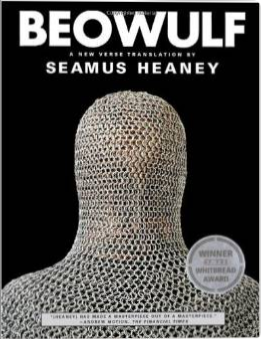
 I’m planning this post for Halloween, so I decided to write about the quintessential monster tale. I’m not enough of a poetry reader to easily read an extended poem. Still, Beowulf is considerably more accessible than I expected.
The poem is, of course, the oldest known work in Old English, or Anglo-Saxon, written sometime between the seventh to early eleventh centuries. It is the story of the feats of Beowulf, a Scandinavian hero. It is also a poem written by a Christian poet looking back to a time of paganism. I read the award-winning translation by the Irish poet Seamus Heaney.
For me, the interest in the story is not the tale of battling monsters but the glimpses into a different past and mindset. For this poem is about right and proper behavior. The hero honors his lord and behaves rightly to him. When Beowulf is rewarded for killing Grendal and his mother, he rightfully takes his treasure back to his own chief. Later in the story, when all of Beowulf’s guard except Wiglaf desert him in the face of the dragon, Wiglaf is steadfast by his chief’s side to the end.
The poem is melancholy, for it tells of the end of the Geats, Beowulf’s people, when they are left leaderless after his death. It also stops several times to relate tales of revenge and blood money.
I barely remember a semester of Old English classes in graduate school, but it was enough to occasionally pass my eyes over the Old English side of this bilingual edition and recognize some similarity to modern English, an interesting pastime in itself.
 What? Me Read?