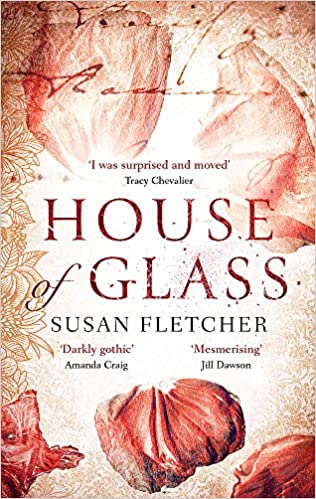
Review 1517: House of Glass

Clara is born with bones so fragile that as she grows, they can snap for the slightest reason. Her mother and stepfather keep her inside a home filled with padded corners until she is an adult. When they judge that she is finally able to come out, she is slightly misshapen through injuries that didn’t heal well.

Shaken after her mother’s death, Clara finds comfort in visiting Kew Gardens and learning about the plants. Her voracious curiosity tends her to spend a lot of time talking to the foreman of the glasshouse. Eventually, he offers her a job. A wealthy man wants to establish his own glasshouse to rival that of Kew. Will she take a job overseeing the planting and establishment of this garden?

Clara decides to take the job at Shadowbrook, where she is received by the housekeeper, Mrs. Bale. The owner of the house, Mr. Fox, is often away on business, and even when he is home he doesn’t like to be disturbed in his rooms on the upper floor.

Clara finds there are rumors in the village about the house and its former occupants, the Pettigrews. Mrs. Bale seems to be under some strain, and she eventually reports that the house is haunted by Vivenne Pettigrew. Clara doesn’t believe in ghosts and begins trying to learn about the Pettigrews. Those who are willing to talk about Vivienne seem to be describing a different person than she imagines from the few words spoken by those who knew her.

Ever since Fletcher’s marvelous Corrag, I have been waiting for her to write something as good. This novel comes very close. It starts out as a ghost story but goes much farther, exploring women’s role in pre-World War I society. It is atmospheric and wonderfully written, with an assertive and appealing heroine. I recommend it highly.


Related Posts

Corrag

Let Me Tell You about a Man I Knew

The Lace Reader

Day 941: Let Me Tell You about a Man I Knew

Cover for Let Me Tell You About a Man I KnewLet me first get this over with. I have rarely encountered a book title that seems so inappropriate to the actual book. This title, which seems so similar to the opening of a 60’s Ray Charles song, is for a historical novel about a fictional relationship between an ordinary woman and Vincent Van Gogh.

That over with, the book itself is another matter. Susan Fletcher’s Corrag was one of my favorite books a few years ago. Even though I have missed some of her others, I was excited to hear about this one. It did not disappoint.

Jeanne Trabuc is the wife of Charles, who runs the mental asylum in Saint-Rémy. She finds herself in a lonely time of life. Her best friend has left town, and her boys have gone off to lead their own lives. She and her husband sleep separately, and she feels unloved. He has many rules about how the house should be run. She feels separate from the other women in the village, whom she feels gossip too much.

link to NetgalleyThere have been no arrivals at the asylum in years, so Jeanne’s interest is piqued when she hears a Dutch painter is coming. Charles does not allow her near the asylum, but she sees the man in the olive orchard painting and begins talking to him. Slowly, she finds herself wondering how she became what she is, instead of the adventurous girl she was.

This novel is more about Jeanne than Van Gogh, but it is touching and compelling. Jeanne Trabuc and her husband were actual people that Van Gogh painted, but Fletcher tells us that the lives she has created for them within the novel are entirely fictional. This novel is about the silences that can grow between people.

Related Posts

Corrag

Clara and Mr. Tiffany

Burning Bright

Day 523: Corrag

Cover for CorragBest Book of the Week!

Corrag tells two tales, both based in history. One is the story of the witch Corrag, a woman about whom little is known except in lore. The other is the story of the infamous massacre at Glencoe, where at the orders of King William, British soldiers attempted to murder an entire clan after accepting hospitality from them.

The Reverend Charles Leslie arrives in the town of Inverary looking for information about Glencoe, because he thinks that public knowledge of the event will help the Jacobite cause. He hears that the witch Corrag, awaiting her trial by burning, was present at the event, so he goes to see her. He is repulsed by her, a tiny young woman with pale eyes who is filthy, with matted hair. As a religious man, he is horrified to be in the same room with a witch. But she agrees to speak to him about Glencoe if he will hear the story of her life.

So, Corrag begins telling her story. She is a gifted story teller who loves the beauties of the world, and we can see Leslie’s changing attitude toward her in the letters to his wife that begin each chapter. She is the daughter of Cora, a persecuted “witch” of northern England. Sensing the end, Cora sends Corrag off to ride north and west for safety. After much hardship and poor treatment, Corrag finally arrives in the valley of Glencoe, where she is left alone at first and eventually earns a place because of her healing skills.

This novel is haunting and at times almost poetic in style. I was in tears most of the time I read it. Corrag tells affectingly about her feelings for the world and particularly for one man. Glencoe is the only community that ever accepted her, and she loves it. She is finally able to repay the people of the glen by saving some of their lives.

The real Charles Leslie anonymously published a pamphlet about Glencoe that struck the world with horror. This reimagining of the circumstances around the event is fascinating, especially for those interested in Scottish history. The novel is also extremely touching.