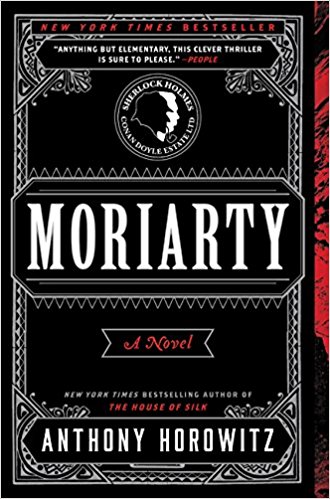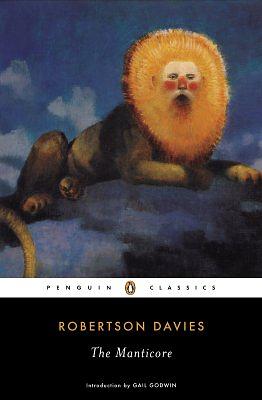
Review 2637: The Manticore

The Manticore is the second volume in Robertson Davies’ Deptford Trilogy. The trilogy itself is about the ramifications through several people’s lives of one malicious act—a snowball with a rock in it thrown by Boy Staunton at Dunstan Ramsey when they were children.

Davies takes up this story again in The Manticore with the next generation, specifically David Staunton, Boy’s son. At the end of Fifth Business, Boy was found dead, having apparently driven himself off the end of a pier, but oddly found with a stone in his mouth. David is a successful, much-feared criminal attorney, but he realizes he drinks too much when he finds himself shouting during a magic show, “Who killed Boy Staunton?” This scene has all kinds of ramifications that David himself doesn’t know about but we do, because we learned in the previous book that the magician, Magnus Eisengrim, was the self-reinvented baby who was prematurely born after the throwing of that stone and may somehow be responsible for Boy’s death.

Davies uses the device of having David seek therapy to develop the story more, in particular what a horrible father Boy was despite David’s continued regard for him. (In fact, it’s fairly clear that Boy was a horrible person in many respects, despite the general respect for his wealth and accomplishments.) In this way, David is an unreliable narrator because there are so many things he doesn’t understand that others, including the readers, do.

To keep his therapy a secret, David goes to Switzerland and seeks the help of Jungian psychiatrist Dr. Johanna van Hallen. This therapy begins on page 7 and lasts for most of the book, so David tells story after story and Dr. van Hallen talks him through therapy. I have no idea if these discussions truly reflect Jungian therapy or if the therapist would indeed go into discussions of archetypes and so on, but the stories were far more interesting than the revelations of Jungian techniques.

The ending of this book I found a little too symbolic and fantastic—in a mild way. I’m not sure how I feel about this book overall.

Related Posts

Fifth Business

The Northern Lights

The Bird Artist

Review 2490: #1970Club AND RIPXIX! Passenger to Frankfurt

Usually, when an Agatha Christie books pops up as a possibility for the biyearly club reads, I am happy to choose it, especially if I haven’t read it before. This year, in looking for books for the 1970 Club (and also for #RIPXIX), I saw Passenger to Frankfurt, one of Christie’s stand-alone espionage novels. Unfortunately, it was not one of her best.

Sir Stafford Nye is a young mid-level diplomat often distrusted by his peers because of eccentric dress and a certain sarcastic sense of humor. He is returning from a trip to Malaya when his plane, bound for Geneva, is rerouted to Frankfurt and thence to London.

In the Frankfurt airport lounge, he is approached by a young woman asking him for help. She tells him that if the plane had landed in Geneva, she would be safe, but since it is going to London, she’ll be killed. She bears a certain resemblance to him. She asks if he will leave the burnoose he’s been wearing with his passport in it and allow himself to be drugged. She will cut her hair and use his passport, and he will wake up long after the plane has landed in London and claim he was robbed. And he agrees.

Back in London, he places an ad hoping to meet her and she ends up sitting next to him during a concert. He is carefully brought into a mission—one that she is already working—by some government officials who are alarmed about a plot that is rousing the youth worldwide to violence and anarchy. Nye travels with the girl, who has many names but might be Countess Renata Zerkowski, to view a Hitler-like rally headed by a young man referred to as the Young Siegfried. He is just a figurehead, but the officials want to find out who is in charge.

The plot of this novel is so ridiculous that I barely had any patience with it. But worse, there is hardly any action, just a bunch of meetings. Once Nye is recruited, we see him traveling with Renata and then he disappears about 2/3 of the way through, only to reappear at the end. The only real action takes place in one page at the end of the novel. This one is pretty much a stinker. The only interesting character is Nye’s elderly aunt, Lady Matilda Cleckheaton.

Related Posts

Destination Unknown

The Man in the Brown Suit

N or M?

Review 2324: Wonder Cruise

Just a little note to say that my biography index page has been selected as one of the Top 30 Biography Blogs on the web by Feedspot. I received a nice email from the founder, Anuj Agarwal, informing of this.

I don’t usually read romance novels, but a few reviews made Wonder Cruise sound like it was more than that. I received the book, to see that it was being marketed as a romance. However, it turns out to be an untraditional representative of the genre.

Ann Clements is a naïve and inexperienced 35-year-old. Before taking a tedious job in a London office as a typist, she lived with her brother, a strait-laced and judgmental rector, and his dull family. Ann dresses dowdily and goes back and forth between her boring job and her dreary lodgings.

Then she wins a sweepstakes—half of a six-hundred-pound winnings from a bet on a horse made by her office mate. All that morning something had been making Ann think of a Mediterranean cruise, so before she loses her nerve, she books passage, after encouragement of her boss.

Her brother Cuthbert vociferously disapproves and even says Ann should give the money to her niece. When Ann is finally on board, she finds herself to be afraid of almost everything. She is seasick, has brought the wrong clothes, and is afraid to do something wrong. Her dining mates are dreadful, but on her first night she meets Oliver Banks, a man she met briefly the day she won the sweepstakes.

This novel mostly dwells on Ann’s self-development—her emergence from a timid woman who thinks she is already old and past chances of happiness to someone who is much more open and wants a chance at happiness.

It’s hard to explain why this novel is not a standard romance without giving too much away. I’ll just say that it takes some unexpected turns.

Related Posts

One Afternoon

It Ends with Revelations

Yoked with a Lamb

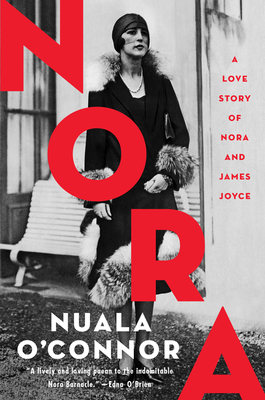
Review 2203: Nora

Nora is based on the movements of Nora Barnacle and James Joyce and on their letters, many of which, apparently, were quite explicit.

On an acquaintance of only a few, heated months, Nora Barnacle goes off with James Joyce to live in Europe despite his not believing in marriage. In 1904, she is 20 and has been working in a Dublin hotel after fleeing her family in Galway.

The life she takes on is difficult. Not only are they very poor and have no permanent abode after the job Joyce was promised at the Berlitz school in Zürich turns out to be a scam, but Joyce himself is difficult. He is a drinker and a spendthrift who buys gifts with the rent money. He is a jealous man who may not be faithful himself and likes to hear about the men Nora knew before him. He is selfish and superstitious, usually certain of his own abilities but not always.

As their life continues, Joyce gets work but never stays satisfied with it. He quits gainful employment to pursue fanciful projects. They have to borrow from his friends and family and move from place to place. Although he is gaining literary fame, he has trouble getting his books published without censorship. He leaves Nora home alone with the children to go drinking with friends and sycophants. Then there is the war, and his failing eyesight.

This is a fascinating depiction of a complex relationship. Aside from the difficulties of living with Joyce and a peripatetic life, Nora has to deal with family pressures and a mentally ill child. Yet her relationship with Joyce is one of fierce passion and love. Although I am not comfortable with explicit sex, I was otherwise wrapped up in this story.

Related Posts

Miss Emily

A Country Road, A Tree

Ghost Light

Review 1999: Edith Trilogy Read-Along: Dark Palace

The Edith Trilogy Read-Along calls for the second book to be read during July. This second book, Dark Palace follows Edith and the fate of the League of Nations from 1931 through the end of World War II. Although most of it is set in Geneva, Edith also visits Australia and the United States.

This novel begins roughly one year after the close of Grand Days. Edith and Robert have been married about a year, but Edith feels she has misunderstood Robert’s character. For one thing, he is not really dedicated to the success of the League, and she sometimes finds him crass. She takes the opportunity of Ambrose Westwood’s return to Geneva and Robert’s departure to cover the Spanish Civil War to rekindle her unusual affair with Ambrose.

At the League, she is considered an expert on protocol but still does not have an official title. At the beginning of the novel, she and other League officers are excitedly preparing for the conference on disarmament they are hosting.

This novel, like many middle novels in a trilogy, has a less focused plot than the first. Edith, at one point, considers moving back to Australia and visits the newly founded Canberra to fish for a job. But Canberra barely exists, and her fellow Australians don’t seem impressed by her accomplishments. The novel skips in an episodic way through several events during the war.

There are times in the novel when Edith’s didacticism is really annoying. What the novel does have, however, is a deeply affecting conclusion.

Related Posts

Grand Days

A Town Like Alice

All the Light We Cannot See

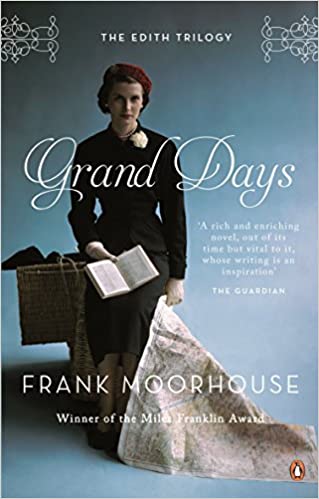
Review 1887: Edith Trilogy Read-Along: Grand Days

I decided to participate in the Edith Trilogy Read-Along hosted by Brona of This Reading Life, but my copy didn’t arrive until June 29th, so I am late for the first one, which was to be read in June. I hope to be on time for the second in the series. This series introduces me to Frank Moorhouse, a highly regarded Australian writer.

On a train from Paris to Geneva to work at the newly created League of Nations, Edith Campbell Berry meets Major Ambrose Westwood, who will be a more senior officer in another section of the League. Edith is naïve and dedicated, a quirky person who has her Ways of Going but is determined to become more cosmopolitan than her Australian roots have made her so far. On the train, she and Ambrose share a kiss.

Edith and her coworkers are excited to be working for this important organization with its worldwide focus and its aim to prevent war. Edith conscientiously studies diplomacy from Ambrose and other senior officers and makes contributions of her own, enough to attract their attention and mentorship.

She does not always make the right choices and finds herself in some ridiculous situations. She also begins an affair with Ambrose, whose unusual proclivities lead her in unexpected directions.

At first, I wasn’t sure how much I liked Edith, particularly her habit of listing and examining what she thinks she knows and her almost aggressive questioning of ideas until she’s sure she understands them. I also noticed that she seemed not to pay much attention to events developing in Europe toward the end of the 20’s. But eventually I was charmed by her.

There were some pages toward the middle of the book when she was enumerating ideas that I skipped after reading several paragraphs, and shortly thereafter, when she was contemplating her poop, a scene I know was supposed to be funny, I was not amused. Still, I’m interested to read Cold Light, the next novel, especially because the book cover description contains a detail that I hope is wrong.

Related Posts

A Town Like Alice

Midnight in Europe

The Gustav Sonata

Review 1868: The Swiss Summer

When Lucy Cottrell’s friend takes her to visit an elderly friend, Lady Dagleish, she has no idea how her immediate plans will be affected. Lady Dagleish is sending her companion, Freda Blandish, to spend the summer at her chalet in Switzerland to inventory its contents, and Lady Dagleish tells Lucy she must go along and spend the summer in the chalet, inviting any friends she wishes.

All during her marriage, Lucy has fallen in with her husband’s ideas for a holiday, he preferring to stay in England or Scotland and near convivial friends. But Lucy has yearned for the alpine meadows of her honeymoon, for quiet and beautiful scenery, so she is surprised but delighted by Lady Dagleish’s invitation.

Lucy is thrilled to arrive at a beautiful, large chalet high up in the mountains. Although she was not impressed by Mrs. Blandish when she met her, Lucy herself is an amenable person, and at first things go well. Then Mrs. Blandish’s teenage daughter Astra arrives and makes it clear that Lady Dagleish doesn’t like her and wouldn’t want her there. Mrs. Blandish asks Lucy not to tell her, and Lucy reluctantly agrees.

Lucy finds she likes Astra but is dismayed to learn that Mrs. Blandish expects more guests—paying guests—her friend Mrs. Price-Wharton and her family, and she expects Lucy to keep quiet about it. Utta, the Swiss housekeeper, is certain these people should not be there, but she doesn’t know what to do about it.

Finally, Lucy’s own guests arrive, her godson and a friend who are mountain-climbing in the area. The two young men begin to make friends with Astra and snobbish friend Kay Price-Wharton. Lucy does not quite have the quiet holiday she desired.

This novel has some likable characters and some not so likable. It is full of the beauties of Switzerland in the 50s, and like another novel, The Enchanted April, made me want to go to its setting immediately. I had to laugh at all the references to the characters’ healthy red (or tanned) faces, though. This novel is charming, with just a hint of the sardonic.

Related Posts

The Weather at Tregulla

A Pink Front Door

The Woods in Winter

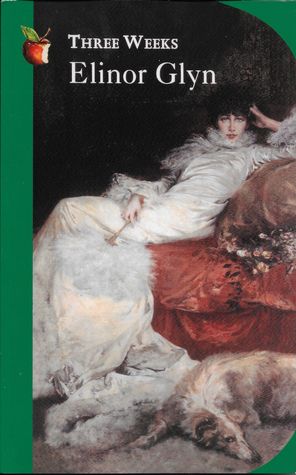
Review 1651: Three Weeks

I realized earlier this month that the deadline I set myself for finishing my Classics Club list is coming up this summer, with about a dozen books left. I’ve been reading lots of classic novels, just not necessarily the ones on my list. I have also read many of the ones on my list but just haven’t posted my reviews yet. So, I decided I was going to have to accelerate my schedule of reviewing and reading them in hopes of getting all my reviews posted on time. Here is one of them.

Elinor Glyn was a romance novelist at the turn of the 20th century whose works were considered scandalous at the time. Three Weeks is the story of a young English man who has an affair with an older Russian queen.

Naïve young Paul Verdayne fancies he is in love with the parson’s daughter, so his mother ships him off for a tour of the continent. He is young and sulky and hates Paris but, being a sportsman, enjoys Switzerland. While in Geneva, he becomes fascinated with a striking woman who is traveling only with her servants.

This mysterious woman, about ten years older than Paul, takes him in hand and begins opening his mind to art and ideas. Soon, they begin a torrid affair. But this affair must remain secret, because there is danger.

First, I found it difficult to buy that this sophisticated, cultured woman would fall madly in love with a gauche, uncultured young man whose only interest is his dog and horses and whose only attraction is his good looks.

Next, Glyn’s writing is florid and overwrought. It is often cloying and downright silly. The style resembles that of writers from the Romantic movement, which was well over by the time Glyn was writing. I have an idea that Glyn may be the type of writer Forster was mocking in A Room with a View.

Finally, the idea that Paul could become informed and educated just by spending three weeks with his mistress is ridiculous. The novel doesn’t say that he is interested in being more informed but that he comes back from his experience poised and culturally literate, enough so as to impress people with his elegance. Right.

In short, this is a really silly book.

Related Posts

Chéri

The Last of Chéri

Dolly: A Love Story

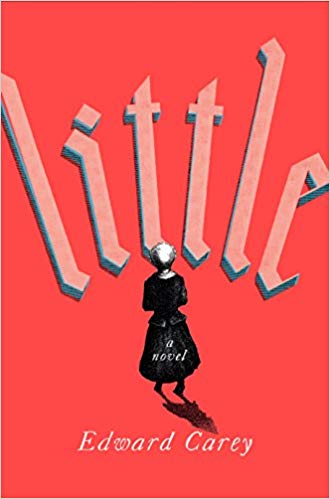
Review 1424: Little

Best of Ten!
Often I don’t read reviews attentively or more often I don’t remind myself what a book is about before reading it, so I didn’t realize for some time that Little is a fictional biography of Madame Tussaud. It is an idiosyncratic one, to be sure.

Marie, often called Little for her small stature, is familiar with loss. In 1760, when she is five, her father dies. Her mother never recovers from it, and shortly after she and her mother take up residence with Doctor Curtius, for whom her mother is employed as a servant, her mother commits suicide.

Doctor Curtius is one of many peculiar characters, Marie not excepted, who occupy the novel’s pages. He is a very odd creature, unused to others, who models body parts in wax to be studied by anatomists. Marie is not dismayed by his peculiarities and is entranced by his wonderful collection of body parts. So, he begins teaching her to draw and model objects in wax.

At Little’s suggestion, they model the entire head of some subjects. Soon, they have a business of selling heads of themselves to customers. Dr. Curtius is mistreated by the hospital, so when a traveling Frenchman, Louis-Sébastian Mercier, suggests they move to Paris from Switzerland to model great men, they do.

Shortly after they arrive in Paris, Doctor Curtius falls under the influence of their landlady, the Widow Picot, who soon has Little working for the entire family, not just Doctor Curtius, even though Little has never been paid. Madame Picot makes no secret that she would like to get rid of her. In the meantime, she and Doctor Curtius begin by modelling the heads of famous criminals. By now, the French Revolution threatens.

Little is narrated in a sprightly, whimsical fashion even when it relates things that are not so pleasant. That, and the pervading personality of its main character, are two of its charms, even as it becomes darker. This is a strange and wonderful novel.

Related Posts

The Fountain of St. James Court or, Portrait of the Artist as an Old Woman

Birdcage Walk

A Tale of Two Cities

Day 1245: Moriarty

Cover for MoriartyDespite not being a fan of Sherlock Holmes-based contemporary mysteries, I read Moriarty because I recently enjoyed Magpie Murders. In this case, Sherlock Holmes does not appear, and the only link to the older mysteries, aside from a few characters, is Moriarty himself.

The novel begins right after the Reichenbach Falls incident, when both Holmes and his nemesis, Moriarty, are assumed dead. The body of one man, identified as Moriarty, is found.

Shortly after the incident, two detectives arrive on the scene. One is Frederick Chase, an investigator from Pinkerton’s in the United States. The other is Inspector Athelney Jones from Scotland Yard. Chase reports that he has been following Moriarty with information that he was meeting with Clarence Devereaux, a criminal mastermind from New York who purportedly wants to join forces with Moriarty. No one has ever seen Devereaux, but the Pinkertons understand he suffers from extreme agoraphobia. Chase and Jones team up to find him.

This, however, is not an easy quest. Every time the two men get a lead, someone is murdered. Soon, the two investigators must fear for their own lives.

I found this novel clever, but there was something missing from it. I don’t know how else to describe my reaction. I was just a little underwhelmed, even though there were twists and turns.

Related Posts

Magpie Murders

Moriarty

Mr. Timothy