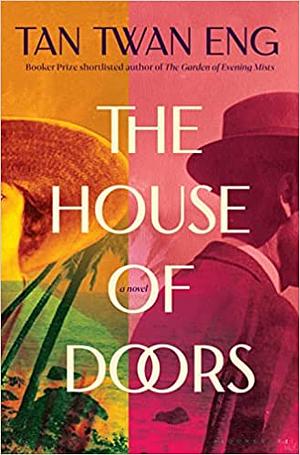
Review 2495: The House of Doors

In 1947 South Africa, shortly after her husband Robert’s death, Lesley Hamlyn receives a package that has come a long way, through circuitous routes, to find her. It has no note and does not say who sent it, but it is a book written by Somerset Maugham more than 20 years ago.

This gift returns her memories to 1921, when she and Robert lived on the island of Penang and were visited by Maugham. The point of view shifts to that of Maugham, who soon learns that his broker has gone under and lost all his money. Although he is dreading his wife’s reaction from England, he is more afraid that Gerald, his secretary and lover, will leave him if he is broke.

He and Lesley begin to get to know each other. Eventually, she tells him about her life 10 years before. On the same day that she heard her best friend, Ethel, had been arrested for murder, she also learned her husband was having an affair.

Tan skillfully weaves the story of Lesley’s relationship with Ethel and the trial with her experiences resulting from meeting Dr. Sun Yat Sen, who has been attempting the overthrow of the Manchu dynasty in China. Lesley begins helping his organization translate its brochure and eventually has an affair with a Chinese man. They meet in the House of Doors.

I was interested in all these stories and although I know very little about Maugham, I spotted the seeds of more than one of his stories in them. For example, Ethel’s story is very similar to that of The Letter, which I am familiar with because of the movie with Bette Davis.

As much as I enjoyed The Garden of Evening Mists, I think I liked this novel even more. Although I read it for my Walter Scott Prize project, I probably would have read it anyway.

Related Posts

The Garden of Evening Mists

The Ten Thousand Things

The Glass Palace

Day 1184: The Garden of Evening Mists

Cover for The Garden of Evening MistsBest of Five!
Yun Ling Teoh, a Malayan federal judge of Chinese descent, has decided to retire early. She has been diagnosed with a neurological ailment that will cause more and more frequent episodes of aphasia and will eventually destroy her language abilities. She decides to return to Yugiri, a Japanese garden in Malaya that she inherited from its creator, Aritomo.

On the advice of her friend Frederik, the owner of a nearby tea plantation, Yun Ling decides to record her memories. She begins in 1951, when she went to Aritomo to ask him to design a garden in memory of her sister, Yun Hong, who died in a Japanese labor camp during World War II. Yun Ling also was in the camp, and her hatred of the Japanese makes it difficult for her to ask for Aritomo’s help. But her sister loved Japanese gardens.

Aritomo refuses her request but makes her a different offer. If she will take on the job of apprentice, he will teach her enough to design her own garden. She decides to accept the offer, having quit her job as prosecutor.

It is a difficult time in Malaya. No sooner did the war end than the government began fighting Communist guerillas, who were attempted to take over the country. And Akitomo has his secrets. He came to Malaya before the war, having resigned as the Japanese emperor’s gardener, but Yun Ling occasionally hears that he played a role for Japan during the war. He had some kind of influence, because he saved his neighbors from the Japanese labor camps. Yun Ling, we find, has her own secrets.

The Garden of Evening Mists is the best kind of historical fiction, immersing me in its time and place while informing me of events I was formerly unaware of. I found it deeply interesting and affecting. The descriptions are delicate and evocative, and the characters feel real yet mysterious. This novel was part of both my Walter Scott Prize and Man Booker Prize projects, as well as the winner of the Man Asian Literary Prize. It is a powerful novel.

Related Posts

The Glass Palace

The Narrow Road to the Deep North

The Ten Thousand Things