Day 362: Finders Keepers

Cover for Finders KeepersBelinda Bauer returns us to Shipton, the setting on Exmoor of her first two chilling novels. Someone abducts a girl from her father’s car, leaving a note that says “You don’t love her.” At first the police assume the kidnapping is for money or revenge against the girl’s apparently wealthy father, but more abductions follow. The small town, which has been ravaged by serial killers twice, is horrified.

Constable Jonas Holly is still on leave following the murder of his wife Lucy the year before. He will soon be returned to duty, although Inspector Reynolds is skeptical of the help he can provide.

Steven Lamb, almost a victim in the first novel, thinks he knows who murdered Lucy Holly. As more children disappear, he becomes worried about his younger brother Davey, as well he might. Unknown to their mothers, Davey and his pal Shane have been running around the countryside while their families think they are at each other’s houses.

Reynolds and his team are at a loss. They hope the children are alive but can’t figure out where they’re being held, despite having covered the moor with heat-seeking technology from a helicopter.

Bauer’s thrillers keep me on the edge of my seat. Her novels are well written and suspenseful, her characters complex. If you like dark thrillers, you can’t do much better.

Day 344: Tuesday’s Gone

Cover for Tuesday's GoneTuesday’s Gone is the second mystery/thriller featuring psychotherapist Frieda Klein in a series that is turning out to be quite exciting. A social worker calls on a mentally ill client for a first visit at a grimy, squalid hostel. The client, Michelle Doyce, leads her in to her apartment and introduces her to her guest–a naked man who has been long dead.

The police, embattled with cost-cutting measures, are inclined to close the case even though the victim has not been identified, but DCI Karlsson wants to see what Frieda Klein makes of Michelle, who seems to be talking nonsense. Frieda soon concludes that, rather than having strangled the victim, Michelle suffers from a rare disorder that makes her unable to distinguish the animate from the inanimate and was trying to help him.

When the victim is finally identified, he turns out to be Robert Poole, an apparently charismatic and charming con man and identity thief. He seems to have several potential murderers, but none of them appears to bear him any ill will.

In the meantime, Frieda is slowly beginning to realize that the case from the first book, Blue Monday, is not closed, because the murderer is not dead, as believed. Frieda is sure he is lurking somewhere nearby. She is also involved with troubles with her family and among her friends, as well as the return of her ex-lover Sandy from the US.

Frieda is an interesting character–a loner who likes to walk the streets of London at night and prefers to keep her own counsel yet has several close friendships. The mysteries are involving and complex, and although I figured out who the murderer was before the secret was revealed, it was only a bit earlier. Although the married writing team who calls itself Nicci French builds suspense slowly, the final chapters of the novel are quite thrilling.

Day 342: The Tryst

Cover for The TrystThe Tryst is an odd book by Michael Dibdin, the author of the Aurelio Zen mysteries. Although billed as a crime novel, it takes some time to get around to the crime. In fact, it misleads us into thinking it is one type of novel when it is actually another.

The novel follows the actions of two characters, a homeless boy and the therapist who is trying to figure out why the boy is pretending to be insane. Gary Dunn has come to the psychiatric hospital where Aileen Macklin works as a psychiatrist requesting institutionalization and insisting that someone is trying to kill him.

We find out that Gary, a glue-sniffing boy who lives with a bunch of junkies, has befriended an old man. Although Gary’s mates would like to rob the man, Gary has become involved in the old man’s long, involved story about a former employer who sees a beautiful woman no one else sees. In the story, the employer follows the woman to his death. This story eventually connects the fates of Aileen and Gary.

Ultimately, the novel doesn’t work that well, because it starts out being a crime thriller and turns into more of a gothic novel/ghost story. It is too much one kind of novel to work successfully as the other kind. Although the novel is well written and interesting, it reads almost as if Dibdin started with an idea and changed his mind in midstream. For a better example of a book that combines a crime story with a ghost story, read Johan Theorin’s fantastic The Darkest Room.

Day 341: Nightwoods

Cover of NightwoodsBest Book of the Week!

Charles Frazier sets his novels in backwoods North Carolina. His first novel, Cold Mountain, was set during the Civil War. His second, Thirteen Moons, went further back to the treatment of the Cherokee in the earlier part of the 19th century. Nightwoods, his third, deals with more recent times, a small mountain town in the early 1960’s.

Luce is a troubled young woman with a traumatized past who has taken up a secluded life as a caretaker for an old disused lodge across the lake from town. She is unprepared when a social worker brings her the young twin children of her murdered sister Lily, an almost feral boy and girl who refuse to speak and like to start fires.

Stubblefield is lazing away his life on the coast of Florida when he learns his grandfather has died and left him, aside from a load of debt, the lodge and a road house and a considerable number of acres on the mountain. When he goes to inspect the lodge, he is immediately smitten by the skittish Luce.

Trouble is on the way, which we know from the beginning of the novel. Bud, the husband and murderer of Luce’s sister Lily has been released from prison because of a hung jury. He is on his way to town in search of the money he stole, which he gave to Lily one night when he was drunk and she refused to give back to him. He beat her to death trying to get her to tell him where it is, and now he thinks the children know.

This novel is at times tender, as Luce blindly copes with the two damaged children in the best way she can, instinctively treating them with delicacy and kindness. At the same time, the violent Bud resembles a character from a Carl Hiaasen or Elmore Leonard novel, almost comic at times in his psychopathic ineptitude.

The result is an enthralling novel that is both a love story, not just between its characters but with the beauty of nature, and a thriller with a true feeling of danger. As usual with Frazier, the novel is wonderfully well written, with entrancing descriptions of nature.

Day 336: 61 Hours

Cover to 61 HoursEvery once in awhile when I want some purely escapist reading, I pick up a Jack Reacher novel by Lee Child. I haven’t read these books in order, in fact I’ve only read a few, but they are certainly exciting, to say the least. For those who are not familiar with Reacher, he is an ex-army major who has become a drifter, wandering around the country and taking care of situations that he mostly falls into.

Jack has hitched a ride on a bus full of senior citizens when an accident strands them in the small town of Bolton, South Dakota, in the middle of a snowstorm. With our inside information, we readers know that the car crash is not actually an accident. Outside of town, a Mexican drug cartel has taken over an abandoned military facility. The local police are guarding Janet Salter, an old lady who is  a key witness against the cartel.

It is simply chance that causes Reacher to become acquainted with Janet. But when he learns that the police are expecting a visit from an assassin, he decides to help protect her.

I have seen comments on Amazon from hard-core Jack Reacher fans complaining that this novel is not as action packed as the others and that the series is deteriorating. I don’t really have any complaints, but then I have only read a couple of the novels. I found the book fast paced and exciting.

Day 324: Trick of the Dark

Cover for Trick of the DarkCharlie Flint is a profiler who is on probation because her testimony freed a man who went on to murder four women. She is asked by Corinna Newsam, her old tutor, to investigate the lesbian lover of the tutor’s daughter, Magda. Corinna Newsam thinks that this lover, Jay Stewart, may be a serial killer, because several people who were in her way conveniently died, including Magda Newsam’s husband on the night of their wedding.

Charlie finds herself attracted to a woman she meets in a seminar. (Spoilers follow in this paragraph and the next. I usually don’t include spoilers, but these are integral to my criticism.) This woman is clearly manipulating her from day one, and in the course of her investigation, Charlie violates the confidentiality of the people she is investigating by confiding in her. Of course, without this happening, there wouldn’t be a plot, but it is still the crux of my problem. I don’t think it would be likely that a person in her position would make the mistake of confiding information on a sensitive case to a new acquaintance, even if she is dating her.

It is the nature of this violation that bothers me most, as it is extremely unprofessional and I felt it unlikely from a profiler. Of course, the woman actually turns out to be connected to the murders, and this coincidence also bothered me.

Finally, I am reluctant to say this for fear it will be misconstrued, but at least five characters are fretting about their sexuality. These characters are lesbians, but I don’t enjoy this kind of emphasis in heterosexual literature either.

I am a big fan of the Tony Hill/Carol Jordan books, and I also like the Kate Brannigan series by McDermid. I know she has a Lindsay Gordon series, but I don’t think I have read any of those. McDermid has written some of the best stand-alone thrillers I have ever read, particularly A Place of Execution. I was disappointed not to enjoy this novel as much.

Day 312: Castle

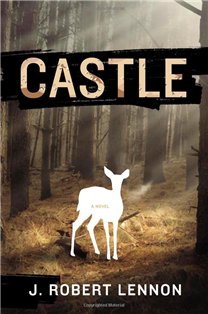
Cover for CastleEven from the first moments of reading the unusual Castle, the novel seems to be about more than is on the surface. That notion turns out to be the case.

Eric Loesch returns to the town where he grew up and buys a large piece of property outside of town. Then he starts fixing up the farm house. He almost immediately becomes fixated on a large rock on the property and eventually finds the ruins of a castle behind it.

This activity seems all very straightforward, but something more is going on, we’re sure. Loesch is an unusual man, as demonstrated throughout by his thoughts and actions. His reactions to seemingly ordinary conversational gambits seem extreme. His emphasis on privacy seems excessive. We also feel, although we don’t know why, that he may have a military background.

Castle is a novel that unfolds slowly but keeps your attention throughout. It becomes clear that there are painful incidents in Loesch’s past, but the novel takes its time getting to them, and Loesch seems to be in denial about some of them.

The writing is skillful, particularly in delineating Loesch’s character through his behavior. In fact, I don’t know when I’ve understood the personality of such an unusual character so particularly before without the author actually telling me about it.

The revelations at the end of the novel are not, for the most part, foreseeable, although I could eventually predict at least one important plot point. All-in-all, Castle is a disquieting, dark tale.

Day 310: The Killer Inside Me

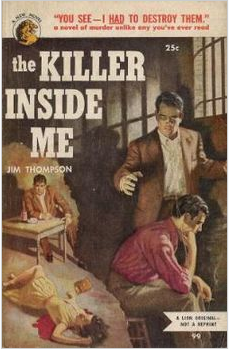
Cover for The Killer Inside MeJim Thompson’s classic noir thriller The Killer Inside Me was one I had never read, so I picked it up out of curiosity. Normally, I am not drawn to classic noir, even though I like a crime novel that is dark. This brief novel easily kept my attention, though.

Lou Ford is a deputy sheriff in a small Texas town. He projects the image of a jovial good guy, maybe even a little stupid, who continually spouts clichés. But he has actually been hiding his sociopathic tendencies for years.

Ford begins a sadomasochistic relationship with Joyce Lakeland, a prostitute. He sees a way to use his relationship with Joyce to get revenge for his brother’s death. As a teenager Ford sexually abused a little girl, and his foster brother Mike took the blame. After he got out of jail, Mike died in a construction accident, and Ford has blamed the local owner of the construction company for Mike’s death.

Ford and Joyce begin blackmailing the owner of the construction company in return for keeping his son’s affair with Joyce secret. Then Ford sees a way to take it all one step further. Of course, things don’t always go as planned.

As in reading Patricia Highsmith’s Ripley novels, a large part of the fascination of this disturbing book lies in wondering how Ford is going to get out of one fix after another. Thompson’s writing is deft and tight. You will be glued to the page, even if you don’t like noir.

Day 303: The Girl Who Kicked the Hornet’s Nest

Cover for The Girl Who Kicked the Hornet's NestI just realized that, having reviewed the other two books in Stieg Larsson’s Millennium Trilogy, I never reviewed The Girl Who Kicked the Hornet’s Nest. This final novel will be difficult to discuss without giving away what happened in the previous books.

As Lisbeth Salander recovers in the hospital from her injuries, journalist Mikael Blomkvist investigates Alexander Zalachenko, the Soviet defector she shot in self-defense at the end of the last novel. He begins to think there has been a massive cover-up on the part of Säpo, Sweden’s security police, to hide Zalachenko’s crimes while he was viewed of value to them. Among those crimes were the horrendous beatings he gave Lisbeth’s mother, for he is her father.

Some former members of Säpo are currently colluding with Dr. Peter Teleborian, the psychiatrist who supervised Salander’s institutionalization when she was a girl, to either have Salander re-institutionalized or to murder her, so that their activities do not become known. Salander is able to assist in her own way with preparations for her trial when a sympathetic doctor smuggles her laptop computer and a phone into the hospital for her.

The freakish Niedermann is still loose, having murdered a police officer and carjacked a woman during his escape.

All these subplots are wrapped up through an exciting trial and a subsequent pursuit of Niedermann.

I believe this series is so successful because of a strong message about violence toward women, interesting and believable characters, complex but careful plotting, thrilling action, and a strong, compelling, and unusual heroine. If you have not read the series already, I strongly recommend it. Start with The Girl with the Dragon Tattoo.

Day 302: The Cradle in the Grave

Cover for The Cradle in the GraveFliss Benson is a television producer who on the same day is unexpectedly handed control of an important documentary on women falsely accused of murdering their babies and then receives a mysterious card with 16 numbers on it.

As a result of her boss’s work, three women have been released from prison and the doctor who testified against them, Dr. Judith Duffy, is under investigation for misconduct. Now Fliss’ boss wants to resign and turn the project over to her. Shortly after receiving the job, Fliss learns that one of the mothers featured in the documentary was murdered–and a similar card was found in her pocket.

As Fliss tries to make sense of all the research materials she has been left with, DC Waterhouse is trying to untangle the evidence from his side. His boss “the Snowman” was the person who originally arrested the murder victim, although he knew her well and continued to protest her innocence. A little later, another of the freed mothers is attacked, and another card left for the police to find.

As usual with a Sophie Hannah novel, the characters are convincing, the plot is complex, and the conclusion is hair-raising. The dialog is bright and clever. Simon Waterhouse is as neurotic as ever, but he always eventually gets to the solution. When I am in the mood for some dark, twisted fun, Sophie Hannah is a great choice.