Day 141: Shadow of Night

Cover for Shadow of NightAs with most second books of a trilogy, Shadow of Night is transitional and therefore harder to describe than the first book.

At the end of the A Discovery of Witches, the first book of Deborah Harkness’s “All Souls Trilogy,” Diana Bishop, an Oxford scholar and nonpracticing witch, and her husband Matthew Clairmont, a geneticist and vampire, were forced to flee because a union between a witch and a vampire is forbidden. Using Diana’s newly discovered time-travel skills, they have arrived in Elizabethan England so that Diana can find a witch to help her learn her powers. Even more importantly, they want to look for Ashmole 782, an enchanted manuscript that Matthew believes may hold the secret to the existence of witches, vampires, and daemons. This decision proves potentially hazardous, though, as the age they’ve chosen is one of persecution of witches and Diana has a tendency to draw attention to herself.

In Tudor England Matthew of the past is part of an intellectual group called the School of Night, the members of which include Sir Walter Raleigh and Kit Marlowe. Kit is a deeply disturbed daemon who is insanely jealous of Diana. Another hazard is that Matthew’s acquaintances may realize he is not the same person as the person from the past. In the meantime, both Diana and Matthew’s friends and enemies back in the present time watch for clues to their existence in the past.

Although this novel is a great sequel that propels you to the next book, it has the typical middle book problem of furthering the plot without arriving anywhere. Strictly because of personal taste, I could also have done without some of the heavy romantic passages, although other readers will like them. Nevertheless, I am extremely interested to see how Diana and Matthew will resolve all their problems in the final book.
Day 122: The Tudor Secret

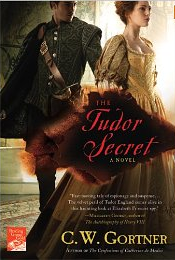
The Tudor SecretI have heard about C. W. Gortner before, but The Tudor Secret is the first book of his I have read. My overall impression is that the book reflects some knowledge of Tudor times and some research, but is generally on the light side, with a fairly predictable plot.

Brendan Prescott is a servant of the powerful Dudley family, a foundling who has been mistreated by the Dudleys all of his life. He is surprised when he is removed from the stables and given training as a body servant. He is dismayed when he is sent to court to wait on the cruel Robert Dudley.

He is almost immediately thrust into dangerous circumstances as he tries to help the Princess Elizabeth see her dying brother, King Edward. Edward’s regent Northumberland, Robert’s father, is trying to keep everyone away from the king.

Elizabeth is in contention for the throne against her half-sister Mary. But Northumberland is trying to manipulate his daughter-in-law, Lady Jane Grey, and his son Lord Guildford Dudley, onto the throne. Soon, Brendan finds himself spying for William Cecil to help Princess Elizabeth.

Although the Tudor era was a turbulent time, involving much intrigue and a lot of paranoia, I felt that some of the plots suggested in the book were absurd, such as Northumberland poisoning Edward so that he can put himself on the throne. I understand from reading one of the reviews on Amazon that this was an early book by Gortner and not up to his usual level, so perhaps I will try another.

Day 89: The Wars of the Roses

Cover for The Wars of the RosesThe Wars of the Roses were a series of complex events involving numerous significant figures. As such, when I have previously read about them, I’ve found it confusing to keep track of events and people.

In The Wars of the Roses: Through the Lives of Five Men and Women of the Fifteenth Century, Desmond Seward presents the clearest and most interesting explication I have read. He organizes the material and infuses interest by following the effects of the wars on five people–William Hastings, Edward IV’s best friend and one of the most powerful men in the realm during his (Yorkist) reign; John de Vere, Earl of Oxford, head of an ancient family and a loyal Lancastrian; Lady Margaret Beaufort, Henry Tudor’s mother; Dr. John Morton, a loyal Lancastrian clergyman who turned Yorkist; and Jane Shore, mistress of Edward IV and daughter of a successful London businessman.

A series of battles between rival factions of the Plantagenet family for the throne, the Wars of the Roses lasted 32 years. The roots of the dispute lay in Henry IV’s usurpation of the crown from Richard II years before. Henry IV and his son, Henry V, were strong rulers, but Henry V’s heir, Henry VI, succeeded at the age of 15. He proved a weak and ineffective ruler who was dominated by his favorites and his wife’s rapacious relatives. Henry also managed to lose the portion of France that his father had so arduously and expensively won back, and England’s state of law and order had almost completely broken down.

The shift in government began when Henry VI had a son who replaced Edward Duke of York (later to be Edward IV) as heir to the throne. This made Edward’s position precarious and he had to flee to Europe. His subsequent battles against Henry’s adherents were only the beginning of years of instability that resulted in the end of the Plantagenet dynasty and the beginning of that of the Tudors.

History can be written with too much detail or in a too academic and dry style, or it can be so lightly researched as to seem like fluff. Seward hits the perfect balance with a terrifically interesting book that is wonderfully well written.

Day 84: Bring Up the Bodies

Cover for Bring Up the BodiesBest Book of the Week! Year!

If Wolf Hall was a wonderful historical novel, Bring Up the Bodies is masterly. In this second of a trilogy, Hilary Mantel continues the story of Thomas Cromwell. Bring Up the Bodies is more focused than the last book, because it deals with a much shorter time period and defined subject–the downfall of Anne Boleyn.

The writing is elegant and impeccable. I have read a few comments that Wolf Hall was sometimes difficult to follow because the readers could not always tell who was meant by “him” or “he.” Mantel has written both books using a strict third person limited point of view, from that of Cromwell, and people don’t think of themselves by their first names. Hence, the difficulty, which I did not notice as a problem in Bring Up the Bodies. This technique is very difficult to employ successfully–we are much more used to a third person that changes from character to character or even to third person omniscient. But Mantel uses it effortlessly to create a memorable character in Cromwell–kind but implacable, one who fosters the growth of others but does not forget the crimes and indignities committed against Cardinal Wolsey, whom he loved as as a father.

Henry VIII has already decided he wants to rid himself of Anne Boleyn and marry Jane Seymour, but Anne has one more chance. She is carrying a child, and if it is born alive and is a boy, she is safe. Henry must have an heir, and he has decided that if he hasn’t been given one, God must have found some fault with his marriage to Anne just as there was one for his marriage to Katherine of Aragon. Thomas Cromwell must find him some way out of his difficulties.

Of course, Cromwell helped Anne to her position in the first place, but the Boleyns have made many enemies in their enjoyment of power, and they have treated him with disdain. More importantly, Anne Boleyn destroyed the Cardinal, and her brother mocked him in his downfall.

From the moment you begin reading, you find yourself plunged into the Tudor world of shifting politics and intrigue. Of course, we know what happens to Anne Boleyn, yet the novel maintains its suspense. The Boleyn and Howard families are going to suffer a huge defeat, but they will go down fighting.

Day 77: Wolf Hall

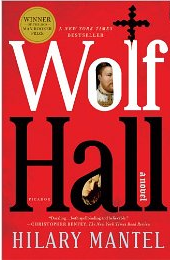
Cover for Wolf HallBest Book of Week 16!

This is a good time to write about Wolf Hall, because I was thrilled to learn that Hilary Mantel’s sequel to it has just come out. My copy is arriving soon. Mantel is always an interesting writer whose work does not occupy any one genre, although her last few books have been historical fiction. Wolf Hall won the Man Booker Prize and was one the best books I read in 2010.

The novel looks at the political and religious machinations of Henry VIII through the eyes of Thomas Cromwell, who rose from low origins to become Henry’s chief minister. Although Cromwell has traditionally been viewed as Henry’s “heavy,” recent historians have looked at his career more kindly, showing that his work as chief minister brought England into more modern statehood and that his changes created more order for government functions that were less controlled by the whims of nobility.

Mantel depicts Cromwell as a loyal man who cares for his dependents and works to reform England. He builds up a great household as he moves from the position of secretary to Cardinal Wolsey to work for the king. Later, after the Cardinal’s downfall, he slowly, almost imperceptibly, works to bring down those who furthered their own interests by destroying the Cardinal, including the rapacious Boleyns.

Cromwell is loving to his family and friends, completely faithful to the Cardinal and then to Henry, intelligent, able in many spheres of work, and decent. Mantel paints a charming pictures of his home life. In contrast, she turns the tables on Thomas More, venerated for centuries, showing him as a sadistic torturer of Protestants who is in love with his own martyrdom.

Cromwell meets Jane Seymour when she is a young, lonely lady’s maid to the queen, teased and neglected by the rest of the court, and feels pity for her. Later, after he is long widowed, he falls in love with her. The title of the book is the name of her ancestral home, Wolf Hall.

Mantel’s approach is understated, leaving the reader sometimes to connect the ideas. The details in this novel seem completely authentic, and Mantel handles the period brilliantly. She somehow manages to generate tension and suspense even about things we know all about, like what will happen to Anne Boleyn.

Day Nine: Mary Boleyn

Cover for Mary BoleynIn the introduction to Mary Boleyn, biographer Alison Weir talks about the many misconceptions we have about Anne Boleyn’s less famous sister, which were not only derived from such popular fictions as The Tudors (wildly inaccurate, but I still loved it!) and The Other Boleyn Girl (ditto), but also from biographers and historians over the centuries. Weir calls her book both a biography and a historiography, because she tackles many published statements about Mary’s life and attempts to show the extent of their truth or even likelihood.

Because most of Mary’s life was spent in the background of her glittering, ambitious family, not many actual records or letters that mention her exist, and only a couple of her own letters survive. Even the exact date of her birth is unknown, so that there has been been debate about whether Mary is the older or younger of the two sisters. (Weir makes a good case for older.)

Weir examines Mary’s life from as early as it is known and explores such subjects as whether she had an affair with the King of France (yes, probably a short one), whether she came from that with a ruined reputation, as has been alleged (no, but her family may have sent her away from court), whether she had an affair with Henry VIII (yes, but possibly reluctantly), whether she was then labeled a “famous whore” as has also been alleged (no, hardly anyone knew about it), whether she was married off to an unworthy but complaisant husband as a result (no, she married before the affair to William Carey, a wealthy and influential courtier who was one of Henry VIII’s trusted friends), and so on.

The picture Weir paints is of a woman who has repeatedly been smeared over the centuries. She certainly did not seem to be ambitious, like the rest of her family, because she got very little from her royal lovers. She was almost certainly also not well regarded by her family, probably because she had taken these lovers without gaining an advantage. After her first husband died, she eventually remarried for love, William Stafford, a relatively poor man much lower in status who was 12 years her junior. After she was cut off from her family and court as a result, she described the time of her widowhood as “bondage” and stated in a letter to Thomas Cromwell that no one in the world cared for her except Stafford.

Mary seems to have been slighted by her family for much of her adult life and was finally exiled from them because of her second marriage. This separation may be the only reason she survived her sister and brother.

Weir makes a strong case for Mary’s first child, Katherine Carey, being the unacknowledged daughter of Henry VIII. An appendix relates what happened to Mary’s descendants. Weir remarks that Henry VIII’s line is believed to have died out with Elizabeth I, but assuming she is correct about Katherine’s birth, she provides a fascinating list of some of the famous British people who can trace their lineage back to Mary’s daugher—and so to Henry—including Winston Churchill, Charles Darwin, Lord Nelson, Vita Sackville-West, Ralph Vaughn Williams, Princess Diana, Camilla Parker-Bowles, and Queen Elizabeth II herself.