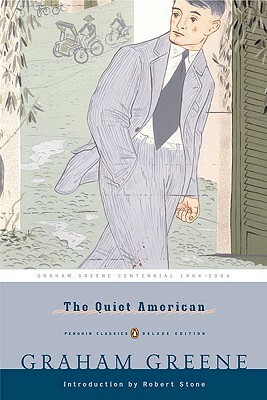
Review 2568: The Quiet American

I long ago saw the movie version of The Quiet American starring Michael Caine and Brendan Frasier, but I couldn’t remember the details. I need to read more Greene, so when this book filled a hole in my A Century of Books project, I found a copy.

The narrator, Thomas Fowler, is an aging British reporter in Saigon, a cynical, world-weary man. The time setting is the early 1950s, when it was the French fighting the Communists in Vietnam. Fowler has lived a long time in Vietnam and has a young mistress named Phuong whom he cares for more than he admits.

At the beginning of the novel, he learns that an American, Alden Pyle, is dead. Then the story backtracks to his meeting with Pyle, a young naïve man who has just arrived in the country. Fowler catches on fairly quickly that Pyle has no real understanding of the country or its people but some half-baked ideas about Vietnam based on a book by an author who spent one week in the country. However, Pyle is not receptive to other ideas (until it’s too late).

Fowler invites Pyle to his home, where he meets Phuong. Very quickly, Pyle decides that he is in love with Phuong and tells Fowler he can make a better life for her, so he will court her but not behind Fowler’s back. He seems to have no conception that this may be painful for Fowler.

Fowler is married, so he cannot marry Phuong, but he writes a letter to his wife asking for a divorce—a request he’s fairly sure will be denied. At about the same time, he receives notice that he has been promoted and should return to London, but all he wants is to stay in Saigon with Phuong. He writes asking to stay.

He knows, though, that Phuong, although she cares for him, is probably ultimately going to be practical and take the young man who can marry her—egged on by her older sister, who has always thought Phuong could do better.

With this situation between them, Fowler begins hearing rumors about Pyle’s activities in Vietnam.

There are some suspenseful passages in this story, but what Greene does even better is get into the motivations of his characters. Of course, all the Americans in the novel are clueless oafs (except Pyle, who is clueless but not an oaf), and the women are disregarded. Phuong’s sister has more of a personality than Phuong does, and in one passage, Greene has Fowler basically say to Pyle that Phuong doesn’t think. (All she does in her own time is dance, visit her sister, and read movie magazines.)

If you can get past these caveats, this is a really good, suspenseful and psychological novel. None of the characters are particularly likable, but at some points you feel a lot of sympathy for Fowler.

Related Posts

The Lotus Eaters

Lyndon Johnson and the American Dream

Perfume River

Review 2450: The Lotus Eaters

I’ve had The Lotus Eaters on my TBR list for a long time, so I finally decided to get a copy. Unfortunately, it turned out to be a DNF for me the first time. (But read on, because I eventually finished it. My review is in two parts.)

The novel begins with the fall of Saigon in 1975. War photojournalist Helen has left it late to try to get herself and her wounded husband, Linh, out of the country. Torn between trying to get photos of the fall and getting out safely, after a long, dangerous struggle to get to the American embassy, Helen gets Linh into a helicopter and then returns to the city.

The novel then moves back in time to 1965, when Linh has just been forced to rejoin the South Vietnamese army. On his first day back, he meets photographer Sam Darrow, who gets him appointed as his assistant. But on the same day, friendly fire destroys his village, including his parents and his pregnant wife. Linh deserts.

After months in Saigon, Linh gets a job with Life magazine by claiming to be Darrow’s friend. He ends up being Darrow’s assistant again. Then the focus of the novel shifts back to Helen and her arrival in Saigon as an inexperienced photographer.

First Review

I gave this novel 100 pages, but although I was interested in the setting, I just didn’t care about these characters. And although Soli does a good job of describing some things, I just wasn’t feeling the setting or getting engaged in the story. This seemed like a mediocre attempt at historical fiction. Things didn’t come to life.

I realized later that this book was part of my James Tait Black project, so I should have tried to finish it, but I didn’t.

Second Review

I gave The Lotus Eaters another try after I realized it was not only part of my James Tait Black project, but it had won the award that year. When I quit reading, it was because I assumed that the novel was mostly going to be about Helen’s romantic relationships with married photographer Sam Darrow and then with Vietnamese photographer Linh, and I wasn’t at that point that interested in them. However, it turned out to be more about Helen’s growing love for the country and whatever it is that makes people risk their lives to get photos of dangerous events.

Soli is good at evoking the landscapes and scents of Vietnam, as well as the dangers. Although I became interested enough in the story to finish it, I still felt a considerable distance from the characters. I was most interested in Linh, but we only see from his point of view briefly at the beginning and end of the novel, and after all he goes through, his most defining characteristics are loyalty and love for Helen.

So, I still only liked this novel somewhat. I couldn’t help contrasting it with the recent movie Civil War, also about photojournalists and much more gut-wrenching.

Related Posts

Lyndon Johnson and the American Dream

In the Lake of the Woods

Perfume River

Day 1228: The Great Railway Bazaar

Cover for The Great Railway BazaarBest of Five!
Although it was not his first published book, The Great Railway Bazaar was Paul Theroux’s first to be profitable. Written in 1975, it describes the journey he took from England through Europe and southern Asia to Japan and then back through Russia almost all the time on railroads. On the journey, he travels on some fabled railways, such as the Orient Express when it still went to Istanbul and the Trans-Siberian Express.

This isn’t a traditional travel book. For the most part, Theroux isn’t interested in describing tourist destinations. There is some description, but Theroux is mostly interested in the people he meets on the train and the glimpses of life beyond.

The book is interesting but especially for me in describing countries as they no longer are but were during my lifetime. He describes a Middle East not torn by war, as it has been since the 1980’s, an Iran ruled by the Shah, a Vietnam abandoned by Americans but still at war. He dismisses Afghanistan as a country to be avoided in future but not because of war.

His descriptions of conditions he finds are graphic, and his conversations on the train are sometimes funny. He is a keen observer of human behavior.

This book just zipped by for me, I was so interested. I was surprised to find that at that time, the Orient Express was one of the least luxurious trains he takes. It is more luxurious now, but sadly it no longer goes to Istanbul.

The Folio Society edition I have is full of beautiful photos of people traveling on trains. Unfortunately, none of them were taken by Theroux on his journey.

Related Posts

Travels in Siberia

The Road to Little Dribbling

Coming into the Country

Day 1203: The 1977 Club! The Honourable Schoolboy

Cover for The Honourable SchoolboyI actually read this novel before the 1977 Club was announced, but I was pleased to find that it was published in that year. I have a couple of other books I’m reviewing this week that I read especially for the club.

Here are my previous reviews of some other books published in 1977:

* * *

I wasn’t aware that there was a sequel to John Le Carré’s Tinker Tailor Soldier Spy until I picked up The Honourable Schoolboy and started reading it. It is truly a worthy successor.

In summarizing the plot, I have to give away a key point of Tinker Tailor Soldier Spy, but a point revealed toward the beginning of the novel. In that novel, of course, George Smiley uncovered a mole for the Russians high up in British intelligence. Because of the mole’s position, as The Honourable Schoolboy begins, all of the service’s spy networks are compromised and must be dismantled.

With a small staff of personnel who were dismissed during his predecessor’s reign, Smiley must figure out a way to make the service viable again. He has the idea that they can look for intelligence in the lacunae of his predecessor’s work, that is, look for promising leads that were suppressed.

1977 club logoThey find one, payments by the Russians to an account in Hong Kong, first small ones but later very large. Since the “spook house” in Hong Kong has been closed, Smiley recalls a journalist, an “occasional” agent, Jerry Westerby, from retirement in Tuscany to investigate this lead. A tangled path leads him from a Chinese businessman in Hong Kong to the man’s former prostitute English mistress, a Mexican drug courier in Vientiane, and some ugly dealings.

It is always amazing to me that Le Carré can evoke as much excitement from a paper chase as from an action sequence. Once again, he is in top form with a taut thriller. This novel is set against a backdrop of Southeast Asia exploding into chaos with the end of the Vietnam War. Westerby’s investigations take him to Hong Kong, Shanghai, Phnom Penh, Vientiane, and Saigon.

Related Posts

Tinker Tailor Soldier Spy

A Perfect Spy

A Delicate Truth