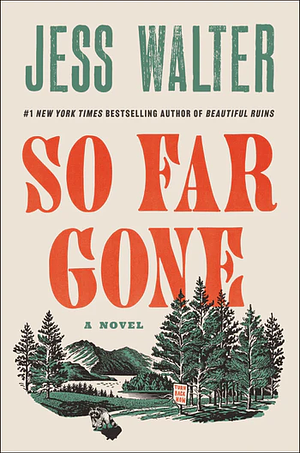
Review 2630: So Far Gone

Rhys Kinnick has been leading a relatively isolated life for seven years. Back then, he lost his job as a journalist, was dumped by his girlfriend, and at a Thanksgiving dinner at his daughter’s house, got into such a big dispute with his ultra-religious, conspiracy theorist son-in-law that Bethany said she never wanted to see him again. At that point, he decided the world had no more use for him, so he moved to his grandfather’s off-the-grid shack in Eastern Washington.

But now, he finds three people on his front porch. Anna Gaines, Bethany’s neighbor from Spokane, has brought him his grandchildren—14-year-old Leah and 7-year-old Asher. Apparently, Bethany left home for somewhere unspecified, leaving instructions with Anna that if her husband, Shane, left to try to find her, she should bring the kids to her father.

Given their rocky relationship, Rhys is surprised. He has only seen his daughter and her kids once since their falling out, during Covid, when Bethany came to visit for a few minutes.

Asher is worried about missing a chess tournament, so Rhys drives the kids into Spokane, where they find out they got the date wrong. But two big thugs appear, saying that Shane has asked them to pick up the kids and bring them back. Rhys has already learned that there is a plan in Shane’s religious group to betroth 14-year-old Leah to the pastor’s son, so he is reluctant to agree. When he tries to come along or get them to agree to call Shane, one of the men hits him in the head with a black jack.

Rhys is now determined to get the kids back, because Bethany entrusted them to him. His ex-girlfriend Lucy hooks him up with ex-cop turned P. I., Chuck Littlefield, who traces them to the Rampart, a religious compound in Northern Idaho. Rhys and Chuck set off to bring them back.

This description makes the novel sound like a thriller, but although it certainly is full of action, it’s really about Rhys trying to pull his life together and recognize his responsibilities to his family. It is also about the dangers of extremist thinking, which really strikes a chord within me these days.

I see that Walter has written quite a few more books than I have read. I need to catch up, because I always enjoy his books, and the three I’ve read have all been completely different from each other.

Related Posts

Beautiful Ruins

The Cold Millions

Idaho

Day 1040: The Orchardist

Cover for The OrchardistOn Tuesday, I meant to say that my review was my tribute to Valentine’s Day, with an unusual story of love. Well, here is another one.

Talmadge is a man with a sad history. When he was still a boy in 1857, his father died in a mining town in Oregon. He and his mother and sister then walked all the way along the Columbia River to Wenatchee, Washington. They created an orchard from the start of two diseased apple trees.

Talmadge’s mother died in 1860, when he was 12, and after that, he and his sister Elsbeth were everything to each other. But then when he was 17, his sister went into the forest to gather herbs and was never seen again. Talmadge searched for her for years.

At the opening of the novel, Talmadge is in his 40’s. He has lived his subsequent life alone, working his orchard. He has friends, particularly Caroline Middey, an herbalist, and Clee, a Nez Perce horse trader whom Talmadge and Elsbeth were friends with since they were children. Every year, he and his men stop by with their horses to work the harvest.

One day in town, Talmadge spots two wild young girls who appear to be homeless. Although barely in their teens, they are both pregnant. They find their way to the valley where Talmadge has his orchard, and he leaves food out for them. Although he tries to make a shelter for them, they stay outside. The girls are named Jane and Della.

Talmadge hears someone is offering a reward for the girls. He does not intend to turn them in but travels to see what type of person this Michaelson is. He finds Michaelson runs a brothel for young girls and is an erratic opium smoker.

Michaelson eventually finds the girls, just after they have their babies. The result is disaster. Della has lost twins in childbirth, but the resulting tragedy leaves Jane dead and Jane’s child Angelene alone with Talmadge and Della.

The rest of the novel is driven by Talmadge’s sense that it is his duty to keep Della and Angelene safe. But Della is a wild girl whose actions are controlled by her unrecognized grief. She learns how to ride and finally goes off to work with Clee and his men. But she proves too unruly for them.

This novel is deeply interesting and beautifully written. It is also incredibly sad. It is about the loneliness of the human condition, about our ties to one another, about responsibilities to other people.

Related Posts

Sweetland

West of Here

Neverhome


Day 143: West of Here

Cover of West of HereThis peculiar novel starts out as a straight intergenerational history showing how the building of a dam by a small town in 1890, which was meant to make the town prosper, ends up determining its future as a permanent backwater. The novel also tells the story of a nearly disastrous expedition into the Olympic Peninsula. The time alternates between 1890, when the dam becomes an idea of an early entrepreneur, and 2007, when the town is beginning to dismantle it. 

If there is such a thing as ensemble fiction, this is it, since the book has many characters, none of whom seem to be more important than the others. Because it has many characters, it has many stories, the oddest of which is that of a mute Klallam Indian boy in 1890 who somehow shares consciousness with a troubled Indian boy in 2007. In 2007, everyone assumes the boy is psychotic and he is admitted to a mental ward. In 1890, he starts his own cult.

Characters in the historical portion are an early feminist fleeing her lover; a prostitute who is fighting with the owner of the whorehouse; the Klallam Indians, already on their way to being destroyed; and an idealistic entrepreneur. Characters in the later story are a Bigfoot enthusiast, a seafood plant worker who longs for the days when he was a high school basketball star, an ex-convict who wants to live off the land, and an environmental scientist.

Evison has written a quirky, interesting book that is sometimes humorous, but I found it a little too diffuse, with too many characters, and too much going on. Although we may be meant to contrast the vigorous original settlers with the sad sacks of the present, the seeds of the area’s troubles are there right from the beginning. Perhaps that is the point. Still, I think the intentions of the author are unclear, and the novel is muddy as a result.