
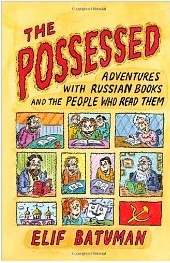
 Maybe not many of you would be interested in a book like The Possessed: Adventures with Russian Books and the People Who Read Them by Elif Batuman, but as a previous student of Russian and also a previous literature graduate student, I found it very funny.
Batuman has written a book about her years as a graduate student of Russian language and literature that skewers many things, but particularly academic conferences with their absurd presentation topics and academic thinking, with the oblique reasoning process that sometimes accompanies it. For example, on the way to a conference on Tolstoy’s estate, Batuman loses her luggage and is forced to dress in flip-flops, sweatpants, and a flannel shirt. Some of the scholars attending the conference assume she is a Tolstoyan and that she has taken a vow to walk around in sandals and a peasant shirt for days. When she calls a Russian clerk to find out about her luggage, the clerk replies, “Are you familiar with our Russian phrase resignation of the soul?”
While relating her adventures in studying, travelling in Russia, and living in Turkey, where she went because her grant was too small for her to afford a stay in Russia, Batuman muses on ideas from literature and compares the lives of the people she meets with the adventures of characters in Tolstoy, Dostoevsky, and Chekhov. Her observations are colored with her own peculiar view of life, which poses that “the riddle of human behavior and the nature of love appear bound up with Russian.” In Turkey, when she is challenged by scholars to study Turkish literature, particularly because of her Turkish heritage, she concludes that no one reads it, even the Turks.
Batuman expanded articles she wrote for Harper’s and The New Yorker into this book, which is named after one of Doestoevsky’s more enigmatic novels. Although her musings are occasionally a trifle too erudite for me to follow (and perhaps my memories of Russian literature too rusty), I found the book amusing and couldn’t put it down.

 What? Me Read?