
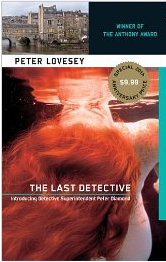
 My husband and I have been enjoying reruns of the older British TV series The Last Detective on Netflix, so I picked up this book. Unfortunately, I spent the first part of the novel bemoaning its lack of resemblance to the series. Since it has a strong message of lack of trust in “new” police methods and technology instead of reliance on the police’s judgment and intuition, I also couldn’t help thinking of recent cases such as that of Michael Morton, who spent 25 years in prison for murdering his wife based on very little but a scenario invented by the police and was last year found by DNA evidence to be innocent. However, since one of Lovesey’s hero’s traits is a dogged pursuit of the investigation rather than a rush to judgment, I got over that.
The body of a woman is discovered nude in a lake near Bath. Although the police aren’t certain of the cause of death, her clothes and possessions don’t turn up anywhere, and the pathologist believes she has been asphixiated. After some time, the body is identified as that of Geraldine Snoo, a soap opera star who had been written out of the plot months before.
One obvious suspect is Gregory Jackman, Gerry’s husband and a professor of English at the local college. Detective Superintendant Peter Diamond leads the investigation, which eventually seems to point toward another suspect, Dana Didrickson, a divorcee who seems to be in love with Jackman. The mystery also involves the whereabouts of letters purportedly written by Jane Austen.
My biggest problem with the novel is one of approach. It contains two long sections narrated first by Jackman and then Didrickson that are supposedly their statements to the police, an approach very similar to that used in older detective novels like The Moonstone. The Moonstone, though, had the excuse that its statements were written ones requested by the investigator to separately verify everyone’s statements of the crime. In the context of a more modern novel, I found them completely unlikely, written as they are like prose, containing too much detail, and with few questions interjected by the police.
Once the novel gets past these sections it improves a lot, though, and becomes lively and entertaining, including a chase through the Roman baths.
 What? Me Read?