Day 434: Coriolanus

Cover for CoriolanusCoriolanus is one Shakespeare tragedy with which I was previously unfamiliar, and it is a powerful one. More than any other Shakespeare play I’ve read, it is about politics, class dissension, and the fickleness of popularity. It is also about excessive pride.

The play has references to events of the time it was written, for it begins with a riot over corn, the like of which had taken place in Warwickshire the year the play was written. Its war between the Romans and the Volscians is also a reference to the war the English and Spanish had been carrying on intermittently.

Caius Marcius is a warrior who has spent most of his life as a soldier and has no social graces. He is proud and arrogant and disdains the common man. After he soundly beats the Volscians in battle, particularly his bitter enemy Aufidius, and conquers their city of Corioles, the Roman generals rename him Coriolanus and the senate wants to award him a consulship. This office as ruler of Rome is the one that all great men aspire to. Unfortunately, to have the office, Coriolanus must beg the honor from the public and show them his wounds gained in defending the state.

He is reluctant to do so, knowing that he is unable and unwilling to ask for what he thinks he deserves, but his austere mother Volumnia and his supporters talk him into it. Two jealous tribunes, who are representatives of the people, are afraid that Coriolanus will strip them of their offices. So, the two, Brutus and Sicinius, work to enrage the people after they have already sworn to support Coriolanus.

The result is another riot, and instead of receiving the high honor, Coriolanus is declared a traitor. The tribunes even try to have him executed, but he is banished.

The seeds of Coriolanus’ downfall are sown both by the treachery of his rivals and by his own hubris. Things go downhill from there.

It is interesting that in the class divide, Shakespeare’s sympathies seem to align with the men of power even while he deplores Coriolanus’ flaws. There are several speeches about the public not being able to make a decision, about their fickleness, and so on, and the actions of the public seem to bear these ideas out. You can image what Shakespeare would think about a democracy or about our current political situation.


Day 433: Black Sheep

Cover for Black SheepI hadn’t read this Georgette Heyer novel in some years. Although it is not one of my absolute favorites, reading it is still a relaxing, amusing way to spend a few hours.

When Abigail Wendover is away from her home of Bath visiting her family, she hears disturbing rumors that her niece Fanny, an heiress, is being courted by a fortune hunter named Stacy Calverleigh. Returning home, she finds that her 17-year-old headstrong niece believes they are madly in love, and she is not ready to listen to arguments that Calverleigh, a much older man, has not behaved as he should. He has also worked his way into the good graces of Abigail’s foolish sister Selina.

Abigail encounters a man named Calverleigh in a hotel parlor, and she is shocked to find him neither of good looks nor address and much older than she is herself. He is further prone to uttering the most shocking remarks that unfortunately make her laugh. Soon Abigail finds that this Calverleigh is not Stacy but his uncle Miles, the black sheep of the family, who was sent away to India after a youthful scandal and has now returned. However, he is unwilling to interest himself in the situation between her niece and his nephew. He is only interested in Abigail herself.

Although Abigail knows she shouldn’t encourage his attentions and finds some of his views about family and duty shocking, he never fails to make her laugh. Soon she discovers that he is even more unsuitable a companion than she thought, for his youthful indiscretion was to run off with Fanny’s own mother, who later married Abigail’s older brother!

Abigail is one of Heyer’s more mature heroines, an intelligent, sensible woman with a sense of humor some of her relatives consider unfortunate. Of course, the journey out of the tangle her niece is in will be enjoyable and entertaining. Although this novel is not as funny as some of my favorites, it is always a pleasure to spend time with Heyer’s creations.

Day 432: The Orphan Master’s Son

Cover for The Orphan Master's SonBest Book of the Week!

I can tell before I even start that this is going to be one of those times where I have difficulty conveying just how good this novel is. It is going to sound dreary and painful, but it is a wonderful, wonderful novel.

For a long while I avoided this book, afraid that the subject matter would be too cold or too harrowing. However, it has earned so many honors that I felt I finally had to read it. It is harrowing, but it is so very human, and touching, and inspiring.

Pak Jun Do (note the purposeful echoing of our clichéd unknown man, John Doe) is the only boy with a father who was raised in an orphanage in North Korea, the orphan master’s son, or so he believes. Of course, many of the orphans actually have parents, who dropped them off because they couldn’t or wouldn’t feed them during the time of the great famine. The orphans, including Jun Do, are shamelessly put to hard labor deep in the mines, where our hero learns a skill that will come in handy, to get around in the dark.

Later, he is assigned to a kidnapping team, sneaking into Japan to abduct unwary Japanese citizens. You can see him quietly processing his opinions about this activity. From this position, he is sent to language school and ends up on a fishing vessel spying on radio transmissions from other countries and vessels, including, significantly, those of a young American woman who is rowing around the world with a partner. Jun Do begins showing himself to be observant, resourceful, and ethical in his own way.

Jun Do has had a difficult start in life in an environment that seems almost totally arbitrary, and as he experiences one event after another, he begins to develop in unexpected directions and to look at his environment with a skeptical and aware eye. After an encounter with an American ship, Jun Do and his shipmates fabricate a ridiculous lie to save themselves and their families. This lie inadvertently results in Jun Do being declared a national hero. From there his life begins a series of remarkable transformations.

I am feeling my inadequacies here, because I am not conveying at all how wrapped up I became in Jun Do’s story. It is told in many voices, including the daily loudspeaker broadcast of propaganda (which is frequently ridiculous) and the “biography” put together by a state inquisitor. Some of the events are difficult to read about, some frankly absurd, as when the Dear Leader Kim Jung Il decides to entertain some American dignitaries with synchronized fork lift demonstrations.

The novel tells a story of hope, mixed in with the grim reality and sheer ludicrousness of what seems to be a fully realized vision of North Korean existence, where people live in terror of innocently making some terrible error. The book tells this story with power, with pathos, with sly humor, and with irony.

This book is really, really great.

Day 431: Butterfly Winter

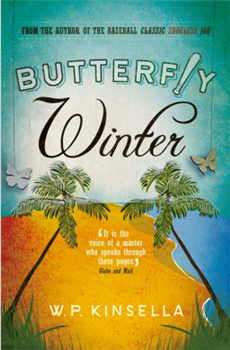
Cover for Butterfly WinterI have to start right out by saying that Butterfly Winter was a poor choice for me. W. P. Kinsella is beloved by many, and I know that people are excited that this is his first novel in fifteen years. However, I should have known better than to select a book by the “master of magical realism,” as one reviewer put it, because I have a problem with magical realism. It is a very tough sell for me. I have to be fully bought into the realism before I can accept the magic. In the case of this novel, though, I don’t even think it can be called magical realism, because the realism was left out.

This novel is about baseball. That shouldn’t be a problem, although I am not a sports fan. I was willing to be wooed by The Art of Fielding into at least grasping that it can be pretty fantastic. But Kinsella doesn’t try to convince us of that. He just posits that it is wonderful and magical and obviously thinks everyone should agree with him.

I think I could have dealt with either of these two issues, but the first chapter of this novel, where the Gringo Journalist is trying to interview the Wizard, and the Wizard refuses to answer his questions but goes off on a bunch of tangents, is the most annoying piece of writing I have ever read. The novel picks up a little in the second chapter when it changes to a narrative style and picks up again every time it returns to that style, but unfortunately the irritating voice from the first chapter is the novel’s primary narrator. The tone of the novel is arch, to me a little forced, and the humor unsubtle.

http://www.netgalley.comNow to the story. Julio and Esteban Pimenthal are twins who play baseball in their mother’s womb (a wince-inducing image). One of them is born with cleats on, and the other with a baseball glove. (I think it is safe to say that only a man would have thought of that.) They are inhabitants of Courteguay, a fictional country wedged between Haiti and the Dominican Republic where magic is commonplace. (Silly me, when I read “magical Caribbean island” in the blurb, I was thinking scenery and beauty.) When Julio and Esteban are ten years old, they travel to the United States to play pro ball. But first we hear about the Wizard and how he came to the island in the late 19th century and introduced baseball to it.

I have to admit, I did not finish this book. I’m sure that many will think it delightful, but I found the narrative style too annoying to continue. This novel was the wrong one for me to choose to become acquainted with Kinsella.

Day 430: The Mansion

Cover for The MansionBest Book of the Week!

The Mansion is the compelling final novel in Faulkner’s Snopes Trilogy, a series remarkable for the way Faulkner is able to focus the activity on a character, Flem Snopes, who is less and less present in each novel. Told again by multiple narrators, each unreliable in his own way (they are all male), the story’s truth is one we don’t begin to really understand until the final omniscient chapters.

This last novel concludes the events of the previous two and in many ways reinterprets them. It begins with Mink Snopes, serving 20 years for a murder he committed in The Hamlet. This event, not so important in the first book except for demonstrating the sheer cussedness of the Snopes clan, becomes the focus of the third book. The Town related how Mink paid no attention to his own murder trial, simply waiting for his powerful cousin Flem to arrive and get him out of his mess. But Flem never arrived, respectability having bitten him by then, and Mink went to jail vowing to kill Flem when he got out.

The beginning of The Mansion returns us back a few years in the events covered by The Town to when Mink is two years from freedom, having rigorously followed the advice he was given when he went in, to do everything he is told to do and not try to escape. Mink has been concentrating all this time on one thing, getting out and having his revenge.

As he is also a Snopes, Flem knows this, so he frames another cousin, Montgomery Ward Snopes, for an offense that is worse than the one Montgomery actually committed, to get him in to the penitentiary. Then Flem pays Montgomery to convince Mink that Flem is helping him escape, further humiliating Mink by getting him to make the attempt in a dress, and then turning him in during the attempt. Mink earns himself twenty more years in the pen–or Flem earns it for him.

The middle portion of the novel focuses on Linda Snopes, Eula’s daughter, who thinks Flem is her father, and her relationship with the upright Gavin Stevens. Stevens helped her escape Jefferson in The Town, and the largest portion of The Mansion covers her life before and after her return to Jefferson from a more exotic life in New York City. Despite her willingness, Stevens refuses to marry her because of the 20 years difference in their ages. She embarks on an apparently naïve and bumbling career of good works.

Finally, the novel comes back to Mink, as he unexpectedly learns he may be eligible for parole two years early, if only he can find a relative to sign for him. His wife died years ago, his children are long dispersed, but a relative does sign for him, Linda Snopes. The novel builds to a climax after his release, following Mink as he tries to get his final revenge against Linda’s father Flem and Gavin Stevens tries to prevent it.

I think the achievement this trilogy represents is astounding, written as if it were gossip told around an old country store (and later in Gavin Stevens’ law office), centering on one man but leaving that man an enigma, almost a ghost in his own life. Events are told and retold, interpreted and reinterpreted, and so this “oral” history of Faulkner’s fictional county in Mississippi is created.

Day 429: The Dark Rose

Cover for The Dark RoseThe Dark Rose is the story of how the lives of two troubled people intersect, with unfortunate results.

Louisa has had a secret for 20 years that changed her life. In flashbacks to 1989, she meets Adam, a singer and bassist in a local rock band, and falls immediately in love. For the first time, she is not the one in charge of her own love life, and he is in turn attentive and evasive, loving and impatient. Louisa is eaten up by jealousy, especially when his band mates make jokes about his relationships with other women. No good comes of this situation.

In the present time, 19-year-old Paul has been forced to testify against his friend Daniel. They have a long-standing friendship that Paul has been wanting to escape. As boys Daniel protected Paul from bullies while Paul kept others from finding out that Daniel was illiterate. But Daniel’s father is a criminal, and Daniel has begun involving Paul in illegal activities just as Paul is trying to begin a new life at university.

While he awaits Daniel’s trial, Paul is sent out of the area for his own protection to help with a project restoring a Tudor garden to its former glory. On site he meets Louisa, the head gardener, who is struck by Paul’s resemblance to her long lost love.

Kelly does a good job of keeping up the suspense, telling the interleaved stories of the young Louisa from 20 years before and of Paul’s more recent history. Although you become aware that each story involves some horrendous event, she spins out her tale so that events are revealed toward the end of the novel. Still, all is not over.

I found The Dark Rose less satisfying than The Poison Tree, Kelly’s debut. Paul and Louisa are definitely more flawed and less likable than the previous book’s heroine. Still, we want to find out what happens to them.

Erin Kelly has been likened to Gillian Flynn or Tana French. I am always skeptical of such comparisons (“If you like so-and-so, you’ll love . . .”), and I prefer the work of Flynn and French. However, Kelly does have a comparable dark sensibility. I just think Flynn and French are better at getting you to sympathize with their main characters, even though they are invariably flawed (except for Gone Girl, that is, where no characters are sympathetic).

A warning about this book if you shop in used book stores. I bought it a second time by accident because the British edition is under a different title, The Sick Rose.

Day 428: Annals of the Former World: Assembling California

Cover for Annals of the Former WorldAssembling California is the fourth volume of McPhee’s massive book about the geologic structure of the country. It dwells mostly on how the ideas of plate tectonics by themselves do not explain the geology of California.

As explained in my reviews of the previous volumes, McPhee spent years traveling along I-80 in the company of different geologists with the aim of describing the geologic formation of the country. In this volume, McPhee continues his travels along I-80, this time with geologist Eldridge Moores. They begin a series of journeys at the eastern border of California near Donner Pass, crossing to the Oakland/San Francisco area.

McPhee introduces the concept of the ophiolitic sequence, a sequence of rock strata that has been found to originate from ocean floor crusts. These crusts were ripped from the floor and mashed upward when an island arc, like that of Japan, collided with the western coast of the continent. Thus the ophiolites, which are the oldest rock, end up on top of mountains. The theory is that three such island arcs joined with the continent over the ages to form California.

McPhee also travels with Moores to Cyprus and Macedonia, two areas with similar rock. He introduces some other structures that are not completely explained by plate tectonics, such as the whole of Southeast Asia, which appears to be a part of the continent that was pushed sideways by the impact of India smashing into Asia and creating the Himalayas.

McPhee finishes this book with a dissection of the 1989 earthquake in San Francisco-Oakland (which occurred after his initial visits). He returns to examine the damage and explain how the shockwave spread and why some areas were more damaged than others.

As in the other volumes, McPhee imparts a great many concepts and theories in clear and interesting prose. This series of books (or the larger volume) makes for reading that can be a little difficult to grasp, as plates and continents seem to whirl and gyrate all over the earth (only, of course, very slowly), but it is nonetheless fascinating.

Day 427: The Leaf Men

Cover for The Leaf MenEven when I was a small child, I looked for beautiful pictures in children’s books (or bunnies–bunnies were good, especially fluffy ones). I had some books that had belonged to my mother, and I used to spend hours looking at Arthur Rackham’s illustrations of fairies and twisted trees full of goblins. As a young adult, I collected children’s books that combined good stories with illustrations by artists such as Rackham, Kay Nielsen, or Mercer Mayer.

A few weeks ago I saw a feature on William Joyce and decided to buy some of his books for my young nieces and nephews. The first one that arrived was The Leaf Men, which I had to order used in hardcover, as it is older. It is written for a young child and is a simple story about the brave bugs who climb to the top of a tree to summon the leaf men in an attempt to save a dying garden and an old woman. (I have seen some editions of this book called just The Leaf Men but the one I purchased was called The Leaf Men and the Brave Good Bugs.)

The pictures are beautifully retro, with a 30’s or 40’s appearance. One of the things that attracted me to the book was the huge man in the moon on the cover, which was one of my favorite childhood images.

Good Bugs
The Brave Good Bugs

This is a lovely book. I think it is readily available new in paperback, but it is easy to find good used copies of the hardcover edition online. (I always think paperbacks are going to be totally destroyed, so I prefer to buy hardcover children’s books.)

People who have older kids are probably familiar with Joyce’s work, perhaps through the Guardians of Childhood series (several of which I have also bought for my older nephew). An animated movie called Rise of the Guardians was made from this series in 2012.

Day 426: A Fatal Likeness

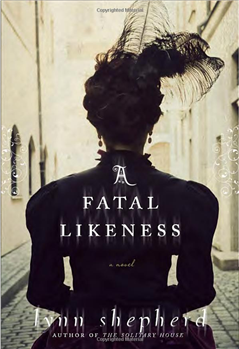
Cover for A Fatal LikenessIn A Fatal Likeness, Lynn Shepherd has created her own gothic horror around the mysteries in the real lives of two fans of the gothic, the poet Percy Bysshe Shelley and his wife, the writer Mary Shelley. It is not only a dark story, but some of it is relatively plausible, given the research Shepherd has done into their lives. Ever since I read Shepherd’s astounding reworking of Bleak House, The Solitary House, I have been a fan of her narrative skills, her writing skills, and her imagination.

Shepherd’s detective, Charles Maddox, is summoned to the home of Percy Shelley, the son of the deceased poet. Shelley and his wife have established a shrine to the poet’s memory and say they are worried about some papers someone is offering to sell them. Mrs. Shelley in particular has been responsible for destroying any papers that would tarnish Shelley’s legacy. They hire Charles to find out what is contained in these papers.

Charles has his own reasons for taking the job, for his beloved great-uncle, also Charles Maddox, the master detective who trained him and is his only family, suffered a stroke upon receiving a calling card bearing the name of his client. Charles learns from his assistant Abel that his great-uncle was employed on a case years before for William Godwin, the brilliant philosopher and Mary Shelley’s father. When the file on this case is located, though, some of the pages have been torn out.

Charles takes a room in the home of the person purveying the papers, whom Charles has been told is an Italian man, and it is not long before he realizes his landlady is Clair Clairmont. Clair, the step-sister of Mary Shelley, infamously ran off with Shelley and Mary when both the girls were only sixteen and Shelley was still married to his first wife, Harriet.

Charles is soon to realize that everyone involved in this case has ulterior motives, those of the Shelleys to find out whether a record of the earlier case still exists, as it certainly contains damaging information. With his great-uncle only slowly recovering, it is up to Charles to discover what mysteries lurk in the Shelleys’ past. As he investigates the earlier case, he finds records of an even earlier encounter with his great-uncle.

The Shelleys’ past is a rat’s nest, with two young suicided women, Shelley’s first wife and Mary’s other step-sister, with several dead infants, with Shelley’s own history of delusions, hallucinations, fits, and obsessions. Each person’s story of the fraught years of the Shelleys’ relationship is different, and it is difficult to know what or whom to believe. It is not long before Charles is to think Percy Shelley was something of a monster.

Doubles are a theme throughout the novel. Shelley is always involved with two women at once, two young women commit suicide, Shelley is obsessed with the idea of a doppelganger and thinks he has encountered a monster with his own face. Charles’ great-uncle was partially deceived long ago by the likeness he perceived between the young Mary Godwin and a lost love.

Shepherd’s writing style is distinctive. She writes in limited third person but overlays this voice occasionally with observations from a more knowing narrator of a later time, perhaps the present. The effect is slightly facetious and ironic in tone.

Her research into this time period and into the lives of the Shelleys is clearly extensive. She impressed me with The Solitary House and here she continues to do so with a fascinating, disturbing tale about some turbulent personalities.